
Almost a year ago, I started working freelance as a gardener and a writer. The writing I learned from a career in academia which I loved; the horticulture, from several years working in a plant nursery. One of the last jobs I did in the nursery was to move pots and pots of peonies in flower, from their place on the row to a table by the front of the nursery: dozens of varieties, all just coming into flower. Months before, when they were nothing but unprepossessing bits of bare root, I had spent a couple of days planting them, and so I had seen them through from beginning to end. As I moved them they released their fragrance into the air, almond with a hint of welcome bitter-sweetness.
Working in a nursery, you think about how much preparation for new life happens when everything is frozen and dormant. Bare root perennials are planted as the temperatures fall; bulbs need cold to force them to flower in the spring. That winter, as I potted up those bare-root peonies, I’d done a cycle of IVF that had failed. In the fall-out from that cycle and the recovery from it, I would eventually lose my job, and it already felt precarious. Around that time I wrote about how that particular loss was bound up with the time of year at which it began: the transition between autumn and winter, when late-October rains first flooded then froze. I found the spring afterwards physically difficult, waiting for my body to recover. I felt frozen; frightened about moving forwards.
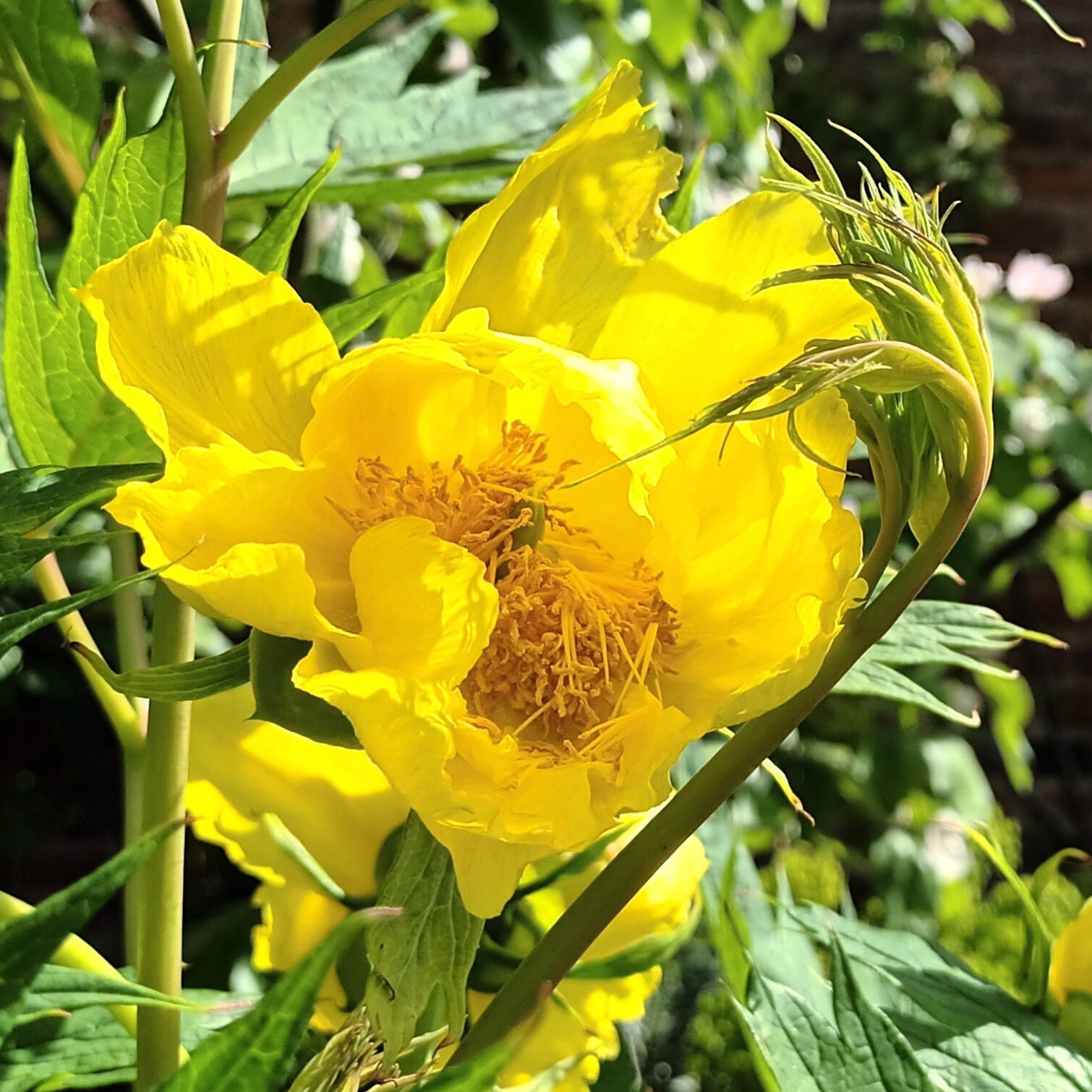
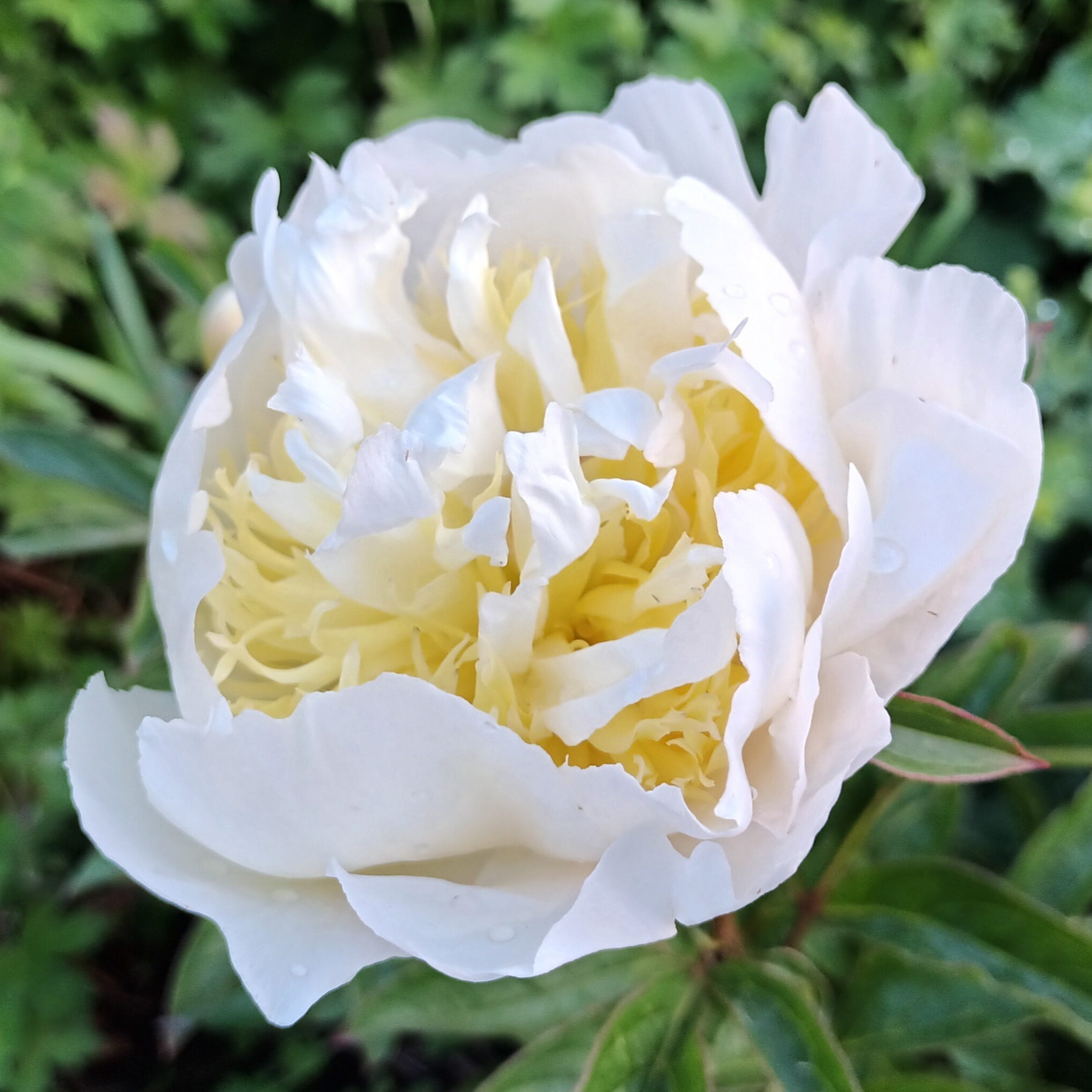
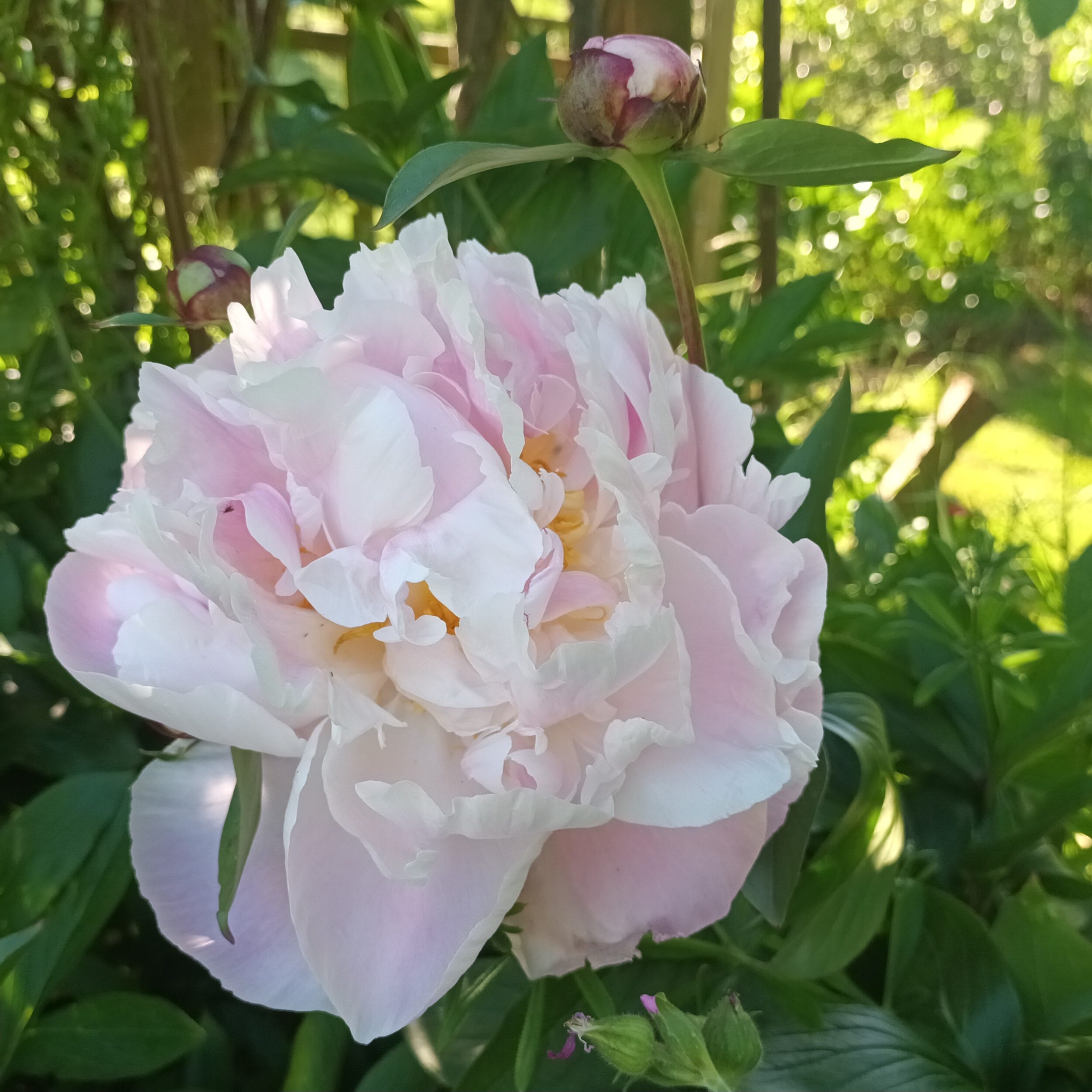
During that spring I noticed the peonies. The first couple of years I worked in the nursery, I don’t remember them particularly catching my eye. The selection was narrow. There were a couple of the very old tree peonies (delavayi and ludlowii, both of which I have grown for years), and the omnipresent, unsubtle candyfloss-pink of ‘Shirley Temple’. I’m not sure whether my memory is faulty or whether my boss just decided to buy in more varieties, but that winter the crates of bare-root perennials were full of new peonies. In June they unfurled into globe-shaped buds and then huge flowerheads with a foam of frilly, feathery inner petals around golden stamens, cupped by satiny, overlapping guard petals in broad heart shapes. These were the lactiflora peonies - Chinese peonies, which came over to this country in the eighteenth century, and were afterwise hybridised with the earlier cottage garden p. officinalis.
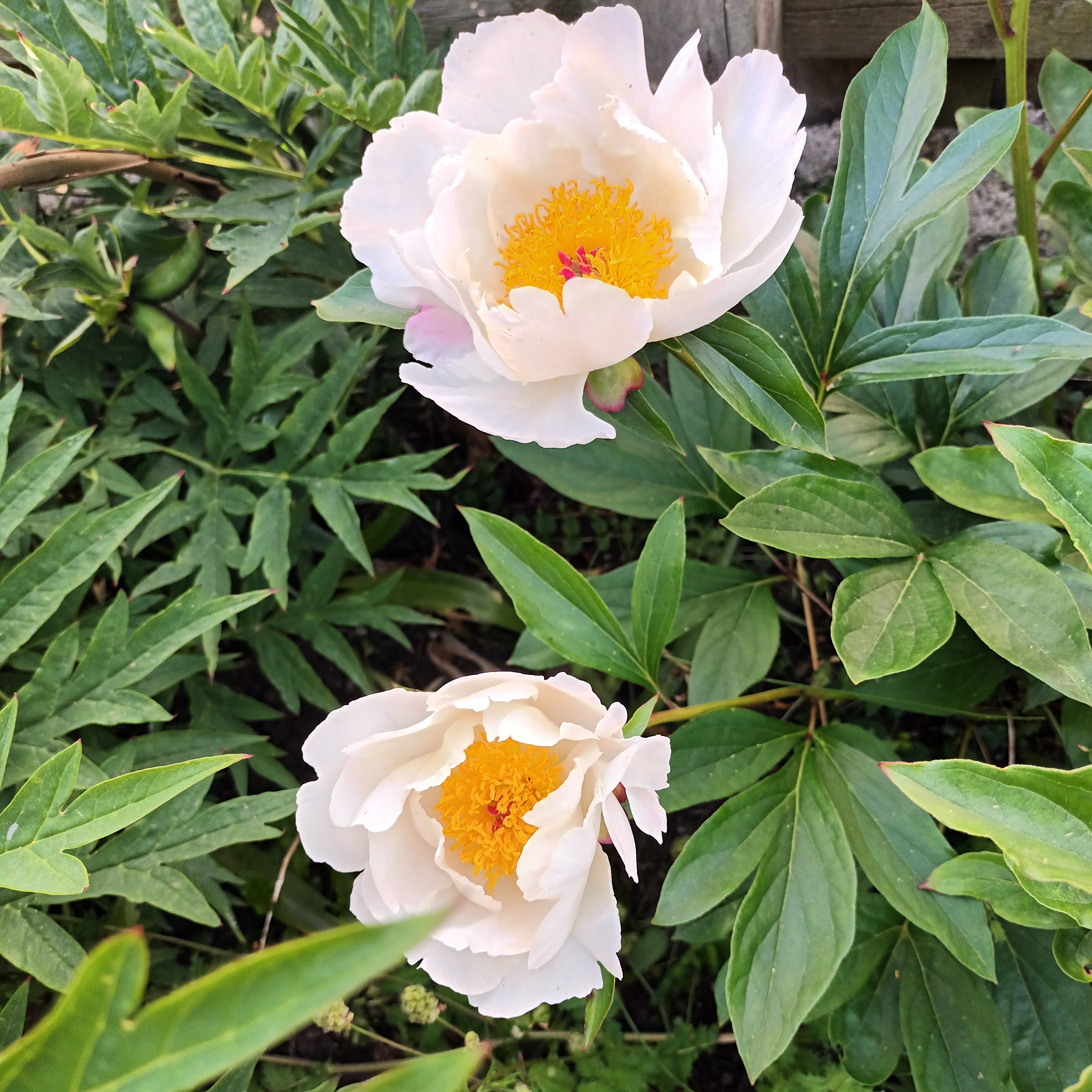
P. officinalis is the herbaceous peony that existed in medieval gardens, and as its name indicates, it was understood as a medicinal plant as much as a decorative one.
In the hauntingly beautiful medieval poem Pearl, peonies are one of the flowers that grow in the enclosed garden - the herber - where the speaker of the poem has buried his baby daughter. Grieving her loss, he falls asleep in the garden, and dreams of her returning to him as a grown woman. As the poem explores human grief, it telescopes and disrupts the passing of time. As it unfolds we see the speaker struggling to accept that his loss is falling away from him into the past, but equally unable to accept that time moves on. Seeing his daughter transformed into a grown woman, he cannot properly recognise her, nor stop himself from reaching for the familiar form of what he has lost. In small but significant ways, this is illustrated by the imagery of the garden and its growth: natural cycles which medieval readers would have been far more alive to than many of us are today.
The enclosed garden of the poem is a refuge, both from the world that goes on around the speaker’s enduring grief, and from the ordinary heat and labour of an August harvest season. Outside the garden, the corn is being cut down in the fields. The sun must be beating down. Inside the garden, though, the predominant colour is green - the green of early June, perhaps. It is the first hint that the poem exists in a time-frame that is disrupted: artificially stilled and held back by the sorrow of the speaker who misses his lost child.
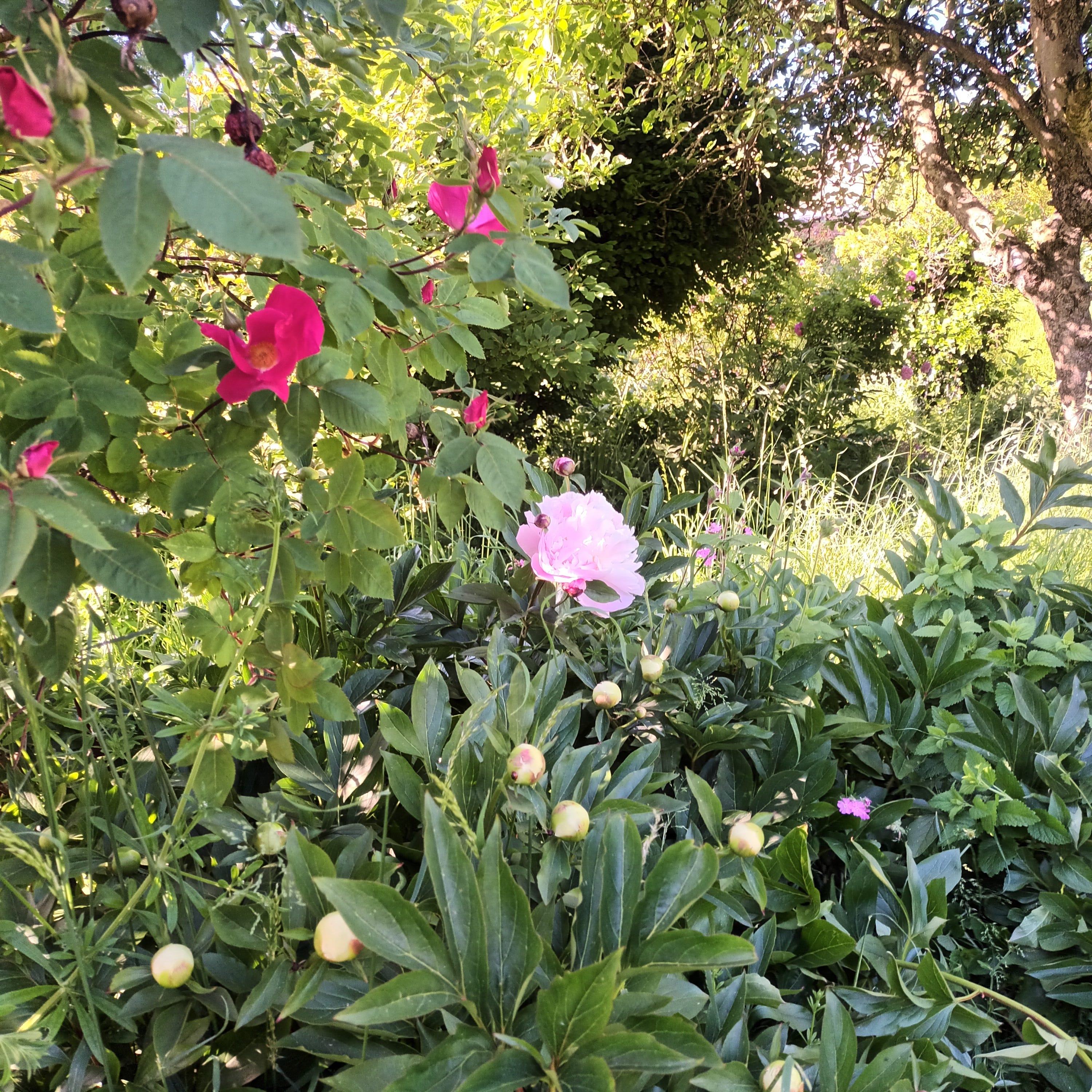
The flowers that grow in that garden are scented, gingers and gillyflowers (gilofre in the Middle English), and the plant the poet names as gromylyoun: later gromwell or graymile, in Latin lithospermum officinale, a small plant with bright blue flowers and white, pearl-like seeds, which also give it the name ‘pearl-plant’. In medieval English the word gilofre can refer both to clove-scented pinks, dianthus caryophyllus or to scented stocks, matthiola incana, both of which share a fragrance with more than a hint of the spice from which the dianthus takes its common name. A gillyflower is also one of the common forms of what is now known as ‘peppercorn rent’ - a symbolic tithe paid at one of the four quarter-days of the medieval year. Along with peppercorns in winter or apples in autumn, gillyflowers are often specified as the rent due at midsummer: St. John’s Day, June 24th. For medieval listeners, then, the flowers suggest a tithe left unpaid, a debt owed that lingers in the garden, as the grieving speaker of the poem clings to his beloved dead infant.
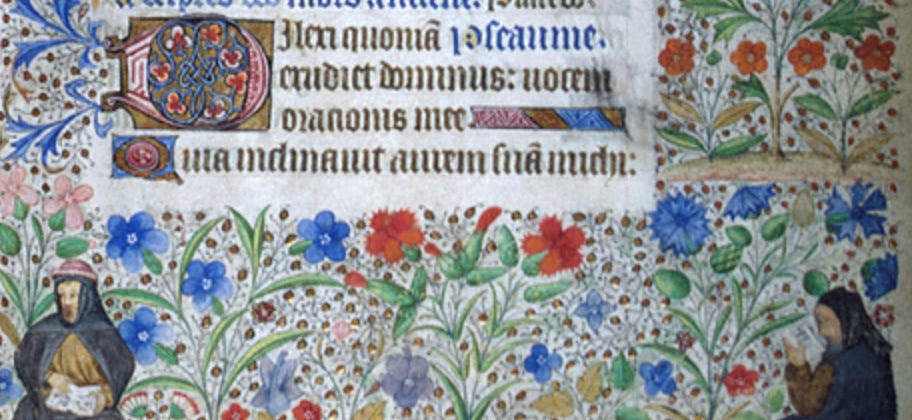
Amongst these spice-scented flowers are ‘paeonies powdered everywhere in between’: peonies growing through the lush green of the garden, like flowers in the border of an illuminated manuscript or a mille fleur tapestry.
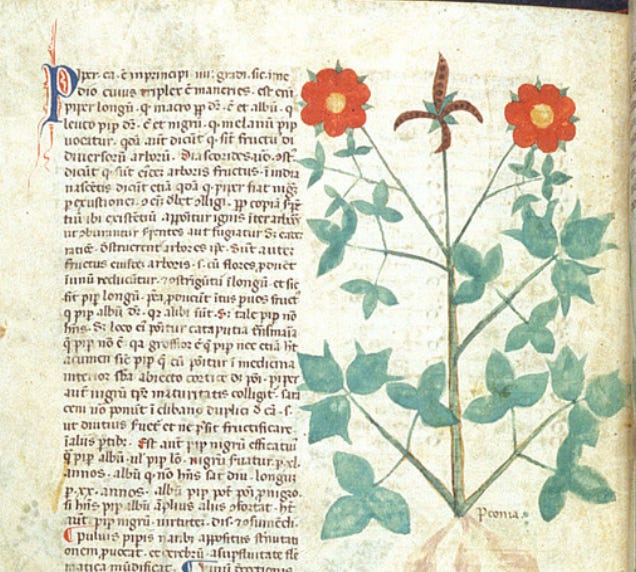
Peonies are one of the plants that need prolonged exposure to low temperatures. Dormancy is part of the cycle of these plants, as it is for matthiola incana, the other possible referent of the name gilofre. They need to be buried in the cold soil in order to spring up again and blossom. They are also - like lithospermum and dianthus, the gromylyoun and gilofre - used in historical medicine for childbirth. As medicinal ingredients, these flowers might once have eased the passage of an infant into the world. Now they ease a father through the passage of his grief for that infant.
Gardens - and nurseries - are about so much more than ‘just’ plants. As Anne Wareham of Veddw garden writes, they are also about sympathy with the spirit of the place. For me they are about the histories that lie behind plants and choices about what to plant. The unknown medieval poet who wrote Pearl could write about peonies and know that an audience would catch the references. That poet knew medieval readers would see the stalled grief of the speaker in the strange stillness, that gives us a garden of June flowers trapped in their green growth, while all around him time moves on to August and harvest. We’ve lost the precision of that familiarity, unless we stay intimately connected to gardens and alive to the way things want to grow.
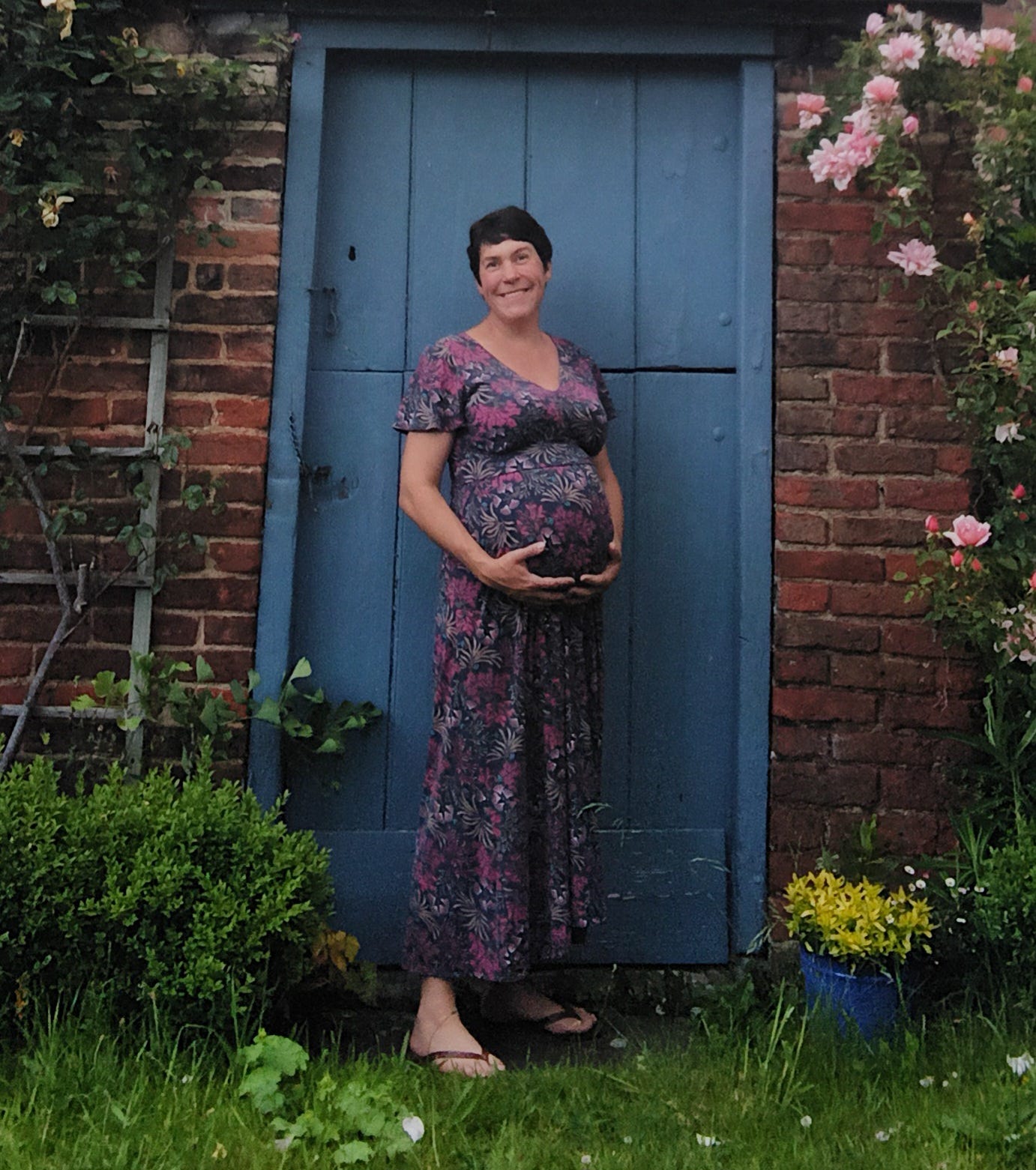
As I write this, I’m just past 38 weeks pregnant following a second IVF cycle, begun just before I lost my job; in a few days I’m going to have to hang up my spade for a bit (and maybe get some more writing done, before the baby comes).
In this past year, I’ve completed several design projects and I have a few more in the pipeline; I’ve built relationships with some wonderful clients. I love the variety of types of garden my work takes me into. At the moment, my ‘regular’ gardens include a formal layout full of clipped yew and box and rose borders, and a wonderful eco-friendly space with billows of cow parsley under orchard trees. Pink scabious, ox-eye daisies and centaurea share space with dark-purple physocarpus and amelanchier lamarkii, and the pond hosts frogs and newts as well as blue water irises. I’m also working on an old and neglected garden that form part of an eight-acre plot surrounding a grand Victorian house, complete with an enormous vegetable and cutting garden and a newly-planted arboretum. And in between I check in on a little, narrow rectangle of garden that borders onto fields where sheep graze, where I’ve planted shade-loving perennials in curving borders around a little stepping-stone path.
These gardens come with histories. They come with a sense of time passing, becoming richer with new growth.
I know that underneath the big circle of lawn in the Victorian garden, there was once a gravelled turning circle. It must have been where first occupants of the house - and their guests - brought their carriages round. There’s a border where the knotted remains of an old quince tree have almost grown into the wall behind it, and mint returns endlessly between the stones: the ghost of a kitchen garden, otherwise long gone. The garden with the yew and box hedges, the neat lawns and trimmed trees standing sentinal in the corners, was once a working farmyard, cobbled and sluiced; now the owner points out where the bluetits have nested in a gap in the loose mortar and where the hares hop over the fences. Even in a garden that is ‘new’ by these standards - planted around a house built only decades ago - those wildflowers and physocarpus grow alongside roses brought from an older garden. Now, they share space with bright pinwheel spinners, which the owner’s grandchildren like to stick into the ground to twirl in the wind.
No posts
Comments
Nothing yet. Say the first thing.
Sign in to join the conversation.