
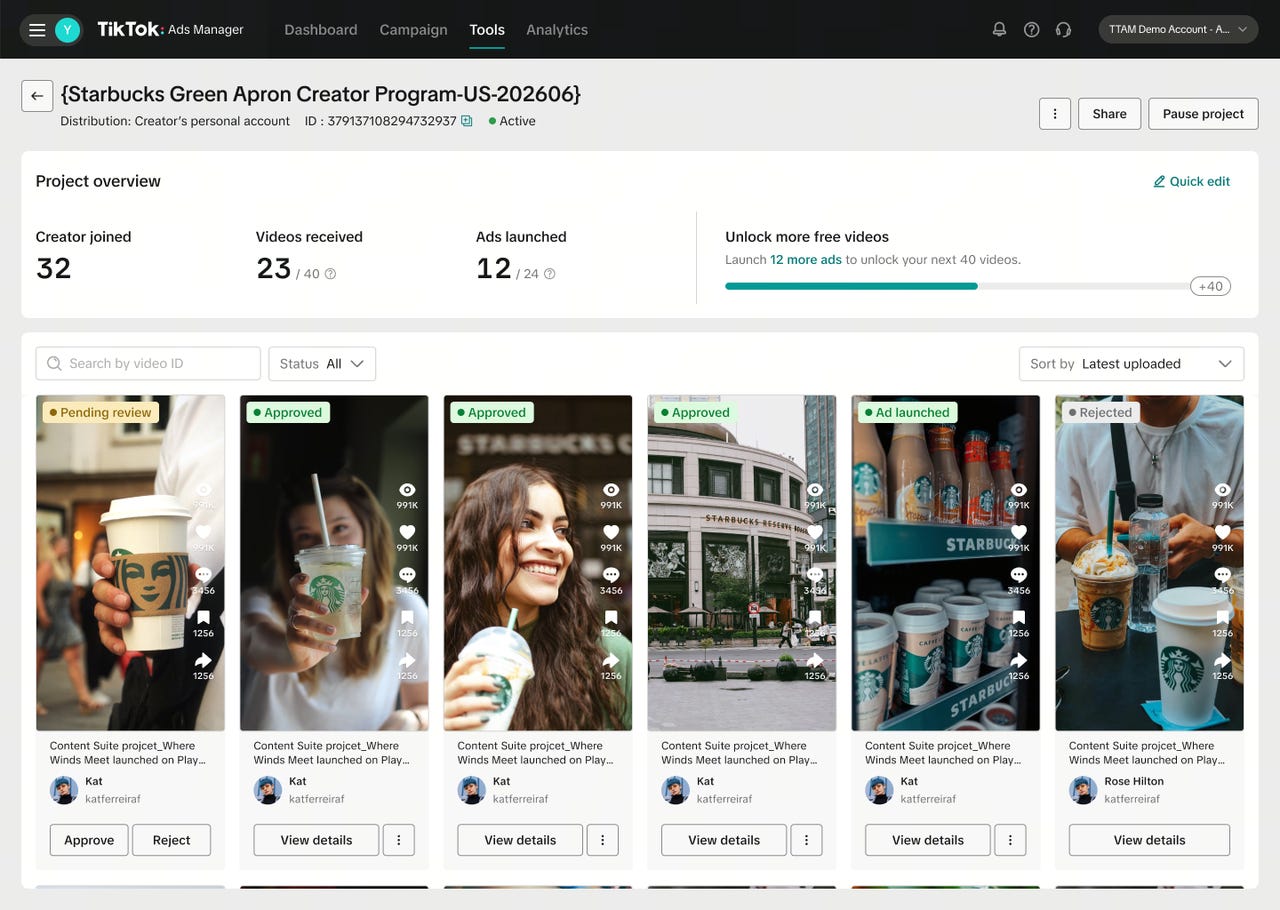
In June, TikTok quietly shared the news of their Starbucks partnership at Cannes Lions, dropping it in between AI updates and creator cameos. I’ve been curious ever since — most of my client calls have revolved around employee advocacy this year. So, I followed up and TikTok kindly agreed to answer all my questions, below.
Things I’ve read and watched this week: Brand mascots and puppets are having a moment; We’re in template hell; Hinge went from newsletters to podcasts to reach Gen Z; Tate McRae’s Neutrogena ad is genius rage baiting; Laura Mercier is trading influencers for SMEs; and I shared my thoughts on the Disney x TikTok deal.
Instagram updated its wordmark for the first time in 10 years
Mark Zuckerberg wrote a manifesto about the future of AI
YouTube significantly raised the requirements to join YPP, its creator monetization program
Twitch is using creator content to train Amazon’s generative AI content models
Reddit is hosting its first-ever community pop-up in New York
ShopMy: Creator affiliate links on Substack have higher conversion rates than other platforms
Exclusive: An interview with TikTok‘s Head of Creative Operations, Moritz Bartsch, about its new Custom Creator Network
5 Reports: Data on everything from how digital fatigue is influencing your social feed to the platform creators think has the greatest long-term potential
Spotted: TikTok is pausing a test of a new dating feature that connected singles in live chat rooms.
Adam Mosseri announced a new wordmark for Instagram — or as it’s now known, Instagzam — and reviews are mixed.
Threads launched its first podcast, Threaded, described as a “conversation series bringing your favorite Threads communities to life.”
Meta announced Muse Glimmer, an AI model to help you build and run your own agents.
Facebook announced its standalone Creator Studio app is now available for all creators using iOS in the US and Canada and shared how creators are using it. ICYMI: Last month, I spoke to Facebook head Tom Alison about Meta’s spinoff app ecosystem.
Mark Zuckerberg wrote 6,526 words on the future of AI. Zuck’s main thesis is:
Superintelligence (AI) will help you invent new things
Everyone should have access to superintelligence (especially Meta’s)
Governments shouldn’t regulate superintelligence
Where he loses me: Zuck glosses over potential risks, because what could go wrong. The whole thing demonstrates a chilling lack of self-awareness from the head of a company that has fueled political polarization, is accused of contributing to genocide, and is currently facing thousands of youth safety lawsuits. Clearly, superintelligence doesn’t come with introspection as a default mode.
YouTube announced it was overhauling the admission criteria to its YouTube Partner Program. Beginning February 1, 2027, creators will need to rack up twice as many views and watch hours before they can begin to earn money. Reactions are: good, sad and oh-no-you-didn’t.
Reddit is hosting its first-ever community pop-up, r/bodega, in New York, August 29–30.
Pinterest partnered with Zillow to help advertisers reach 34 distinct Zillow consumer segments on the platform. (Feel free to target me as part of the Zillow Gone Wild segment.)
Twitch told creators it would use their content to train generative AI content models across Amazon (their parent company) unless they opt out. Streamers are not amused.
Substack now allows writers to add personalized content blocks within a single post that are only visible to specific groups, like paid subscribers. (I tested the feature below.)
Look, we can’t all be as lucky as Staples — who watched from the sidelines as print specialist Kaeden “Baddie” Rowland unexpectedly rose from the ranks to make the company go viral.
Staples has since supported Rowland but had virtually nothing to do with the creator’s success or the spotlight they brought to the office supply company.
Others aren’t leaving it to chance. There has been an increased awareness in corporate circles and among tech platforms that your average employee advocacy program is just not going to cut it — which typically includes employees cutting and pasting links from the company’s intranet to LinkedIn.
Put down the TPS reports, pick up the ring light, and welcome to the era of ECP (employee creator program) and EGC (employee generated content) on social media.
You might have seen the news about Gap expanding its creator affiliate and ambassador program to employees.
“Our employees know our brands, products and customers better than anyone,” Marketing SVP Damon Berger said in a release.
But it’s not just about knowing the difference between barrel versus baggy jeans.
Another good reason a company might want to tap into their in-house ambassadors: 74% of people surveyed by The Harris Poll said that employees are more influential than traditional marketing in shaping a company’s brand.
Meanwhile, 61% of Gen Z consumers say they frequently discover a product or service through employee-generated content, according to Sprout Social.
No wonder leadership’s looking around at these potential new influencers with a gleam in their eyes.
In this regard, Starbucks has a head start.
The coffee chain announced a special partnership with TikTok this summer that would build upon its already-existing Green Apron employee advocacy program.
For its part, TikTok calls this beta program the Custom Creator Network. It’s a test to amplify employee content through TikTok One — part of an ambitious plan that will roll out to all advertisers on the platform.
I caught up with Moritz Bartsch, Head of Creative Operations at TikTok, to ask about how the program works and what impact this could have on how companies think about employees and creators:
Here’s how it works: Employees opt in to the Green Apron program. Once approved, they’re automatically tagged in Starbucks’ Custom Creator Network within TikTok One. This gives Starbucks the ability to easily locate and identify the content and automatically put paid spend behind it.
If there are specific campaign needs, Starbucks can post a brief to its Custom Creator Network detailing what type of content it’s looking for. Or they can search for content that’s already trending organically within the Green Apron network.
Employees who opt in to the program will be able to benefit, just like any other creators, earning rev share on TikTok Spark Ads. Payments do not come through their Starbucks paychecks.
The payoff is pretty clear all around:
Baristas create content they were probably making anyway, except now there’s a financial incentive
Starbucks enjoys easy access to unlimited employee content — which tends to perform better than brand assets — and the peace of mind from knowing the content is created by people within their vetted network
And TikTok gets more “creator” content on the platform and a renewed interest in Spark Ads as brands realize how easy it is to identify and boost organic content that’s already performing
“A lot of creators who became famous actually started out as everyday people posting about their job and about their daily lives,” Bartsch told me. “We consider them as creators already. It’s not like we compare, ‘This is an athlete and this is a creator.’”
For brands, it means the Custom Creator Network can extend beyond employees to your loyal customers or other brand ambassadors.
To be clear, it’s not that creators are disappearing but the definition of who gets to be a creator is becoming much broader. We’re seeing this from Gap, Dick’s Sporting Goods, and others employees and customers are incorporated into their creator and affiliate programs.
“Who can tell your story best?” Bartsch recommends prioritizing. “You might have access to a network of customers and you could say, ‘Post videos on your social handles, and if you post really good content, we’re going to reward you.’ There are a lot of ideas on how to design these custom creator pools.”
The bottom line: When it comes to social media, your job title matters less than your editing skills and loyalty to the brand.
The Custom Creator Network is going to be a generally available product. “That is our ambition,” Bartsch told me. “We’re starting with Starbucks and we’ll see how far we can push this.”
When I pointed out this is a single platform solution and asked whether TikTok would ever expand this to flag content on other platforms and become more of a full social ecosystem solution, here’s what Moritz replied:
“We want to provide those insights. We want to provide those solutions where people are already building their creatives. We’re very open and excited to have discussions with our partners. If there’s a partner that says, ‘Hey, this is amazing. How can we build something like this?’ We’re having those conversations.”
If you’re building out an employee influencer program, this is something you need to have on your radar.
TikTok’s creator marketing tech stack is, well, stacked. The Custom Creator Network tool touches on so many areas: Employee Advocacy, Community Rewards, Social Listening, Social Ad Management, Creator Discovery and Creator Management — it’s one big vertical integration, all owned by TikTok.
Of course, this is a TikTok-only solution (for now). But if TikTok can find a way to support brands that have stronger advocate networks on other platforms, like Instagram, YouTube or LinkedIn… watch out!
Train a creator: Brands are nurturing in-house talent, giving them the support and resources they need to become creators who post about the business online. See: the internal programs at United, Dick’s Sporting Goods, and Dunkin’.
Find an internal creator: Brands are tapping internal employee-influencers who have already established themselves through the content they post online. See: Southwest pilot Captain Matty Mo, Who What Wear’s fashion editor Sierra Mayhew and Coach’s digital fashion marketer Brandon Nguyen.
Hire a creator: In-house creator roles are on the rise, according to a new CPG Influencer Staffing Report from Linqia — 50% of the brands it analyzed have established an in-house creator role. Brands are recruiting external talent and embedding them within their social, marketing and sales teams. See: John Deere’s Chief Tractor Officer, Memphisto’s Retail Manager-Creator, and The Cut’s Beauty Blogger.
The brand has to create a culture that is worth sharing. This LinkedIn post pointed out how New Balance built a garden for its employees to enjoy — no one’s making employees post about the garden but the move shows an investment in the employees wellbeing. The wildflowers have the added benefit of looking good in social posts.
The infrastructure to support this program has to exist. According to a Harris poll, 41% of employees say their company has not provided the tools or training to help them represent the brand externally. Even the most enthusiastic employees need some guidance getting started.
Create clear company social media policies. In addition to training, have a well-articulated social media policy that employees can easily refer to.
What to post
What not to post
Guidance on any disclosures they need to make
Prohibited conduct
Enforcement and consequences
A clearly designated person or team at the helm. You need a cheerleader or hype crew as the face of the program that gets people excited about joining and then maintains ongoing enthusiasm and offers inspiration.
Training has to take a social-first approach. Social teams understand social. They know what audiences respond to. They understand which content formats are performing. Even if the program is run by another group, the social team needs to be actively involved in anything that’s meant to increase employee activity or the quality of content posted on social.
The creative secret to employee advocacy? Make it worth sharing
Why employee-generated content is a priority for brands like Starbucks and Mephisto
I’m mortified to admit I pitched a marketing strategy when I worked at E! that included employees posting to their personal Facebook profiles to let friends and family know about the second season premiere of Keeping Up With the Kardashians. It was 2008 — I’m not even sure there were social media guidelines to prevent us from asking staffers do this. Early employee advocacy was obnoxious — I’m so sorry if you worked with me at the time! Note: you cannot force employees into an advocacy program.
Women represent 87% of all identified CPG influencer marketing professionals - Linqia CPG Influencer Staffing Report 2026
When asked which skills would be most important in five years, 92% of marketers said AI - American Marketing Association’s State of Marketing Careers Report
55% of Americans are posting less now than they did five years ago - Incogni Digital Fatigue Study
Of more than 15K branded creator assets analyzed across TikTok, YouTube Shorts and Instagram, only 6% delivered both strong platform engagement and strong brand-building potential - Kantar’s CMO Guide to Creator Effectiveness
38% of creators chose Instagram as the platform that has the greatest long-term potential over TikTok (35%) and YouTube (23%) - CreatorIQ’s State of Creators 2026
It’s panel picker time for SXSW, which gives the community a say in what sessions are programmed. Christina Le put together a brilliant pitch — including me, Sarah Whittle and Ademola Adelakun — to dig into how we monetize our expertise, whether it’s a 9 to 5, launching an agency or building out a newsletter like this one. I need your vote to make it to Austin 🙏
Comments
Nothing yet. Say the first thing.
Sign in to join the conversation.