
Everything is now being reconsidered through the lens of teens. Social media use. Attitudes toward AI. Design. And more.
This is the first piece from ICYMI’s youth expert-in-residence for Q3, Kaley Mullin. Kaley is a cultural insights expert, sociologist, and the co-founder of the cultural relevance consultancy Cool Shiny Insights (subscribe to Cool Shiny Culture on Substack!).
As the former Youth & Trends Insights Lead at YouTube, Kaley specializes in navigating the nuances of Gen Z and Gen Alpha and helping brands achieve relevance.
She’ll be collaborating and creating some upcoming newsletters, looking to make sense of it all.
Brita water filters. Pine-Sol. Mug Root Beer. What do all of these brands have in common? For one, they’re all little freaks on social.
Each of these brands leans into an absurdist content strategy that has gained them an outsized following on social platforms like TikTok and Instagram.
These spiritual daughters of Duolingo’s paradigm-shifting social strategy might at first look chaotic — like the brands unleashed their worst graphic designer on their social accounts — but if you look more closely, they’re following a similar recipe, one that’s replicable in the right conditions.
Today, we’re unpacking the semiotics of “chaotic” brand social accounts, why they resonate with young internet users, and advising on when brands should - or should not - adopt a similar approach.
First, credit where credit is due: All three of the brands unpacked today are supported by VaynerMedia. Shout out to Vayner for being ahead of the curve and proving this strategy’s got (long, spindly) legs.
But lest you think Vayner is the engine driving the aesthetic, it’s actually part of Gen Z’s preference for saturated maximalism, memes, and densely layered online references.
Step 1: Start with an existing brand, often in a densely competitive or even commodified space (e.g. soda, household cleaners, snack cookies). This strategy works best when your brand is firmly established in culturally residual territory, not brand new.
Step 2: Collect a cast of recurring characters. Introduce a collection of characters, with their own names, lore, catchphrases and sometimes theme songs. Bright, colorful characters are most ideal.
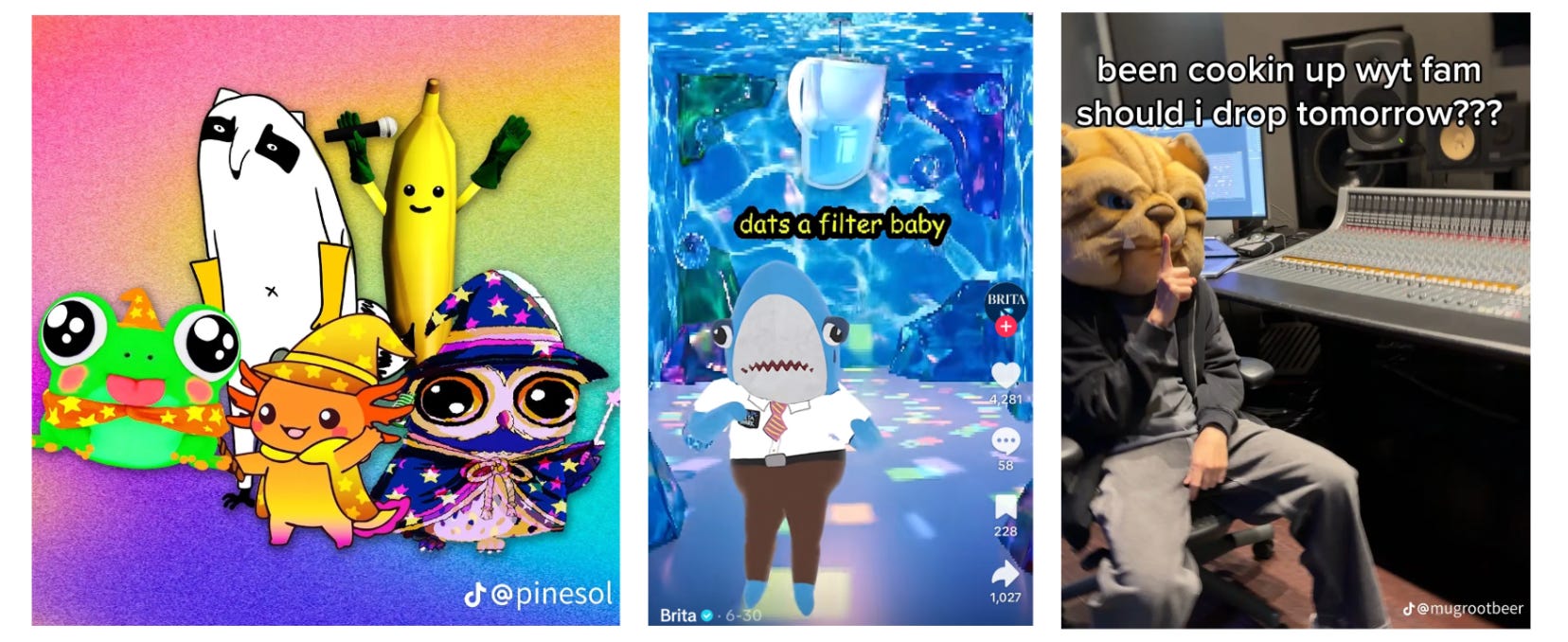
Pine-Sol has the fullest cast, including but not limited to the Frog Wizard, Trash Pine-da, Breezy the axolotl, dancing banana, and Night Owl. Brita has Brita Shark and Bwita Kitten, who each have their own theme song. And Mug Root Beer has, of course, a bulldog, reminiscent of its logo. Intuitive, but less wacky!
Comments
Nothing yet. Say the first thing.
Sign in to join the conversation.