
Published: 22 August 2026
Governments normally calculate the cost of acting. They rarely calculate the future cost of undoing what they have done. That may be one of the most dangerous weaknesses of crisis government.
In the previous discussion of Europe’s confrontation with Russia, we encountered an uncomfortable phenomenon.
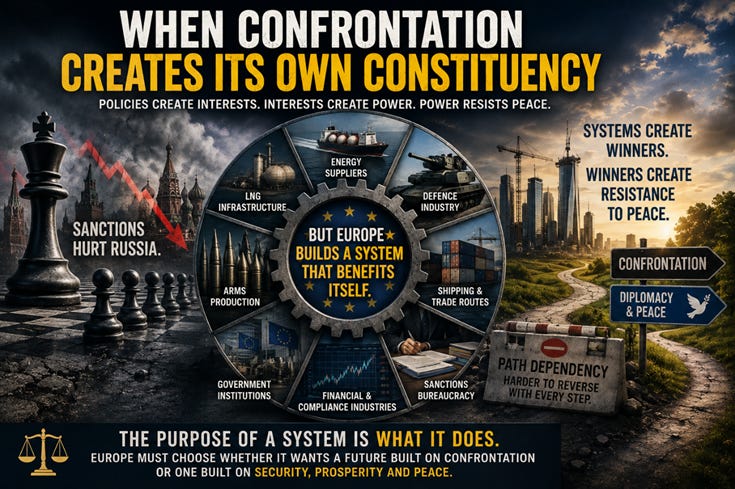
§ Policies create economic structures.
§ Economic structures create interests.
§ Interests create political constituencies.
§ Institutions acquire responsibilities, budgets and authority.
§ Investments are made on the assumption that policies will continue.
And gradually, decisions originally taken in response to an emergency become increasingly difficult to reverse. This is path dependency. But there is a further stage that deserves considerably more attention.
What happens when path dependency becomes capability loss?
A government does not need to lose its legal authority for this to happen. Parliament may still legislate. Ministers may still issue instructions. Elections may still replace governments. Treaties may still be renegotiated. Policies may theoretically still be reversed.
The constitutional machinery continues functioning. Yet the government’s practical freedom of action may have become dramatically narrower. The options remain on paper. But some have become too economically expensive, institutionally disruptive or politically dangerous to use.
That is a very different kind of loss of sovereignty. And modern governments may be considerably more vulnerable to it than they realise.
We normally think about government power in legal terms.
§ Can the government impose sanctions?
§ Can parliament repeal them?
§ Can an administration change energy policy?
§ Can military procurement be reduced?
§ Can diplomatic relations be restored?
If the legal answer is yes, we assume the government remains free to choose. But formal authority is not the same thing as practical agency.
A government may possess the legal authority to change course while discovering that previous decisions have made doing so extraordinarily difficult. Consider a government that has spent years restructuring its energy system. Billions have been invested in terminals, pipelines, storage facilities and long-term supply contracts.
§ Companies have reorganised themselves around the new arrangements.
§ Investors expect returns.
§ Workers depend upon the resulting industries.
§ Regions depend upon the resulting employment.
§ Government revenues may depend upon the resulting economic activity.
The government can theoretically reverse course. But reversal now creates losers. And those losers have voices.
§ They have employees.
§ They have shareholders.
§ They have communities.
§ They have lobbyists.
§ They have political influence.
The government’s legal option therefore still exists. Its practical option space has narrowed.
Europe’s relationship with Russia illustrates the mechanism particularly clearly. After Russia’s invasion of Ukraine, European governments responded rapidly.
§ Sanctions were imposed.
§ Russian energy dependence was reduced.
§ Trade relationships were severed.
§ Supply chains were redirected.
§ LNG infrastructure expanded.
§ Defence expenditure increased.
§ Weapons production accelerated.
§ Military procurement programmes multiplied.
§ Sanctions enforcement institutions expanded.
Each decision can be debated individually. Many were responses to an extraordinary crisis. But four years later, Europe is no longer merely implementing policies. It is constructing an economic and institutional system around those policies.
That distinction matters.
§ Suppose circumstances eventually change.
§ Suppose the war ends.
§ Suppose a negotiated settlement emerges.
§ Suppose European governments decide that some degree of economic normalisation with Russia is now strategically desirable.
They may discover that changing direction is considerably harder than expected. Not because Russia prevents them. Because their own previous decisions do.
§ Energy companies have made investments based upon permanent diversification.
§ Defence manufacturers have expanded production based upon long-term demand.
§ Governments have entered multiyear procurement agreements.
§ New suppliers have acquired European markets.
§ Sanctions bureaucracies have developed institutional responsibilities.
§ Political leaders have spent years defining Russia as a generational threat.
§ Entire national strategies have been rewritten around confrontation.
None of this makes reversal impossible. But every additional commitment increases its cost. That is how policy gradually becomes structure. And structure gradually constrains policy.
We therefore need to recognise a point in government decision-making that is rarely discussed. We might call it the Path Dependency Threshold. It is:
the point at which the accumulated economic, institutional and political costs of reversing a policy become sufficiently high that formal freedom of choice remains, while practical freedom of action becomes substantially constrained.
Crossing that threshold does not mean reversal is impossible. It means reversal has become so costly that governments increasingly avoid considering it.
That distinction is important because governments rarely announce: “We can no longer change this policy.” Instead something subtler happens.
§ Alternatives gradually disappear from serious discussion.
§ Officials describe them as unrealistic.
§ Industries warn of economic consequences.
§ Institutions defend existing arrangements.
§ Political parties fear accusations of inconsistency.
§ Experts calculate transition costs.
§ Governments explain that commitments have already been made.
Eventually the debate no longer concerns whether another path might be preferable. It concerns how best to continue along the existing one. The policy has become its own justification.
Here lies the governance failure. During crises, governments understandably concentrate on immediate questions.
§ What must be done?
§ How quickly can it be done?
§ How much will it cost?
§ What legislation is required?
§ How can public support be secured?
§ How can implementation be accelerated?
§ These are necessary questions.
But one question is remarkably uncommon: How difficult will this decision be to reverse? That should be followed by several others.
§ What economic interests will this policy create?
§ What industries will become dependent upon it?
§ What institutions will acquire responsibility for maintaining it?
§ What infrastructure will assume its continuation?
§ What political narratives will become attached to it?
§ What contractual obligations will extend beyond the crisis?
§ What would changing direction cost in five or ten years?
And perhaps most importantly:
Are we solving today’s crisis by reducing tomorrow’s freedom of choice?
That is not an argument against decisive government. It is an argument for more capable government.
Governments naturally privilege the present. Elections encourage it. News cycles reinforce it. Financial markets demand it. Crises intensify it. The political reward for solving an immediate problem is visible. The cost of creating future path dependency is not.
A minister who announces an emergency energy programme receives political credit today. The government that discovers ten years later that the resulting infrastructure has become economically difficult to abandon inherits the problem.
A government that dramatically expands military procurement during a security crisis demonstrates resolve. The government that later attempts to reduce expenditure confronts factories, workers, regions and companies whose economic interests now depend upon that spending.
§ Emergency institutions follow the same pattern.
§ Powers created temporarily acquire staff.
§ Staff acquire budgets.
§ Budgets create programmes.
§ Programmes create beneficiaries.
§ Beneficiaries develop expectations.
The extraordinary gradually becomes ordinary. And the temporary acquires defenders.
The principle extends far beyond sanctions. Consider energy policy.
Governments subsidise particular technologies. Industries grow around those subsidies. Investment decisions follow. Supply chains develop. Employment becomes geographically concentrated. Changing policy eventually becomes politically difficult even when technology or economics changes.
Consider taxation: Temporary taxes introduced during emergencies acquire revenue streams upon which governments subsequently depend. Removing them becomes fiscally painful.
Consider regulation: A new regulatory regime creates regulators, compliance departments, consultants, lawyers and industries specialising in navigating the rules. The regulation develops an ecosystem.
Consider surveillance: Emergency security powers introduced in response to extraordinary threats create intelligence capabilities and institutional practices that governments may later find difficult to dismantle.
Consider industrial policy: Governments choose strategic sectors, subsidise investment and protect domestic production. Eventually companies depend upon protection and governments become politically dependent upon the employment those companies provide.
And now consider artificial intelligence and technological governance: Governments across the world are making decisions today about infrastructure, education, regulation, data, compute and automation whose consequences may shape national capability for decades.
The same principle applies. Today’s policy creates tomorrow’s option space.
Governments cannot avoid path dependency entirely. Nor should they. Some decisions are deliberately intended to be permanent.
A country builds infrastructure because it expects infrastructure to last. It enters alliances because credibility requires commitment. It establishes institutions because societies require continuity.
The objective therefore cannot be maximum reversibility. That would produce governments incapable of making long-term commitments.
The objective should instead be conscious reversibility.
Before making major crisis decisions, governments should know which commitments they are locking in and why.
That suggests a simple addition to serious policy assessment. Alongside economic cost, social impact, environmental impact and national-security consequences should sit another question:
What is the reversibility profile of this decision?
Some decisions may be easily reversible. Others may require years.
Some may create large stranded assets. Others may create powerful institutional constituencies.
Some may bind future governments contractually. Others may create political expectations that are extremely difficult to unwind.
And some may be effectively irreversible.
Those differences should be understood before, not after, governments commit themselves.
There is also a deeper democratic problem. Democracy assumes that elections allow societies to change direction. A government follows one policy.
§ Voters disagree.
§ Another government is elected.
§ Policy changes.
That is the theory. But what happens when the previous government has created structures that make meaningful policy reversal prohibitively expensive?
The incoming government may possess a democratic mandate for change while lacking the practical capability to implement it.
§ Contracts remain.
§ Debt remains.
§ Infrastructure remains.
§ International commitments remain.
§ Industrial dependencies remain.
§ Institutional interests remain.
The electorate has changed the government. But it has not necessarily regained control of the policy.
That should concern democrats regardless of ideology. Because democratic sovereignty ultimately requires more than the right to replace political leaders. It requires a meaningful capacity to alter political direction.
If accumulated path dependencies continuously narrow that capacity, democracy risks becoming a choice between administrators of increasingly predetermined systems.
This brings us to a broader understanding of governance capability. Capable government is normally associated with the ability to act.
§ Can it make decisions?
§ Can it implement them?
§ Can it mobilise resources?
§ Can it respond quickly?
§ Can it enforce policy?
All are important. But another capability belongs on the list:
Can government preserve its capacity to choose differently later?
That is future agency. And preserving it requires political discipline.
§ Emergency measures should contain review mechanisms.
§ Sanctions should contain clearly understood conditions for relaxation.
§ Temporary institutions should have genuine sunset provisions.
§ Long-term contracts should recognise plausible alternative futures.
§ Major infrastructure decisions should be tested against changing strategic assumptions.
§ Governments should identify the constituencies their policies will create.
§ And large crisis interventions should include an explicit assessment of their future reversibility.
None of this prevents decisive action. It makes decisive action more intelligent.
The lesson from Europe’s confrontation with Russia is therefore larger than Russia. Europe may eventually decide that much of its post-2022 transformation should remain permanent.
§ It may conclude that Russian energy dependence must never return.
§ It may decide permanently higher defence expenditure is necessary.
§ It may maintain substantial sanctions even after hostilities end.
Those may ultimately be legitimate choices. But they should remain choices. That distinction is fundamental.
Governments should not arrive at permanent policies simply because temporary decisions accumulated until alternatives became practically impossible. Democratic stewardship requires something more demanding. It requires governments to manage the present without unnecessarily imprisoning the future.
That leads to a principle worth remembering:
Governments normally calculate the cost of acting. Capable governments must also calculate the future cost of reversing what they do.
Because the greatest danger of path dependency is not that governments formally lose sovereignty. It is that they retain every appearance of sovereignty while gradually losing something more important:
the practical agency to change course.
And once that happens, the system is no longer merely implementing government policy.
Government has begun serving the system its previous decisions created.
Leon Vermeulen is an independent historian and commentator specialising in European memory, conflict, reconciliation and social cohesion.
No posts
Comments
Nothing yet. Say the first thing.
Sign in to join the conversation.