
Published: 24 August 2026
The coming BRICS summit may not produce a new currency or dethrone the dollar. But a changing global financial landscape is giving the group something potentially more important: the opportunity to build credible alternatives.
For years, predictions of the imminent demise of the US dollar have been greatly exaggerated. The dollar remains the world’s dominant reserve currency. American capital markets remain unmatched in depth and liquidity. US Treasury securities remain central to the global financial system, while American corporations continue to attract enormous quantities of international capital.
None of that is about to disappear. But something more subtle — and potentially more consequential — is happening. The question facing the international financial system is no longer simply whether the dollar will remain dominant. It almost certainly will for the foreseeable future.
The more interesting question is whether the world will remain as dependent upon it as it has been.
And that makes the coming BRICS summit in India considerably more important than another gathering of emerging economies issuing declarations about reforming the international order.
For perhaps the first time, BRICS’ long-stated ambition for greater financial autonomy coincides with significant weaknesses appearing inside the financial architecture from which it wants greater independence.
The immediate warning has come from the US Treasury market. Long-term American government borrowing costs have risen sharply. The 30-year Treasury yield recently reached approximately 5.3 percent, its highest level since 2007, forcing the US Treasury to announce a substantial increase in its programme for buying back older long-dated government securities.
The intervention provided temporary relief. It did not remove the underlying problem.
America’s gross federal debt has passed $40 trillion. Persistent deficits require enormous quantities of new borrowing. At the same time, some of America’s historically important foreign creditors are reducing their exposure.
· Japan remains the largest foreign holder of US Treasuries, but its holdings fell by approximately $26 billion in June.
· China’s officially recorded holdings have fallen even further — from about $731 billion in June 2025 to $633 billion a year later.
· Total foreign Treasury holdings also declined in June, although they remain higher than a year earlier.
This does not mean that nobody wants American debt. It means something more important:
investors increasingly have alternatives — and are demanding greater compensation for lending to Washington for decades.
That distinction matters.
The danger for America is not that China suddenly sells every Treasury security it owns. Such an action would damage China almost as much as the United States. The greater danger is that China, Japan and other surplus countries simply become less willing to keep recycling their accumulated savings into US government debt.
Washington still gets its money. But increasingly it may have to pay more for it.
BRICS would make a serious strategic mistake if it defined its objective as destroying or replacing the dollar. It does not possess the institutions required to do so.
Its members have different economic interests, political systems and strategic ambitions. India does not want to exchange American monetary dominance for Chinese monetary dominance. China and India remain geopolitical competitors. Gulf BRICS members retain enormous dollar-denominated interests. Most BRICS financial markets lack the liquidity, transparency and institutional depth of American markets.
There will therefore almost certainly be no credible “BRICS dollar” emerging from the coming summit. Nor is one necessary. The real contest is becoming something quite different:
Where will the world’s surplus capital be invested?
For decades the answer disproportionately favoured America. The United States offered both the world’s premier reserve asset and its most attractive equity market.
BRICS does not need to destroy either. It merely needs to create credible alternatives.
Here lies perhaps the greatest geopolitical irony surrounding the coming BRICS summit. BRICS’ fundamental weakness has always been its heterogeneity.
Brazil is not Russia. India is not China. Saudi Arabia is not South Africa. Their strategic interests frequently conflict, and declarations about multipolarity have historically travelled considerably faster than the institutions required to create it.
Donald Trump may now be providing BRICS with something it could never manufacture for itself: a common strategic problem without requiring a common ideology.
The latest confrontation with Canada makes this considerably more important. Following the collapse of negotiations, Washington imposed 50 percent tariffs on approximately $20 billion of Canadian goods. Canada has announced dollar-for-dollar retaliation beginning September 8—only days before BRICS leaders gather in New Delhi. The significance extends far beyond the goods affected.
Canada is not Iran, Russia or China. It is one of America’s closest historical allies, its neighbour, one of its most deeply integrated economic partners and a member of a formal trade agreement with the United States. Yet the dispute has deteriorated to the point where Canada’s government openly talks about the weaponisation of economic interdependence, while the future stability of USMCA itself has become less certain.
For policymakers elsewhere, the lesson is difficult to ignore. If even deep economic integration and a formal American trade agreement cannot guarantee long-term predictability, then excessive dependence upon any single market becomes a strategic risk.
Washington’s pressure on countries trading with Iran reinforces the message from another direction. America is increasingly demonstrating its willingness not merely to determine access to its own market, but to use that access as leverage over the economic relationships countries maintain with third parties.
For China and Russia, resistance to such extraterritorial economic power is hardly new. The countries that matter are India, Brazil, the UAE, Indonesia, South Africa, Saudi Arabia and the wider group of emerging economies that have little interest in joining an anti-American coalition. For them, however, the proposition can now be framed entirely differently. Not:
How do we challenge America?
But:
How do we ensure that no single foreign government can determine our economic choices?
That transforms the BRICS proposition.
This is why BRICS would make a serious mistake by responding aggressively in the conventional sense. A declaration of financial war against Washington would strengthen America’s hand. Announce a common currency intended to overthrow the dollar and India becomes uncomfortable. Gulf states become cautious. Potential partners begin wondering whether participation requires choosing sides.
There is a much more effective strategy. BRICS can present the construction of alternative financial infrastructure as economic insurance. The argument becomes:
We are not replacing the American system. We are ensuring that countries can continue functioning if access to that system becomes uncertain.
That distinction could be transformative.
India does not need to become anti-American to support it.
Saudi Arabia does not need to abandon the dollar.
Brazil does not have to choose Beijing over Washington.
Indonesia does not need to join somebody else’s geopolitical bloc.
Every one of them nevertheless has a rational interest in possessing alternative markets, payment systems, currencies, financing mechanisms and investment relationships.
Trump’s increasingly transactional use of American economic power therefore risks turning what was once an ideological BRICS ambition into a straightforward exercise in national risk management. And that could prove a far stronger unifying force.
The opportunity confronting BRICS in New Delhi is no longer merely monetary. It is architectural. BRICS can begin constructing an economic network offering countries optionality. That means moving simultaneously on several fronts.
1. Turn Payment-System Discussions into an Implementation Programme
BRICS central banks are already discussing interoperability between fast-payment systems and potentially central-bank digital currencies. The Reserve Bank of India has publicly confirmed that these discussions are underway.
The New Delhi summit should therefore move beyond another declaration of intent. The meaningful breakthrough would be a timetable.
A pilot programme.
Technical standards.
Named participating central banks.
An implementation body.
Or agreed milestones for interoperability. That would represent an important transition: from talking about alternative financial architecture to actually constructing it.
2. Accelerate Local-Currency Trade Settlement
The objective should not be eliminating the dollar. It should be ensuring that using the dollar becomes a choice rather than a necessity. More intra-BRICS trade could therefore be settled directly:
rupee → real
yuan → dirham
real → rand
rather than automatically passing through dollars and dollar-based correspondent banking.
This becomes particularly important when countries face the possibility that access to American markets or financial infrastructure may become conditional upon their relationships with third countries.
3. Build Trade Resilience Against Third-Country Economic Pressure
This is the area where recent events create perhaps the greatest reason for BRICS to become more ambitious. If international trade is increasingly vulnerable to unilateral sanctions, secondary tariffs or restrictions imposed because of relationships with third countries, BRICS members have an incentive to ensure legitimate commerce can continue without automatically requiring American financial infrastructure. That means developing alternative:
trade finance,
payment and clearing mechanisms,
insurance,
shipping finance,
currency liquidity arrangements
and potentially mechanisms for maintaining trade when conventional financial channels become unavailable.
This need not involve circumventing laws within US jurisdiction. The more profound objective is to reduce the amount of international commerce that needs to enter US jurisdiction in the first place.
4. Turn the New Development Bank into an Investment Competitor
This may ultimately matter more than de-dollarisation. The NDB has already made local-currency financing increasingly important and recently announced plans for approximately $7.5 billion of investment in India over five years, with particular emphasis on rupee-denominated lending. But the larger strategic question is:
Can BRICS create assets in which the world’s savings actually want to invest?
America currently has an extraordinary advantage. Investors buy Treasuries for security and American equities for growth. BRICS cannot compete merely by criticising that system. It must provide something attractive enough to compete with it.
Infrastructure bonds.
Energy investments.
Development securities.
Local-currency debt.
Industrial projects.
Digital infrastructure.
Commodity-related financial instruments.
The objective should ultimately be to make:
Global South savings → Global South productive investment
as natural as:
Global savings → US financial markets.
5. Connect Commodities to the Emerging Financial Architecture
BRICS contains both enormous commodity producers and enormous commodity consumers. That creates an unusual opportunity. Commodity exchanges and trading platforms can be connected to local-currency settlement, BRICS payment infrastructure, trade finance and eventually investment markets. The significance is not merely who sells grain, oil, minerals or agricultural products. It is:
where they are priced,
how transactions are settled,
which institutions finance them,
and ultimately
which currencies participants need to hold.
Trade architecture and financial architecture then begin reinforcing one another.
6. Create Alternatives Without Attacking US Treasuries
China in particular should resist any temptation to weaponise its Treasury holdings. A rapid liquidation would damage American markets—but it would also reduce the value of China’s remaining holdings and destabilise a financial system upon which China itself still depends. There is a considerably more sophisticated strategy: Do not dump Treasuries.
Allow some holdings to mature.
Reduce incremental purchases.
Diversify reserves.
Increase gold and other assets.
Develop local bond markets.
Increase bilateral currency settlement.
Expand development finance.
Build alternative payment infrastructure.
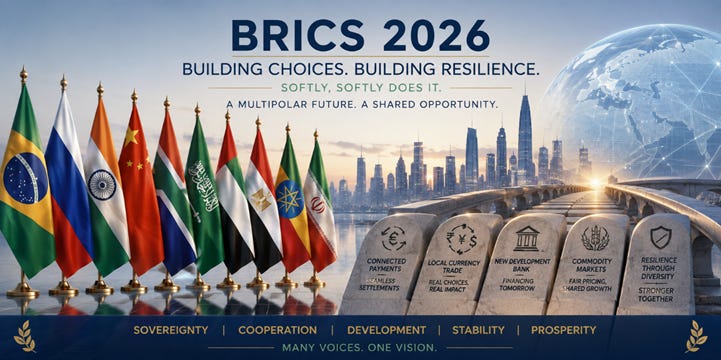
Gradually give countries fewer reasons to require dollars. That is the financial equivalent of softly, softly does it. No dramatic attack. No single moment at which Washington can retaliate. Simply a gradual reduction in structural dependence.
7. Open the Architecture Beyond BRICS
Recent events suggest one additional opportunity that deserves much greater attention. BRICS should not think merely in terms of acquiring new members. It should build an economic network in which countries can participate without joining BRICS politically.
Payment connectivity.
NDB financing.
Commodity exchanges.
Local-currency settlement.
Infrastructure investment.
Trade agreements.
Joint investment vehicles.
This would allow countries seeking diversification to participate without requiring them to choose between Washington and Beijing. Canada itself is not about to become a BRICS country.
That misses the point. The significance of the Canadian confrontation is its demonstration effect. Every middle power watching Washington’s treatment of one of America’s closest economic partners has another reason to ask whether excessive dependence upon a single market is prudent.
BRICS’ greatest opportunity may therefore lie outside BRICS itself. It could evolve from a grouping of countries into the nucleus of a much wider optional economic network.
This brings us back to the fundamental financial competition.
America needs enormous quantities of global capital to finance federal deficits.
American corporations simultaneously require enormous capital to finance AI, data centres, energy systems and the wider technological transformation.
Europe requires enormous investment to restore competitiveness, finance defence and complete its energy transition.
The Global South requires trillions for infrastructure, industrialisation, education, energy and technological development.
There is not an unlimited pool of inexpensive global capital capable of financing everything simultaneously. The competition is therefore becoming larger than:
Dollar versus yuan.
Or even:
America versus China.
The emerging question is:
Which economic system can offer countries and investors the best combination of security, return, liquidity, market access and freedom of economic choice?
America still possesses enormous advantages in that competition. But its increasing willingness to make market access conditional introduces a new variable:
political predictability.
That is an asset too. And BRICS has an opportunity to compete for it.
The most probable outcome remains considerably less dramatic than either BRICS enthusiasts or Western critics imagine.
There will almost certainly be no common BRICS currency.
There will be no coordinated dumping of US Treasuries.
There will be no declaration ending dollar supremacy.
And BRICS’ internal differences will remain substantial. But recent events have increased the probability of something more consequential occurring beneath the rhetoric.
I would now expect particularly strong language against unilateral economic coercion.
I would expect further commitments to local-currency settlement.
I would watch closely for concrete movement on payment-system interoperability.
I would expect stronger emphasis on NDB and local-currency financing.
Commodity and alternative trading infrastructure deserves considerably greater attention.
And there is now a realistic possibility that BRICS begins considering mechanisms specifically designed to preserve trade and investment when individual members encounter third-country economic pressure.
The most consequential development of all, however, would be recognition that BRICS’ objective should extend beyond protecting its existing members.
If New Delhi begins constructing financial and trading mechanisms available to countries that want diversification without geopolitical alignment, something important will have changed. BRICS will have moved beyond de-dollarisation. It will have begun competing to provide economic optionality.
America remains enormously powerful. Its companies remain extraordinarily innovative. Its capital markets remain unparalleled. The dollar remains dominant. None of this is about to disappear.
But dominance and indispensability are not the same thing. And economic power exercised too frequently can eventually create the incentives required to build alternatives to that power. That is the paradox confronting Washington.
Tariffs can extract concessions.
Sanctions can alter behaviour.
Market access can provide extraordinary leverage.
But every time access to the world’s largest economy becomes a political bargaining instrument, another government has reason to reduce the cost of someday losing it.
BRICS does not need those governments to become anti-American. It merely needs them to become pro-optionality. That is a much larger potential constituency.
The September summit should therefore no longer be judged simply by whether BRICS makes progress toward de-dollarisation. A better question is:
Does New Delhi produce practical mechanisms that allow countries to trade, finance, invest and settle transactions with one another while reducing the political risk created by dependence upon any single economic power?
If the answer is yes, even modestly, September could represent an important turning point. Because the great geopolitical contest of the next decade may no longer be simply about who gives the world’s money somewhere else to go. It may increasingly be about:
who gives the world’s money, trade and investment somewhere else to go — without demanding that countries choose sides.
And herein lies the final irony. The smartest BRICS response to an increasingly aggressive America may not be greater aggression at all. It may simply be:
softly, softly does it — but considerably faster.
Leon Vermeulen is an independent historian and commentator specialising in European memory, conflict, reconciliation and social cohesion.
No posts
Comments
Nothing yet. Say the first thing.
Sign in to join the conversation.