
Published: 20 August 2026
A highly valuable comment made by my subscriber, Tris, on my op-ed -
https://leonvermeulen.substack.com/p/sanctions-hurt-russia-but-europe ,
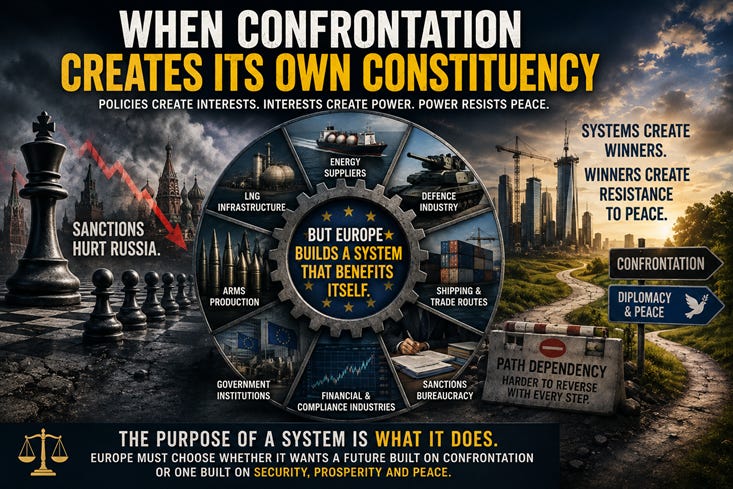
made me realise that once an economic system reorganises itself around confrontation, constituencies emerge that benefit from confrontation. That realisation moves the discussion beyond the argument about whether sanctions “work.” The real subject becomes path dependency: emergency policy changes economic structures; those structures create beneficiaries; beneficiaries acquire political influence; and what began as a temporary response becomes increasingly difficult to unwind.
In a 2-part series I will further explore the implications of what I have called ‘path dependency’.
Europe’s confrontation with Russia began as a response to war. Four years later, an uncomfortable question deserves asking: what happens when entire industries, investments and political institutions begin adapting to the expectation that confrontation will continue?
Wars create winners and losers. So do sanctions. So does rearmament. And so does the deliberate restructuring of an economy around geopolitical confrontation. This does not require conspiracy. It does not require believing that defence companies secretly control governments, that energy suppliers manufacture international crises, or that European politicians deliberately seek permanent conflict with Russia. The mechanism is considerably more mundane — and precisely for that reason, considerably more important.
Once an economic system reorganises itself around confrontation, constituencies emerge that benefit from confrontation.
And once those constituencies exist, returning to the world that preceded the confrontation becomes progressively more difficult.
That is the question Europe should now be asking itself. Not merely whether sanctions against Russia are hurting Russia.
They are.
Not merely whether Europe should defend Ukraine.
It should.
But something larger:
What kind of European political economy are four years of sanctions, energy decoupling and accelerating militarisation creating — and what incentives will that economy have to eventually return to peace?
Consider what has happened since 2022.
§ Europe dramatically reduced its dependence on Russian pipeline gas.
§ New LNG infrastructure was built.
§ Alternative energy contracts were signed.
§ Trade routes were redirected.
§ Supply chains were reorganised.
§ Russian assets were frozen.
§ European defence budgets increased dramatically.
§ Weapons manufacturers expanded production.
§ Governments signed long-term procurement contracts.
§ Financial institutions developed entire compliance structures around sanctions.
§ Ports, shipping companies, energy traders and commodity markets adapted to new patterns of global commerce.
§ Government departments acquired new responsibilities.
§ European institutions developed increasingly sophisticated machinery for designing, monitoring and enforcing economic restrictions.
Each individual decision can be justified as a response to Russia’s invasion of Ukraine. But collectively they have done something much larger. They have begun creating an economic architecture of confrontation.
And economic architectures develop interests of their own.
There is an old systems principle associated with Stafford Beer: “The purpose of a system is what it does.”
It is deliberately provocative. It asks us to stop judging systems exclusively by what their architects say they intend and instead examine the outcomes those systems repeatedly produce.
Apply that principle to Europe’s sanctions and security architecture. What does the system actually do?
It damages Russian economic interests. But it also redirects European energy purchasing.
§ It increases demand for LNG.
§ It increases defence expenditure.
§ It expands weapons production.
§ It redirects shipping and trade.
§ It creates new infrastructure.
§ It increases government intervention in strategically important industries.
§ It strengthens sanctions bureaucracies.
§ It creates demand for compliance lawyers, consultants, financial investigators and enforcement mechanisms.
§ It redistributes economic activity between European regions and industries.
And it gradually makes the restoration of the old economic relationship with Russia more difficult.
None of this establishes sinister intent. It establishes incentives. And incentives matter enormously in politics.
Start with energy. Europe’s extraordinary dependence on Russian pipeline gas before 2022 has been substantially dismantled. From a strategic perspective, reducing excessive dependence on a single supplier was defensible. But replacing one energy architecture necessarily created another.
§ LNG terminals require investment.
§ Shipping capacity requires investment.
§ Long-term supply contracts require commitments.
§ Alternative pipelines require infrastructure.
§ Storage facilities require financing.
§ New suppliers acquire market share.
§ Companies build business models around servicing the new system.
Those investments are not made on the assumption that Europe will simply return to the energy relationships of 2021. They are made because investors expect the new structure to endure.
Then there is defence. Europe’s rearmament is creating perhaps the most obvious new constituency. For decades European governments were criticised — often correctly — for underinvesting in defence. That era has ended.
Defence budgets are rising sharply. Ammunition factories are expanding. Production capacity is being increased. Procurement commitments extend years or decades into the future.
Again, much of this is strategically understandable. Europe requires credible defence capability regardless of what happens in Ukraine. But economics does not stop operating simply because expenditure has a national-security justification.
§ Factories create jobs.
§ Jobs create communities dependent upon factories.
§ Companies create shareholders.
§ Shareholders expect returns.
§ Industries create trade associations.
§ Trade associations lobby governments.
§ Regions compete for defence investment.
§ Politicians celebrate factories and employment arriving in their constituencies.
A temporary increase in military expenditure thereby becomes something considerably more durable:
an industrial constituency for continued military expenditure.
The phenomenon extends beyond companies. Governments themselves accumulate institutional investment in policy. Imagine the political difficulty facing a European government that has spent four years telling its population that Russia represents a fundamental long-term threat.
§ It has increased military expenditure.
§ Accepted higher energy costs.
§ Reorganised supply chains.
§ Imposed 21 rounds of sanctions.
§ Asked companies to absorb losses.
§ Asked taxpayers to finance Ukraine.
§ Asked households to tolerate economic consequences.
§ And justified all of this as necessary for European security.
Then imagine that government announcing:
“Circumstances have changed. We should now negotiate a broader accommodation with Moscow.”
Even if circumstances genuinely had changed, the political reversal would be enormous. Opponents would ask whether previous sacrifices had been necessary. Governments would fear appearing weak. Institutions whose authority expanded during the confrontation would face diminished roles. Politicians whose reputations were built upon uncompromising positions would have to explain compromise.
The obstacle to changing policy therefore becomes more than Russia.
Europe itself becomes institutionally invested in the continuation of its existing strategy.
This may help explain one of the strangest characteristics of Europe’s sanctions regime. Sanctions packages are numbered.
Package 18.
Package 19.
Package 20.
Package 21.
Now discussion turns toward Package 22. But notice the direction of travel. The political debate is overwhelmingly about what should be added.
§ Which additional banks?
§ Which ships?
§ Which companies?
§ Which individuals?
§ Which commodities?
§ Which loopholes?
§ Which countries facilitating circumvention?
There is considerably less public discussion about the reverse mechanism.
§ Under precisely what circumstances would Package 21 become Package 20?
§ When would Package 20 become Package 19?
§ What Russian actions would produce measurable sanctions relief?
§ What sanctions are bargaining instruments?
§ Which are effectively permanent?
§ What would a negotiated sequence of reciprocal concessions actually look like?
Without such mechanisms, sanctions develop a ratchet effect. They tighten much more easily than they loosen. And that should concern anyone who believes sanctions are supposed to be an instrument for changing behaviour rather than simply a permanent condition of international relations.
Here lies the deeper problem. Europe is building increasingly powerful constituencies around security, defence, energy diversification and economic separation. But where is the equivalent constituency for peace?
§ Where are the institutional incentives for restoring trade if political conditions permit?
§ Where are the diplomatic mechanisms continuously exploring possible settlements?
§ Where is the European architecture developing proposals for the security order that might follow the war?
§ Where are the political rewards for reducing confrontation?
o There are enormous budgets for defence.
o There are enormous programmes for weapons procurement.
o There are sophisticated mechanisms for sanctions enforcement.
o There are expanding intelligence capabilities.
o There are institutions dedicated to identifying sanctions circumvention.
All may have legitimate purposes. But institutional capability reveals political priorities. And the imbalance is becoming striking. Europe has developed formidable machinery for managing confrontation. Its machinery for ending confrontation appears considerably less developed.
The danger is not that somebody in Brussels secretly decided Europe should remain permanently at odds with Russia.
The danger is almost the opposite. Nobody needed to decide it. Systems can acquire direction through accumulated decisions.
§ One LNG terminal does not determine foreign policy.
§ One weapons factory does not determine foreign policy.
§ One sanctions package does not determine foreign policy.
§ One defence procurement programme does not determine foreign policy.
But thousands of contracts, investments, regulations, careers, institutions and political commitments eventually create something larger than any individual decision.
They create path dependency.
The cost of reversing direction steadily increases. Eventually policymakers are no longer choosing freely between alternative strategies. They are operating inside a structure created by yesterday’s choices.
And that is precisely why democratic governments must periodically ask not merely whether individual policies remain defensible, but where the accumulated policy architecture is taking society.
That brings us to an uncomfortable test. Imagine tomorrow that serious negotiations produced a credible settlement in Ukraine.
Not Russian capitulation.
Not Ukrainian capitulation.
A difficult, imperfect negotiated settlement accompanied by enforceable security arrangements.
Who would benefit?
Obviously Ukraine. Russian and Ukrainian families. European taxpayers. Industries struggling with energy costs. Companies interested in restored commerce. Governments facing fiscal pressure. Perhaps Europe as a whole. But now ask the inverse question.
Who would lose economically, institutionally or politically from a rapid normalisation of relations?
§ Some energy suppliers would face renewed competition.
§ Some infrastructure investments would become less valuable.
§ Some defence projections would have to be reconsidered.
§ Some companies would face lower anticipated demand.
§ Some bureaucratic structures would shrink.
§ Some political narratives would become harder to sustain.
None of those actors therefore needs to “want war.” That is far too simplistic. They need only prefer continuation of the economic and institutional arrangements from which they benefit.
That distinction is crucial. Because political economies are rarely driven by villains conspiring in dark rooms. They are driven much more often by perfectly rational actors defending perfectly understandable interests. And when enough of those interests point in the same direction, the system acquires momentum.
There is nothing inherently wrong with Europe rebuilding its military strength.
There is nothing inherently wrong with reducing dangerous energy dependencies.
There is nothing inherently wrong with imposing economic costs on a state that invaded its neighbour.
The mistake would be failing to recognise that these policies are creating a new political economy. And political economies shape future choices.
Europe therefore needs something that has been largely missing from its Russia policy:
an explicit theory of how confrontation eventually ends.
§ Sanctions should contain pathways toward relaxation.
§ Diplomacy should continue even while fighting continues.
§ Military deterrence should be accompanied by proposals for future security architecture.
§ Economic separation should not automatically become permanent separation.
§ And European governments should regularly assess not only who bears the cost of their policies, but who benefits from their continuation.
Because the longer confrontation lasts, the harder ending it may become. Not simply because Moscow and Kyiv remain divided. Not simply because Moscow and Brussels distrust each other. But because economic structures gradually grow around the conflict itself.
§ Europe should defend itself.
§ It should support Ukraine.
§ It should maintain credible deterrence.
But it should also remember something history repeatedly teaches:
Preparing for war and preparing for peace are not the same activity.
Europe has spent four years becoming considerably better at the first. It is time to start investing seriously in the second. Because once confrontation becomes an economic system, peace requires more than an agreement between governments.
It requires overcoming the interests the confrontation itself has created.
Leon Vermeulen is an independent historian and commentator specialising in European memory, conflict, reconciliation and social cohesion.
No posts
Comments
Nothing yet. Say the first thing.
Sign in to join the conversation.