
Published: 14 August 2026
Something disturbing is happening to Europe’s language of security. It is no longer merely becoming harder. It is becoming narrower.
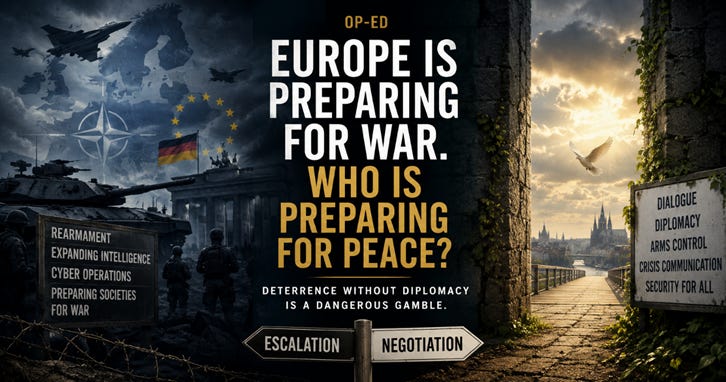
Military preparedness is discussed. Rearmament is discussed. Intelligence capabilities are expanded. Cyber operations are strengthened. Citizens are warned that Russia may eventually attack NATO. Governments speak increasingly openly about preparing their societies for war. Yet one word is becoming strangely difficult to hear:
Diplomacy.
That absence matters. It matters even more when the language surrounding the Ukraine war begins to cross the boundary between determination and dehumanisation.
A widely circulated video from a recent appearance involving Ukrainian President Volodymyr Zelenskyy and Serbian President Aleksandar Vučić shows German journalist Michael Martens of Frankfurter Allgemeine Zeitung asking what Europeans could concretely do to help Ukraine “kill more Russians,” before clarifying “more Russian soldiers, of course.”
Vučić’s response was considerably more revealing than the question. He objected to its formulation and said that, as far as killing was concerned, he hoped the killing would stop.
That should have been the obvious European answer too. Not because Ukraine does not have the right to defend itself. It does. Not because Russian soldiers are somehow exempt from the brutal consequences of invading another country. They are not. But because when a European journalist can formulate the objective of European policy as helping to “kill more Russians,” something has gone badly wrong with the language through which this war is being understood.
Journalism should interrogate war, not become emotionally absorbed into it. And Europe should be especially careful about allowing opposition to the Russian government to mutate into hostility towards Russians as a people.
Polish President Karol Nawrocki has similarly used the historically derogatory term Moskal when speaking about Russia. Whatever its historical context, such language contributes to a political atmosphere in which an entire nationality increasingly becomes synonymous with the enemy.
There is a dangerous progression here.
· First governments identify a state as a threat.
· Then political rhetoric identifies its military as the enemy/
Eventually the distinction between government, military and people begins to disappear. Europe, of all continents, should understand where that road can lead.
Against this rhetorical background comes another development.
This week, the German cabinet approved sweeping reforms intended to give its intelligence agencies substantially greater operational powers.
Interior Minister Alexander Dobrindt has described the objective in remarkable language: Germany’s intelligence agencies are to become “genuine secret services,” capable of operating on something closer to an equal footing with foreign counterparts.
The proposed legislation would expand the ability of the BND and other agencies to access information, conduct active operations and employ artificial intelligence. German officials have explicitly described the changes as a qualitative leap in the country’s intelligence capability. The legislation still requires parliamentary approval.
There are perfectly legitimate reasons for Germany to modernise its intelligence services. Europe faces cyberattacks, terrorism, sabotage, espionage and hybrid warfare. No responsible government can simply ignore those threats. Germany’s own government argues that the changed security environment requires intelligence services capable not merely of observing threats but, under defined circumstances, actively countering them.
But Germany’s intelligence transformation does not occur in isolation.
It accompanies a historic German rearmament and Chancellor Friedrich Merz’s ambition to build the Bundeswehr into Europe’s strongest conventional military force. Put the pieces together.
· Europe is increasing military expenditure.
· Germany is rebuilding military power.
· Intelligence agencies are acquiring more offensive capabilities.
· Cyber capabilities are expanding.
· Russia is increasingly described as the principal long-term security threat.
· European populations are being told to prepare for the possibility of war.
And yet there is no comparable political mobilisation behind creating a negotiated European security settlement.
That is the strategic contradiction we urgently need to confront.
The dominant European argument is understandable.
Moscow has demonstrated its willingness to use military force. Therefore, Europe must become sufficiently strong that Russia concludes an attack on NATO could never succeed.
That is deterrence. There is considerable logic behind it. But deterrence was never intended to eliminate diplomacy.
During some of the most dangerous periods of the Cold War, Washington and Moscow simultaneously built military forces and talked to one another.
· They negotiated arms-control agreements.
· They established crisis communications.
· They discussed nuclear doctrine.
· They developed confidence-building measures.
· They negotiated rules intended to prevent accidents from becoming wars.
None of this required friendship. It required something much more important:
an understanding that adversaries sharing a continent must manage their hostility if they wish to survive it.
Today’s Europe increasingly appears to have forgotten that distinction. Dialogue with Moscow is too often portrayed as appeasement. Negotiation becomes morally suspect. Discussion of Russian security perceptions is interpreted as accepting Russian political claims.
But understanding an adversary’s perception is not the same thing as endorsing it. It is one of the oldest requirements of strategy.
European leaders repeatedly explain what their military and intelligence expansion means to us.
· It is defensive.
· It is deterrence.
· It is preparation.
· It is resilience.
Fine. But serious strategy requires another question:
What does it look like from Moscow?
Russia sees NATO military expenditure increasing.
· It sees Germany undertaking its largest military transformation in generations.
· It sees European intelligence services acquiring more active cyber capabilities.
· It sees Western weapons supporting a country with which Russia is fighting a major war.
· It hears discussion about European troops, long-range weapons and preparations for a possible future confrontation.
· And it hears prominent European voices speaking casually about killing Russians.
Europe may regard all of these developments as defensive. Russia may not.
That distinction is extraordinarily important. Because security policy is not determined solely by what you intend. It is also shaped by what your opponent believes you intend.
This is the classic security dilemma.
One state arms itself because it feels threatened. Its opponent observes the buildup and feels threatened in return. It therefore increases its own military readiness.
The first state then interprets that response as proof that its original fears were justified.
Both sides become more secure militarily and less secure strategically. Eventually enormous military systems face one another, each convinced the other created the danger.
History contains more than enough examples of where that dynamic can lead.
There is another reality European political rhetoric increasingly treats almost as an abstraction.
Russia possesses the world’s largest nuclear arsenals. Its strategic and intermediate-range capabilities mean that a direct Russia-NATO confrontation would not resemble Afghanistan, Iraq, Libya or the Balkan wars.
European capitals themselves would exist within the escalation equation.
That does not mean Europe should submit to nuclear blackmail. Quite the opposite.
Credible deterrence remains necessary precisely because nuclear coercion cannot become an acceptable instrument of international politics. But nuclear deterrence without diplomatic engagement is an extraordinarily dangerous long-term strategy.
The objective cannot simply be:
prepare indefinitely for the war we insist must never happen.
There must also be a political strategy for making that war less likely. And here Europe appears intellectually paralysed.
What exactly is Europe’s desired security order ten years from now?
· Permanent confrontation with Russia?
· A militarised frontier stretching from Finland to the Black Sea?
· Ever-increasing defence expenditure?
· Permanent cyber conflict?
· Successive generations raised to expect an eventual European war?
· A continent divided into hostile military camps indefinitely?
Perhaps European leaders believe this is unavoidable. If so, they should say so. But if the objective is eventually a stable European security order, then at some point Europe will have to negotiate with Russia.
· Not because Europeans admire Vladimir Putin.
· Not because Russia must be trusted.
· Not because Ukraine’s sovereignty should be traded away.
But because security arrangements are negotiated with adversaries precisely because they are adversaries.
We did not build Cold War arms-control architecture because Washington trusted Moscow. We built it because Washington did not trust Moscow. That is the entire point.
Europe unquestionably needs stronger defensive capability. The invasion of Ukraine demonstrated that military weakness does not guarantee peace. But Europe needs something else at exactly the same time:
a diplomatic architecture designed to prevent military strength from becoming military catastrophe.
That means reopening serious channels of communication with Moscow.
· It means discussing future arms control.
· It means military-to-military crisis communications.
· It means examining missile deployments, nuclear risk reduction, cyber boundaries and mechanisms for preventing incidents from escalating.
Ultimately it means asking the hardest question of all:
What European security arrangement could make both Russia and the rest of Europe sufficiently secure that neither side believes war is necessary?
· Russia will have demands Europe cannot accept.
· Europe will have demands Moscow may reject.
That is called negotiation. Negotiation begins where agreement does not exist.
Perhaps the most dangerous development in Europe is therefore not rearmament itself. It is the emerging belief that advocating dialogue demonstrates weakness.
That reverses the lessons of the nuclear age. Military capability without diplomacy is not strength. It is incomplete statecraft.
Deterrence without communication is not strategy. It is a gamble.
And rhetoric that reduces Europe’s objective to killing more Russians is not moral clarity. It is evidence that the psychological distance between preventing war and accepting war as inevitable is becoming dangerously small.
· Europe should defend itself.
· Europe should support its security.
· Europe should possess credible military capability.
But every additional billion spent preparing for a future confrontation should make European leaders more—not less—determined to prevent that confrontation from occurring.
Because the ultimate measure of European leadership will not be how effectively it prepared Europeans to fight the next great European war. It will be whether it possessed the wisdom to prevent one.
Europe is rapidly developing a strategy for war. It urgently needs a strategy for peace.
Leon Vermeulen is an independent historian and commentator specialising in European memory, conflict, reconciliation and social cohesion.
No posts
Comments
Nothing yet. Say the first thing.
Sign in to join the conversation.