
Published: 15 August 2026
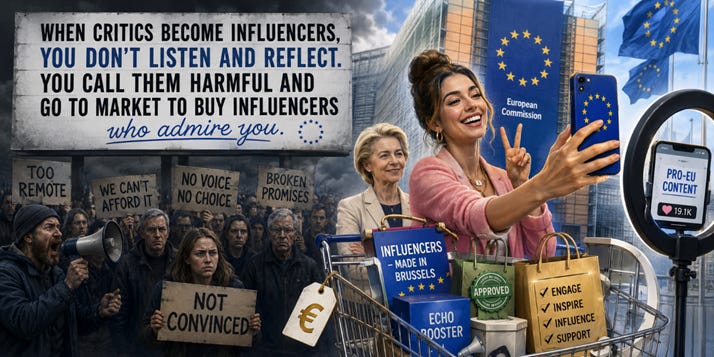
Politico reports: The EU is embracing influencers in an effort to claw back ground in an online information environment increasingly hostile to Brussels, placing pro-European voices into feeds where anti-EU narratives are thriving, three officials told Playbook.
Getting involved: “If the objective is to create a pro-democratic, pro-European environment, then we need to tap into these resources,” Sevim Aktas, an Instagram influencer employed by Youth Commissioner Glenn Micallef, told my colleague Sebastian Starcevic.
Siege mentality: “The European information space is under siege from authoritarian actors from all sides,” said Saman Nazari, coordinator of the Counter Disinformation Network at democracy-defense nonprofit Alliance4Europe. The EU, he said, is an attractive target because while it symbolizes “European unity and liberal democracy,” many citizens have relatively little understanding of how its institutions work.
#Europe: Instagram and TikTok stars will again be invited to Commission President Ursula von der Leyen’s State of the EU speech in Strasbourg next month. That’s on top of a push inside the European Council to bring influencers in to cover summits later this year and a long-standing working relationship between Parliament and digital creators.
There was once a quaint democratic idea that when citizens became dissatisfied with their government, the government might ask itself why.
Perhaps a policy had failed. Perhaps living standards had deteriorated. Perhaps people no longer believed the official explanation. Perhaps the institutions had become too remote, too bureaucratic, or too convinced of their own wisdom.
Brussels has apparently discovered a more modern solution.
Hire influencers.
The European Union is reportedly stepping up its efforts to cultivate “pro-European” voices on Instagram, TikTok and other platforms in response to an online environment increasingly hostile to Brussels.
One has to admire the efficiency of the diagnosis. People distrust us. Therefore, we require better communications. Problem solved.
According to those involved, the objective is to create a “pro-democratic, pro-European environment” online.
That phrase deserves considerably more attention than it will probably receive. Because democracy traditionally works the other way around.
Political institutions do not create the appropriate democratic environment in which citizens should think about those institutions. Citizens form opinions, argue among themselves, criticise governments, vote, protest, organise and occasionally decide that those governing them are doing a terrible job.
That untidy process is called democracy.
But increasingly Brussels seems to regard public dissatisfaction not primarily as political feedback, but as an information-environment problem. If citizens become sceptical of European institutions, perhaps they have encountered misinformation.
If young Europeans dislike EU policies, perhaps malign foreign actors have influenced them. If anti-EU narratives spread rapidly online, perhaps the answer is to make pro-EU narratives spread rapidly online.
Enter the influencer.
· The ancient Greeks had the agora.
· The Enlightenment had pamphlets and coffee houses.
· The European Commission has Instagram.
Progress is a wonderful thing.
No contemporary European communications initiative would be complete without the obligatory appearance of Russia, China and Iran.
We are told that the European information space is “under siege from authoritarian actors from all sides.” Undoubtedly foreign governments attempt to influence European public opinion. Russia does it. China does it. The United States does it. European governments themselves do it. Influence is hardly a new invention of the digital age.
But something rather convenient happens when foreign interference becomes the preferred explanation for domestic dissatisfaction.
You no longer have to ask whether the dissatisfied citizens might occasionally have a point.
· Perhaps Europeans are concerned about stagnant economies.
· Perhaps they are worried about industrial decline.
· Perhaps they dislike energy prices.
· Perhaps they are unconvinced by migration policy.
· Perhaps they question the wisdom of Europe’s increasingly militarised geopolitical posture.
· Perhaps they believe too many decisions affecting their lives are made by institutions they cannot meaningfully influence.
· Perhaps some simply think Ursula von der Leyen is wrong.
None of these possibilities requires Vladimir Putin, Xi Jinping or an Iranian troll farm.
Sometimes citizens become hostile toward political institutions for the deeply mysterious reason that they do not like what those institutions are doing.
This possibility appears increasingly difficult for Brussels to contemplate.
The comedy reaches its finest point with TikTok.
The European Commission prohibits TikTok on staff devices because of security concerns and does not operate an official account. At the same time, it increasingly wants independent creators who do use TikTok to communicate European messages to the very people the Commission cannot—or will not—reach there itself.
This is magnificent.
TikTok is apparently too dangerous for Commission employees but sufficiently safe for European democracy. The Commission explains that working with content creators allows it to “effectively communicate with citizens at large and foster open and transparent communication.”
Of course.
Nothing says open and transparent democratic communication quite like a government institution recruiting fashionable intermediaries to make government messaging appear organically in your social-media feed.
Perhaps the next innovation will be mandatory #Authenticity.
Instagram and TikTok personalities are again expected to be invited to Commission President Ursula von der Leyen’s State of the European Union speech. The European Council is exploring greater influencer access to summits. The European Parliament already works with digital creators.
There is nothing inherently wrong with any of this. Governments should communicate through the media citizens actually use. A political institution refusing to engage with social media in 2026 would be rather like a government in 1960 refusing to use television.
The problem is not using influencers. The problem is the political philosophy revealed by the justification for using them. If the objective were simply to explain complicated EU institutions better, excellent. If creators were given access to commissioners and encouraged to ask uncomfortable questions, even better. If young Europeans were invited to challenge EU assumptions, interrogate policies and expose institutional failures, I would enthusiastically applaud the initiative.
But that is rather different from consciously seeking to create a “pro-European environment” because anti-EU narratives are flourishing.
One is democratic communication. The other begins to resemble brand management. And the European Union is not Coca-Cola.
We are even offered evidence that the strategy works. Youth Commissioner Glenn Micallef’s social-media following reportedly rose from around 5,000 to more than 19,000 after influencer Sevim Aktas joined his office.
There have been policy posts, travel content, birthday messages and more playful campaigns designed to reach beyond the Brussels bubble.
Splendid.
But somewhere inside the Berlaymont, somebody might eventually ask the slightly more difficult question:
Did European citizens become more convinced by the policies, or did the commissioner simply acquire more followers?
These are not remotely the same thing. A political institution measuring democratic legitimacy through social-media engagement risks confusing popularity metrics with public consent.
Taylor Swift has 280 million Instagram followers. Fortunately, she has not yet claimed jurisdiction over European competition policy.
There is a deeper danger here. Criticism is one of democracy’s most valuable information systems. It tells governments where legitimacy is weakening. It exposes contradictions. It identifies unintended consequences. It reveals the distance between institutional assumptions and lived experience.
A capable political system therefore does something extremely inconvenient when criticism increases:
it listens.
· It distinguishes lies from legitimate grievances.
· It corrects misinformation where necessary.
But it also asks whether some of the supposedly troublesome narrative might reflect genuine policy failure. That requires institutional humility. And humility is much harder than communications strategy.
The alternative is seductive.
· Classify hostile narratives as disinformation.
· Attribute public anger to foreign manipulation.
· Hire specialists in strategic communications.
· Recruit friendly creators.
· Improve social-media penetration.
· Measure engagement.
· Announce success.
And never once ask whether the underlying criticism was justified.
The European Union’s fundamental communications problem may ultimately be much simpler than its strategists imagine.
· People tend to trust institutions that visibly improve their lives.
· They trust governments that demonstrate competence.
· They trust leaders who admit mistakes.
· They trust political systems in which criticism produces correction rather than irritation.
· And they become suspicious when institutions appear more interested in controlling the narrative surrounding policy than reconsidering the policy itself.
That cannot be repaired by Instagram. The irony is almost perfect.
Brussels worries that European citizens are being manipulated by sophisticated actors who understand how social media shapes perception. Its response is therefore to become more sophisticated at shaping perception through social media. Presumably this is different because Brussels has the correct values.
Perhaps it does.
But democracies should be particularly careful about believing that possessing the right values gives institutions the right to manufacture the right information environment.
So by all means invite the influencers to Strasbourg.
· Give them excellent Wi-Fi.
· Show them the Parliament.
· Take selfies with commissioners.
· Give Ursula a TikTok dance if somebody is courageous enough.
But then do something truly revolutionary.
Let the influencers bring the critics with them.
Put them in the room. Let them ask why Europe’s economy has stagnated, why its industrial competitiveness has weakened, why trust in institutions has declined, why political fragmentation is increasing and why so many citizens feel decisions are being made further and further away from them.
Then listen to the answers.
Because when your critics are becoming more influential than your spokespeople, there are two possible explanations.
You have a communications problem.
Or you have a governance problem.
Brussels appears to have decided which one it prefers.
And conveniently, it is the one that can be solved by hiring a social-media consultant.
Leon Vermeulen is an independent historian and commentator specialising in European memory, conflict, reconciliation and social cohesion.
No posts
Comments
Nothing yet. Say the first thing.
Sign in to join the conversation.