
Published: 9 August 2026
Last week I suggested that perhaps we are asking the wrong questions. Much of the public debate in Western democracies revolves around how to protect children from Artificial Intelligence.
· Should AI be allowed in classrooms?
· Should students be permitted to use it for assignments?
· Will it undermine critical thinking?
· Will children lose the ability to write, reason and solve problems independently?
These are important questions. But they are not the only questions. Elsewhere, another conversation is taking place. Rather than asking how to restrict Artificial Intelligence, some countries are asking how an entire generation can be prepared to master it.
China provides perhaps the clearest example.
The debate about artificial intelligence in Western education has understandably begun with caution.
· How do schools protect academic integrity?
· How do teachers prevent students from outsourcing thought?
· How do we preserve reading, writing, memory, calculation and independent reasoning when increasingly powerful tools can perform many of those tasks instantly?
These are legitimate questions. Education cannot fulfil its purpose if technology allows students to avoid the intellectual effort through which knowledge, judgement and creativity are developed. Artificial intelligence should support learning, not quietly replace it.
But caution creates its own danger. A society can become so preoccupied with preventing the misuse of a new technology that it fails to prepare its people to use that technology well.
While much of the Western education debate has concentrated on plagiarism, assessment integrity, privacy and the risks of cognitive dependency, China has framed the challenge differently.
It is asking a strategic question:
What capabilities will the next generation require if artificial intelligence becomes a foundational technology of economic and national life?
That does not mean China has solved the educational dilemma. It means China has recognised its strategic significance.
In late 2024, China’s Ministry of Education issued national guidance for strengthening artificial-intelligence education in primary and secondary schools. The stated objective was not simply to familiarise students with another digital tool. It was to cultivate innovative talent capable of addressing future challenges, while strengthening scientific interest, digital literacy, problem-solving and project-based learning.
The approach is intended to develop progressively across different stages of schooling. Younger students are introduced to artificial intelligence through basic concepts, practical experiences and age-appropriate interaction with technology. Older students move toward deeper understanding, application, experimentation and problem-solving.
The underlying message is clear. Artificial intelligence is not being treated merely as software that students may encounter after leaving school. It is being treated as part of the environment in which they will learn, work, innovate and participate in society.
Beijing has taken this approach further by requiring primary and secondary students to receive AI education during each academic year. It has also created teaching teams that draw expertise from universities, research institutions and technology companies.
A limited number of hours alone will not transform an education system. Its importance is symbolic and structural. It places artificial-intelligence learning inside the formal educational responsibility of the state.
It would be easy to caricature the contrast. China embraces artificial intelligence. The West fears it. That would be both inaccurate and unhelpful.
China is not encouraging children to hand every assignment to a chatbot. Its official guidance also addresses plagiarism, overdependence, inappropriate use and the need for generative AI to complement rather than displace existing forms of teaching and learning.
Nor is the West simply resisting change. Western institutions are developing increasingly sophisticated approaches to AI literacy. The European Commission and OECD framework, for example, seeks to develop students’ capacity to engage with, create with, manage and help shape artificial intelligence. It emphasises agency, critical judgement and responsible participation rather than unrestrained technological adoption.
The true contrast is therefore not between adoption and rejection. It is between different levels of strategic coordination.
China increasingly connects education policy with industrial development, technological sovereignty, workforce planning and national competitiveness.
Western systems are more likely to distribute responsibility among national governments, regional authorities, school districts, individual institutions and teachers.
That decentralisation has advantages.
· It permits experimentation.
· It protects institutional independence.
· It gives teachers and communities greater freedom to adapt education to local needs.
· It may also encourage the intellectual openness and independent inquiry on which genuine innovation depends.
But fragmentation carries a cost. When responsibility is widely dispersed, preparation can become uneven.
One school may build an ambitious AI programme while another lacks trained teachers, suitable infrastructure or even clear guidance. Some students may learn how to design, test and apply intelligent systems. Others may encounter artificial intelligence mainly through disciplinary rules warning them not to use it.
The result is not cautious preparation. It is unequal preparation.
China’s approach reflects a broader understanding of technological competition. National leadership in artificial intelligence will not be determined solely by which country produces the most advanced model or the fastest semiconductor. It will also depend on how widely societies can apply intelligent systems across manufacturing, logistics, agriculture, healthcare, public administration, scientific research and commercial enterprise.
That requires more than a small technological elite. It requires engineers, technicians, entrepreneurs, teachers, managers and citizens who understand what the technology can do, where it fails and how it can be applied to practical problems.
China is therefore not merely building an AI curriculum. It is attempting to expand the population capable of participating in an AI-enabled economy. The educational objective is connected to a national development objective.
That is the strategic lesson.
The lesson is not that Western democracies should copy China’s education system. Some would argue that China’s centralised model carries serious limitations such as
· Political conformity may restrict genuine inquiry.
· A strong emphasis on measurable technical performance can also discourage the very independence, imagination and intellectual challenge from which major innovations often emerge.
There is also a deeper question of purpose. An education system should not exist merely to serve industrial competition or state power. Its responsibility is larger. It must develop capable human beings, not simply useful economic instruments. It must preserve autonomy, ethical judgement, cultural understanding, civic responsibility and the capacity to question authority—including technological authority.
But rejecting China as a political model should not prevent us from recognising a valid strategic insight. China understands that educational preparation, technological development and national capability are connected.
Many Western governments still treat them as largely separate policy areas.
· Education ministers discuss curriculum.
· Technology ministers discuss innovation.
· Economic ministries discuss productivity.
· Industry departments discuss competitiveness.
· Privacy regulators discuss risk.
Schools are then expected to reconcile all of these concerns at classroom level. That is not a strategy. It is an accumulation of responsibilities.
Western education systems are right to protect foundational learning. Children must still learn to read closely, write clearly, calculate independently, remember important knowledge and construct arguments without technological assistance.
There are stages of intellectual development during which automation may interfere with rather than support learning. But protecting those foundations cannot become the final objective. The larger task is to decide what students should eventually be able to do with artificial intelligence once those foundations have been established.
· Can they question an AI-generated answer?
· Can they detect fabricated information?
· Can they understand the data and assumptions behind an automated recommendation?
· Can they use intelligent tools to investigate a scientific problem, design a product, improve a community service or establish a business?
· Can they distinguish between tasks that should be automated and decisions that require human responsibility?
· Can they remain intellectually independent while working with systems that are often faster and more knowledgeable than they are?
These abilities will not emerge automatically from access to technology. They must be deliberately developed.
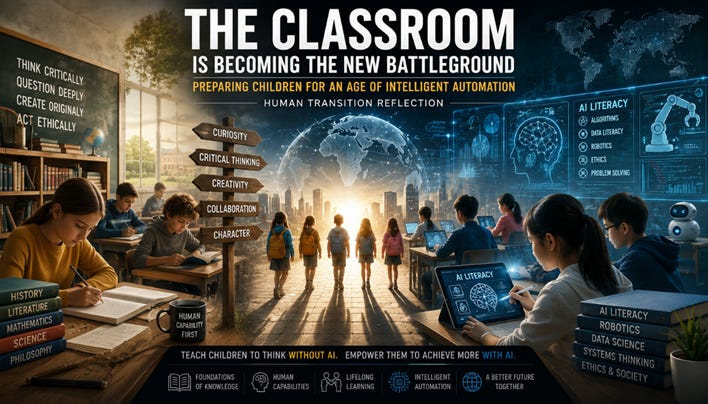
Strategic preparation therefore requires balance. Students should sometimes work without AI so that essential human capacities are strengthened. At other times they should work with AI so that they learn to direct, evaluate and improve its contribution.
The question is not whether artificial intelligence belongs inside or outside the classroom. The question is where, when, why and under whose judgement it should be used.
The emerging educational divide may not ultimately be between China and the West. It may be between societies that prepare deliberately and societies that adapt accidentally.
Deliberate preparation does not require centralised political control. Democratic societies can establish shared national objectives while preserving educational independence, local experimentation and intellectual freedom.
· They can define essential capabilities without prescribing every lesson.
· They can invest in teacher development without turning teachers into agents of technological policy.
· They can protect children from premature dependence while ensuring that they eventually become confident and responsible users, creators and governors of intelligent systems.
The choice is not between China’s model and Western values. The choice is between strategy and drift.
For generations, educational innovation largely flowed from West to East. Today that assumption can no longer be taken for granted. Valuable ideas may emerge from many parts of the world. Studying another country’s educational response is not an endorsement of its political system. It is simply recognising that every civilisation is grappling with the same technological transformation, and each may discover solutions from which others can learn.
There is another important distinction. The educational challenge is not simply teaching children how to use Intelligent Automation. Nor is it protecting them from it. The real challenge is teaching them to master it without becoming dependent upon it.
That is a subtle but profound difference. Children should still learn to write before asking an AI system to improve their writing. They should still develop mathematical reasoning before relying on automated calculations. They should still learn to investigate evidence before accepting computer-generated answers.
Human capability must always come first. Technology should extend that capability—not replace it.
This brings us back to one of the central ideas of the Human Transition. Education is ultimately about developing human agency.
Agency is the capacity to perceive, evaluate alternatives, exercise judgement, make informed decisions and act with purpose and responsibility.
Intelligent Automation will increasingly assist each of those activities. But it cannot replace the human responsibility that accompanies them.
The societies that flourish during the Human Transition will therefore be those that cultivate both forms of capability. The ability to think independently. And the ability to use Intelligent Automation wisely.
These are not competing objectives. They are complementary ones.
The educational challenge of the twenty-first century is not choosing between human intelligence and machine intelligence. It is ensuring that one strengthens the other.
That is why I believe democratic societies should broaden the conversation. The question is no longer whether our children will grow up in a world shaped by Intelligent Automation.
They will.
The real question is whether they will simply consume technologies developed by others—or possess the knowledge, judgement and confidence to shape those technologies themselves.
That choice begins long before young people enter the workforce. It begins in the classroom.
China’s approach should not be romanticised. Its institutional strengths come with political and ethical costs that democratic societies should not accept. But neither should it be dismissed merely because it emerges from a different political system.
The relevant lesson concerns governance capability, not ideology. A society that believes artificial intelligence will transform its economy cannot leave preparation to a handful of enthusiastic teachers, wealthy schools or technology companies. It must determine what every young person should understand, what teachers require to guide them and what protections are necessary to preserve human learning and agency.
The objective is not to produce a generation dependent upon artificial intelligence. Nor is it simply to produce more programmers. It is to prepare people who can understand technological change, participate in it and exercise meaningful influence over how it is used.
That leads to the deeper question behind this series. What are education systems ultimately trying to build?
The answer may be larger than AI literacy. It may be human capability itself.
Next week: Reflection Three: Human Capability as the New National Asset.
Leon Vermeulen is an independent historian and commentator specialising in European memory, conflict, reconciliation and social cohesion.
No posts
Comments
Nothing yet. Say the first thing.
Sign in to join the conversation.