
Published: 25 August 2026
History is often written in a language that softens responsibility. Economic decline becomes an “unexpected consequence.” Institutional weakness becomes an “unforeseen outcome.” Political instability becomes a “development no one could have predicted.”
Sometimes that is true. Often, it is not.
There is an important distinction between an event being unintended and its consequences being unforeseeable. The two are not the same and confusing them has become one of the most convenient habits of modern political analysis.
A government does not have to intend every consequence of a policy to bear responsibility for consequences that were visible, discussed and repeatedly warned about before the policy was adopted.
That distinction matters because many of the crises now confronting Western societies did not emerge from nowhere. They developed along pathways that economists, diplomats, industrialists, military analysts and social scientists had identified years earlier.
The issue is not whether anyone intended the present outcome. The issue is whether enough people knew where the road was likely to lead.
Warnings Are Not Predictions
No serious analyst claims to predict history with certainty. Complex systems do not permit that. But governments are not judged by whether they possess perfect foresight. They are judged by whether they recognise material risks and prepare for them.
There is a profound difference between saying: “No one could have known.” and saying: “We knew this was a serious possibility, but believed the benefits outweighed the risks.”
The first removes responsibility. The second accepts it.
Too often, public debate retrospectively collapses these two very different statements into one.
· Before Europe’s energy crisis, analysts warned that replacing cheap pipeline gas with imported LNG would raise industrial costs and expose the continent to greater volatility.
· Before sanctions regimes expanded, economists warned that major powers would seek alternative payment systems, diversify reserves and reduce dependence on Western financial infrastructure.
· Before prolonged confrontation hardened into strategic rivalry, diplomats warned that once security relationships, industrial investment and political identities reorganised around conflict, returning to the previous order would become increasingly difficult.
None of these warnings guaranteed what followed. They established that the outcomes were foreseeable risks. That is enough to make them relevant to questions of responsibility.
The Architecture of Foreseeable Consequences
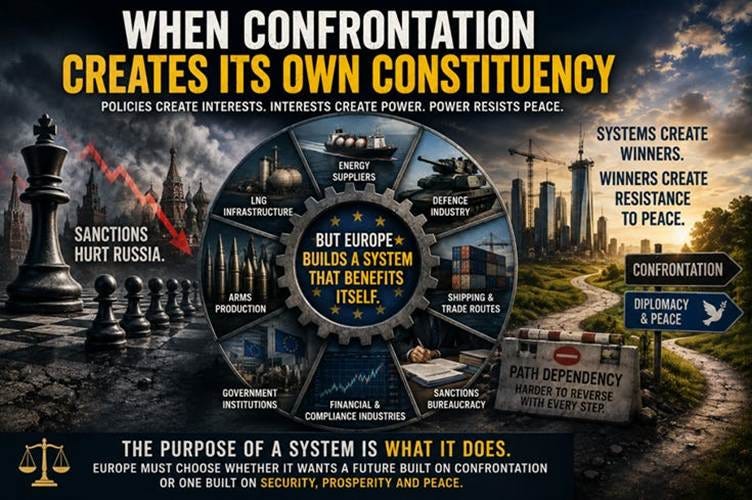
Policies rarely produce only their immediate effects. They create chains.
· A decision to impose restrictions creates incentives.
· Incentives change investment.
· Investment creates infrastructure.
· Infrastructure produces institutions.
· Institutions develop constituencies.
· Constituencies defend the new arrangement.
Eventually, the consequences of the original decision become embedded in the structure of the economy and the state. At that point, observers often describe the result as though it had emerged organically.
It did not. It emerged through a sequence of choices.
This does not mean every step was planned in advance. History is far messier than that. It means that once governments repeatedly choose among known risks, the resulting trajectory cannot honestly be described as entirely accidental. The architecture may have evolved. The foundations were still laid.
Responsibility Without Conspiracy
This is where public debate often breaks down. Raise the question of whether policymakers should have anticipated consequences and someone immediately hears an accusation of conspiracy. That is unnecessary. Institutions do not need secret coordination to produce predictable outcomes.
· Governments respond to incentives.
· Bureaucracies protect mandates.
· Industries defend investments.
Political leaders prefer policies that are easier to explain than to reverse. Each actor may behave rationally within their own sphere. The aggregate result can still be profoundly damaging.
Economists have understood this for generations. Markets produce externalities without anyone intending them. Organisations become path-dependent without anyone designing the trap. Political systems drift because incentives reward short-term decisions.
Responsibility therefore does not require proof of intent. It requires evidence that significant risks were known and insufficiently addressed. That is a much higher standard than conspiracy. It is also a much more useful one.
The Question Governments Avoid
There is a question every serious democracy should ask after a major strategic failure:
What did we know, when did we know it, and why did we decide that the risks were acceptable?
Instead, governments often conduct reviews that focus on implementation.
· Could the policy have been communicated better?
· Were the regulations clear enough?
· Did agencies coordinate effectively?
These questions matter. But they can leave the central issue untouched.
· Was the underlying strategy sound?
· If warnings existed, were they considered?
· If alternative courses were available, why were they rejected?
· If the same policy were proposed today, with everything now known, would the government still choose it?
Those questions are harder because they examine judgment rather than administration. And judgment is where political accountability ultimately resides.
From Foreseeability to Accountability
Democratic governments cannot guarantee outcomes. No government can. But they can be expected to distinguish between low-probability speculation and repeatedly identified strategic risks.
When experts from different disciplines independently warn about similar vulnerabilities—energy dependence, industrial competitiveness, financial fragmentation, demographic pressure or institutional rigidity—the warnings deserve more than a footnote. They deserve to shape contingency planning.
If those risks later materialise, it is misleading to describe them simply as accidents. The better description is often:
They were not inevitable. But neither were they unforeseeable.
That distinction is not semantic. It determines whether societies learn from failure or merely wait for the next crisis.
The Deeper Problem: Capability to Foresee
There is an uncomfortable implication here. If governments repeatedly fail to act on foreseeable risks, the problem may not be individual mistakes alone. It may indicate a deeper erosion of governing capability.
Modern states possess more data than any governments in history. They have intelligence agencies, central banks, research institutes, universities and specialist departments devoted to identifying emerging risks. Yet they often appear less able to translate warning into preparation.
· Information is not the same as foresight.
· Foresight is not the same as decision.
· And decision is not the same as execution.
This is precisely the capability chain that increasingly appears to be breaking down. Governments often know more than they can act upon. They receive warnings they cannot politically absorb. They recognise long-term risks while operating inside short-term electoral incentives.
The result is a strange paradox of modern government: unprecedented analytical capacity combined with repeated strategic surprise. Perhaps the surprise lies not in the event itself, but in the failure to prepare.
Foreseeable Is Not the Same as Accidental
History should be humble about claims of certainty. Few events are inevitable. But humility should not become an escape from responsibility.
· A consequence can be unintended and still foreseeable.
· A crisis can emerge without conspiracy and still reflect years of ignored warnings.
· A policy can be adopted in good faith and still prove to have been strategically unsound.
Recognising these distinctions does not make political debate more cynical. It makes it more honest. Because the real lesson of path dependence is not that governments are powerless once events begin to unfold. It is that choices made early shape the range of choices available later. And the lesson of institutional interests is not that every crisis is manufactured. It is that once a system adapts to a crisis, reversing course becomes progressively harder.
The final lesson is therefore about accountability.
If societies wish to avoid repeating the same strategic errors, they must stop asking only whether leaders intended the outcome. They must also ask whether they were warned, whether they understood the risks, and whether they possessed the governing capability to choose a different path.
History may forgive uncertainty. It should be much less forgiving of the repeated failure to distinguish the unforeseeable from the merely inconvenient.
Foreseeable is not the same as accidental.
And in democratic government, that difference is where responsibility begins.
Leon Vermeulen is an independent historian and commentator specialising in European memory, conflict, reconciliation and social cohesion.
No posts
Comments
Nothing yet. Say the first thing.
Sign in to join the conversation.