
For the Global South, real energy sovereignty does not require reproducing every stage of China’s clean-technology supply chain. It begins with owning domestic generation assets, controlling the grid and dispatch system, and developing the engineers, maintenance networks, spare-parts access and alternative suppliers needed to keep equipment operating through external disruption. Local manufacturing should then be built selectively around the technologies that matter most for system control, frequent replacement and wider industrial learning. A country can import most of its solar panels and still become more energy sovereign; the decisive question is whether it controls the system those panels are building.
This essay is part of Global Energy System and Critical Mineral Series.

Huangshan (黄山), Liu Haisu (刘海粟), 1988.
A luminous vision of mountains, clouds and shifting colour — a fitting image for an essay about how imported clean-energy equipment can take root in a local landscape and become long-lived domestic productive capacity.
In my first essay (Europe’s Stalled Electrification and China’s Electric Economy) of this mini-series about Energy Autonomy of the Global South, I made a simple distinction that is often lost in debates over energy dependence. Imported oil and gas are consumed and must be bought again; imported solar panels, batteries and other clean-energy equipment can become productive assets inside the importing country, generating power for years after the original trade transaction is over. For the Global South, that difference matters enormously: scarce foreign exchange can either keep financing recurring fuel imports or be converted into domestic energy capacity.
The second essay, Europe’s Stalled Electrification and China’s Electric Economy took the argument one step further. Building clean power is only half the transition. Unless transport, buildings and industry increasingly run on electricity, much of the economy remains tied to imported oil and gas. China’s experience shows how generation, grids, storage and end-use electrification can reinforce one another, allowing domestic electricity to penetrate progressively deeper into the economy.
That leaves a harder question. If imported clean-energy equipment can strengthen domestic energy capacity, and electrification can extend that capacity across the economy, what does genuine energy sovereignty actually require? Must developing countries reproduce entire clean-technology supply chains at home? Or does sovereignty rest more fundamentally on who owns the assets, controls the system, keeps it operating through disruption and decides where scarce industrial capital should be deployed?
Since the Russian gas crisis, Europe has increasingly tied energy security to clean-technology manufacturing. Under the EU’s Net-Zero Industry Act, domestic manufacturing capacity for strategic net-zero technologies is expected to approach or meet 40% of annual deployment needs by 2030. Solar panels, batteries, wind equipment and grid technologies have moved beyond climate policy into debates over industrial security, employment and strategic autonomy.
The concern is well founded. China supplies much of the world’s solar manufacturing capacity and holds still larger shares in several upstream stages. Lithium-ion battery supply chains are similarly concentrated. Export restrictions, geopolitical conflict or severe supply disruption could raise equipment costs, delay projects and slow the expansion of energy capacity in importing countries. Europe has sound reasons to diversify supply, retain key technologies and rebuild parts of its manufacturing base.
The problem lies in how autonomy is measured. Domestic manufacturing content is increasingly treated as a proxy for strategic independence, even though the resilience of an energy system depends on far more than the origin of its equipment.
A country may import most of its solar panels while owning and controlling its power plants, grids, storage assets, dispatch systems and engineering capabilities. Another may manufacture large volumes of energy equipment while remaining dependent on foreign fuels, critical software, control systems or operating services.
Domestic manufacturing can strengthen energy sovereignty. It cannot define it on its own.
Industrial policy also involves trade-offs. Tariffs, local-content rules and import restrictions may create space for domestic producers, but they can also raise the cost of solar, storage and other clean technologies, slowing the construction of new energy assets. Europe could increase the local share of selected technologies while extending the role of imported oil and gas in its energy system.
A policy designed to increase technological autonomy can weaken energy autonomy if it slows the construction of domestic energy capacity.
The relevant unit of analysis is the energy system as a whole. After an external disruption, can power still be generated? Can the grid remain stable? Can equipment be repaired and replaced? Can new projects continue to be built?
Ownership and control come first. Who owns the generating assets, grids, storage facilities and transmission infrastructure? Who manages dispatch, system data and critical control software? Can domestic institutions make investment, operating and expansion decisions without relying on external actors?
Solar modules may be manufactured abroad. Once installed in a domestically owned project and connected to a nationally controlled grid, however, they become part of the country’s energy base. The location of manufacturing and the location of energy capacity are separate questions.
Imports provide the capital equipment. Control determines how the assets operate, whom they serve and how they fit into the wider energy system.
Ownership turns imported equipment into domestic assets. System control turns those assets into national energy capacity.
A country may possess substantial manufacturing capability and still operate a fragile energy system if its grid is unreliable, dispatch capacity is weak or operating control lies elsewhere. Conversely, generation built with imported equipment can provide durable domestic supply when the assets are locally owned, nationally controlled and integrated into a resilient system.
Yet infrastructure does not run itself for decades.
Solar modules may last twenty-five or thirty years, but inverters require replacement. Wind turbines need maintenance and spare parts. Batteries degrade. Transformers need servicing. Control software must be updated. Grids have to expand as demand grows.
Turning imported equipment into domestic assets is therefore only the beginning. Long-term resilience also depends on engineers, system operators, maintenance networks, spare-parts inventories, software expertise and access to alternative suppliers.
The important distinction is not simply between domestic and imported equipment. Greater vulnerability often comes from single-source dependence, proprietary standards and critical components that cannot be substituted. An import-dependent system with several suppliers, compatible technical standards, local repair capacity and adequate inventories may be highly resilient. A system with a high domestic-content ratio may still contain serious weaknesses if core software, specialised components or operational expertise depend on one external provider.
Imported equipment becomes resilient infrastructure when it can be operated, repaired, upgraded and replaced locally without dependence on a single foreign supplier.
Operating capability turns equipment into infrastructure. Maintenance and replacement capacity determine whether that infrastructure can survive supply shocks, technological change and equipment ageing.
This is where industrial policy matters—but selectively.
Solar glass, wafers, modules, inverters, batteries, grid software, transformers and control chips do not carry the same strategic weight. Some products are easy to stockpile and available from several countries. Others sit close to the control of the power system and are difficult to replace once supplies are interrupted. Some technologies create large spillovers into the wider manufacturing economy.
The task is to identify genuine points of systemic risk: where a single failure could disable the system, which technologies affect dispatch and control, which components require frequent replacement, which supplies would be difficult to restore during a crisis, and which industries fit the country’s market size and existing industrial base.
Domestic production is only one policy instrument. Diversified imports, strategic inventories, regional supply, technology licensing, local repair capability, joint research and interoperable standards can all improve resilience.
A high domestic-content ratio does not automatically produce energy sovereignty. Heavy dependence on imported equipment does not automatically make an energy system fragile.
A country may import most of its solar modules and still possess a robust energy system if it owns the assets, controls the grid, maintains the equipment locally and can obtain replacements from several suppliers. Another may export large volumes of energy equipment while remaining vulnerable because critical fuels, control software, cybersecurity or system operation depend on outside powers.
Strategic autonomy should be assessed at the level of the energy system, not the individual product.
This distinction matters most for the Global South.
Most developing countries neither need nor can afford to build complete domestic supply chains spanning polysilicon, wafers, battery materials, cells, wind turbines, power semiconductors and every category of grid equipment. Replicating an entire clean-technology industrial base requires a very large home market, deep pools of capital, accumulated engineering expertise and sustained industrial policy. For many countries, pursuing full supply-chain self-sufficiency too early would raise energy costs and delay urgently needed investment in generation and grids.
A more practical route is to use global manufacturing capacity to build a domestic energy system.
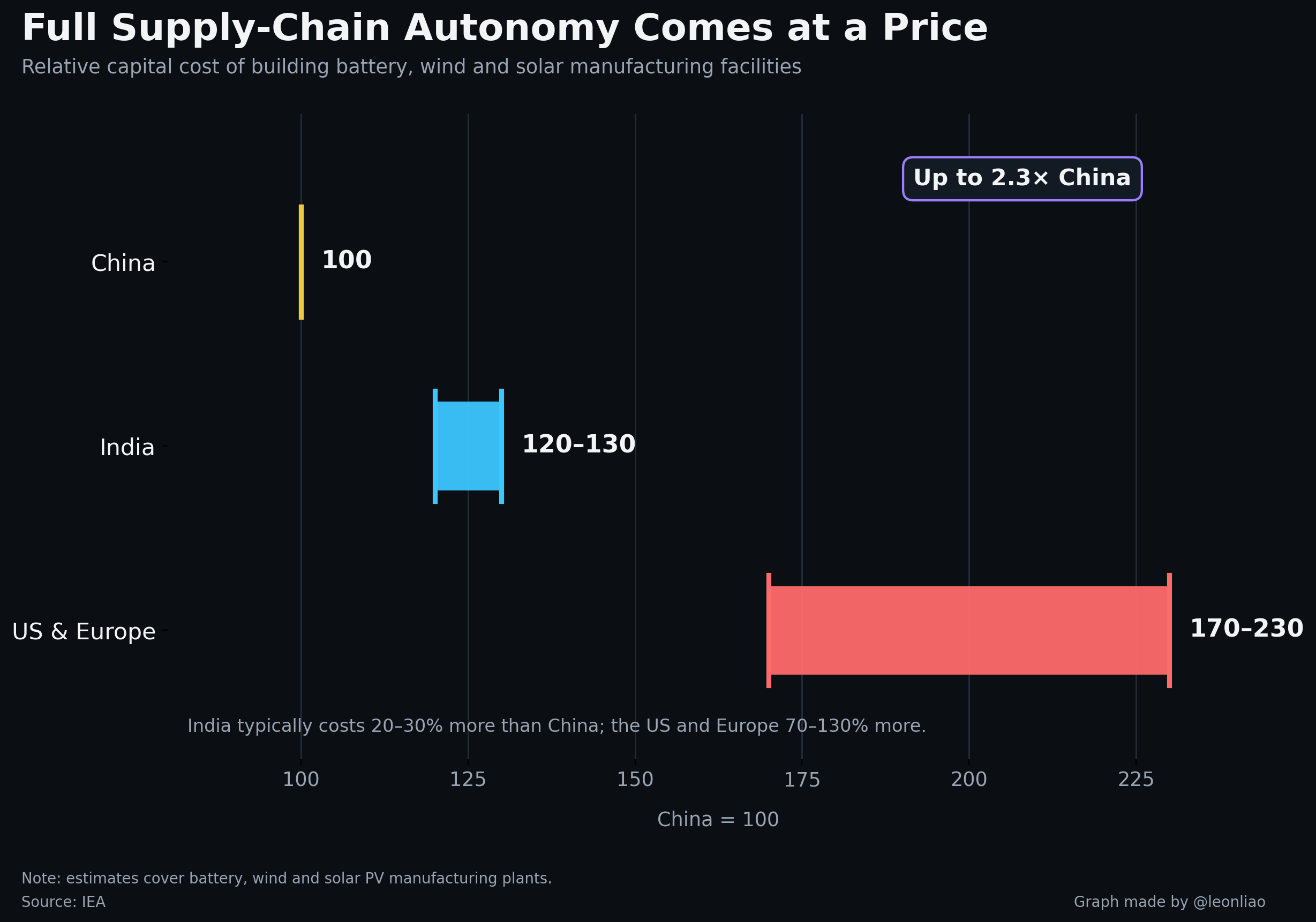
The capital penalty can be formidable. IEA analysis of more than 750 manufacturing facilities found that battery, wind and solar plants typically cost 20–30% more to build in India than in China, and 70–130% more in the United States and Europe. For countries with scarce capital and underdeveloped grids, attempting to reproduce an entire clean-technology supply chain can absorb funds that might otherwise finance generation, storage and transmission. Every country needs some domestic industrial capability. The difficult question is which capabilities deliver the most resilience for each dollar invested.
Low-cost solar panels, batteries, inverters and other core technologies can be imported. Domestic capability can initially concentrate on project development, construction, grids, system integration, dispatch, operations, maintenance and local repair. These functions often matter more to the reliability of the energy system than module assembly itself.
Local manufacturing can grow from sectors that fit the existing industrial base: mounting structures, cables, steel components, transformers, distribution equipment and engineering services. As the domestic market expands and firms accumulate experience, they can move into more sophisticated technologies and manufacturing stages.
For most developing countries, workable strategic autonomy will come from controlling the energy system while building industrial capability selectively around it.
Imported equipment, domestic control and local industry are complementary. Imports reduce infrastructure costs and accelerate the expansion of generating capacity. Domestic engineering and operating systems embed those assets in the local economy. Selective manufacturing strengthens supply resilience and turns energy investment into industrial learning.
The balance will vary. Large economies can support more domestic production. Smaller countries may rely more heavily on regional supply chains. Resource-rich states can concentrate industrial capability in areas where they possess genuine advantages. The common objective is not to manufacture every component within national borders. It is to preserve energy supply, maintain existing infrastructure and continue adding capacity when external conditions become less favourable.
The strongest systems will usually combine domestic ownership, national control, local engineering, diversified supply and selective manufacturing. The proportions will differ from country to country. The tests are simpler:
Can energy keep flowing?
Can equipment remain in operation?
Can failures be repaired?
Can new generating and grid capacity still be built?
Energy sovereignty ultimately rests on the ability to control the system, endure disruption and keep building.
If this framework helps you understand China, industrial power, state capacity, capital, technology, and global order beyond the usual headlines, please consider subscribing to China as a System.
A like, restack, comment, or share also helps this work reach more readers.
For a full guide to the publication and its main research series, start here: China as a System: Publication Map.
No posts
Comments
Nothing yet. Say the first thing.
Sign in to join the conversation.