
The dollar does not need to lose its reserve-currency status for America’s exorbitant privilege to weaken. The more plausible shift is not a collapse in the dollar’s reserve share from 58% to 20%, but a world in which the United States must offer 4.5%, 5% or even higher Treasury yields to attract enough capital to absorb its expanding debt supply.
The dollar can remain central to the global financial system for decades, and Treasuries can remain the world’s premier safe asset, while the institutional advantage that once lowered America’s borrowing costs gradually erodes. The signal worth watching may not be the dollar’s share in IMF reserve data, but a more subtle market shift: Treasury yields rising while the dollar fails to strengthen.
This essay is part of America Unpacked.

于非闇《临赵佶〈御鹰图〉》
Yu Fei’an, After Emperor Huizong of Song’s Imperial Eagle, 20th century
In the first article of this series, I examined why America’s fiscal imbalance is shifting from a cyclical problem toward a structural high-deficit regime.
The second article then asked the next question: who will absorb the growing mountain of Treasury debt? America still possesses the world’s strongest financing capacity, but that financing increasingly depends on investors who care about risk-adjusted returns, rather than official institutions that must hold dollars as reserves.
That naturally leads to the dollar system itself. For decades, the greatest benefit America derived from issuing the world’s reserve currency was not some mysterious ability to print unlimited money. It was the ability to borrow at enormous scale while paying unusually low risk premiums because the rest of the world actively wanted dollar assets. That privilege has not disappeared. The terms on which it operates are changing.
The debate over the dollar’s future often starts in the wrong place. The issue is not who will replace the dollar, but something more fundamental:
How much will America have to pay to preserve the same financial advantage it has enjoyed for decades?
The phrase “exorbitant privilege” was coined by French Finance Minister Valéry Giscard d’Estaing in the 1960s to describe the unique international role of the U.S. dollar. Over time, however, the term has become increasingly politicised, often reduced to the idea that America can run persistent deficits, issue dollars without constraint, and shift the cost onto the rest of the world.
That description captures part of the outcome, but it does not explain the mechanism.
The real privilege granted by the dollar system is that the world actively wants the liabilities America creates. Central banks need dollars as reserves. Global traders need dollars for settlement. Banks need dollar liquidity. Pension funds and insurers need safe assets such as Treasuries. The repo market relies on government bonds as collateral. This structural demand allows the United States to borrow at risk premiums far below those faced by ordinary high-debt economies.
The essence of the exorbitant privilege is therefore a cost-of-capital advantage.
The essence of the exorbitant privilege is therefore not that U.S. yields are always the lowest in the world. Japan and Germany have often had lower nominal government bond yields because of their own economic conditions and monetary regimes.
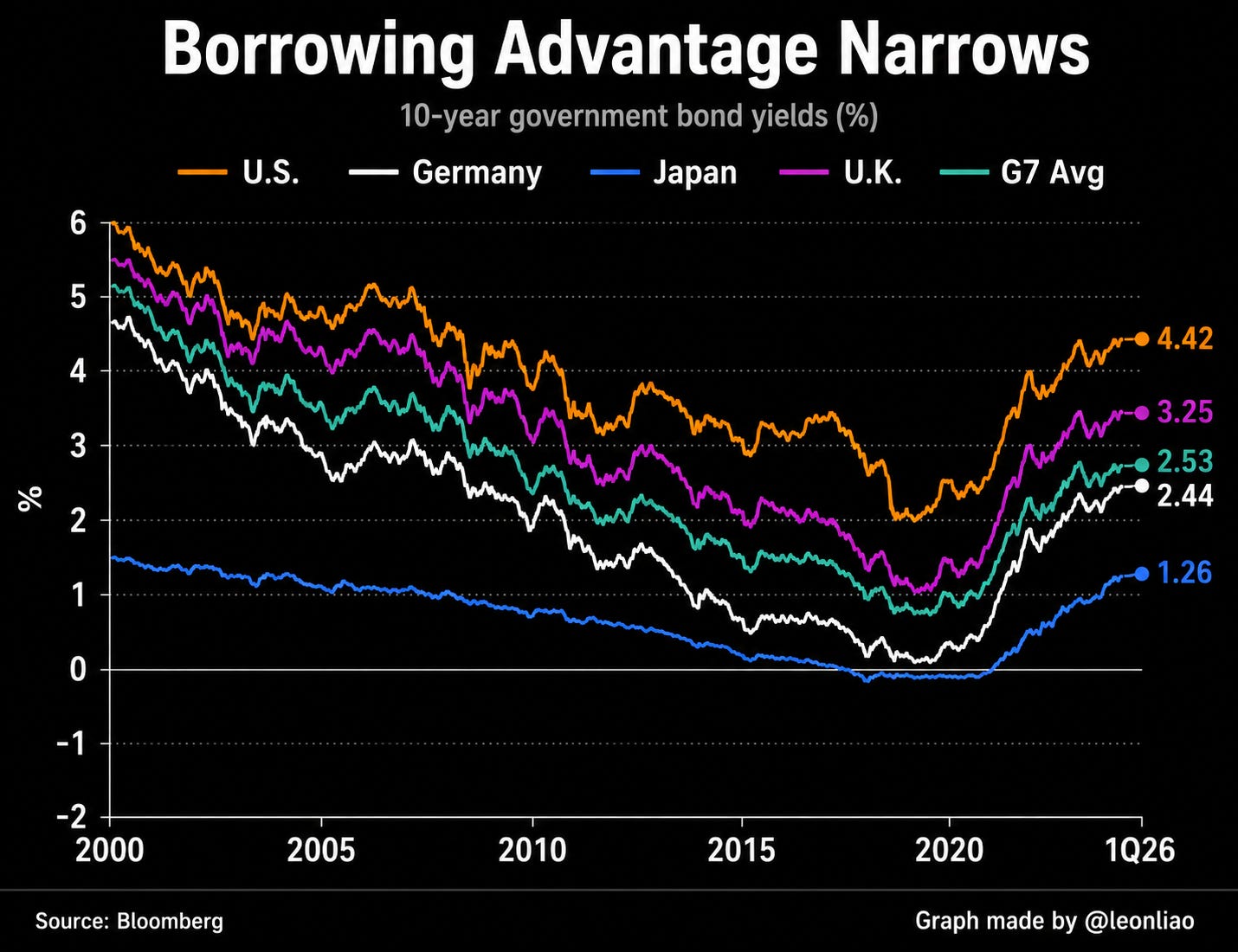
The deeper advantage is that the United States can borrow at much lower risk premiums than its fiscal position would normally imply. The liabilities it issues are themselves among the most important assets in global finance.
America can sustain a much larger debt burden than most countries because global investors demand the assets it creates. Even as the United States ran persistent current-account deficits and accumulated a larger net international liability position, investors remained willing to hold Treasuries with exceptionally low term premiums.
The 2010s represented an unusually favourable environment for this privilege. Low inflation, near-zero policy rates, foreign reserve accumulation and Federal Reserve quantitative easing all worked in the same direction, compressing long-term yields. Treasury issuance expanded continuously, yet investors did not demand substantially higher compensation for holding duration risk.
That environment has changed.
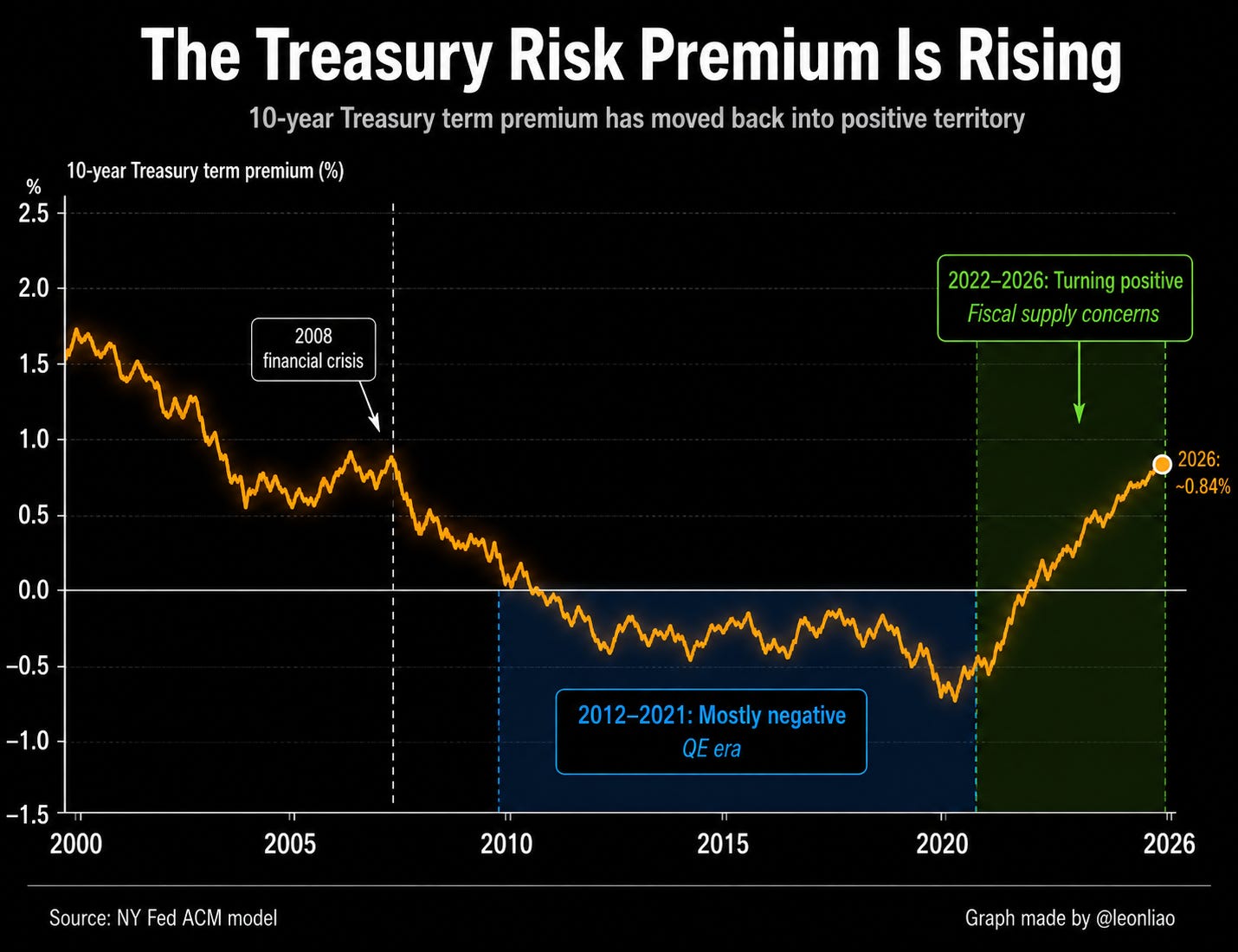
Debt levels are higher. Fiscal deficits are larger. Inflation has returned to market pricing. The Federal Reserve is no longer expanding its balance sheet. Foreign official demand is growing much more slowly than Treasury supply.
The United States remains far from a traditional sovereign funding crisis. It retains the deepest capital markets in the world and the most liquid government bond market ever created. But the old combination — more debt accompanied by lower financing costs — is becoming increasingly difficult to sustain.
America’s privilege has not disappeared. The financing discount is shrinking.
If we look only at global foreign-exchange reserves, the dollar is clearly less dominant than it was at the turn of the century, when it accounted for more than 70% of allocated reserves. Today, its share is closer to 60%. That shift is real. But using it as evidence that “dollar dominance is fading” explains very little about the actual structure of global finance.
The dollar’s role extends far beyond central-bank reserves. Cross-border payments, foreign-exchange trading, offshore lending, international bond issuance, trade finance and derivatives markets all remain deeply dollar-based. In many critical parts of the financial system, the dollar’s influence is even greater than its share of official reserves reported through COFER data.
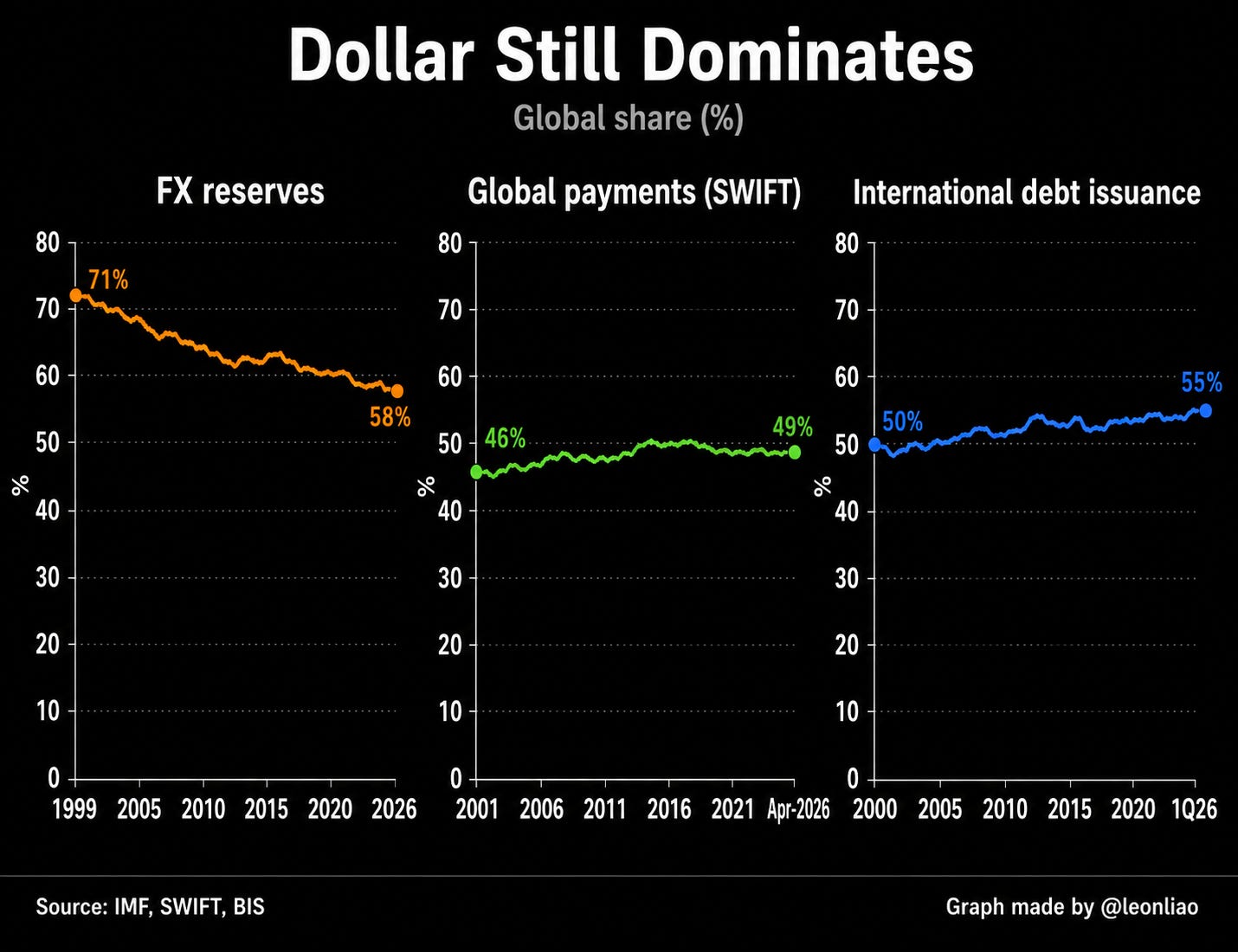
This is the limitation of the conventional de-dollarisation narrative. A country can reduce the dollar share of its reserves while continuing to price its exports in dollars. A company can increase its borrowing in renminbi or euros while still managing its global balance sheet through dollar markets. A central bank can accumulate more gold while still relying on dollar swap lines during a liquidity crisis.
The true foundation of dollar power is not a single reserve-share chart. It is the world’s largest, deepest and most liquid network of dollar-denominated assets. Funding depth explains monetary power better than reserve share alone.
Precisely because the dollar system remains so powerful, the current shift deserves closer attention. The dollar has not lost its central role, and global capital has not stopped buying U.S. assets. The change is occurring somewhere more subtle:
The yield required to maintain this system is rising.
Foreign investors’ holdings of U.S. securities have expanded steadily over the past two decades. These holdings include not only Treasuries, but also Agency MBS, corporate bonds, equities and other dollar-denominated assets. The U.S. capital market remains one of the world’s most important destinations for global savings, and no other economy can currently offer the same combination of safe assets, credit assets and risk assets at comparable scale.
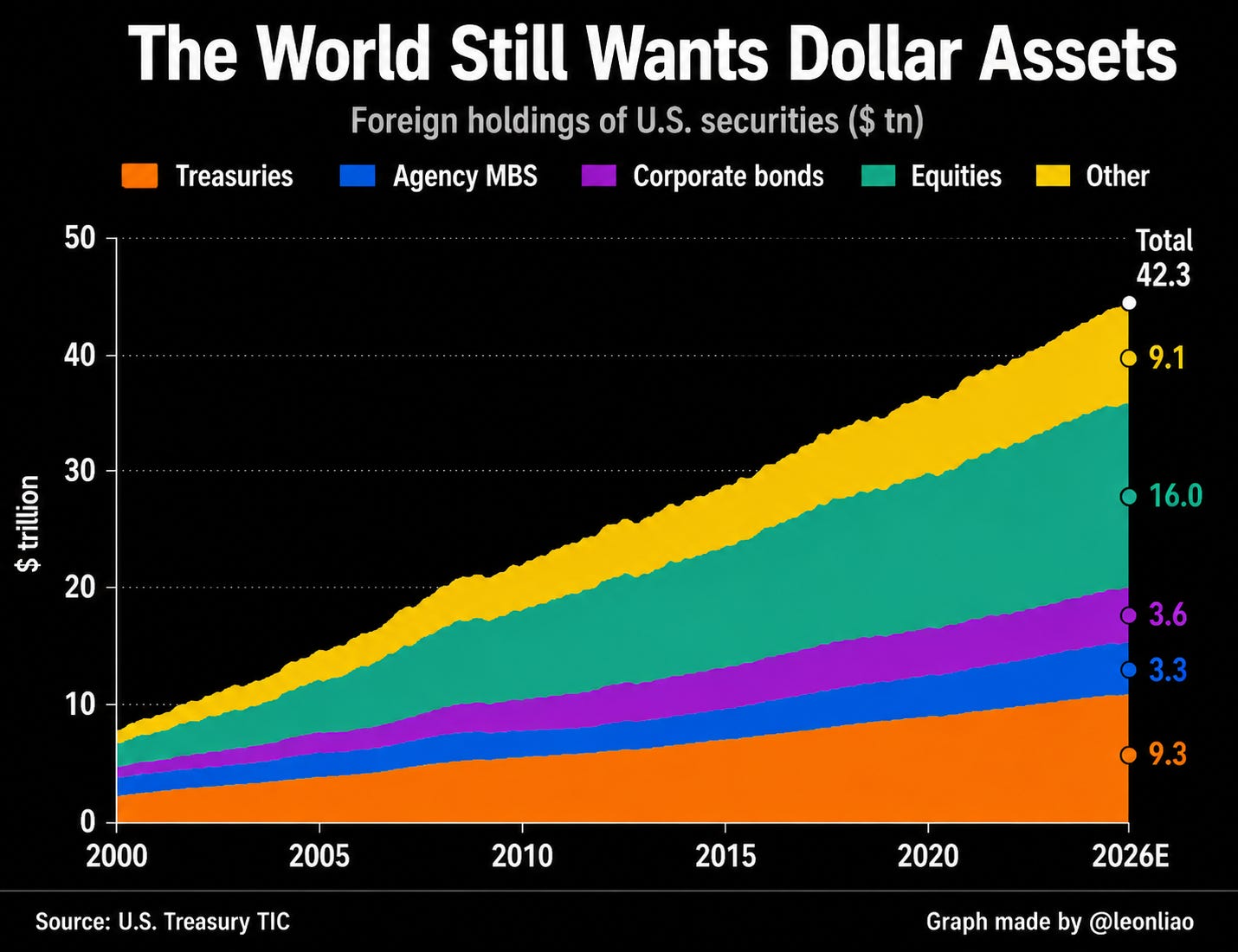
The true moat of the dollar system is therefore not the currency itself, but the capacity of the U.S. asset market. Europe has deep capital markets, but it lacks a unified sovereign safe asset comparable in scale and liquidity to the Treasury market. China has the world’s second-largest economy and a vast domestic bond market, but its capital account remains only partially open.
Replacing the dollar would require more than creating another currency. It would require building tens of trillions of dollars’ worth of assets that global investors can access freely, exit quickly, use as collateral and trade at enormous scale.
The tension is built into the system itself. The more the world needs dollar assets, the more dollar assets America has to provide — and the largest source of global safe dollar assets is the Treasury market. For decades, this demand helped suppress U.S. borrowing costs. But as Treasury issuance begins expanding by trillions of dollars each year, while the balance sheets of traditional official buyers cannot expand at the same pace, the same dollar system begins imposing a different constraint:
The assets still attract buyers. The price, however, has to rise.
The dollar system of the past several decades operated through a powerful cycle: the world needed dollars, global investors therefore needed Treasuries, strong structural demand compressed U.S. borrowing costs, and lower financing costs gave Washington greater fiscal flexibility. That cycle has not broken. But the marginal economics behind it are changing.
As discussed in the previous article, the composition of Treasury buyers is shifting. Foreign central banks still hold trillions of dollars of U.S. government debt, and the Federal Reserve still owns a massive Treasury portfolio. But incremental Treasury supply is increasingly being absorbed by money-market funds, mutual funds, banks, insurers, households and other private investors.
The difference is fundamental. Foreign central banks buy Treasuries because they need reserve assets. The Federal Reserve buys Treasuries because it conducts monetary policy. Private capital, however, starts with a different question:
Is the yield sufficient for the risk?
That difference changes the nature of America’s fiscal advantage. The United States does not need to lose reserve-currency status for its privilege to weaken. There does not need to be a collapse in foreign demand or a sudden flight from dollar assets.
The adjustment can happen through price. Treasury yields can rise. The term premium can rise. The government can continue finding buyers. But attracting those buyers becomes more expensive.
This distinction separates a realistic future scenario from the popular but misleading idea of a dollar crisis. The dollar can remain the world’s dominant currency. Treasuries can remain the world’s preferred safe asset. Yet the United States can still discover that preserving this system requires a much higher fiscal carry cost.
The privilege remains. The discount is shrinking.
For decades, markets followed a relatively stable relationship: when Treasury yields rose, the dollar usually strengthened as well. The logic was straightforward. Stronger U.S. growth pushed up expectations for interest rates, while a more hawkish Federal Reserve increased the return on dollar assets relative to assets denominated in other currencies, attracting capital toward the United States. Under this framework, higher Treasury yields represented stronger demand for U.S. assets.
A different regime, however, would tell a very different story:
Treasury yields ↑ + USD ↓
If this combination appears only briefly, it does not necessarily indicate a structural change. Exchange rates are influenced by many factors, including global growth expectations, risk appetite, and monetary policy in Europe and Japan. But if this relationship persists, especially alongside a rising term premium and weakening foreign official demand, the market’s interpretation of higher yields may be changing. Rising yields would no longer mainly reflect stronger growth or tighter monetary policy, but instead concerns about fiscal supply, duration risk and the additional compensation investors demand for holding U.S. government debt.
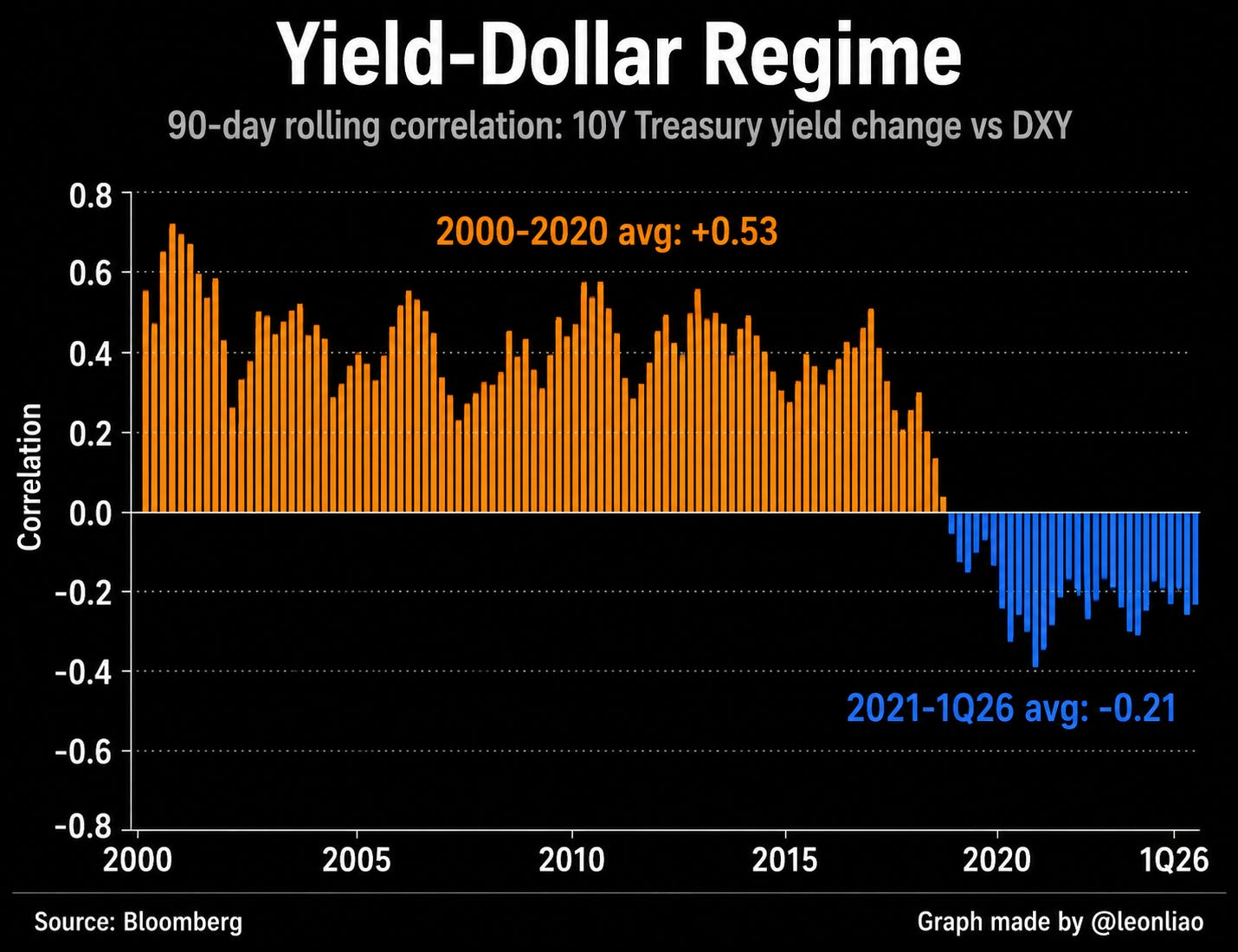
This is the new Yield-Dollar Regime. Rather than repeatedly debating what it means if the dollar’s share of global reserves falls from 58% to 56%, a more revealing question is whether higher yields can still generate stronger demand for the dollar. If Treasury yields and the DXY remained broadly positively correlated from 2000 to 2020, but that relationship weakened significantly or even turned negative after 2021, it would suggest a question worth monitoring closely:
Higher yields may no longer be an unambiguous vote of confidence in the dollar.
The real danger is not that nobody buys Treasuries. It is that investors continue buying them, but demand increasingly higher yields, while the dollar no longer receives the same support in return. That would mean the United States is paying a higher price to maintain the same level of global financial attraction.
Comments
Nothing yet. Say the first thing.
Sign in to join the conversation.