
America has not lost its buyers. It is changing them. For two decades, foreign reserve accumulation and Federal Reserve quantitative easing gave Washington two enormous classes of creditors that were relatively insensitive to price. Both are now less important. Money-market funds, mutual funds, households, banks and other private investors are taking more of the load. America’s capital markets are deep enough to sustain that shift for a long time. But private capital has one habit central banks do not: it demands to be paid.
This essay is part of America Unpacked.

White Eagle《白鹰图》Yu Fei’an 于非闇 (1900–1959)
In the first part of this series, America Never Locked In Low Rates, I argued that America’s fiscal problem is becoming structural. Large deficits are persisting even near full employment, interest costs are rising rapidly, and an ageing population is pushing mandatory spending higher. The old assumption that growth and low rates would quietly stabilise the debt burden is becoming much harder to defend.
But debt does not finance itself. Every dollar of deficit ultimately creates another Treasury security that somebody has to hold. That leads to the next question—and, in some ways, the more important one:
Who is going to absorb an ever larger supply of U.S. government debt, and at what price?
Every day, the U.S. Treasury sells billions of dollars of new debt while rolling over securities that mature almost continuously. The process is so routine that markets treat it as part of the plumbing of global finance.
The scale, however, has changed fundamentally. By the first quarter of 2026, marketable Treasury securities outstanding had reached $30.64 trillion, roughly $2.2 trillion more than a year earlier. In the first quarter alone, the annualised increase in marketable Treasury liabilities exceeded $2.1 trillion.
America has entered what might be called a permanent refinancing machine. The Treasury is dealing with far more than an annual deficit of roughly $2 trillion. Behind that deficit sits a stock of more than $30 trillion in Bills, Notes, Bonds, TIPS and FRNs, constantly maturing and constantly being replaced. As the stock grows, so does the amount that has to be rolled over. Large deficits then add fresh borrowing on top of that refinancing burden.
America does not occasionally need to find somebody willing to lend it money. It needs the global financial system to keep expanding its Treasury balance sheet.
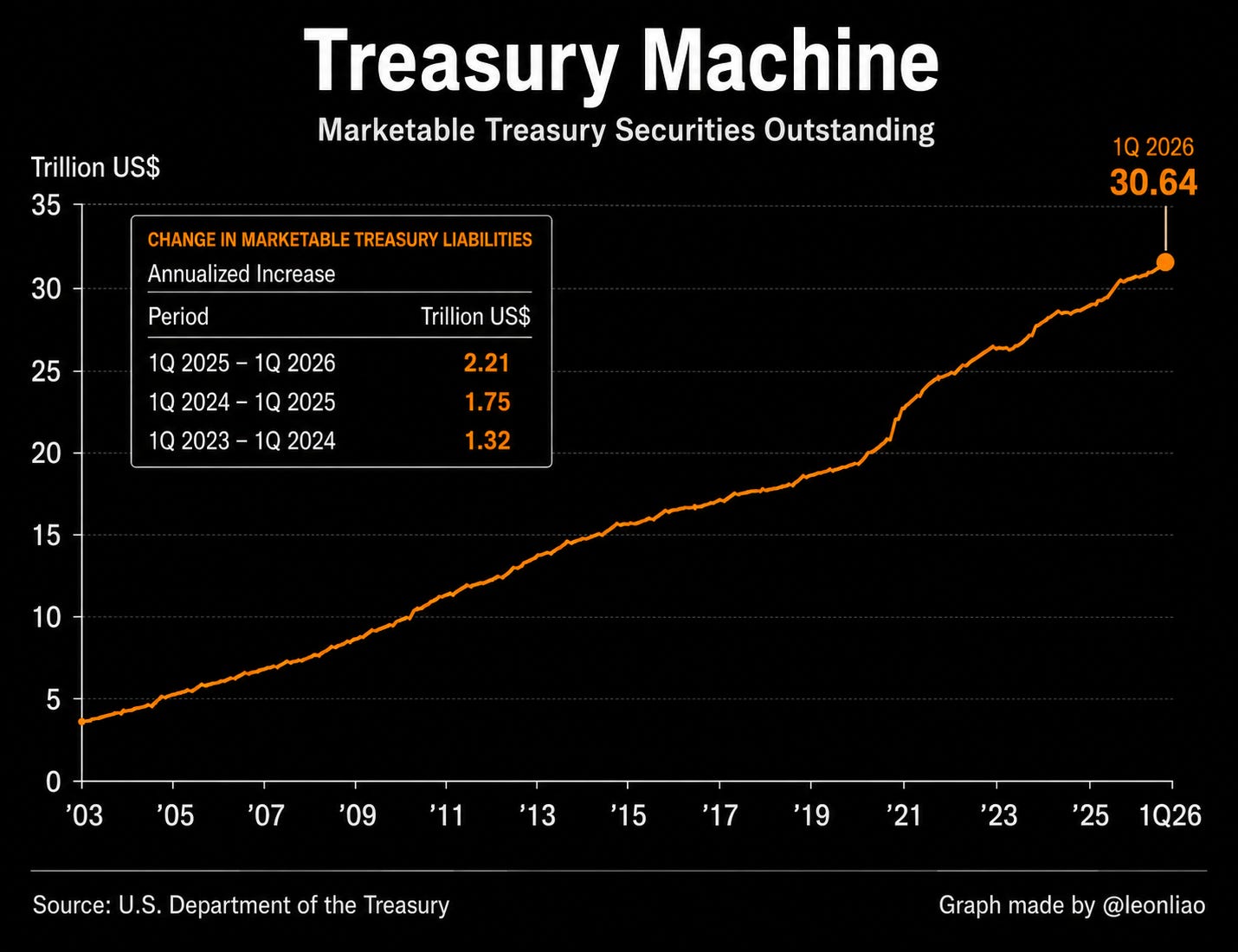
This is why so much discussion of American debt starts with the wrong question. A country that issues the world’s principal reserve currency, runs the deepest capital market on earth and borrows overwhelmingly in its own currency is unlikely to wake up one morning and discover that nobody will buy its debt. Treasury auctions can clear at many different prices.
That is the point. America’s binding constraint is increasingly the price of money.
At a high enough yield, buyers will appear. The important questions are who absorbed the debt over the past several decades, who is absorbing it now, and what happens when the nature of those buyers changes.
From the closing decades of the twentieth century through the aftermath of the global financial crisis, the United States enjoyed an unusually favourable financing regime. China, Japan, other Asian surplus economies and major oil exporters accumulated vast current-account surpluses and recycled much of their growing stock of dollar reserves into U.S. Treasuries. American consumption and investment generated trade deficits; dollars flowed abroad; foreign central banks then lent a large share of those dollars back to the United States.
The loop was simple: America exported dollars, and the world lent them back.
These buyers were fundamentally different from ordinary asset managers. Foreign central banks did not buy Treasuries solely because they offered the highest risk-adjusted return. They needed to manage exchange rates, hold liquid reserves, preserve access to dollar liquidity and own an asset large enough to be sold quickly during periods of stress. The Bank of Japan, the People’s Bank of China or the Monetary Authority of Singapore does not rebuild its reserve portfolio because the 10-year Treasury yield moves by 20 basis points.
For Washington, this was an extraordinarily valuable class of price-insensitive buyers.
After 2008, the United States acquired a second one: its own central bank. As quantitative easing became a conventional policy instrument, the Federal Reserve’s balance sheet expanded from less than $1 trillion before the financial crisis to almost $9 trillion at the pandemic peak. The Treasury issued debt; the Fed bought Treasuries in the secondary market. The transactions were institutionally separate, but the economic result was straightforward: a large volume of Treasury supply ended up on the central bank’s balance sheet.
For much of the post-2008 period, foreign reserve accumulation and QE were both suppressing the term compensation investors demanded on U.S. government debt.
Those conditions are fading.
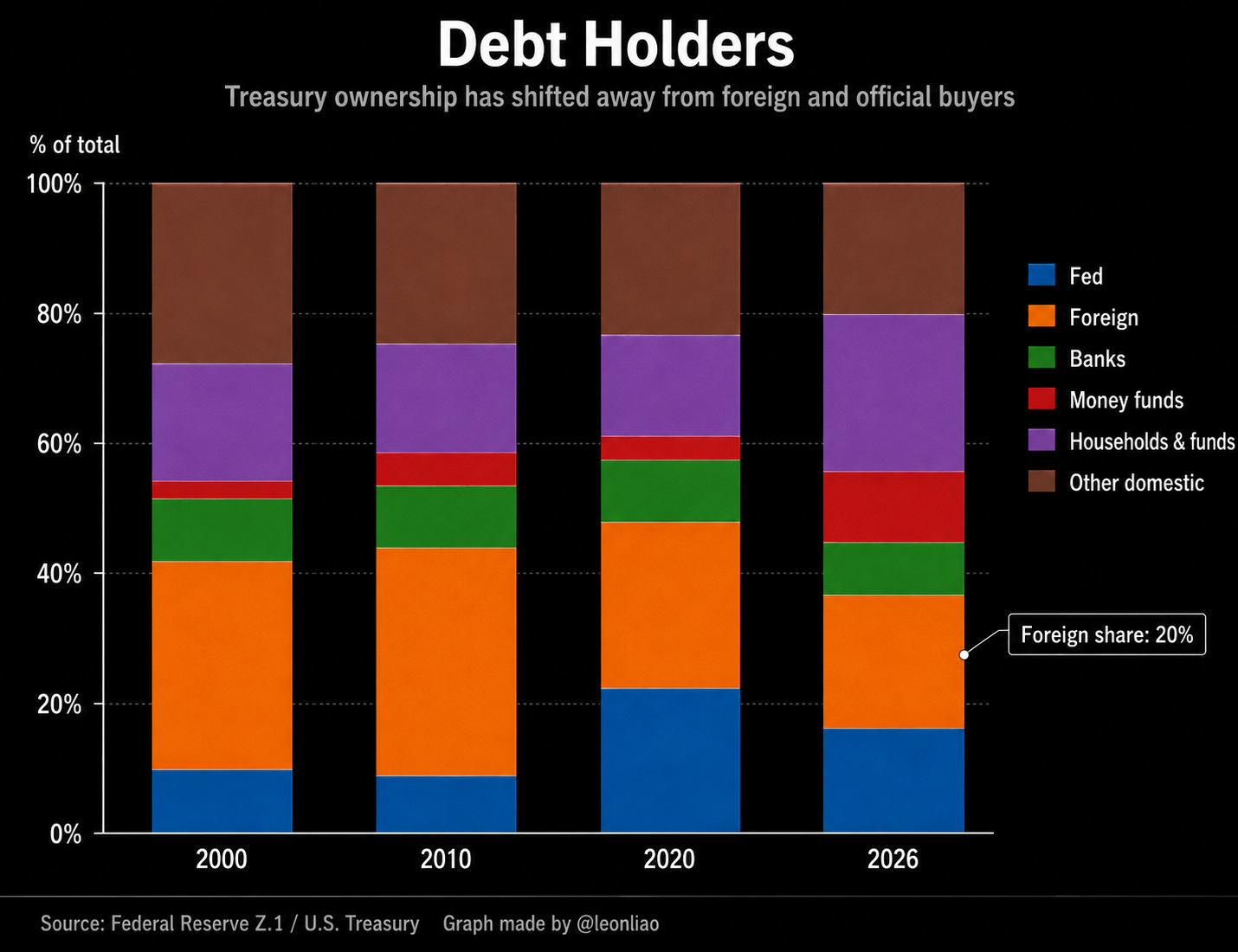
The identity of Treasury creditors therefore matters more than the headline debt number. Over the past two decades, the shift has been slow but clear. Foreign investors have become less important relative to the size of the market. The Fed is no longer expanding its holdings as it did during pandemic QE. Domestic private balance sheets are carrying more of the burden.
America still has access to financing. But the buyer base is changing.
China’s Treasury holdings once exceeded $1.2 trillion in the early 2010s and have since declined steadily. That makes for an easy story: Beijing is dumping Treasuries and Washington is losing a creditor.
It is also the wrong scale of analysis.
The more revealing number is foreign official Treasury holdings as a share of the entire Treasury market. By the first quarter of 2026, foreign official institutions still held roughly $3.92 trillion in Treasury securities. That is an enormous number. Foreign central banks have plainly not left the market.
But marketable Treasury debt itself has already exceeded $30 trillion.
Foreign official holdings can therefore remain stable, or even rise occasionally, while their share of the market keeps falling.
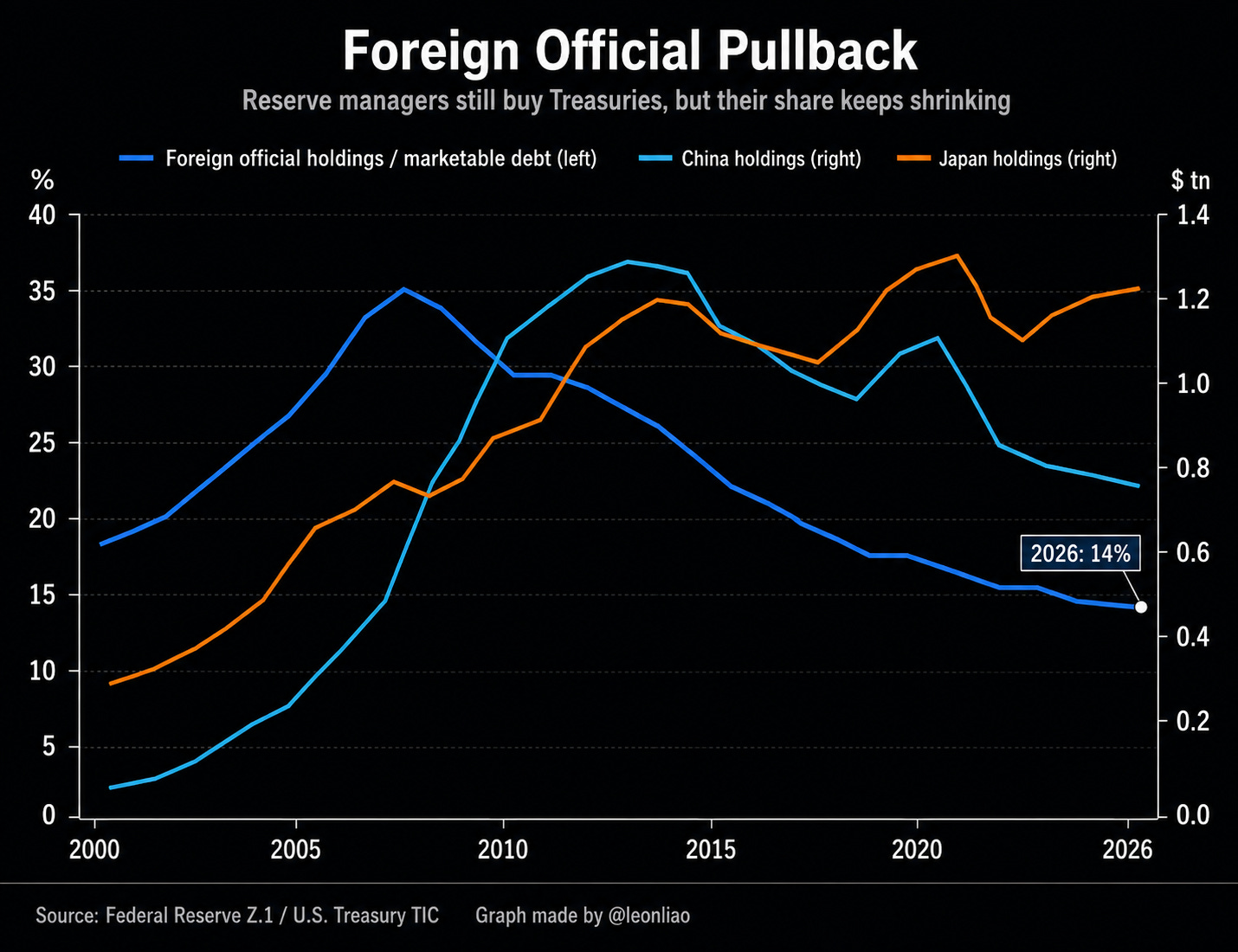
Foreign demand remains large. What has disappeared is the period when official reserve accumulation could keep pace with Treasury issuance.
During the 2000s, Asian export economies were rapidly building reserves, especially after China joined the WTO. Today China still runs a large current-account surplus, but its reserves no longer rise at anything like the old pace. Japan has no reason to increase dollar reserves indefinitely. Sovereign wealth funds increasingly want equities, infrastructure, private credit and gold alongside government bonds.
The dollar remains the core global reserve currency. Treasuries remain the dominant reserve asset. The U.S. fiscal balance sheet is simply expanding faster than the global official sector wants to expand its Treasury holdings.
That is why focusing on Chinese selling understates the issue. Even if Beijing stopped reducing its holdings tomorrow, the Treasury would still need to find enormous new marginal demand. Even if Japan maintained more than $1 trillion of Treasuries indefinitely, its share of a market above $30 trillion and growing by trillions every year would continue to shrink.
The Treasury market is growing faster than its traditional official buyers.
If foreign central banks are retreating in relative terms, the Federal Reserve’s shift is more direct.
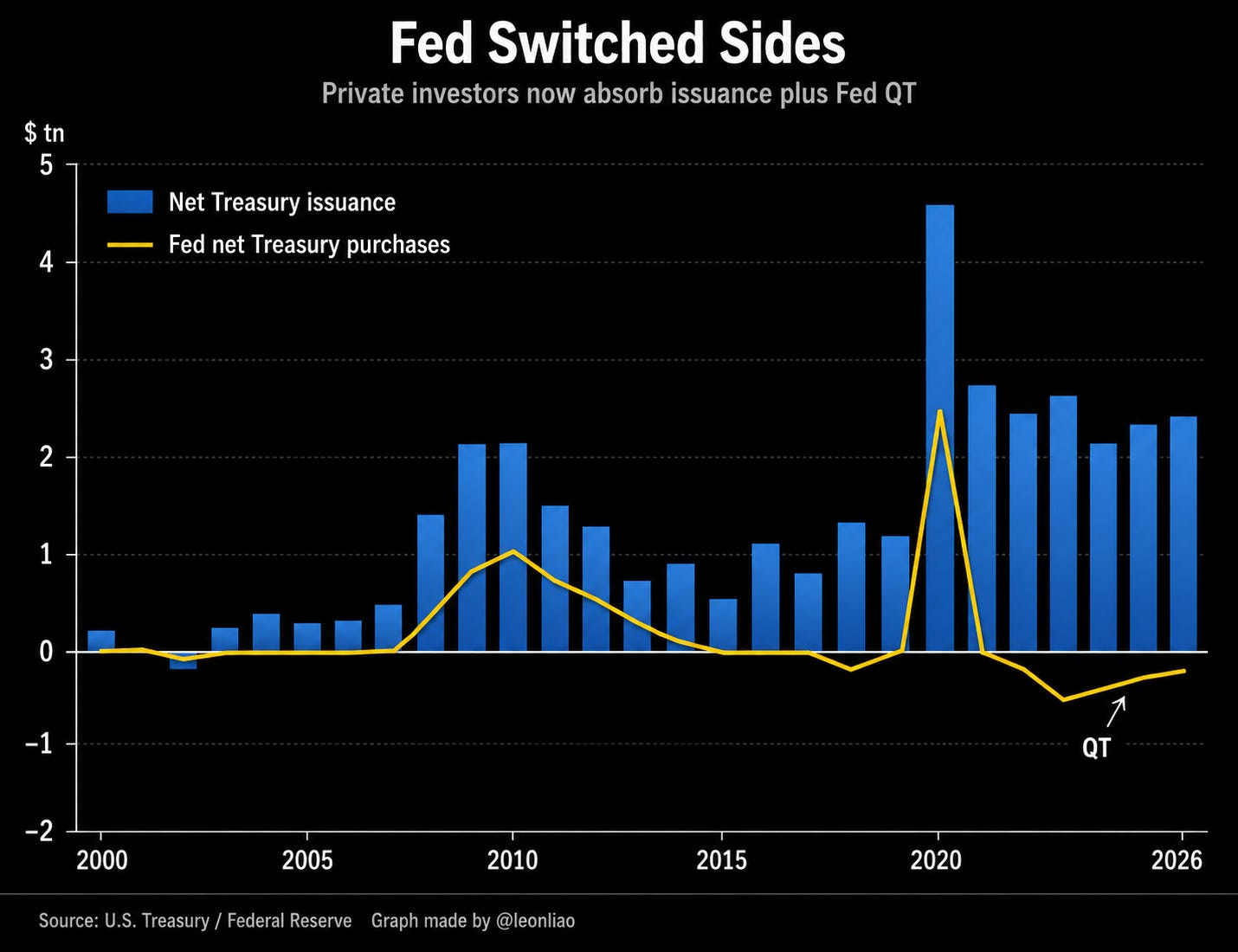
When the pandemic hit in 2020, the Fed restarted large-scale quantitative easing and bought trillions of dollars of Treasuries and mortgage-backed securities. Fiscal deficits exploded as Washington financed relief programmes, while the central bank’s balance sheet expanded in parallel. The federal government borrowed at unprecedented speed, and the Fed bought government bonds at unprecedented speed.
Since 2022, the direction has reversed.
Under quantitative tightening, securities held by the Fed are allowed to mature without being fully reinvested. Private investors therefore have to absorb more than new Treasury issuance alone. They must also absorb duration that the Fed is handing back to the market as its balance sheet shrinks.
By August 12, 2026, the Fed still held roughly $4.54 trillion of Treasury securities. That remains an enormous portfolio. But the central bank is no longer playing its pandemic role of continuously swallowing a large share of supply.
This creates a market variable that fiscal debate often misses: private-sector net Treasury supply.
Suppose the Treasury issues $2 trillion of net new debt in a year while the Fed lets several hundred billion dollars of Treasuries roll off its balance sheet. Private investors then have to absorb more duration than the fiscal deficit alone suggests. During QE, the Fed removed duration from private balance sheets. During QT, it gives some of it back.
Fiscal and monetary policy meet on the same balance sheet through Treasury supply.
This also explains why long-term yields do not have to fall in lockstep with Fed rate cuts. The Fed can set the overnight rate. It cannot order a pension fund, bond fund or insurer to own 30-year Treasuries at 3%.
When the Treasury has more long-duration debt to sell and the Fed is no longer an automatic buyer, the market-clearing yield has to do the work.
This is where the standard debt-crisis story usually jumps the rails.
Foreign central banks are buying relatively less. The Fed is shrinking its balance sheet. Therefore, the argument goes, Treasuries must eventually run out of buyers.
The American financial system has so far done the opposite: it has absorbed more.
By the first quarter of 2026, U.S. domestic financial sectors held roughly $14.86 trillion in Treasury securities. One of the biggest changes has come from money-market funds. By early 2026, they held about $3.43 trillion in Treasuries directly, up sharply from 2022.
Higher short-term rates made Treasury bills unusually attractive as cash-management assets. At the same time, the money-market-fund complex itself expanded rapidly. Money funds have therefore become one of the Treasury’s most important new sources of demand.
Mutual funds, ETFs, banks, insurers, pension funds and households have also absorbed more government debt. There is even a faint echo of Japan here, though the United States remains a long way from the Japanese model: more public debt is being intermediated inside the domestic financial system.
The government creates a safe asset. Households put savings into funds and pensions. Those institutions buy Treasuries. Fiscal deficits become part of private financial wealth.
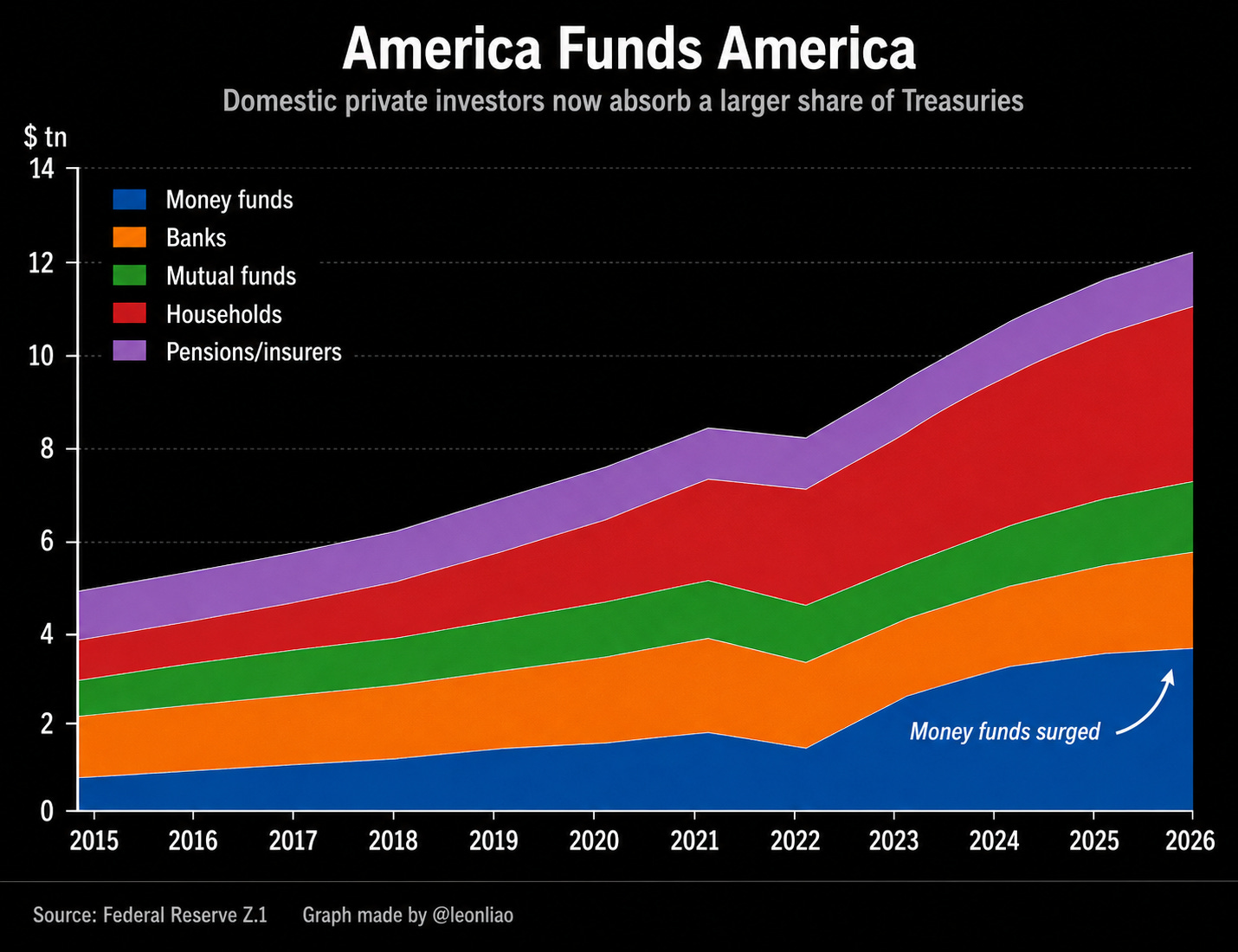
This is one of the biggest differences between the United States and a conventional emerging-market sovereign crisis. When Argentina or Turkey loses foreign capital, exchange-rate pressure, reserve depletion and sovereign funding stress can arrive together.
The United States has an immense, wealthy and highly financialised domestic private sector. Foreign official demand can weaken at the margin while Washington sells more debt to its own residents and financial institutions.
But this buyer base behaves differently.
Foreign central banks buy Treasuries because they need reserve assets. The Fed buys them to conduct monetary policy. PIMCO, BlackRock, Fidelity, bank Treasury desks, insurance companies, pension funds and American households buy them because the yield compensates them for taking duration risk.
Private capital will happily own tens of trillions of dollars of government bonds. It simply does not promise to own them at any price.
That is where the real constraint begins.
Comments
Nothing yet. Say the first thing.
Sign in to join the conversation.