
For sixteen years, Wang Xingxing has kept doing the same thing: find the constraint that matters most, turn it into an engineering problem, and let the real world decide whether the answer works. When money was scarce, he designed cost into the product. When the market was too small, he standardized the hardware. When humanoids first became worth pursuing, he assigned three people to the project. Once the body began to scale, he moved the largest pool of new capital toward the brain. Unitree’s history is a sequence of solved bottlenecks creating new ones. Wang now wants AI to enter the same observe-build-test-revise loop that once depended largely on him and a small group of engineers.
This essay is part of the series of Hard Tech Frontiers.

Yu Fei’an (于非闇)’s White Eagle and Ancient Pine 《苍松白鹰 》pairs the precision of gongbi painting with the alert stillness of a perched raptor. The image fits Wang Xingxing’s engineering temperament: restrained in posture, exact in observation, and ready to move quickly once the moment arrives.
Yesterday, Unitree Robotics listed on Shanghai’s STAR Market. The shares were priced at RMB150.8 and closed at RMB845, a gain of more than 460%, briefly taking the company’s market value above RMB340 billion. Unitree generated just RMB1.699 billion (or US$250mn) of revenue in 2025. At more than US$50 billion, investors were valuing the company on robots that do not yet exist at scale and capabilities that have not yet been commercialized.
Much of the discussion so far has focused on wealth and valuation: at the opening price, Wang’s stake made him China’s richest entrepreneur born in the 1990s, early investors were sitting on extraordinary returns, and Unitree was suddenly commanding a valuation multiple usually reserved for much larger technology companies.
But at the post-listing luncheon, Wang had already moved on to the next technical problem.
He spoke about foundation models, AI coding, simulation, physical deployment, automated evaluation and retraining. His proposed system would search papers and open-source tools, generate code, train in simulation, deploy the result to a real robot, evaluate what happened, then feed the result into another round of training. He called it “Physical AI Robot Self-Evolution V1.0.”
Seen against Unitree’s history, the idea looks like a software version of how Wang has always worked:
Find the bottleneck, build around it, test it in the real world, then revise. The bottleneck kept moving—first cost, then supply chain and scale, then the robot body itself, and now intelligence. Wang’s answers moved with it.
He has shown little interest in presenting himself as a prophet. In one interview, he put it simply: “I say far less than I do.” In robotics, that may also be practical. The dominant technical architecture is still unsettled. Last year’s answer may not survive the next one.
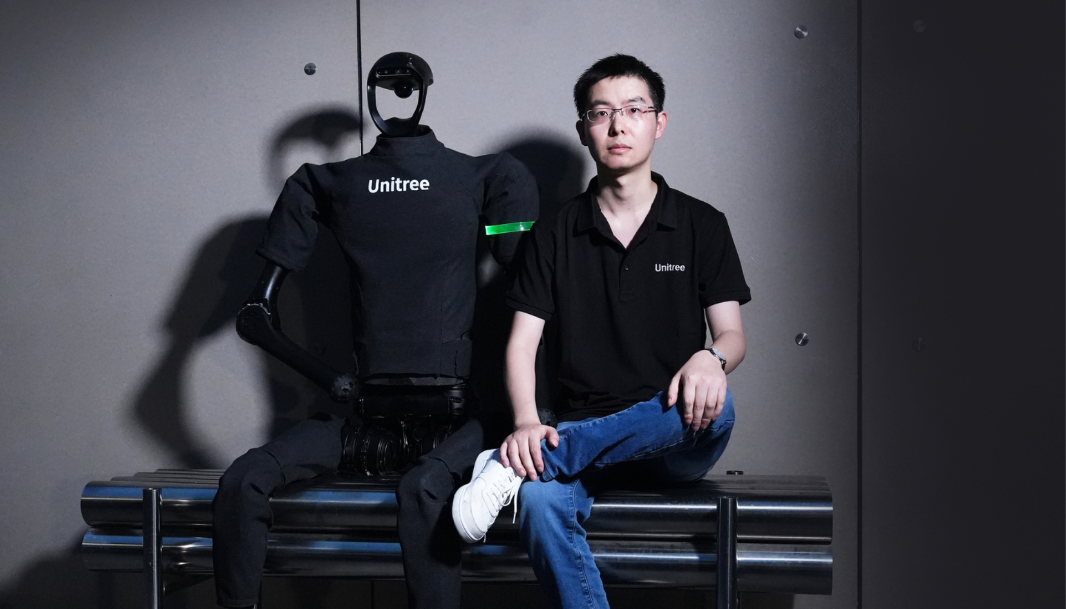
When Wang first entered robotics, there was no embodied-AI boom and no company worth hundreds of billions of renminbi. In 2009, as a freshman at Zhejiang Sci-Tech University, he built a small 14-degree-of-freedom biped for roughly RMB200. Industrial motors and drives were mostly out of reach. The mechanical structure had to be built around whatever he could afford. Cost entered his engineering decisions from the beginning.
Years later, in an interview with Xinhua’s Yangsheng, Wang described his approach this way: “A lot of creation is really combinatorial innovation.” He used his early biped as an example. Some university teams relied on expensive industrial motors and industrial drives. He looked instead for motors better suited to a small robot and paired them with compact, higher-performance electronics. The physics did not change. The cost, weight and performance of the system did.
At Shanghai University, where he later studied for a master’s degree, Wang began building XDog. Boston Dynamics had already pushed legged robotics to remarkable dynamic performance with hydraulics. High-end hydraulic systems were also expensive, complicated and far beyond the means of a student project. Wang chose electric actuation and handled much of the mechanics, electronics, software and system integration himself.
When he was supposed to graduate in 2015, XDog was still unfinished. He delayed graduation. His later explanation was characteristic: “Something half finished has no value.”
For Wang, the machine had to close the engineering loop. It had to stand, walk and be used before the next layer of problems would reveal itself. XDog ultimately cost only around RMB10,000-20,000 to develop. It won second prize in a Shanghai robot-design competition, earning RMB80,000. Videos of the machine then spread through robotics communities in China and abroad, attracting customer inquiries and investor interest.
Finishing XDog did three things at once: it proved the machine worked, attracted buyers, and brought Wang the resources to keep going.
He later summarized the same instinct in another line: “Where there is a problem, there is an opportunity.” His problems were usually concrete. A motor was too expensive. A reducer was unsuitable. A controller was too bulky. A supplier had no interest in serving a customer that needed only a few dozen sets a year. Solving those problems one by one gradually produced what became Unitree’s characteristic chain of capabilities: selection, recombination, simplification, engineering and industrialization.
There is little reason to cast Wang as the original inventor of every underlying technology. Modern high-dynamic electric quadrupeds grew out of years of open research at institutions including MIT and the University of Pennsylvania. Unitree’s stronger contribution was industrial: combine published research, control algorithms, motors, reducers and China’s manufacturing ecosystem into robots that could be built repeatedly, sold cheaply and iterated quickly.
Cost was therefore embedded in the technical architecture long before procurement began.
After Unitree was founded in 2016, the harder question shifted from whether the robot could run to who would buy it.
Robotics offers an obvious way for young companies to survive: do projects. Utilities need inspection robots, fire departments need emergency equipment, factories need automation upgrades. Each customer has a budget and a list of special requirements. A project can sell for hundreds of thousands or even millions of renminbi, but usually brings custom engineering, on-site integration and extensive after-sales work. Revenue rises; engineering headcount often rises with it.
Unitree tried some of that work early on, then moved increasingly toward standardized hardware and open interfaces. Wang’s description was straightforward: “Where the real demand is, that is the problem we solve.” In practice, the company looked for capabilities that enough customers shared, froze them into a standard platform, and left much of the application development to users.
Research and education became ideal early markets. University labs and robotics developers buy machines because they want to build on top of them. They do not need Unitree to finish the final application. They need a body that is stable enough, affordable enough and open enough to develop. That allowed Unitree to sell the same hardware repeatedly instead of redefining the product with every order.
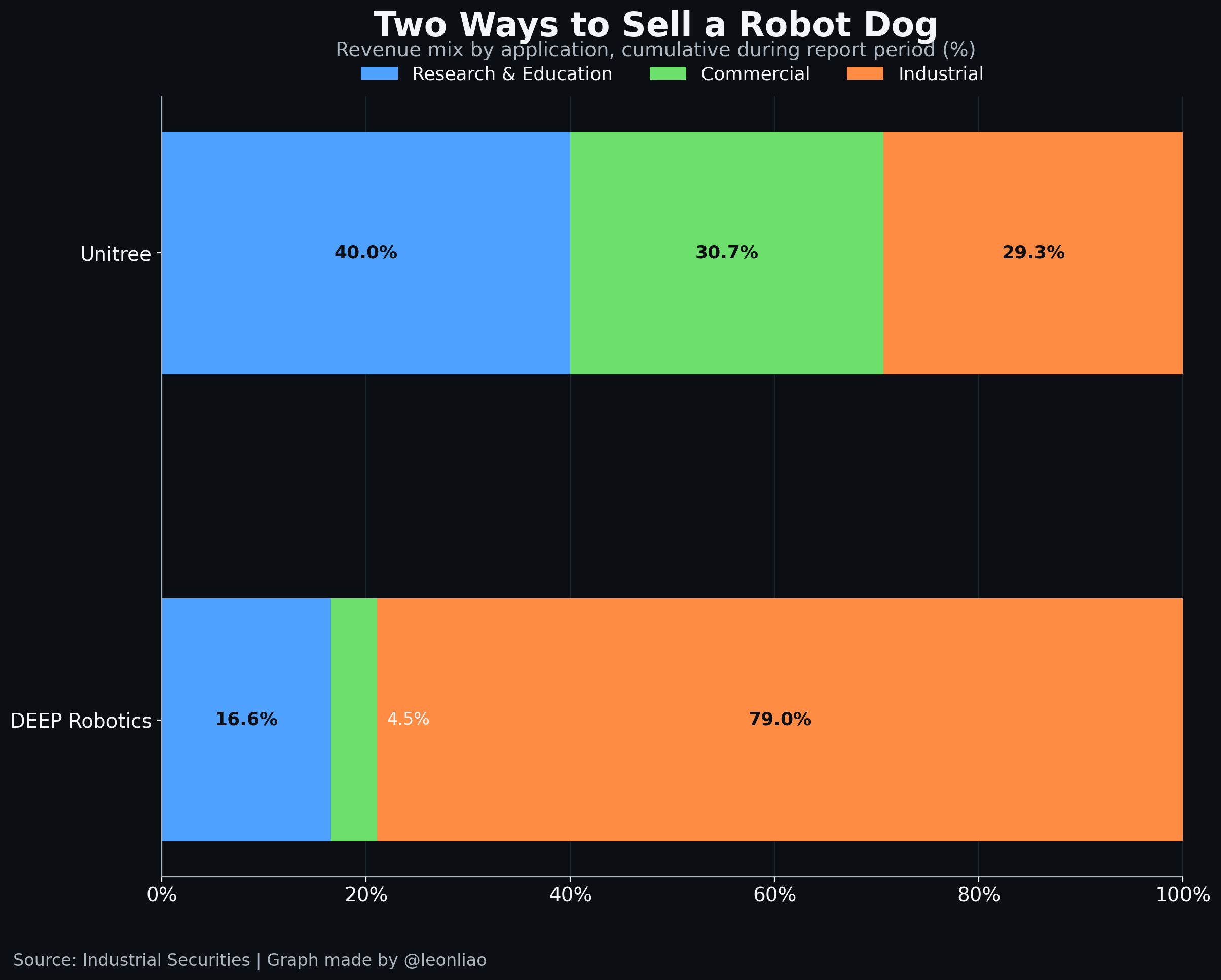
That choice gave Unitree a very different business from some of its Chinese peers. According to Industrial Securities, roughly 39.98% of Unitree’s cumulative quadruped revenue over the reporting period came from research and education, 30.68% from commercial consumption and 29.34% from industrial applications. At DEEP Robotics, about 78.95% of quadruped and wheeled-legged revenue came from industrial applications. DEEP Robotics looks more like a high-ticket industrial solution provider. Unitree looks more like a platform that can spread across research, consumer and industrial markets.
Each new quadruped pushed the platform into another market. Early models mainly validated the hardware architecture, motion control and system engineering. Go1 drove the product into a price range accessible to consumer buyers. B1 extended the same legged platform into inspection, firefighting and emergency-response work. Go2 and B2 improved perception, onboard intelligence, payload, battery life and industrial robustness. Go2-W and B2-W added wheels to improve long-distance mobility and performance across mixed terrain. A2 pushed further into industrial-grade performance.
B2-W
Unitree did not wait for a universal robot dog. Speed, payload, endurance, perception, algorithms and developer access improved as the applications broadened. By 2025, the company sold 23,037 quadrupeds at an average price of about RMB30,300. The research market supplied far more than orders. It brought papers, developers, field failures, custom applications and thousands of hours of use outside Unitree’s own labs.
The parts of the robot Unitree chose to control in-house kept expanding as well. The first priorities were joints, motors, reducers, drivers and body structure because they directly determined dynamic performance, weight and cost. As quadrupeds entered harder environments, perception, computing and power systems became more tightly coupled with whole-system design. Unitree moved into its own LiDAR and camera systems, thermal design, battery packs and power management. Some interfaces, encoders and IMUs were designed internally and assembled externally. Standardized components such as compute modules and battery cells continued to come from suppliers.
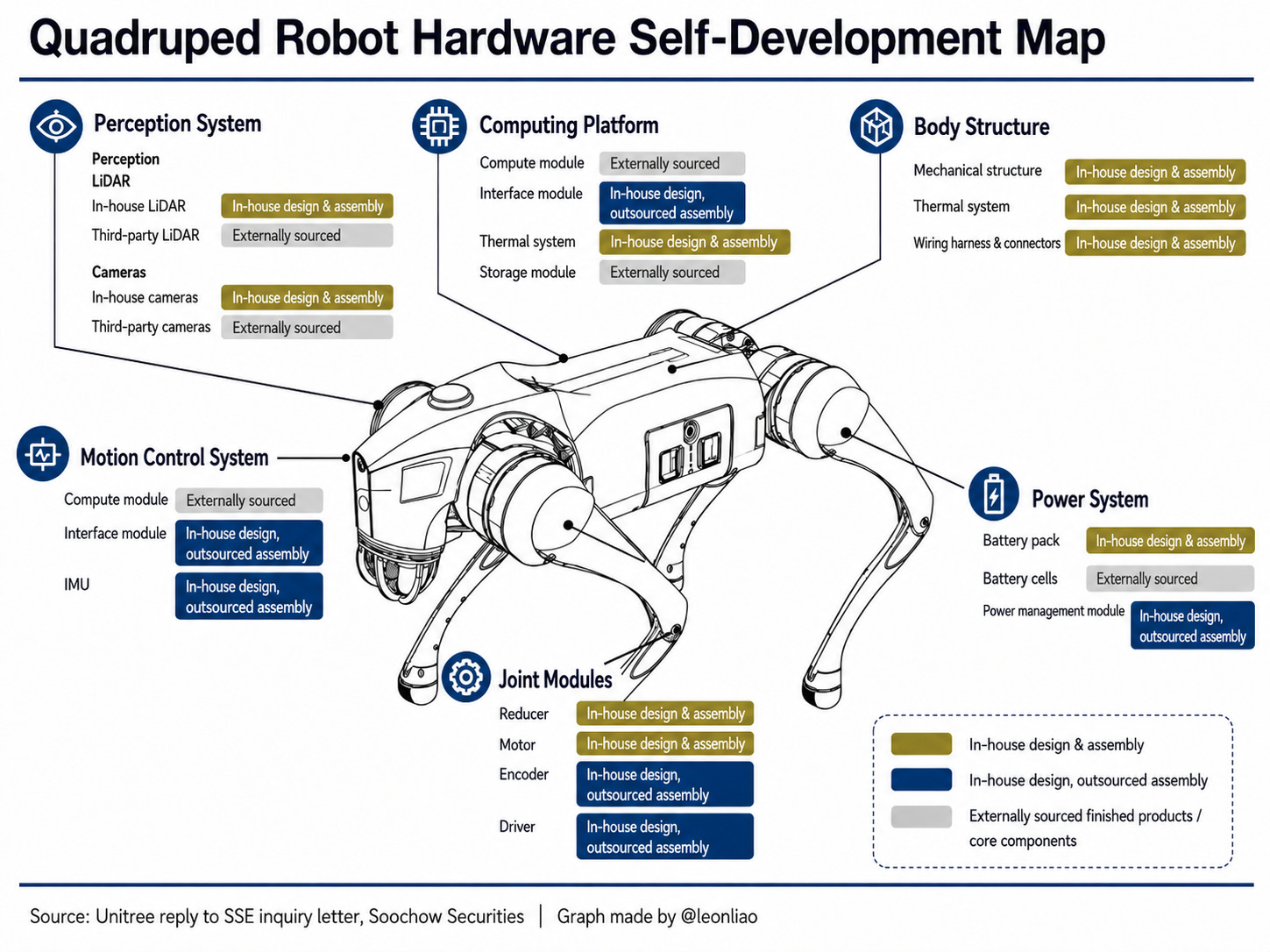
Unitree practices selective vertical integration. It keeps design control over components that materially affect motion, reliability and cost, while buying standardized parts where outside supply is already deep. The pattern is visible in Wang’s approach to cost reduction. In an interview with Shanghai Securities News, he worked from product design downward:
Can the part count be reduced? Can tooling cost less? Can assembly tolerances be relaxed? Can the structure be standardized? Can production be automated more easily?
He went all the way down to screws, wiring and paint.
When talking about the scale robots might ultimately reach, Wang mentioned “ten million units, even one hundred million.” Those volumes are distant. The comment still reveals how he thinks. At that scale, an unnecessary part, cable or machining step becomes an industrial problem.
Wang has said repeatedly that “cost has always been a KPI for everything we build.” Unitree’s low prices begin before the bill of materials is finalized.
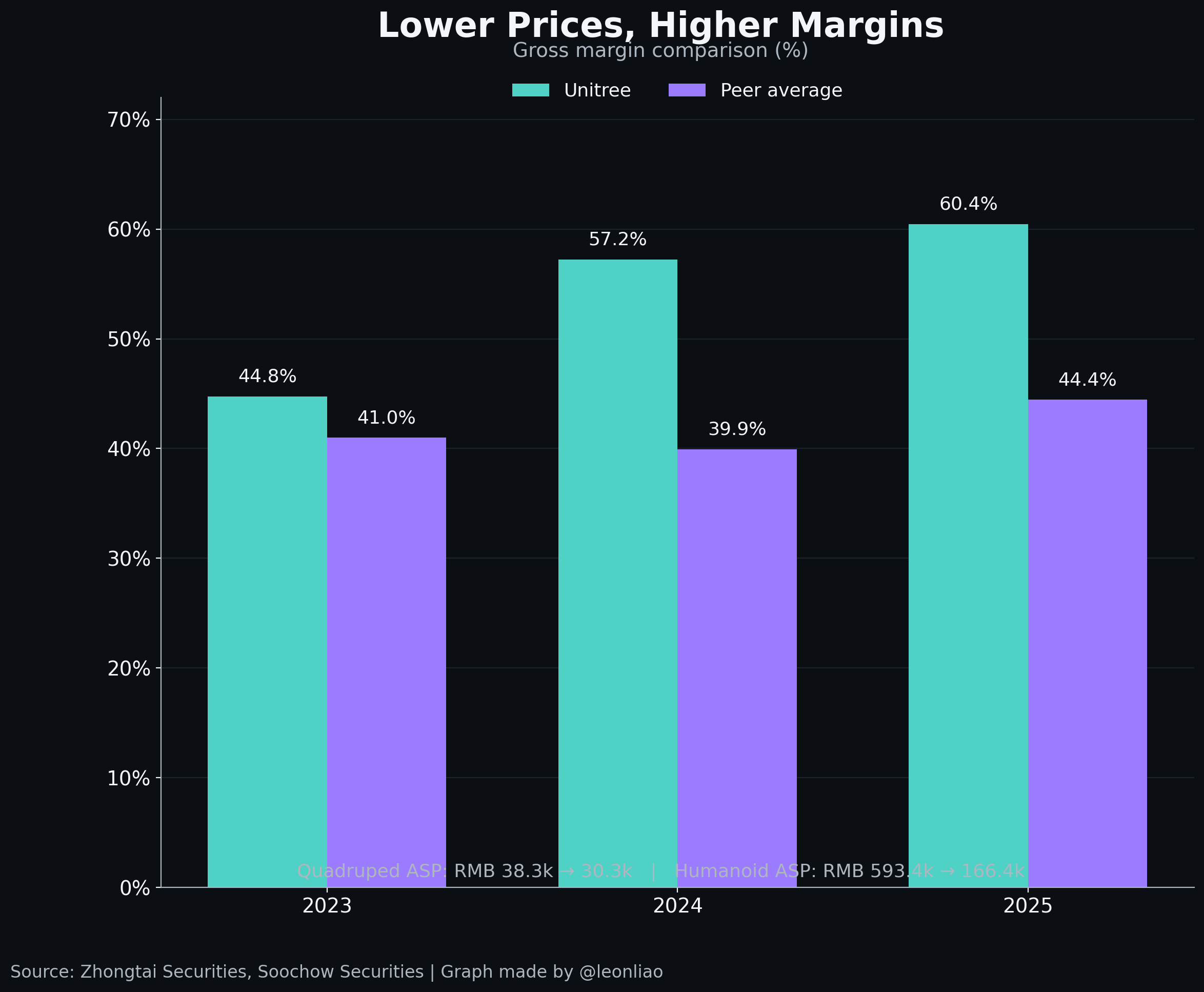
Between 2023 and 2025, the average selling price of Unitree’s quadrupeds fell from RMB38,300 to RMB30,300. The average humanoid price fell from RMB593,400 to RMB166,400. Over the same period, consolidated gross margin rose from 44.75% to 57.22% and then 60.44%. In 2025, quadruped gross margin reached about 56.7%. Humanoid gross margin remained around 63.2% even as cheaper models drove volume.
Unitree’s early move into motors, drivers, joints and mechanical structures did not come entirely from a grand plan for full-stack integration. When annual demand was measured in dozens of robots, large suppliers often had little reason to customize components for a tiny startup. Weak external supply forced Unitree inward. Once volumes rose, capabilities built for survival became advantages in cost and iteration speed.
In 2018, at one of the company’s lowest points, Unitree reportedly had only around RMB100,000 of cash left. Customers had already paid deposits. The robots still had to be delivered. Wang later recalled: “If you do something, at least finish it completely.”
That experience helps explain his emphasis on margins and cash flow. Financing can buy time in robotics. Products eventually have to fund the company themselves. Profit gave Unitree a rare strategic freedom: when a technology was not ready, the company could afford to wait.
Humanoids offer the clearest example.
Wang built a biped as early as 2009, yet after founding Unitree he did not turn the company into a humanoid-robot business. Between roughly 2018 and 2021, investors repeatedly asked why. His answer remained practical: the hardware was complicated and expensive, the AI was too weak, and there were few genuine customers. A technology can look important over ten years and still be a poor use of engineers today.
In the Xinhua interview, Wang put his rule plainly: “Whether you are starting a company or building a product, don’t gamble. You need a foothold. You need to grasp the key point.” Another statement captures his sense of timing: “All technological progress happens in steps.” A field can sit on a plateau for months or a year. Once an underlying condition crosses a threshold, capability can jump.
By 2022-23, several conditions were changing together. Tesla had moved beyond a concept image and was seriously developing Optimus. ChatGPT sharply raised expectations for what general AI might eventually do. Customers were also asking Unitree with growing frequency whether it could supply a humanoid. Wang’s assessment moved from “not worth doing” to “worth starting.”
The initial commitment remained tiny. In 2023, only three full-time people were assigned to H1, with occasional help from the quadruped team. Existing large-dog joints, motors and motion-control systems were reused extensively. H1 appeared in less than six months.
Three people were enough because much of the engineering bill for H1 had already been paid by years of building robot dogs.
Comments
Nothing yet. Say the first thing.
Sign in to join the conversation.