
Europe has cleaned its power system far faster than it has electrified the wider economy, leaving transport, heating and industry tied to oil and gas. China shows how generation, grids, storage, manufacturing and end-use demand can reinforce one another, turning electricity into common infrastructure for economic growth. For the Global South, the prize extends far beyond decarbonisation: the real energy transition begins when clean power leaves the grid and starts replacing imported fuel across the economy.
This essay is part of Global Energy System and Critical Mineral Series.

Huangshan (黄山), Liu Haisu (刘海粟), 1982.
A luminous vision of mountains, clouds and shifting colour — a fitting image for an essay about how imported clean-energy equipment can take root in a local landscape and become long-lived domestic productive capacity.
Europe’s energy transition over the past decade has achieved something remarkable. It has also exposed an increasingly obvious gap.
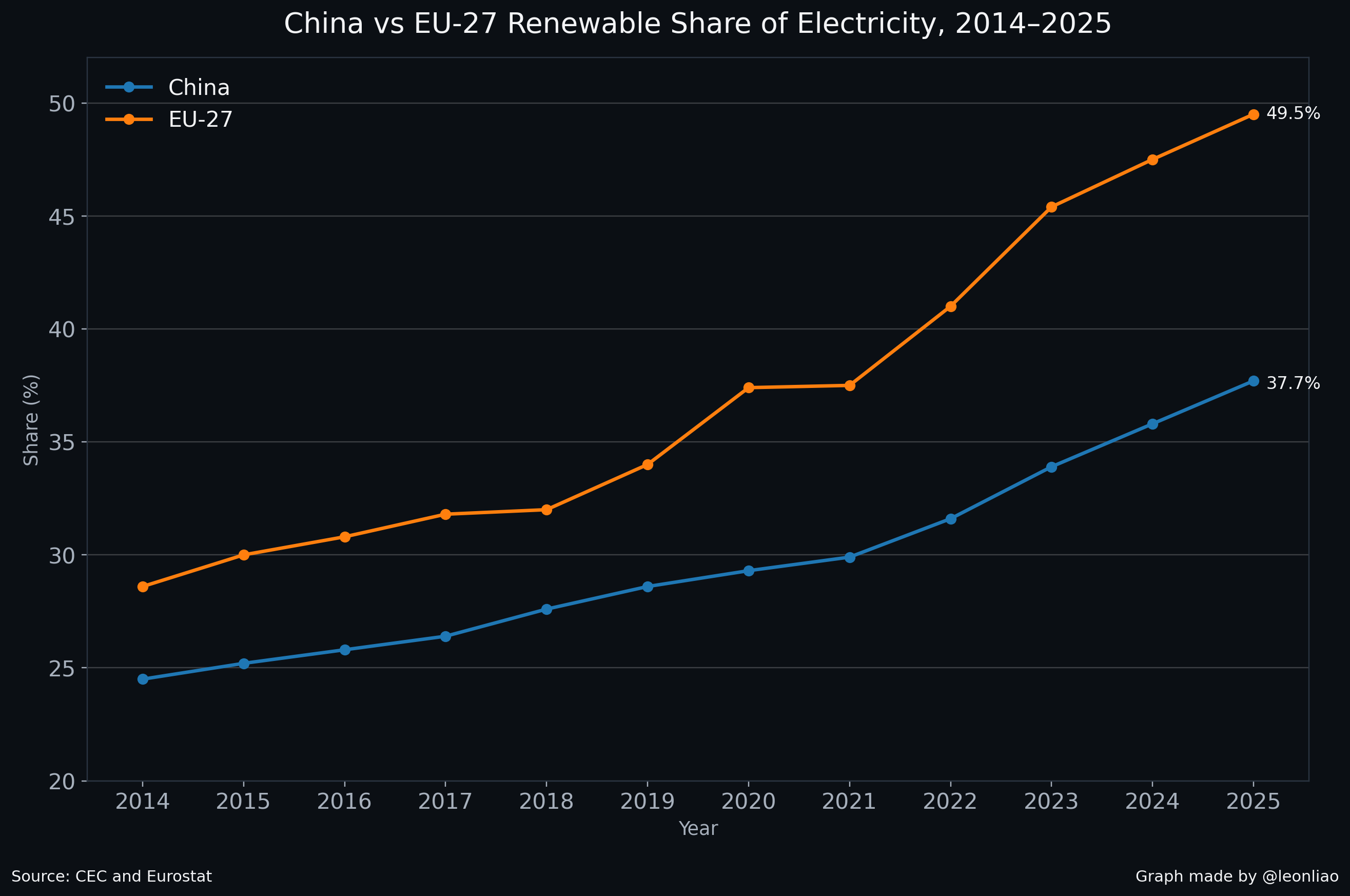
By 2025 renewables accounted for 49.5% of electricity consumption in the European Union, up sharply from 28.6% in 2014. Wind and solar expanded rapidly, coal generation retreated, and Europe’s power system became substantially cleaner.
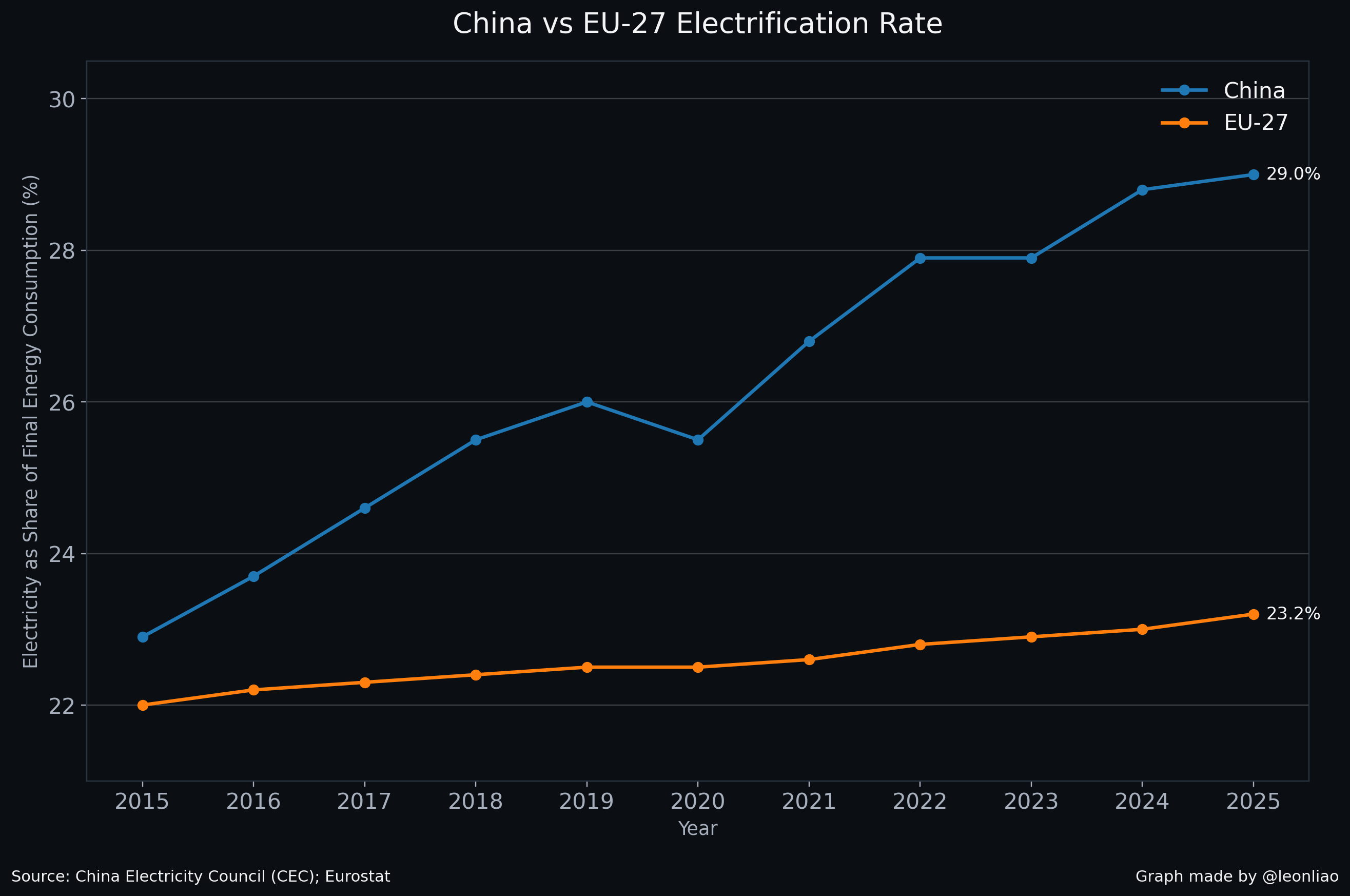
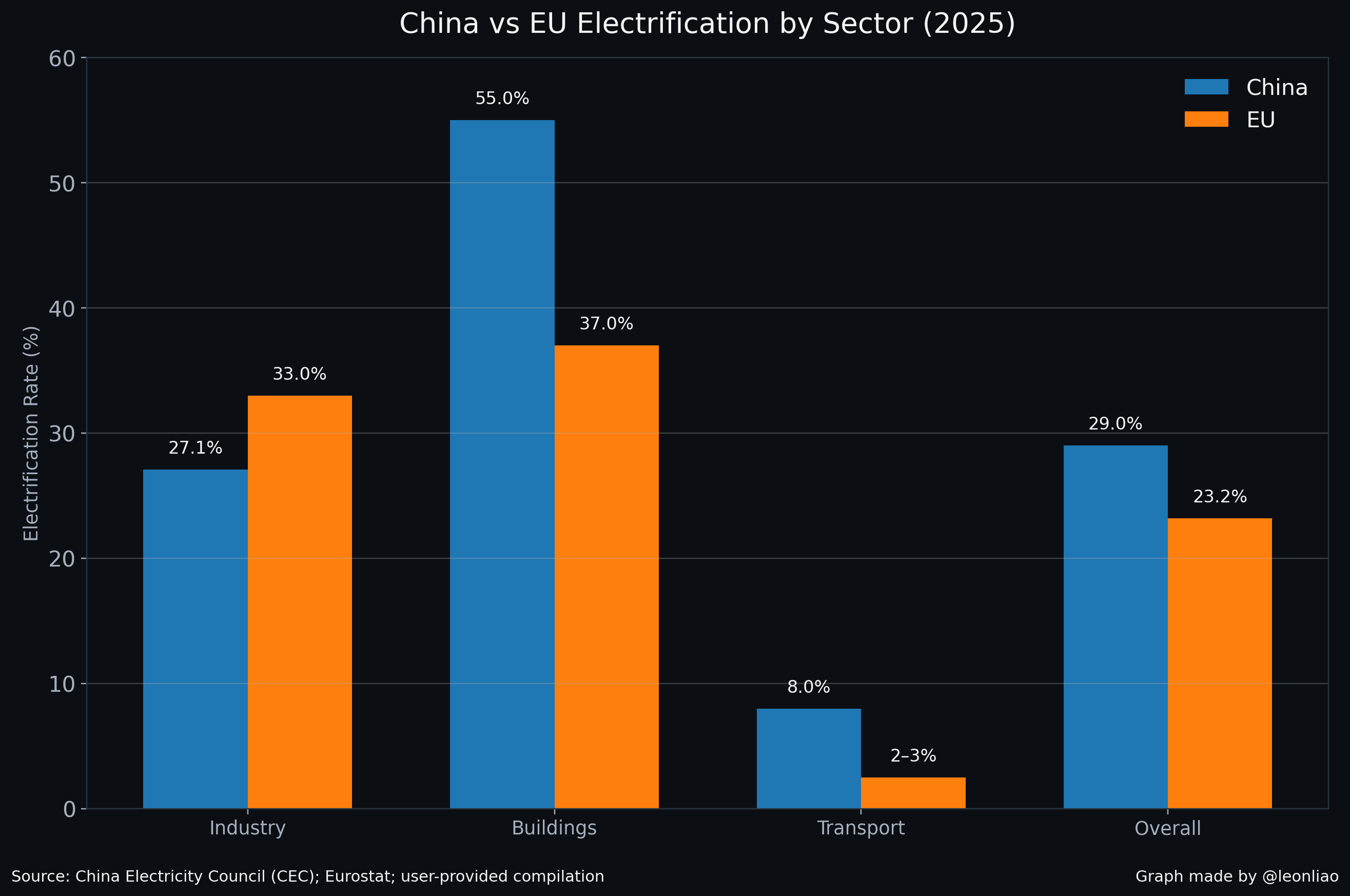
Yet electricity still accounts for only about 23% of final energy consumption, barely changed from a decade ago. Cars continue to burn large volumes of petrol and diesel. Industrial heat has yet to shift towards electricity on a comparable scale. Buildings remain heavily dependent on natural gas for heating. In 2025 EU’s electricification in Buildings was just 37%, well below China’s 55%.
Europe has made electricity cleaner far faster than it has made the wider economy electric.
This explains why building more wind and solar capacity does not automatically eliminate dependence on oil and gas. Solar, wind, hydropower and nuclear energy all produce electricity. As long as cars continue to run on petrol, new clean power cannot enter road transport. As long as homes rely on gas boilers, wind power cannot directly replace the natural gas used for heating. As long as industrial furnaces continue to burn coal and gas, much of the economy’s energy demand remains beyond the reach of the domestic power system.
Generating capacity determines how much electricity a country has. Electrification determines how much of the economy that electricity can reach.
Seen from this perspective, the changes under way in China are more consequential than electric-vehicle sales, solar installations or any single industry taken in isolation.
In 2025, electricity accounted for 29% of China’s final energy consumption, up from 23% a decade ago, and is much higher than in Europe or the United States. Chinese electricity demand grew by 5% that year, adding more than 510TWh—close to the average annual increase in global electricity consumption over the previous decade. Since 2020, China’s electricity demand has consistently grown faster than its economy, suggesting that a growing share of production and everyday activity is moving onto the power system.
And Beijing is already planning the next step. Under China’s newly released 15th Five-Year Plan for Building a New-Type Power System, electricity is expected to rise from 29% of final energy consumption in 2025 to 35% by 2030.
Behind this shift lies the simultaneous expansion of generation, grids, storage, manufacturing and end-use demand.
China invested more than $625bn in clean energy in 2024, nearly twice the level recorded in 2015. It also reached its original 2030 wind and solar capacity target six years ahead of schedule. As renewable generation expanded, China continued to build long-distance transmission, distribution networks and energy storage. In 2025 alone, the country added about 62.24GW of new energy-storage capacity, lifting the total to 145GW. China is now the world’s largest battery-storage market, accounting for roughly 52% of global capacity.
New electricity supply is also creating new sources of demand.
Chinese consumers bought 13.875m new-energy vehicles—battery-electric and plug-in hybrid models—in 2025, an increase of 19.8% from the previous year. NEVs accounted for 50.8% of all new-vehicle sales. Many electric models are already cheaper than comparable petrol cars, giving end-use electrification an increasingly powerful commercial logic of its own. As transport consumes more electricity, investment rises across batteries, motors, power semiconductors, charging infrastructure and the grid. Larger manufacturing volumes then push equipment costs down further.
The cycle now extends well beyond passenger cars.
China has the world’s largest markets for electric buses and electric two-wheelers. Its railway network is highly electrified, while ports, mines and urban logistics are adopting more electric equipment. Activities once dependent on petrol and diesel are increasingly being connected to the same generation and grid infrastructure. In 2025 China’s electricification in transport reached 8%, much higher than EU’s 2-3%.
Industry may prove even more important.
Chinese industry consumes about 60% of the country’s electricity. From 2022 to 2025, industrial users accounted for roughly half of the increase in national power demand. Electricity has long powered motors, pumps, compressors, robots and automated production systems. It is now beginning to enter industrial heat, an area historically dominated by coal and natural gas. Electric boilers, industrial heat pumps, electric furnaces and direct electric heating are expanding across a wider range of sectors. In 2025 China’s electricification in industry reached 27.1%, still below EU’s 33%.
China’s industrial heat demand is enormous. About one-fifth is used for low- and medium-temperature processes that are well suited to heat pumps and other electrification technologies. Policy support, large-scale equipment manufacturing and an expanding supply of clean electricity are gradually shifting more industrial process heat towards power. The IEA expects China’s use of renewable electricity for industrial process heat to increase nearly sixfold in the coming years and account for more than half of global demand growth.
None of this means that China has completed its energy transition. Coal still generated 51.1% of the country’s electricity. Rapid renewable expansion has also created pressures involving grid congestion, balancing, storage and power-market reform. Some regions still require more flexible generation and stronger interregional coordination, while many high-temperature industrial processes remain difficult to electrify.
The value of China’s experience lies in the systemic nature of the transition.
Wind and solar expand electricity supply. The grid links generation in one region with demand in another. Storage improves the system’s ability to absorb variable renewable power. Electric vehicles and industrial equipment create new sources of electricity demand. A larger market supports greater production of batteries, motors, inverters, power semiconductors and electrical equipment. As costs fall, more end-use activities become economically viable candidates for electrification.
The individual parts do not advance in a fixed sequence. They reinforce one another as they scale.
This pathway has broader significance for the Global South.
The centre of global energy-demand growth has already shifted towards developing economies. In 2024, emerging-market and developing economies accounted for more than 80% of the increase in global energy demand. Over the coming decades, much of the world’s new housing, factories, transport networks, data centres and urban infrastructure will also be built in these countries.
Europe faces the expensive task of retrofitting a vast installed base of petrol cars, gas boilers and mature industrial facilities. Many countries in the Global South face a different choice: whether new cities, factories and transport systems should be built around a continuing dependence on imported oil and gas, or increasingly around domestic electricity systems.
That choice will shape energy structures for decades.
Building a new oil-based transport system requires refining capacity, fuel imports, storage, distribution and filling stations, while leaving the economy exposed to international oil prices. Electric buses, electric two-wheelers and electric cars connect transport demand to the power system instead. Electricity can come from domestic solar, hydropower, wind, natural gas, nuclear energy or other future sources. The energy mix can evolve as local resources, technologies and economic conditions change.
New industrial facilities face a similar choice. Electric motors, furnaces, heating systems and digital energy-management technologies can be incorporated when plants are first built. For economies that have not yet accumulated a vast stock of fossil-fuel infrastructure, installing electric systems from the outset is often easier than retrofitting equipment constructed decades earlier.
For the Global South, electrification is first and foremost a development strategy.
It can expand reliable energy supply, reduce the impact of international fuel prices on trade balances and public finances, improve end-use efficiency and provide a common infrastructure for industrial growth. Lower emissions are an important result, but they are not the only objective.
South-East Asia is approaching this choice rapidly. The region remains in a period of fast industrialisation and urbanisation, with energy demand continuing to grow. The IEA estimates that, without structural change in the energy system, South-East Asia’s energy import bill could rise from more than $80bn in 2024 to roughly $245bn by 2035. Meeting existing energy and climate commitments could reduce the region’s 2035 fossil-fuel import bill by about half.
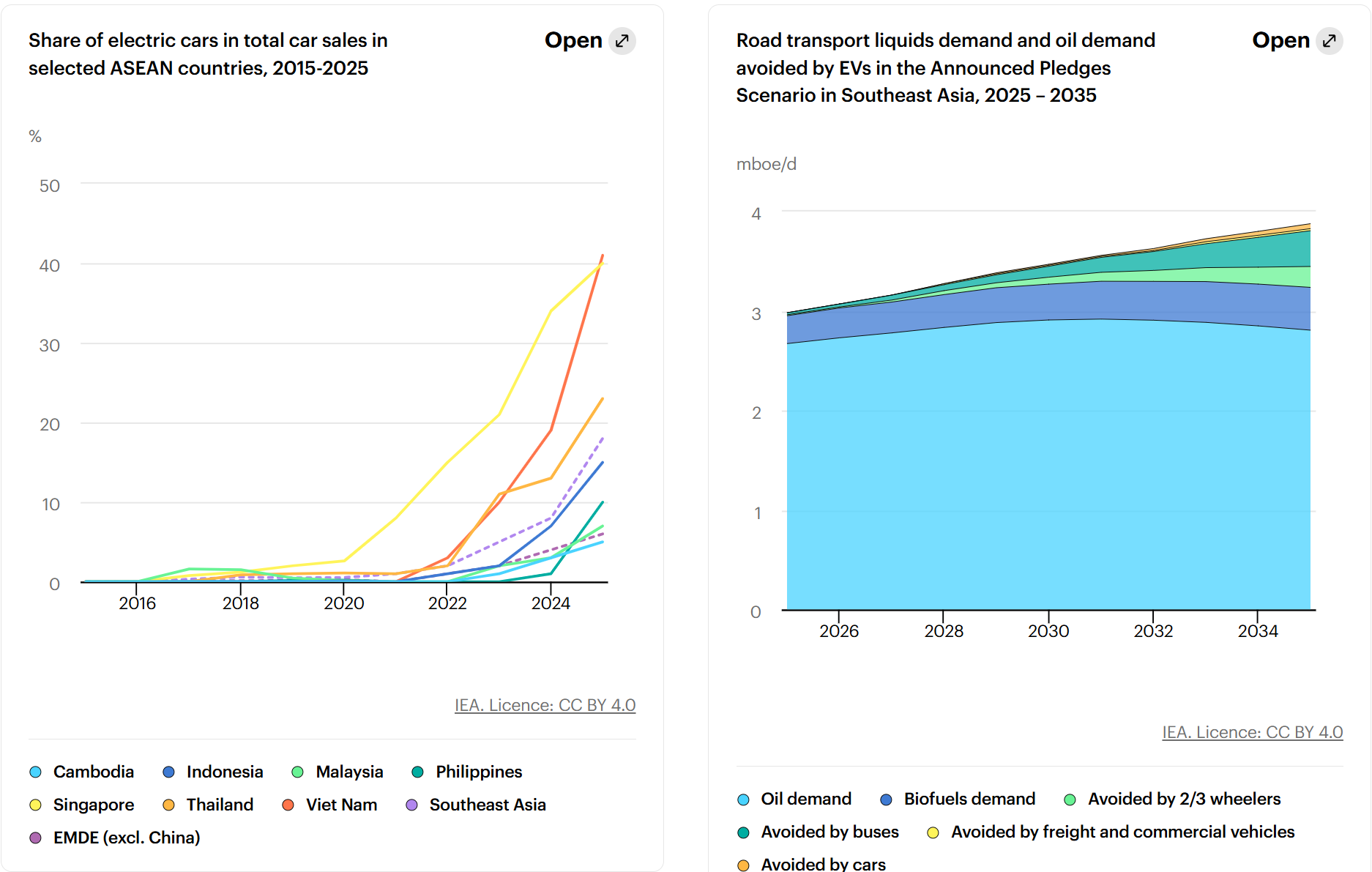
At the same time, investment in clean energy is rising and the regional electric-vehicle market is expanding. In 2025, new-energy vehicles—BEVs and PHEVs—accounted for 16% of new-car sales in South-East Asia. Lower-priced Chinese electric vehicles have become an important driver of that growth.
None of this requires developing countries to replicate China’s institutions. Nor does it mean that every piece of equipment must be imported from China.
China offers a set of observable lessons. Affordable clean-energy equipment can accelerate the construction of domestic generating capacity. Grids, storage and end-use technologies need to expand together. Manufacturing at scale can lower the cost of electrification. And only when transport and industry are connected to the power system can new clean electricity displace imported fuels across a broader share of the economy.
Different countries will adopt different combinations according to their resources. Economies with abundant hydropower can link it more closely to electric transport. Countries with strong solar resources can develop solar generation, storage and electricity-intensive industry. Natural-gas producers may choose to use gas increasingly to support the power system, rather than leaving every household, vehicle and factory separately dependent on fossil-fuel combustion.
The common direction is to connect more economic activity to a power system capable of drawing on a diverse range of domestic energy sources.
Europe has shown that rapid growth in clean electricity is not enough to transform the wider energy system. The grid can become progressively greener while transport, heating and industry remain embedded in oil and gas.
China is demonstrating another possibility. When generation, grids, manufacturing and end-use demand expand together, electricity can evolve from one energy carrier among many into the common infrastructure supporting a much larger share of economic activity.
For the Global South, the potential gains extend far beyond carbon reduction. Electrification could support industrialisation at lower long-term energy cost, reduce ever-growing fuel-import bills and allow future cities, transport systems and productive capacity to rest on a larger base of energy controlled at home.
The next stage of the energy transition will be determined not only by how electricity is produced, but by how much transport, industry and everyday economic life it is allowed to power.
Read more:
A like, restack, comment, or share also helps this work reach more readers.
For a full guide to the publication and its main research series, start here: China as a System: Publication Map.
No posts
Comments
Nothing yet. Say the first thing.
Sign in to join the conversation.