
China’s national average hides the real scale of its transformation: 19 leading cities, 287 million people, more than $7.3 trillion in GDP, and an average output per person of about $25,500. The four first-tier cities are already close to Japan and South Korea, while the 15 new first-tier cities together are approaching the economic size of Germany. China is still developing, but the developed economy inside it is already larger than almost every country on earth.
This essay is part of Rethinking the China Debates series.

Splashed-Color Landscape(泼彩山水)By Zhang Daqian(张大千), Modern China
Its luminous colour fields and layered mountain forms echo the central theme of this essay: beneath China’s national average lies a vast developed urban economy, partly hidden from view but already powerful in scale.
Over the past few years, as China has expanded visa-free access, foreign tourism to China has rebounded sharply and returned close to pre-pandemic levels. YouTube is now full of travel vloggers carrying cameras through Shanghai, Shenzhen, Chongqing, Chengdu and Hangzhou, trying to reconcile what they see with the China they had absorbed for decades through Western narratives. They use words such as “shocked” to describe their reaction, and “futuristic” to describe high-tech cities such as Shenzhen or moutain city Chongqing. What they are really seeing is a China that does not fit the image they were given.
Yet China is still, by the usual statistical definition, a developing country. That is the part many of them do not understand.
In 2025, China’s GDP per capita reached $13,400. That placed the country firmly among the world’s upper-middle-income economies, in roughly the same range as Mexico, Russia and Turkey. It is also the starting point for much of the international discussion about China. But it is becoming increasingly inadequate as an explanation of modern China.
China has a population of 1.4 billion and the geographic scale of a continent. Shanghai, Shenzhen, Suzhou and Chengdu are placed in the same denominator as counties in western China, producing a national average that is statistically accurate but highly abstract in practice. Decades of rapid industrialisation and urbanisation have widened the development gradient between regions. China now contains multiple income levels, industrial stages and urban living systems at the same time. Increasingly, too much information is lost when the entire country is compressed into a single GDP-per-capita figure.
Yicai’s annual city-tier ranking provides a useful entry point for examining this internal structure. It is neither an official administrative classification nor a direct measure of household income. Instead, it ranks 337 prefecture-level cities and above according to commercial resources, urban connectivity, population activity, new-economy competitiveness and future development potential. The 2025 ranking again placed Shanghai, Beijing, Shenzhen and Guangzhou in the first tier, followed by 15 “new first-tier” cities: Chengdu, Hangzhou, Chongqing, Wuhan, Suzhou, Xi’an, Nanjing, Changsha, Zhengzhou, Tianjin, Hefei, Qingdao, Dongguan, Ningbo and Foshan.
The four first-tier cities have a combined permanent population of about 83.6 million, roughly equal to the entire population of Germany. Their combined GDP is projected to reach $2.8 trillion in 2026, with GDP per capita exceeding $33,000. Average economic output per person across these four cities is already approaching that of South Korea, at about $36,000, and Japan, at roughly $34,000.
Beijing, Shanghai, Shenzhen and Guangzhou possess dense metro networks, extensive high-speed rail connections, international airports, modern healthcare systems, digital payments, instant delivery and highly developed consumer services. Public safety, mobile connectivity and urban infrastructure have reached the standards of high-income East Asian economies. Some aspects of daily life are already more convenient. Household wages and private consumption have yet to fully catch up with Tokyo and Seoul, but the urban systems residents use every day are now remarkably close.
The larger shift is taking place one level below.
The 15 new first-tier cities contain about 203 million people. Their combined GDP is projected to exceed $4.5 trillion in 2026, approaching Germany’s economy of roughly $5 trillion in 2025, surpassing Japan’s $4.4 trillion, and exceeding India’s $3.9 trillion. Weighted GDP per capita across these 15 cities is approximately $22,300.
Combined with the four first-tier cities, they form an urban system of 287 million people, equivalent to one-fifth of China’s population. Their total GDP exceeds $7.3 trillion, accounting for roughly one-third of national output. Average GDP per capita reaches approximately $25,500. Were these 19 cities treated as a separate economy, their population would exceed Brazil’s, while their economic output would surpass that of every individual country except the United States and China itself.
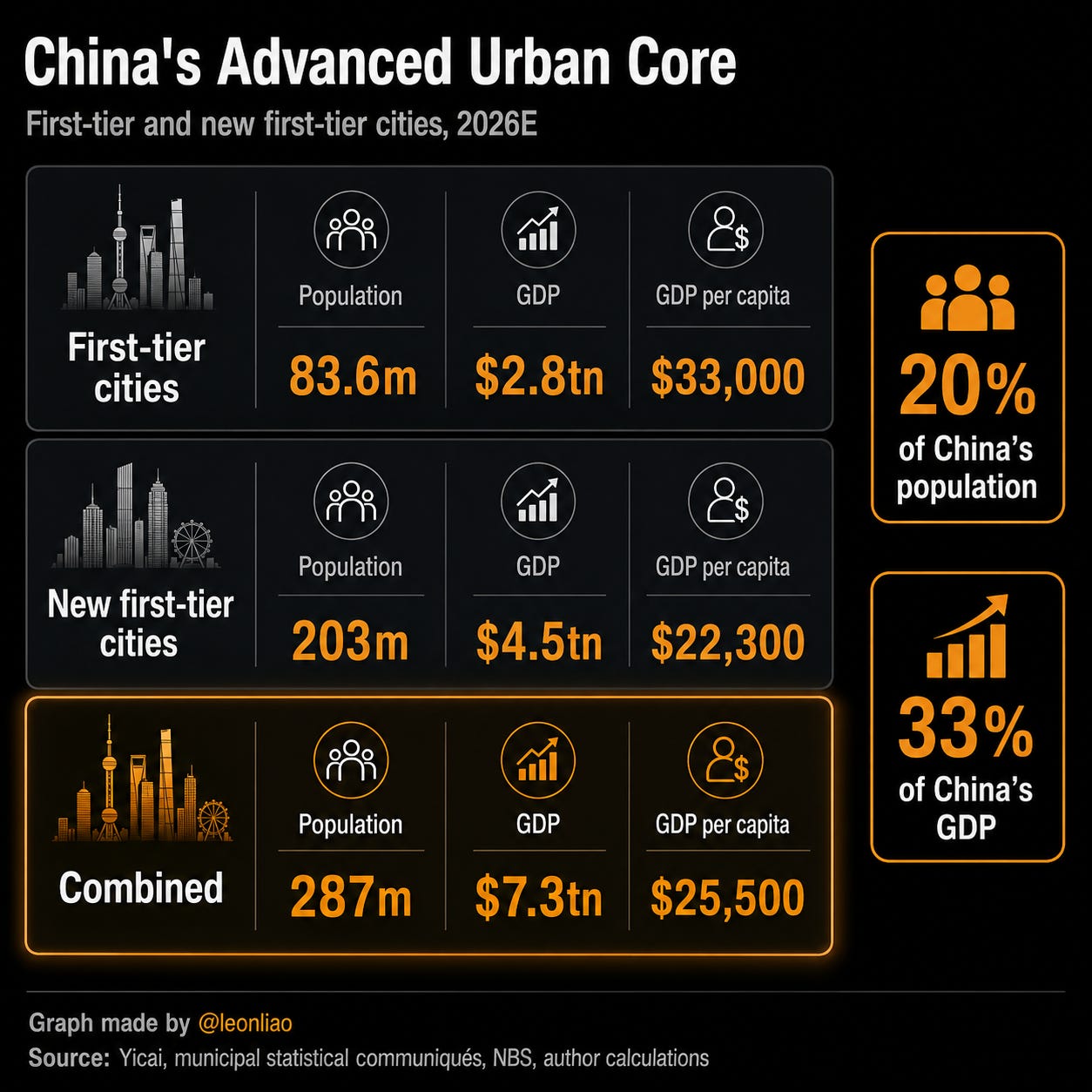
An advanced urban economy of nearly 300 million people already exists inside China.
“Advanced” does not mean that the incomes of all 287 million residents have reached American levels. Average GDP per capita across the 15 new first-tier cities remains far below that of the United States and western Europe, and below Japan and South Korea. Differences within the group are also substantial. Suzhou, Nanjing, Ningbo and Hangzhou are already approaching the first-tier cities in output per person; Chengdu, Xi’an and Chongqing remain considerably lower.
Administrative geography further complicates the comparison. A Chinese “city” is usually not a continuous built-up urban area. Chongqing covers more than 80,000 square kilometres and includes large numbers of counties, towns and rural communities. Chengdu, Xi’an and many provincial capitals also administer extensive peripheral territories. Including the entire administrative population lowers measured output per person in the urban core, but also better reflects the economic responsibility these cities carry for surrounding counties and rural areas.
The more interesting phenomenon is that many Chinese cities appear richer than their income statistics suggest.
A Chinese city with GDP per capita of only $20,000 may already possess metro lines, high-speed rail, a major airport, a complete expressway network, 5G connectivity, same-day delivery, mobile payments, top-tier hospitals, large commercial centres and highly digital public services. Comparable infrastructure and everyday convenience remain unavailable in some countries with GDP per capita of $30,000 or even $40,000.
Income still matters. It determines how much housing, education, healthcare, travel and private services a household can afford. GDP cannot be treated as a direct measure of household welfare. Chinese cities still face substantial shortcomings in housing affordability, educational competition, working hours and social protection.
But income describes only part of urban life.
The same dollar of income does not buy the same urban system everywhere.
Over the past four decades, China has directed enormous amounts of capital into railways, power grids, roads, airports, metro systems, telecommunications and urban public infrastructure. Much of this capacity was built while household incomes were still relatively low. A unified national industrial system reduced the cost of cars, home appliances, electronics and a wide range of everyday consumer goods. Fierce competition among digital platforms lowered the cost of payments, delivery, transport and consumer services. High population density gave metro systems, food delivery and instant retail economies of scale that are difficult to reproduce elsewhere.
The result is an unusual development combination: household incomes remain within the upper-middle-income range, while urban infrastructure and consumer convenience have moved into a more advanced stage ahead of them.
This also helps explain the surprise experienced by many foreign visitors arriving in China in recent years. They know that China’s GDP per capita is only about one-sixth that of the United States. Yet they find Shanghai’s metro cleaner than New York’s, Shenzhen’s digital services more seamless than those of many European cities, and Hangzhou’s technology sector and urban landscape difficult to reconcile with conventional images of a “developing country”. The statistics remain correct. The old visual assumptions and lived expectations no longer do.
The first-tier and new first-tier cities represent only the upper layer of this urban system. Below them are another 30 second-tier cities and 70 third-tier cities, including numerous provincial capitals, ports, manufacturing centres and regional transport hubs. By 2025, 29 Chinese cities had GDP exceeding RMB 1 trillion, and many of them were neither first-tier nor new first-tier cities.
Wuxi, Changzhou, Nantong, Quanzhou, Jinan, Fuzhou and Yantai rarely appear in international discussions of China. Yet they possess large advanced-manufacturing sectors, extensive urban infrastructure and relatively high output per person. Further down the hierarchy, many third-tier cities have already entered the broad income range of the world’s upper-middle-income economies. Their household incomes may not exceed those of Russia, Turkey, Mexico or Brazil, but in high-speed rail, logistics, digital services, industrial capacity and public safety, the comparison often looks more favourable.
China therefore contains an unusually deep hierarchy of development.
At the top are global cities such as Beijing, Shanghai and Shenzhen, approaching the development levels of Japan and South Korea. Below them are technology and industrial centres such as Hangzhou, Suzhou, Nanjing and Ningbo, now moving into the high-income range. Beneath those are regional hubs such as Chengdu, Wuhan, Changsha, Hefei and Xi’an, each with populations in the millions, complete industrial systems and modern infrastructure. Many ordinary prefecture-level cities are still catching up, yet already provide urban functions that numerous middle-income countries cannot offer on a broad national scale.
These layers are not isolated from one another.
Shanghai’s financial system, Hangzhou’s digital economy and Suzhou’s advanced manufacturing share supply chains, power grids, railways, logistics networks and a unified national market with Anhui, Henan and the central and western regions. Coastal cities generate capital, technology and demand. Inland cities provide space for industrial expansion, new pools of talent and growing consumer markets. Infrastructure investment and national fiscal capacity continue to connect lower-income regions with higher-productivity economic networks.
China’s most advanced cities are therefore difficult to understand as a handful of wealthy enclaves detached from the rest of the country. They sit at the top of a much larger industrial and institutional system, continually spreading technology, capital, infrastructure and patterns of consumption into the cities below them.
“China remains a middle-income country” is still a statistically accurate description. Hundreds of millions of people continue to live in lower-income counties, rural areas and less developed regions. Urban-rural gaps, regional inequality and differences in public services remain substantial.
At the same time, the national average now obscures another reality that is equally important.
China has an advanced urban core of nearly 300 million people, producing one-third of national GDP. Around that core are several hundred million more people living in second- and third-tier cities that are rapidly approaching the economic and living standards of higher-income economies. This urban population is far larger than that of Japan, Germany, Britain or France, and larger than the population of almost every country in the world.
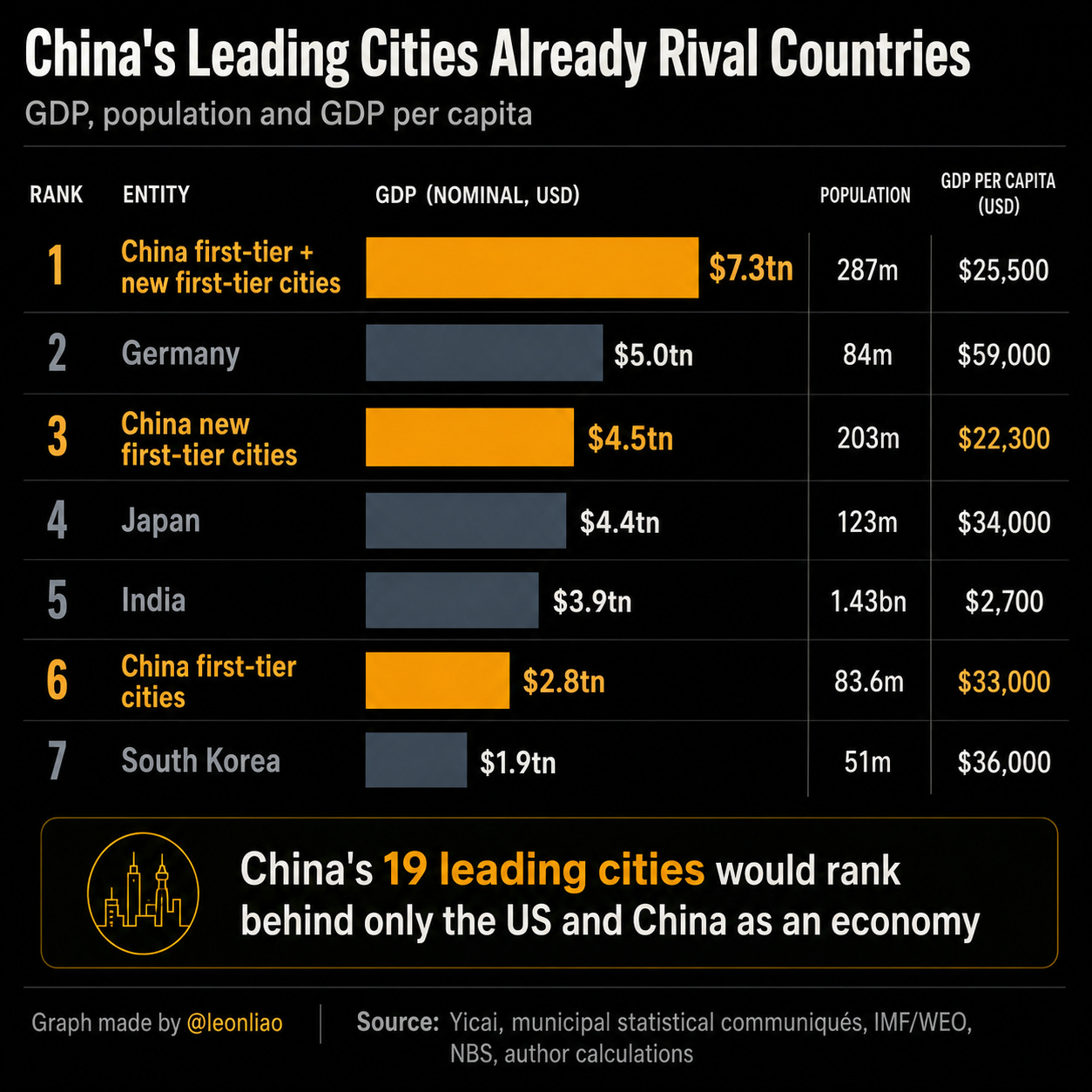
China’s future transition towards high-income status is likely to take the form of a continued expansion of this existing urban system: from the first-tier cities into the new first tier, from powerful provincial capitals and coastal manufacturing centres into ordinary prefecture-level cities, and eventually from those cities into counties and smaller urban areas.
China is still developing. The developed urban economy hidden beneath its national average is already larger than almost every country on earth.
Read more:
If this framework helps you understand China, industrial power, state capacity, capital, technology, and global order beyond the usual headlines, please consider subscribing to China as a System.
Paid subscriptions help support this work. A like, restack, comment, or share also helps this work reach more readers.
For a full guide to the publication and its main research series, start here: China as a System: Publication Map.
No posts
Comments
Nothing yet. Say the first thing.
Sign in to join the conversation.