

You have taken 15 investor meetings this quarter. You refined the deck after each one. You rehearsed the answers. Every conversation ended the same way.
“Interesting business. Let’s stay in touch.”
Your board is asking which conversations are actually progressing. You don’t have a good answer.
Here is what is happening. You are playing a game with rules nobody explained to you.
This article covers the four mistakes that kill capital raises before they start, and the four-step process that institutional investors actually respond to.
Most founders operate on the same assumption: get the deck right, take enough meetings, and eventually someone will say yes.
That assumption is wrong.
The problem is not your deck. Institutional investors do not invest in good businesses. They invest in businesses positioned correctly for institutional capital. Those are two different things.
Treating fundraising like a sales process, where more meetings equal more chances to close, does not work at this level. Every meeting that ends with “let’s stay in touch” without clear feedback trains investors to see you as someone who does not understand their world. You are not building momentum. You are burning credibility.
When you are sitting on eight months of runway with burn accelerating, you cannot afford to learn by trial and error.
Raising institutional capital is not about pitching harder. It is about positioning correctly before you pitch at all.
Institutional investors see hundreds of deals. They pattern-match in the first five minutes: Does this founder understand how we think? Is this business positioned for public market scrutiny? Do they have the right advisors around them?
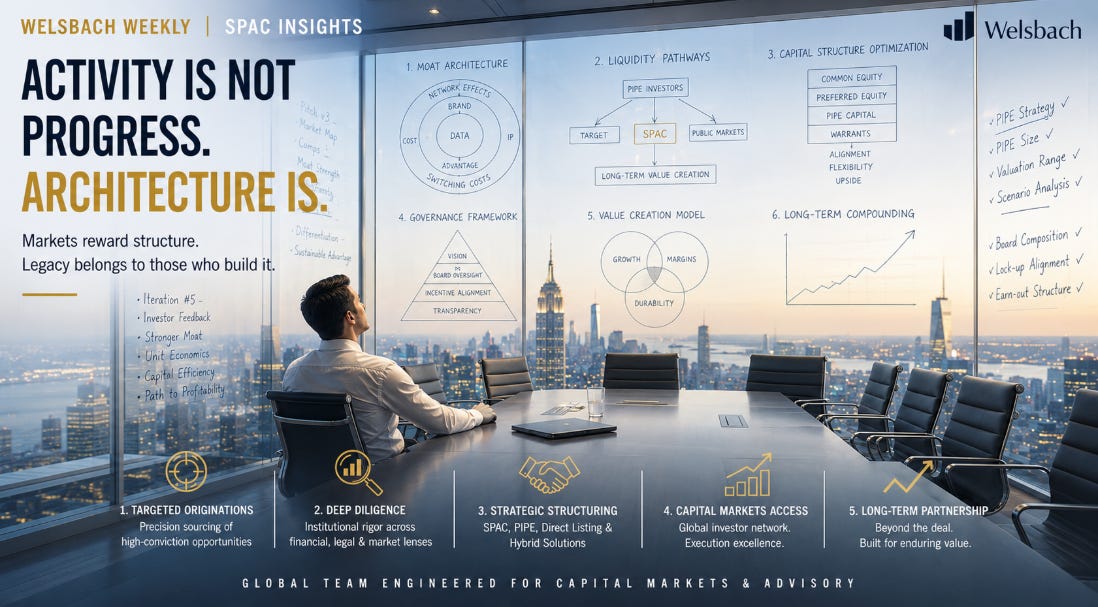
Fix positioning first and the pitch becomes straightforward. Map investors before you reach out and you stop wasting time in the wrong rooms. Architect your capital story in public market language and term sheets follow.
At Welsbach, we built the TTSM Process, the Target To SPAC Matching Process, not as a framework born in theory but as a response to watching smart founders make the same four mistakes over and over. Companies that spent six to twelve months pitching to the wrong investors, then rebuilt their approach from the ground up and closed rounds in 90 days.
Here are the four mistakes. And how to fix them.
Founders pitch the metrics that got them to Series A: ARR growth, customer logos, product roadmap. That worked with early-stage VCs. It does not work with institutional capital.
Institutional investors think in public market terms. Total addressable market. Competitive moat. Path to liquidity. Governance structure. If you cannot speak that language, they assume you are not ready, regardless of your revenue.
You might have USD 30 million in revenue and 30 employees. If you are still talking like a startup, institutional investors hear “not ready.”
The fix is a Market Positioning Audit. Diagnose how you are currently perceived by institutional investors and identify the gaps between your operational credibility and your capital markets positioning.
The shift looks like this: from “we grew ARR three times” to “we are capturing 12 percent of a USD 4 billion addressable market with a defensible moat and a clear path to public listing.” Same business. Different language. Different response.

When founders are under pressure they take every meeting they can get: local VCs, angel syndicates, family offices found on LinkedIn. The logic is that volume increases the odds.
It does not. A family office writing USD 5 million checks may not be the right lead for your USD 50 million round. An early-stage VC cannot help you at this scale. Every meeting with the wrong investor wastes time and dilutes your story.
Worse, when investors who were never going to back you pass, other investors notice. The market is smaller than it looks.
The fix is an Investor Mapping and Access Strategy. Identify the 10 to 15 institutional investors who have the mandate, sector focus, and check size to match your stage and geography. Then create a warm introduction pathway through trusted relationships, not cold outreach.
The critical distinction is this: focus on investors who have capital they need to deploy. SPACs, for example, are sitting on committed capital with a defined timeline. They are not evaluating whether to invest. They are evaluating where to invest. That changes everything about the conversation.
That is the difference between 15 meetings that go nowhere and five conversations that produce term sheets.
Most founders open with “here is what we built” and spend the first 20 minutes on features, tech stack, and customer use cases.
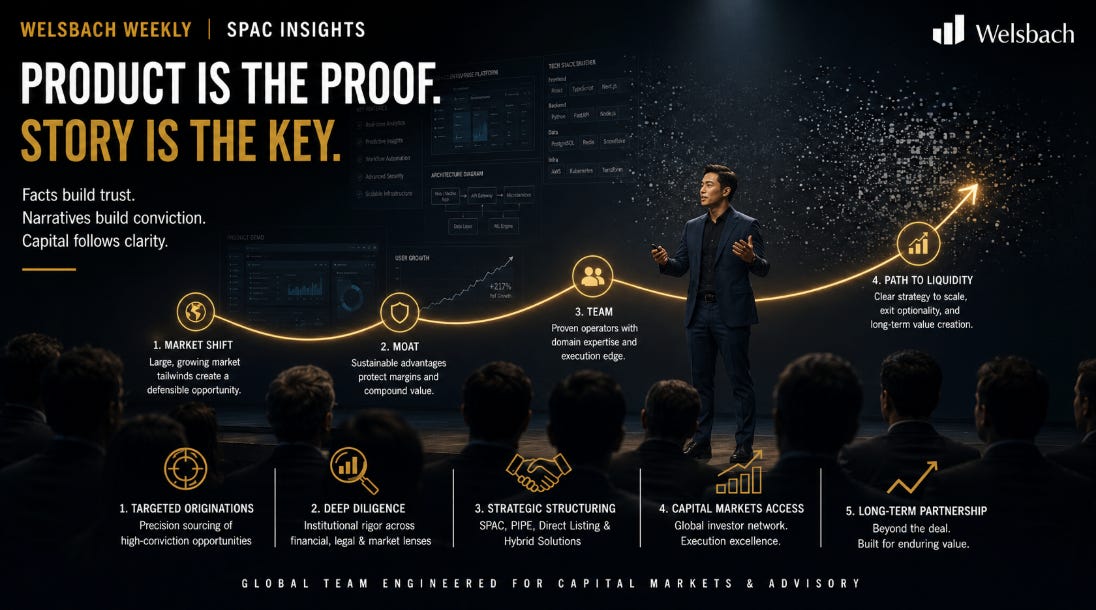
Investors do not buy products. They buy narratives. They want to know why this company wins, why now, and why this team. If you cannot answer those questions in the first five minutes, they have already moved on.
The fix is Capital Story Architecture. Translate your operational metrics and business fundamentals into the narrative and positioning language that public market and institutional investors respond to.
Your capital story needs to answer four questions. Why is this market about to shift, and why are you positioned to capture it. Why competitors cannot replicate what you have built. Why this team executes. Why the path to liquidity is clear.
Once the story is clear, the product details become evidence. Not the main event. And if you are serious about institutional scrutiny, get a PCAOB audit done. It signals that you understand the game.
Founders exploring a listing often gravitate toward the ASX, TSX, LSE, or a regional Asian exchange because an advisor told them it would be faster or the barriers are lower.
For institutional capital at scale, only US public markets matter. The depth of capital, the liquidity, the analyst coverage, the institutional investor base: nothing else comes close. A NASDAQ or NYSE listing gives you access to investors who write USD 50 million and above checks and understand high-growth business models.
A secondary listing first means you are building toward a smaller capital pool, lower valuations, and limited liquidity. You will spend years trying to uplist to the US from a position of weakness.
The fix is Public Market Pathway Design. Map your route to US public markets from day one. Structure pre-listing milestones, governance, and investor engagement strategy so you are building toward NASDAQ or NYSE, not settling for a regional exchange.
Other markets have their place as secondary listings after you have established yourself in the US. Leading with them is a strategic mistake that costs you time, money, and credibility.

I know the objection. This sounds like it takes months and you need capital now.
The TTSM Process is not designed to replace what you are doing. It runs in parallel. Keep taking the meetings you are taking. Keep working your network. But start building the institutional pathway at the same time.
If your current approach closes a round in 60 days, you have bought runway. But you will need to raise again in 12 to 18 months. The positioning work you start today makes that next raise significantly easier.
If your current approach is not working and you are six months in with no term sheets, you will be glad you started this process when you did. The earlier you start, the better position you are in.
Only a problem if you come back with the same story.
If you have repositioned, rebuilt your capital story, and you are now introduced through a trusted advisor rather than cold outreach, you are a different company in their eyes. Investors respect founders who take feedback seriously and come back stronger.

Raising institutional capital is not about pitching harder. It is about positioning correctly before you pitch at all.
The four mistakes that kill raises: positioning like a private company, pitching to anyone who will listen, leading with product instead of story, and building toward the wrong public market.
The TTSM Process addresses each one in sequence: Market Positioning Audit, Investor Mapping and Access Strategy, Capital Story Architecture, Public Market Pathway Design.
If you are sitting on 6 to 12 months of runway, taking meetings that go nowhere, wondering why investors are not biting, the answer is not more meetings. It is a better process.
Start now. In parallel with everything else you are doing.
Take ten minutes and review your current approach with these questions.
Are you positioned for institutional capital, or are you still talking like a private company?
Are you in the right rooms, or wasting time with investors who cannot write the check you need?
Is your CFO talking to SPACs and institutional investors with capital to deploy?
Do you have a capital story, or just a product pitch?
Are you building toward US public markets, or settling for a secondary exchange?
If you are not sure, that gap is what is costing you term sheets.
Exploring growth capital or a U.S. listing? Partner with the Welsbach team to make it happen. Reach Us: Click Here
Website: https://welsbach.group/
Contact Us: Click Here
Email: contact@welsbach.sg
Comments
Nothing yet. Say the first thing.
Sign in to join the conversation.