
The blank-check market has come back to life, but the terms of survival have changed. U.S. SPAC issuance hit 145 new listings in 2025, the highest annual total since 2021, with 245 vehicles holding roughly $56.8 billion in undeployed capital as of mid-June 2026. SPACs accounted for 69% of U.S. IPO deal volume in the first quarter of 2026, a structural shift, not a fad.
Yet the headline number that should occupy any management team is not issuance, It is redemptions. The recent average SPAC redemption rate ran near 99%, with June alone at 97%. In practice, the cash a target expects to inherit from the trust account frequently evaporates at closing. A listing, in other words, no longer guarantees the capital that justified pursuing one.
That reframes the entire exercise. Getting public has become the easy part. Arriving public with a balance sheet capable of sustaining a valuation and a float deep enough to attract institutional buyers, is the hard part. Growth still matters. But capital structure now decides whether the growth ever gets financed.
Welsbach operates as an integrated capital markets platform supporting companies across the full public-company lifecycle, SPAC and De-SPAC advisory, target-to-SPAC matching (TTSM™), structured finance, pre-IPO bridge financing, IPO and PIPE solutions, capital markets and M&A advisory, and post-listing capital raises. The relevant point for this discussion is sequencing: liquidity is treated as a problem to be engineered before a deal is announced, not patched after redemptions are known. That orientation reflects where the market has moved
The 2021 SPAC boom collapsed for a specific reason. As redemptions climbed, sponsors compensated by handing targets more equity, accepting inflated valuations, and layering on warrant-heavy PIPEs. Public float shareholders in some deals ended up owning a sliver of the combined company. More than 90% of de-SPAC companies still trade below the $10 reference price, and only about 15% of mergers from the past five years trade above it.
Investors learned the lesson and repriced the risk. Today’s SPAC IPO buyer largely treats the instrument as a redeemable, trust-backed money-market position, collect interest, redeem at closing, and decide separately whether to hold the operating company. That behavior is rational, and it is now the base case sponsors must structure around.
The consequence is that trust cash can no longer be assumed. Capital availability at closing depends on what the deal team builds alongside the merger: committed financing, anchor participation, and credible downside protection. Liquidity has become the variable that determines deal completion, valuation support, and post-listing trading.
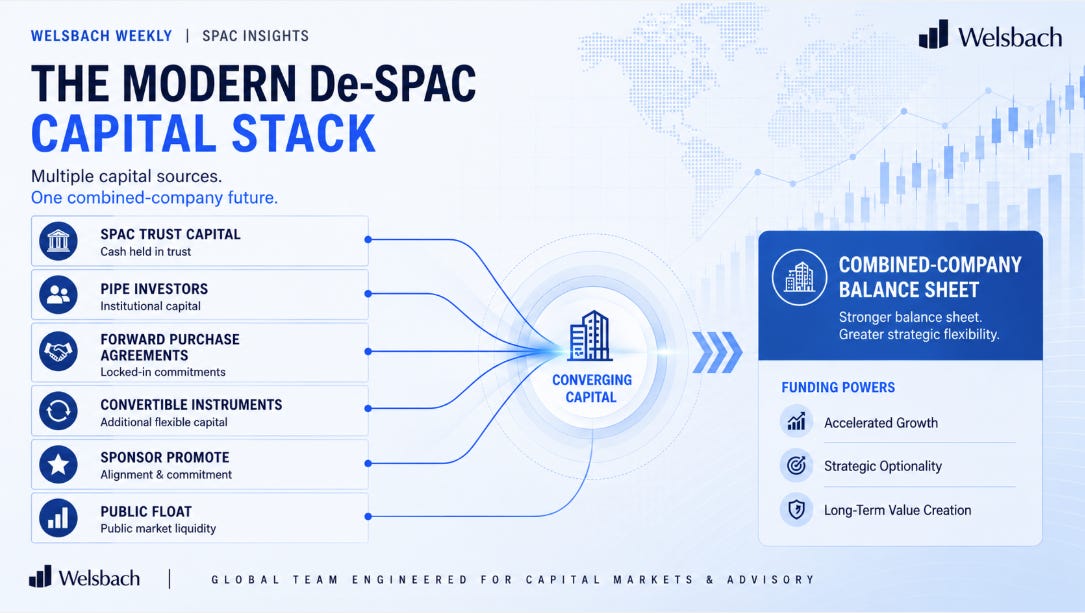
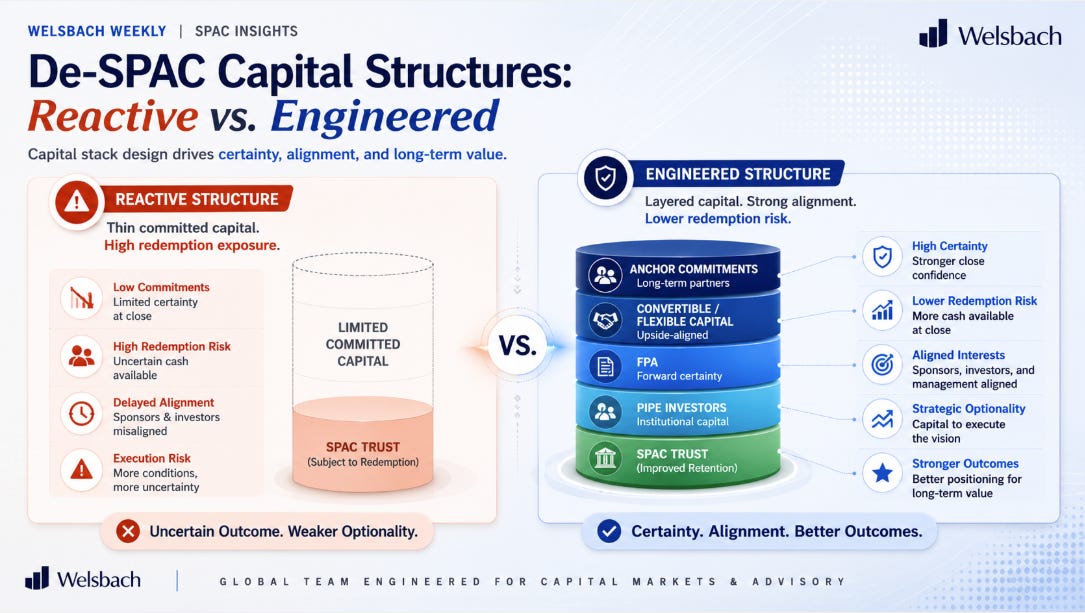
Liquidity engineering is the deliberate construction of committed, layered capital that does not depend on public shareholders staying invested. The toolkit is now well established:
PIPE financing: Still the workhorse. The market has reopened, with a growing number of $10 PIPEs priced to match the SPAC reference price. The Einride combination with Legato Merger Corp. III, which listed on Nasdaq as ENRD in June 2026, is the template: Einride raised $113 million in an oversubscribed PIPE that exceeded its $100 million target, bringing committed capital to roughly $213 million against about $220 million of trust cash before redemptions. The PIPE was the difference between a deal exposed to redemptions and one underwritten in advance
Convertible instruments: Convertible notes and preferred stock, typically carrying 6-7% coupons and conversion features, give institutional investors a defined return plus upside. The tradeoff is overhang: conversion shares can pressure the float once the stock clears the conversion price
Forward purchase agreements (FPAs): A sponsor or affiliated fund commits at IPO to buy combined-company shares at $10 regardless of redemptions, committed capital that directly reduces the PIPE burden later
Structured equity and earnouts: These bridge valuation gaps between sponsor and target, tying a portion of consideration to post-close performance rather than front-loading dilution
Sponsor restructuring: Promote adjustments and non-redemption agreements realign incentives. Sponsors are increasingly committing fresh capital to signal conviction
Pre-IPO bridge financing and secondary liquidity: Capital that funds the company through the transaction window and offers early holders an orderly exit, reducing the pressure that drives redemptions in the first place
The shift Odyssey Trust flagged for 2026 is timing: PIPE financing, anchor investors, and forward purchase agreements are now arranged alongside deal negotiations rather than after the fact.
Engineered liquidity is not a defensive measure. Done well, it changes the economics of the transaction:
Reduced dilution: Committed FPAs and $10 PIPEs lower the need to over-issue equity to cover redemption shortfalls, protecting the cap table
Stronger valuation support: A deal that closes with predictable cash and a credible float defends its price; a deal that closes underfunded invites the discount
Greater institutional participation: Anchor investors and structured protections signal that sophisticated capital has underwritten the story, a prerequisite for attracting more of it
Higher transaction certainty: Minimum cash conditions backed by committed financing reduce the binary risk that a wave of redemptions sinks the merger at the eleventh hour
Improved post-listing performance: Research consistently links high redemptions and low public cash to worse subsequent returns. Capital depth at closing is among the cleaner predictors of how the stock trades afterward
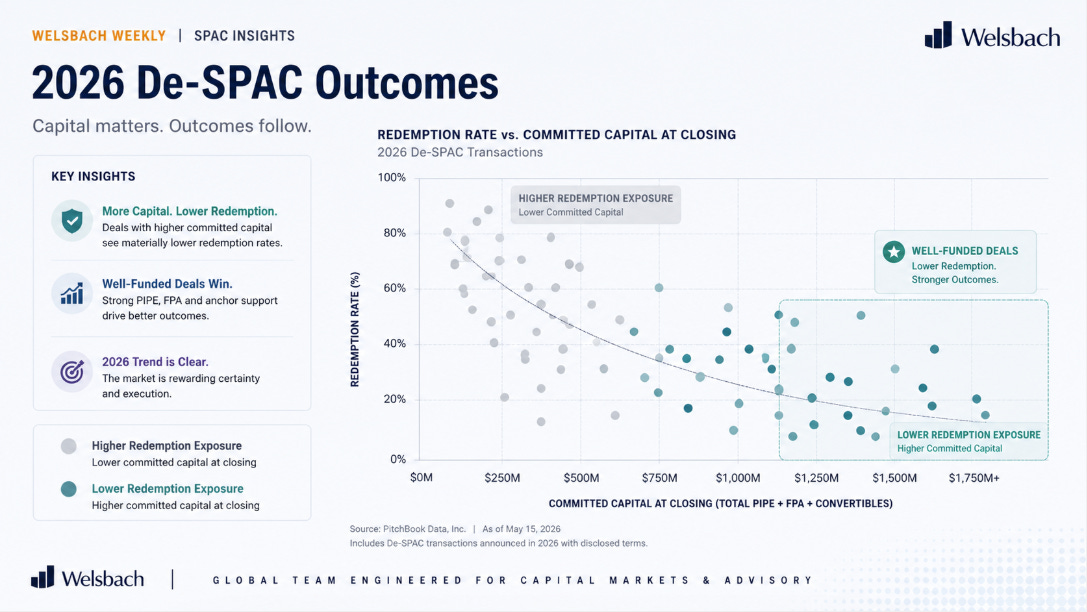
The 2026 cohort sharpens the contrast with the boom era. 20 deals closed in the first half of 2026, representing roughly $25 billion in equity value, a more deliberate cadence than the mergers consummated in 2021. The dispersion in outcomes is the lesson, and it tracks capital structure closely.
Several patterns are worth noting:
Pre-committed financing is the differentiator: The cleanest 2026 closings paired the merger with locked-in capital. General Fusion’s announced combination with Spring Valley Acquisition Corp. III, valuing the company near $1 billion, came with a $105 million PIPE from institutional investors alongside $230 million of trust capital, committed before close, explicitly “to remove risk from the transaction,”
Structured PIPEs now reach niche and digital-asset targets: Ace Green Recycling secured a $32 million PIPE from sector-focused institutions to fund its merger, and Avalanche Treasury Co. (AVAT) closed its de-SPAC and PIPE together on Nasdaq in June 2026, evidence that committed capital, not trust cash, is what carries a deal across the line
Redemption management is assumed, not hoped for: Terms are now engineered on the premise that some, often most, public shareholders will redeem
Institutional credibility gates capital: As one 2026 market analysis observed, even well-structured deals can struggle to raise capital; investors weigh execution risk and the credibility of the participants holistically. The fact that serial sponsors backed a clear majority of new 2026 vehicles reflects that flight to credibility
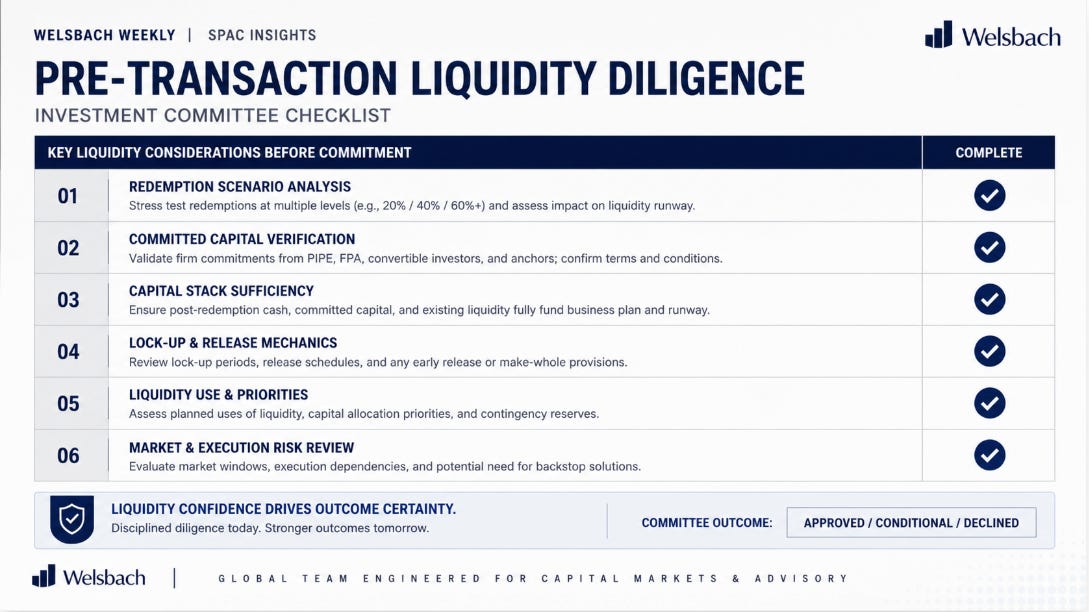
Before committing to a De-SPAC path, management teams should pressure-test the capital plan against the following checklist:
Is our capital structure public-market ready? Can it withstand 90%-plus redemptions and still fund the business plan?
Where are the liquidity gaps? What is the realistic cash position at closing under a high-redemption scenario, not the trust headline?
How much capital is actually needed post-closing? Through the next milestone, with a margin for a market that may stay selective on follow-on raises
Are institutional investors aligned with the story? Is there anchor or PIPE conviction before announcement, or only after?
Is the financing committed or contingent? FPAs, backstops, and minimum cash conditions, signed, or aspirational?
Does the sponsor have skin in the game? Is promote restructured and fresh sponsor capital committed?
The first SPAC era treated the listing as the finish line and financing as an afterthought. The market punished that sequence severely. What replaced it is a discipline, not a transaction technique.
Liquidity engineering now sits upstream of valuation, investor confidence, execution certainty, and long-term public-market performance. It determines whether a company arrives public with the capital to compete or merely with a ticker.
With 245 active SPACs competing for targets and redemptions still the rule rather than the exception, the firms that engineer liquidity across the full transaction lifecycle, rather than negotiate for it after the fact, are the ones that will still be trading above their reference price a year out. Getting listed was never the achievement. Staying financed is.
Exploring growth capital or a U.S. listing? Partner with the Welsbach team to make it happen. Reach Us: Click Here
Website: https://welsbach.group/
Contact Us: Click Here
Email: contact@welsbach.sg
Comments
Nothing yet. Say the first thing.
Sign in to join the conversation.