
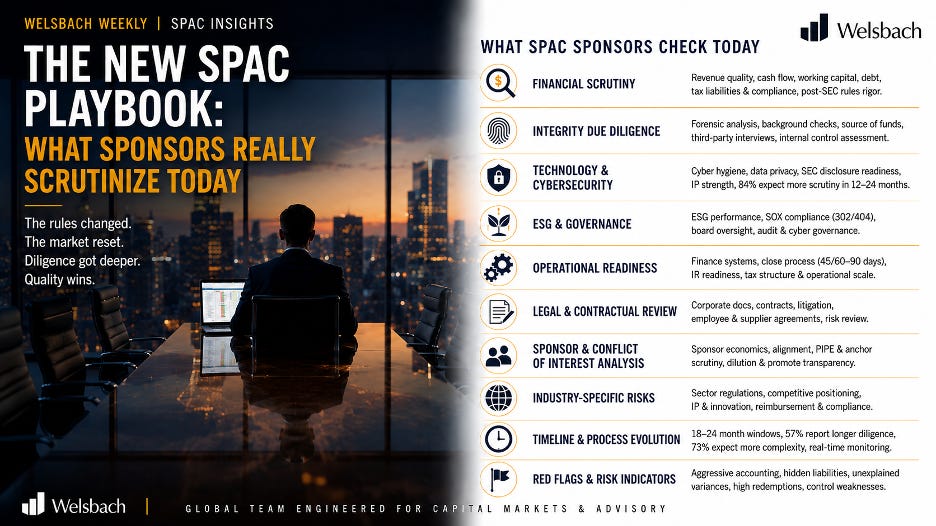
A private company CEO stated that his SPAC merger fell apart "out of nowhere." It did not. It fell apart in a windowless conference room three weeks earlier, when a PIPE investor's analyst asked for monthly revenue by cohort and the company produced a spreadsheet that disagreed with its own audited financials.
That is the modern SPAC failure: not a market crash, not a missing sponsor, but a quiet moment of arithmetic that reveals the company was never actually ready to be public. By the time it surfaces, the timeline is already eating the deal alive.
The uncomfortable truth of 2026 is that capital is no longer the scarce ingredient. Readiness is.
At Welsbach, we increasingly find that the most valuable work happens long before a deal is announced. Sponsors are no longer underwriting ambition alone; they are underwriting execution. Helping companies build the governance, financial reporting, investor positioning and transaction readiness expected by today’s SPAC ecosystem has become just as important as identifying the right capital markets pathway.
SPAC Market Share at Cycle High: SPACs accounted for 61% of all U.S. IPOs by count through May 2026, matching the record level reached during the 2021 boom. Market share has risen sharply from 19% in 2024 and 42% in 2025, underscoring the continued resurgence of the SPAC market.
Search Capital Remains Elevated: Of the active SPAC universe, 245 vehicles are actively searching for targets, representing approximately $46.0 billion of deployable capital available for mergers and acquisitions.
Deepest Live Deal Pipeline Since 2022: There are currently 107 announced but unclosed SPAC transactions representing $69.6 billion in aggregate equity value, highlighting a robust forward merger pipeline and sustained sponsor confidence.
Strong Conversion Environment: YTD, 15 SPAC mergers have closed with aggregate equity value of $20.1 billion, while only 4 SPACs have liquidated representing $0.9 billion, reflecting one of the healthiest completion environments since the post-2021 market reset.
Forward IPO Pipeline: An additional 69 SPACs are currently in registration, representing $8.9 billion of prospective trust capital that could enter the market over the coming quarters.
But this is not 2021 wearing a new tie. The composition has changed. Serial sponsors, teams that have closed before and intend to close again, drove the large majority of new issuance through 2025. These are repeat players with reputations to protect, anchor investors to keep happy, and no appetite for the celebrity-endorsed wreckage of the last cycle.
The result is a market that is simultaneously more open and less forgiving. More vehicles are hunting. Fewer mistakes are survivable.
For years, the binding constraint in a de-SPAC was finding a willing sponsor. That constraint has loosened. The new constraint is whether the target can withstand institutional scrutiny on a clock.
Consider the redemption data, which is brutal and clarifying. Houlihan Capital pegged the median Q2 2025 redemption rate at 99.6%. Translation: public shareholders are voting with their feet and pulling almost all the trust cash out the door. A deal now lives or dies on committed capital that is locked in before the vote, primarily the PIPE, where mean proceeds ran about $259 million across a thin handful of Q2 2025 deals.
PIPE investors do not write nine-figure checks on vibes. They write them with diligence and diligence is precisely where unprepared companies discover, in public, what they should have fixed in private.
The deals that defy the redemption gravity prove the point. When Churchill Capital Corp X merged with quantum firm Infleqtion in early 2026, shareholders largely declined to redeem, and the company collected more than $550 million, including a $125 million PIPE. Low redemptions are not luck. They are the market’s verdict on a company that showed up ready.
Deals rarely die from one dramatic event. They die from an accumulation of small, avoidable failures that erode confidence until the financing won’t hold. The recurring culprits:
Financial reporting gaps. Numbers that can’t be reconciled across the data room, the audit, and management’s own model. Nothing spooks a PIPE faster than two true-looking numbers that don’t match
PCAOB audit timing. Private-company audits and public-company (PCAOB) audits are different animals. Companies routinely discover they need to re-audit prior years to PCAOB standards, a multi-month surprise dropped into a 90-day window
Weak internal controls. No documented close process, no segregation of duties, no audit trail. Functional for a startup; disqualifying for a registrant
Forecast credibility. Since the SEC’s January 2024 rules stripped SPACs of the PSLRA safe harbor for forward-looking statements, projections now travel without a liability shield. A hockey-stick model nobody can defend is no longer optimistic, it’s exposure
Governance deficiencies. A board that has never operated under public-company obligations, missing committees, undefined independence. Sophisticated investors read this as risk, and price it
Disclosure weakness. Under the new Subpart 1600 of Regulation S-K, sponsor compensation, conflicts, and dilution must be laid bare, and the target is now a co-registrant carrying Section 11 liability. Vagueness is no longer a strategy; it’s a filing comment
Data-room chaos. When diligence requests are met with “let me find that,” investors quietly recalculate their redemption decision.
Projections for vehicles that did not yet exist in production form
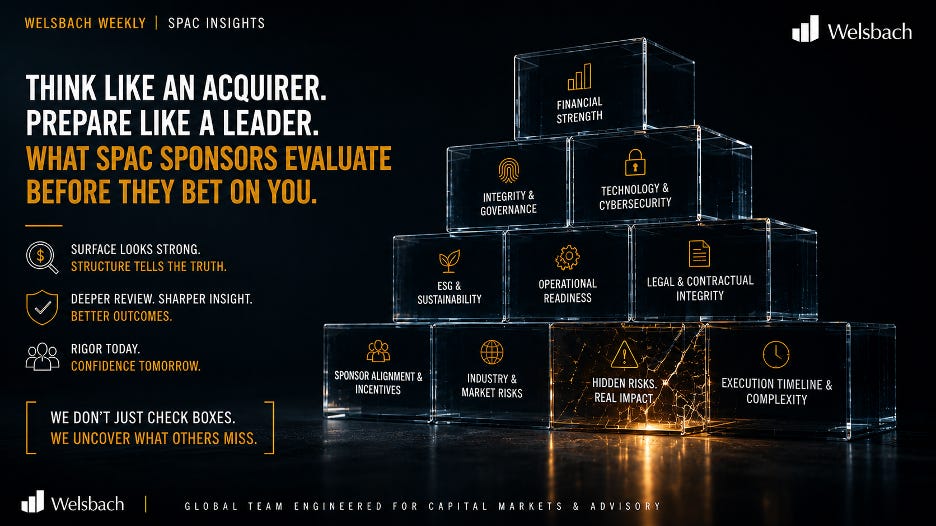
Here is the trap. Founders model the de-SPAC as an event: sign, announce, close. Regulators and auditors experience it as a process, and processes have queues.
Most SPACs in 2024–2025 took more than two years to reach the post-merger stage. The friction lives in the parts founders underestimate: PCAOB-compliant audits that can run months; SEC comment cycles on the proxy and registration statement; the mandatory 20-day minimum dissemination period for de-SPAC disclosure documents; and investor diligence that compounds every time an answer arrives late.
Time is not neutral here. Every week of delay raises the probability that a sponsor’s deadline lapses, that anchor PIPE commitments wobble, that market conditions turn, or that the projections quietly drift away from reality, which now triggers an affirmative obligation to disclose that they’ve changed. Delay doesn’t just cost time. It compounds into lost value, and eventually, lost deals.
The companies that close cleanly treat readiness as work to be done before a process begins, not during. A working framework:
Financial readiness: PCAOB-ready audited statements, a fast and documented monthly close, and a model that reconciles the audit to the dollar
Operational readiness: KPIs you can defend cohort by cohort, with the data infrastructure to produce them on demand, not on request
Governance readiness: An independent-majority board, functioning audit and comp committees, and directors who have lived under public-company scrutiny before
Investor readiness: A genuine equity story, a credible (defensible, not maximal) forecast, and PIPE conversations seeded early rather than scrambled late.
Regulatory readiness: Subpart 1600 disclosures drafted, projection assumptions documented, and the Section 11 co-registrant reality understood at the board level
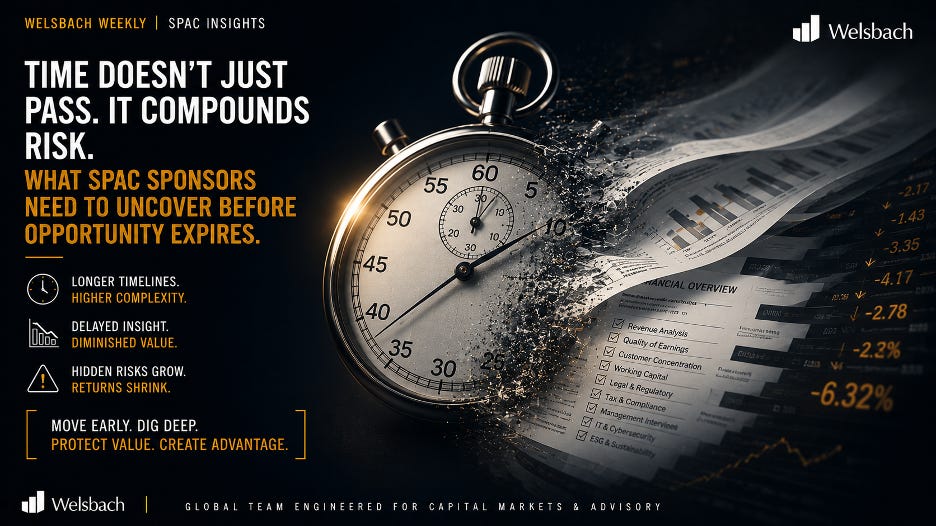
This is the work Welsbach does before the clock starts. We sit with companies in the quiet months ahead of a transaction, closing financial-reporting gaps, hardening governance, pressure-testing forecasts against what institutional investors will actually accept, and shaping the equity story so the first diligence call confirms strength rather than exposing it.
Our role is capital-markets readiness in the literal sense: making a private company genuinely fit for public ownership before it commits to a structure or a deadline. By the time a sponsor or PIPE investor is in the room, the answers already exist. That is the difference between negotiating from readiness and improvising under pressure.
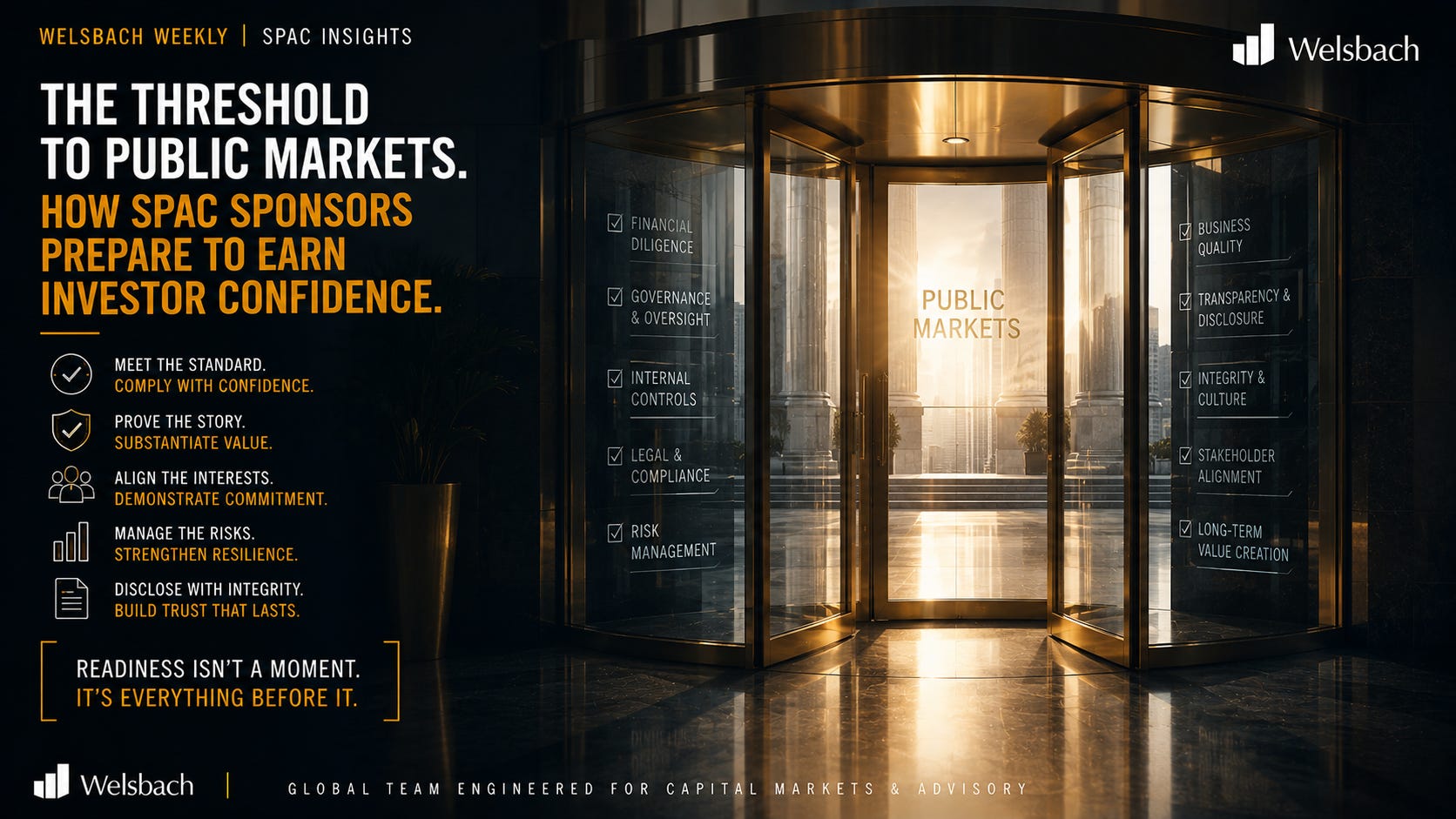
There was a time when being prepared for public-company life was an edge, the thing that separated the good de-SPAC from the average one. That era is over. In 2026, readiness has been repriced from advantage to ante.
The market will still hand you the capital. It simply expects you to have done the unglamorous work first. The CEO who learns this in the conference room learns it too late. The one who learns it months earlier closes the deal everyone else assumed was about luck.
In this market, nobody fails at the finish line. They fail at the starting one, and just don’t find out until later.
SPACs are back, but disciplined. SPACs now account for 61% of all U.S. IPOs, matching the peak levels of 2021. 107 live De-SPAC transactions represent nearly $70B in equity value, the deepest pipeline since 2022
Capital isn’t the constraint, readiness is. Median redemptions hit 99.6% in Q2 2025, so deals survive on committed PIPE capital won through diligence, not on trust cash
The SEC changed the rules. The January 2024 rules removed the PSLRA safe harbor for projections, made targets Section 11 co-registrants, and mandated Subpart 1600 disclosures. Forecasts now carry real liability
The timeline kills the unprepared. PCAOB re-audits, SEC comment cycles, and the 20-day dissemination period turn “small” gaps into deal-ending delays
Readiness is now the ante, not the edge. Financial, operational, governance, investor, and regulatory readiness must be built before a process starts
Exploring growth capital or a U.S. listing? Partner with the Welsbach team to make it happen. Reach Us: Click Here
Website: https://welsbach.group/
Contact Us: Click Here
Email: contact@welsbach.sg
Comments
Nothing yet. Say the first thing.
Sign in to join the conversation.