
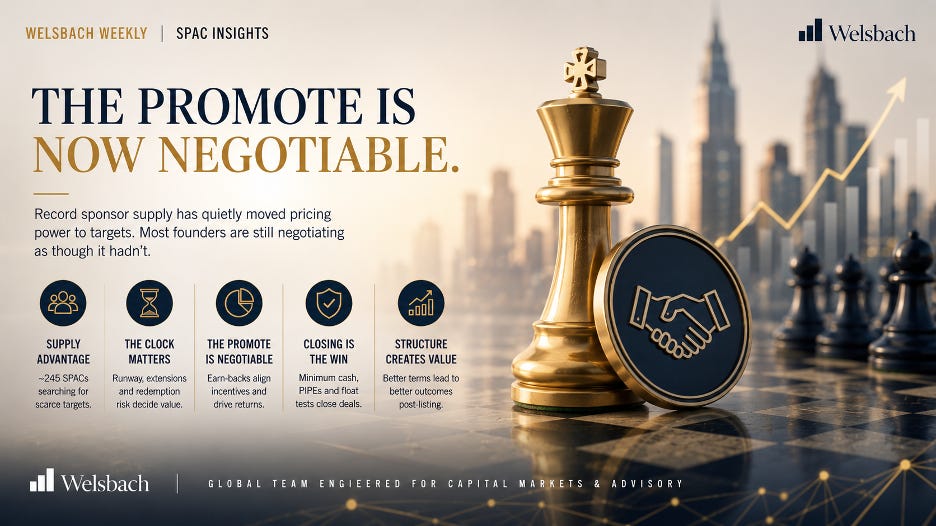
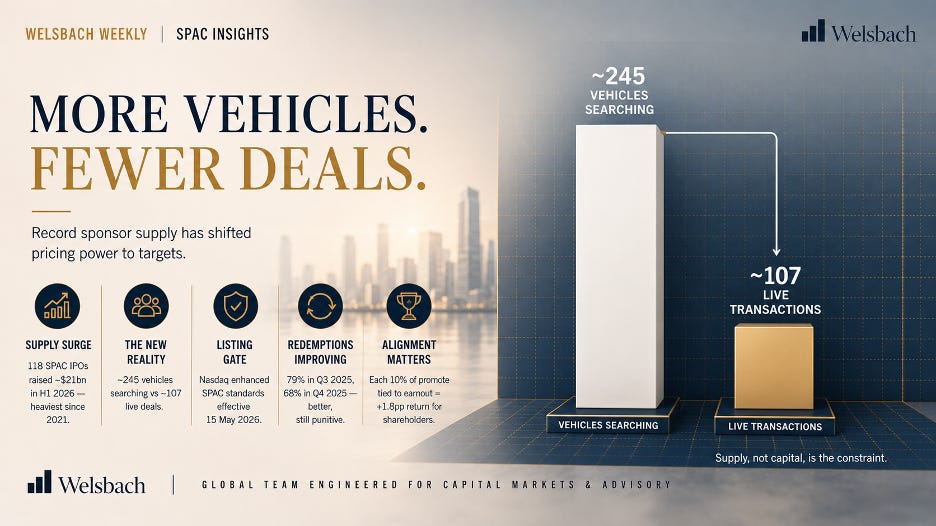
Roughly 245 SPACs are still searching for a target, part of an active universe of about 352 vehicles holding somewhere near $55.6 billion in trust. Against that sits a live pipeline of around 107 announced transactions, per Boardroom Alpha’s running tally.
Read those figures in the right order and the market looks different from the way it is usually described.
Trust cash is abundant. Companies worth listing are not.
That inversion is the most important unpriced fact in the SPAC market today and it shows up not in valuation, but in the terms nobody used to negotiate.
“The scarce asset in 2021 was a listing. In 2026 it is a target”
Sponsor formation has run far ahead of deal formation. Through 30 June, 118 SPAC IPOs raised approximately $21 billion, against 66 SPAC IPOs and roughly $11.8 billion in the first half of 2025.
FTI Consulting put SPACs at 69% of US IPO deal volume in Q1 2026, up from 58% in Q4 2025, a share that reflects vehicle count, not enterprise value created.
Each of those vehicles carries two things a target does not: a clock, and an economic structure that pays the sponsor only on closing.
Meanwhile the traditional market has absorbed the oxygen. PwC counted about $114.1 billion of US IPO proceeds in the first half, more than seven times the prior year, concentrated in a handful of mega-deals. EY recorded 85 Americas listings raising $130.4 billion, volume down 27%, value up sharply.
The practical consequence: sponsors are competing for scarce assets in a year when public-market attention is already spoken for.
Sponsors understand this better than targets do. A vehicle that fails to close returns trust capital, extinguishes the promote and ends the sponsor’s economics entirely. A target that walks away from a bad structure simply keeps operating.
Asymmetric downside is the foundation of negotiating leverage, and it currently sits on the buyer’s side of the table. Very few founders price it.
Supply: 118 SPAC IPOs, ~$21bn raised in H1 2026, the heaviest issuance since 2021.
Demand: ~245 vehicles searching against ~107 live deals; the ratio, not the dollar figure, is the negotiating fact.
Listing gate: Nasdaq’s enhanced SPAC standards became operative on 15 May 2026, a minimum $100m Market Value of Listed Securities on the Global Market, and on the Capital Market $75m MVLS with at least $20m of unrestricted publicly held shares.
Redemptions: aggregate redemption rates eased to roughly 79% in Q3 2025 and 68% in Q4 2025, better, still punitive.
Alignment premium: in research published in the Journal of Financial Economics, Feng, Nohel and Tian find that each 10% of sponsor promote tied to an earnout is associated with 1.8 percentage points of additional return for non-redeeming shareholders.
That last point deserves attention. Promote restructuring is not a founder-friendly concession. It is empirically correlated with better outcomes for the public shareholders a company will depend on for the next decade.
Valuation is the term founders anchor on and the term that matters least, because a headline number attached to a vehicle that cannot close is worth nothing. The negotiable set has widened considerably.
Promote earn-back. A meaningful share of founder shares placed in escrow, releasing only against post-closing price hurdles. Increasingly the market’s baseline expectation rather than a favour.
Minimum cash condition. Set with reference to the Nasdaq float and unrestricted-share tests at closing, not to a comfortable internal budget.
PIPE committed at signing. Announcement risk transfers to the sponsor when the capital is already documented.
Clock quality. A vehicle with under nine months of runway is a different counterparty from one with eighteen, regardless of trust size.
Extension economics. Sponsors funding extensions at roughly $0.03–$0.05 per unredeemed public share per month are consuming optionality that the target ultimately pays for.
Lock-up symmetry. Sponsor lock-ups matching management’s, not expiring ahead of them.
Deferred underwriting and expense caps. Fixed at signing, before the balance sheet meets them.
“A signed deal at a strong valuation with a weak closing structure is not a transaction. It is an option the market will decline to exercise”
They accept “market terms” without asking which market. The 20% promote convention was set in a period of sponsor scarcity that no longer exists. Quoting 2021 precedent into a 2026 supply environment is a transfer of value, not a standard.
They optimise the announcement, not the closing. Redemption behaviour, minimum cash and float tests decide whether a listing survives contact with Nasdaq’s rules. A deal engineered for the press release routinely fails the tests that follow.
They negotiate with one sponsor. Bilateral discussions with a single motivated vehicle produce bilateral outcomes. The founder never learns what the alternative bid was.
They let the sponsor own the story. Investor positioning drafted by a counterparty whose economics vest on closing will emphasise closing, not durability. The company inherits the narrative and the multiple it supports.
The advantage available today is procedural rather than clever. Companies that run a structured process across multiple vehicles, comparing clocks, trust quality, sponsor track record, PIPE relationships and promote flexibility side by side, are extracting materially better terms than companies responding to inbound interest.
Three things travel with that discipline:
Better economics, because competitive tension exists and can be observed.
Higher closing probability, because minimum cash and float are solved before signing rather than during the proxy.
A cleaner cap table at listing, which is what determines coverage, index eligibility and aftermarket depth.
Sponsors, for their part, are not disadvantaged by this. A vehicle that wins a competitive process with restructured economics and committed capital closes more reliably than one that wins on price alone.
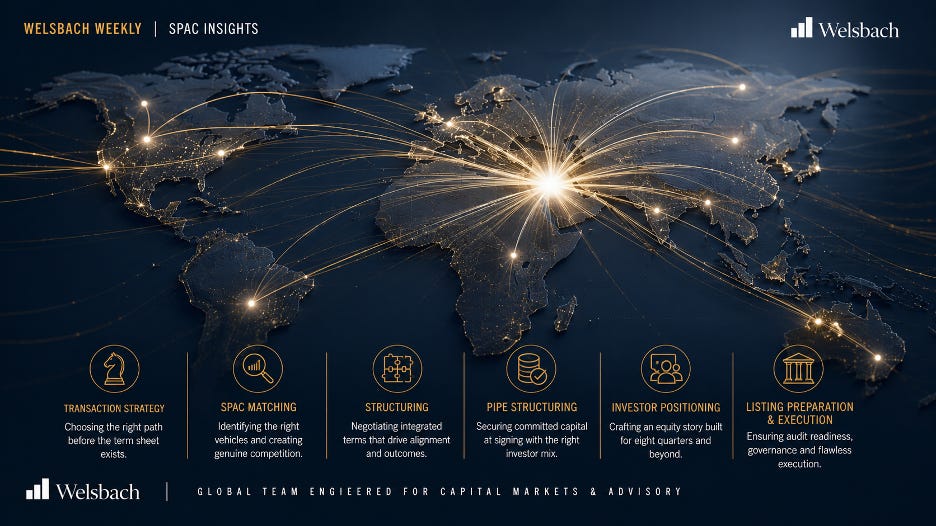
The value an advisor adds here is comparative knowledge, not access. Welsbach’s work sits at six points.
Transaction strategy. Establishing whether a SPAC route, a traditional listing or a delay produces the better long-run cost of capital, before a term sheet exists.
SPAC matching. Assessing vehicles on clock, trust composition, sponsor history, redemption exposure and PIPE reach, then creating genuine competition among them.
Structuring. Negotiating promote earn-backs, minimum cash conditions, lock-up symmetry and expense caps as an integrated package rather than isolated concessions.
PIPE structuring. Securing committed capital at signing, sized against Nasdaq’s closing tests, with investors chosen for their behaviour after the lock-up expires.
Investor positioning. Building an equity story the company can defend across eight quarters of reporting, owned by the issuer rather than the counterparty.
Listing preparation and execution. Audit readiness, governance, float construction and disclosure sequencing, so the closing tests are arithmetic rather than hope.
Most value in a de-SPAC is created or destroyed in the six weeks before signing. That is where experience compounds.
The SPAC market spent five years arguing about whether the structure works. That argument is largely settled: it works when the terms are right and fails when they are not.
What has changed in 2026 is who gets to set the terms. Capital has become plentiful and impatient; quality has become scarce and unhurried.
Founders keep asking whether a SPAC will accept their valuation. The better question, and the one the numbers now support, is whether they should accept the sponsor’s economics.
Exploring growth capital or a U.S. listing? Partner with the Welsbach team to make it happen. Reach Us: Click Here
Website: https://welsbach.group/
Contact Us: Click Here
Email: contact@welsbach.sg
Comments
Nothing yet. Say the first thing.
Sign in to join the conversation.