
We spend hours researching, and talking to the smartest founders, dealmakers and investors in the SPAC landscape. This is our attempt to give you a short 5-10 minute summary on how we are thinking about the macro, markets & SPACs, and what lies ahead. Hundreds of hours summarized, so you don’t have to.
Visit our website at Welsbach Group to learn more about our services and expertise.
U.S. equities remained near record highs through early August, although easing inflation gave way to renewed concerns over rising energy prices and interest rates. June CPI slowed to 3.5%, supported by a sharp decline in energy costs, while core inflation eased to 2.6%. However, a late-July surge in Brent crude above US$100 briefly reignited inflation fears, pushing Treasury yields higher and increasing expectations of another Federal Reserve rate hike following the July FOMC meeting. Economic growth moderated, with Q2 GDP expanding 1.5%. Meanwhile, strong corporate earnings provided support, as S&P 500 companies continued to deliver robust revenue and profit growth.
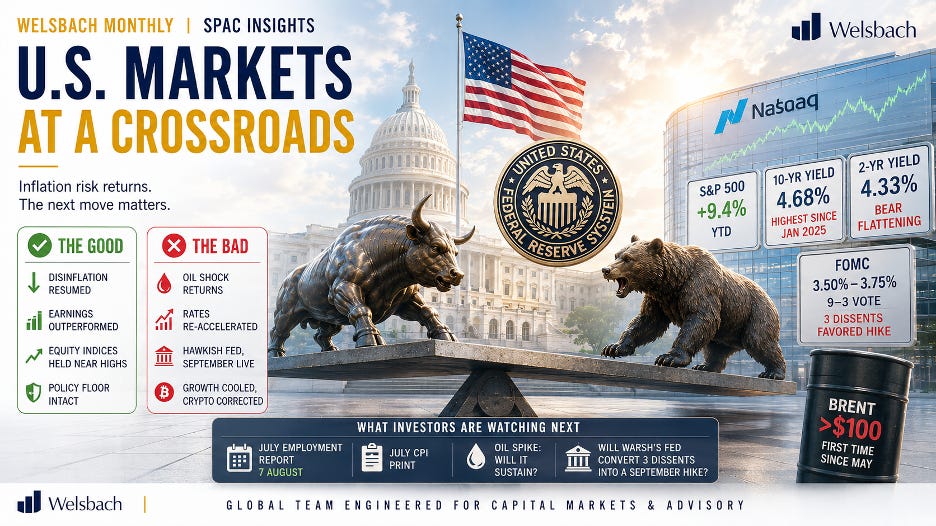
Disinflation resumed at mid-month. June CPI cooled to 3.5% from 4.2%, a 0.4% monthly decline, the largest since April 2020, as the energy index fell 5.7% and gasoline 9.7%. Core inflation eased to 2.6% from 2.9%
Earnings outperformed a soft macro. With 61% of the S&P 500 reported, blended Q2 earnings growth reached 47.4% and revenue growth 14.1%, the strongest top line since Q4 2021; 86% of companies beat EPS estimates against a 78% five-year average
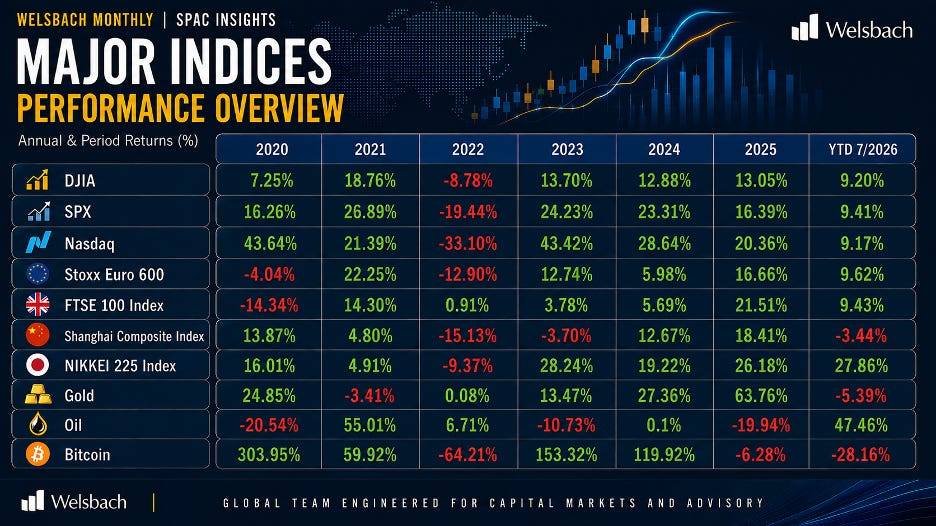
Equity indices held near highs. Through July, the S&P 500 was up 9.4% year-to-date, the Dow 9.2% and the Nasdaq 9.2%, while Japan’s Nikkei 225 led major markets at 27.9%, evidence of breadth beyond U.S. mega-caps
Policy floor intact. The FOMC held at 3.50–3.75%, well below the prior peak after last year’s cuts. Tellingly, all three dissents favored a hike, not easing, a sign the economy is absorbing restrictive policy rather than breaking under it
Oil shock reversed the energy tailwind. A Red Sea tanker strike sent Brent above $100 for the first time since May, up 7% in a single session to $100.69, with WTI up 6% to $92.19. Crude is up roughly 47% year-to-date, the largest rally across major assets
Rates re-accelerated. The 10-year Treasury yield rose to 4.68%, its highest since January 2025, and the two-year climbed faster to 4.33%. The bear-flattening signals renewed inflation risk, not growth optimism
A hawkish Fed left September live. Policymakers held at 3.50-3.75%, but three officials dissented for a hike and markets price about a 57% chance of a September increase. Chair Warsh declined to signal any easing
Growth cooled and crypto corrected. Q2 GDP slowed to a 1.5% advance rate, below expectations. Bitcoin fell roughly 28% year-to-date and gold gave back 5%, the sharpest reversals among tracked assets after 2025’s outsized gains
Market share near a cycle high. SPACs represented 59% of U.S. IPOs by count in 2026 year-to-date, up from 42% in 2025 and 19% in 2024, and within reach of the 61% record set in 2021. In July, 18 SPAC IPOs priced against 11 traditional listings
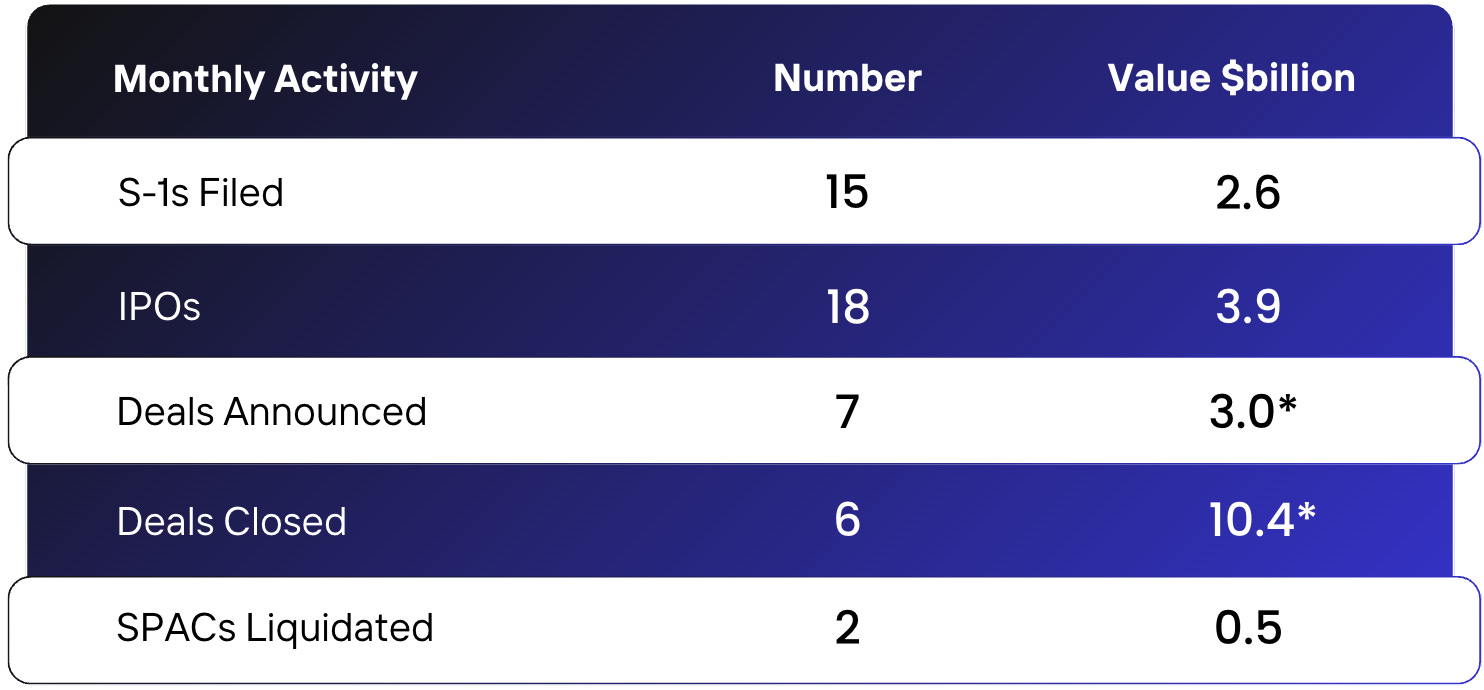
Issuance stayed firm. July delivered 18 SPAC IPOs raising $3.9 billion, alongside 15 new S-1 filings targeting $2.6 billion. Year-to-date, 135 SPAC IPOs have priced for $27 billion, already exceeding 2024’s full-year count and nearing 2025’s 144 deals
The pipeline is the deepest since 2021. The forward book holds 65 pre-IPO vehicles seeking $7.4 billion, 371 active SPACs with $60.1 billion in trust, and 107 announced live deals carrying $65.1 billion in equity value
Listings have shifted structurally toward SPACs. Blank-check vehicles out-issued traditional IPOs in six of the year’s seven months and matched them in June. July’s 18-to-11 ratio confirms the SPAC as the dominant route to U.S. public markets this cycle, not a periodic complement
For more regular insights into macro, subscribe to our weekly newsletter: 5-Minute Macro and Crypto Weekly.
Fundraising contracted sharply. Global private-equity fundraising fell to $287 billion in the first half of 2026, down 30% from $412 billion a year earlier, with U.S. vehicles raising $89.2 billion (down 19%) and Europe $42.7 billion (down 48%). LP liquidity remains the binding constraint on new commitments
Secondaries filled the liquidity gap. With distributions slow, sponsors leaned on the secondary market: continuation and secondary capital reached $67.3 billion in H1, up 43% year-over-year. Dry powder stood near $2.1 trillion across PE and VC, but is being deployed selectively at 11.2x EBITDA entry multiples on large deals
Capital concentrated in scale and AI. The five largest firms captured 73% of new LP commitments in the first quarter, and 80% of Q1 venture value flowed to AI, OpenAI’s $122 billion round alone represented 41% of global VC. Emerging managers face intensifying pressure as allocations consolidate
Issuance momentum held. July produced 18 SPAC IPOs for $3.9 billion and 15 new S-1 filings for $2.6 billion. Year-to-date, 135 SPACs have priced for $27 billion, with a further 65 pre-IPO vehicles in registration seeking $7.4 billion
Combinations accelerated. Sponsors announced 7 deals in July worth $3.0 billion in equity value and closed 6 for $10.4 billion, against 2 liquidations ($0.5 billion). Year-to-date, 28 combinations have closed for $36.7 billion versus 9 wind-downs returning $2.3 billion
Trust capital underwrites a multi-year runway. The ecosystem now spans 371 active SPACs holding $60.1 billion, of which 264 are still searching ($49.7 billion) and 107 carry announced deals worth $65.1 billion in equity value, one of the deepest committed-capital pools since 2021
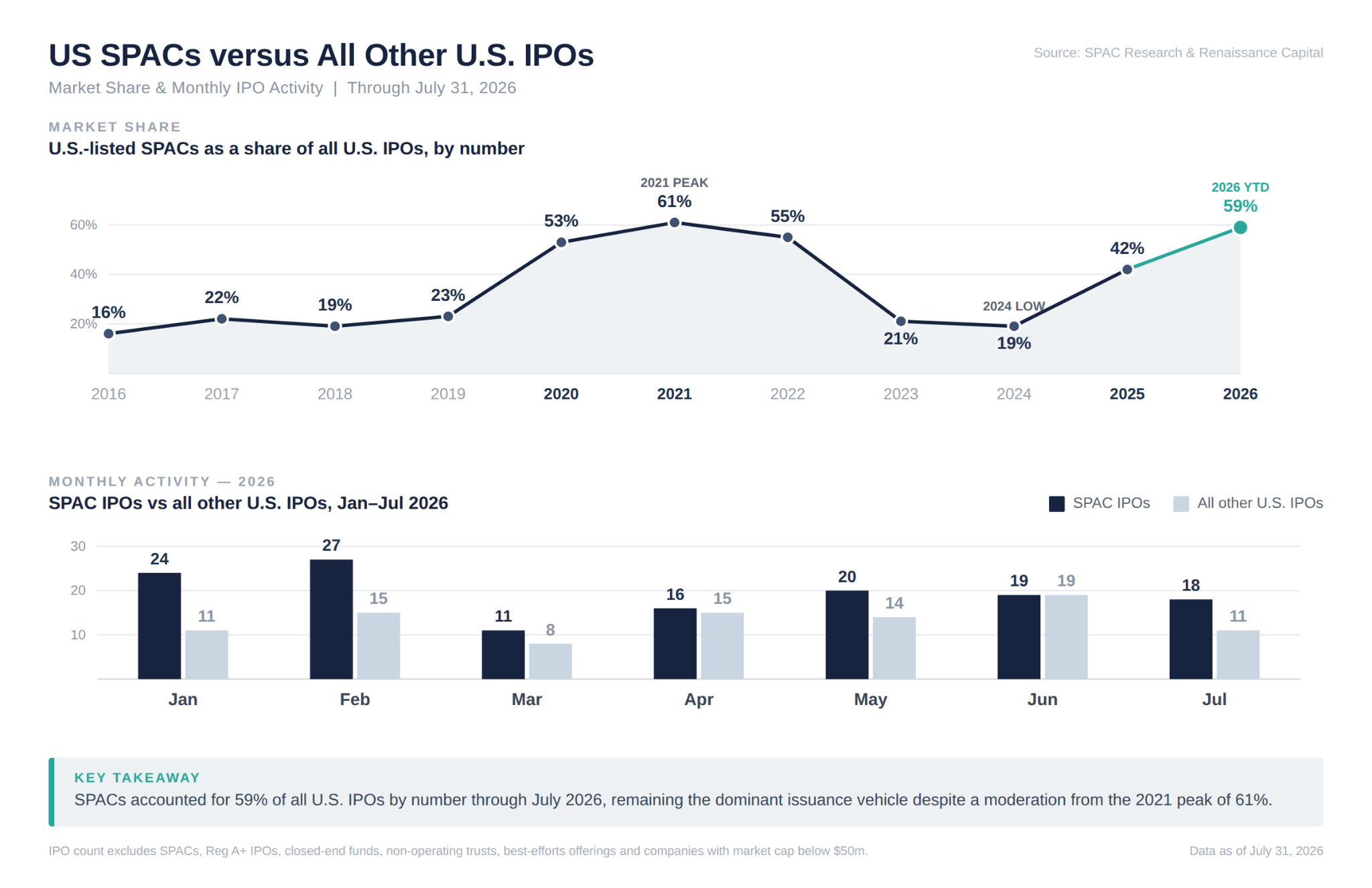
Note: IPO count exclude SPACs, Reg A+ IPOs, closed end funds, non-operating trusts, best efforts offerings and companies with market cap below $50m;
Source: Renaissance Capital, SPAC Research, as of July 31, 2026
July issuance stayed firm without overheating. Eighteen SPACs priced for $3.9 billion, a step down from the first-quarter surge but well above the 2023–2024 trough, when annual issuance fell to 31 and 57 IPOs respectively. Fifteen fresh S-1 filings for $2.6 billion replenished the queue, holding the pre-IPO pipeline at 65 vehicles and $7.4 billion
The larger story is conversion. Sponsors closed six combinations worth $10.4 billion in equity value during the month against only two liquidations, extending a year-to-date record of 28 closings for $36.7 billion versus nine wind-downs returning $2.3 billion. Closed value now exceeds liquidated trust capital by more than fifteen times, evidence that sponsors are executing deals rather than returning capital to shareholders
The forward book is both the constraint and the opportunity. With 107 announced live deals carrying $65.1 billion in equity value, the pending pipeline dwarfs what has closed year-to-date and points to a heavy 2026–2027 completion calendar as trust deadlines approach. If completion rates hold, the second half should deliver a substantial wave of newly public operating companies, and rising competition among the 264 vehicles still searching for targets
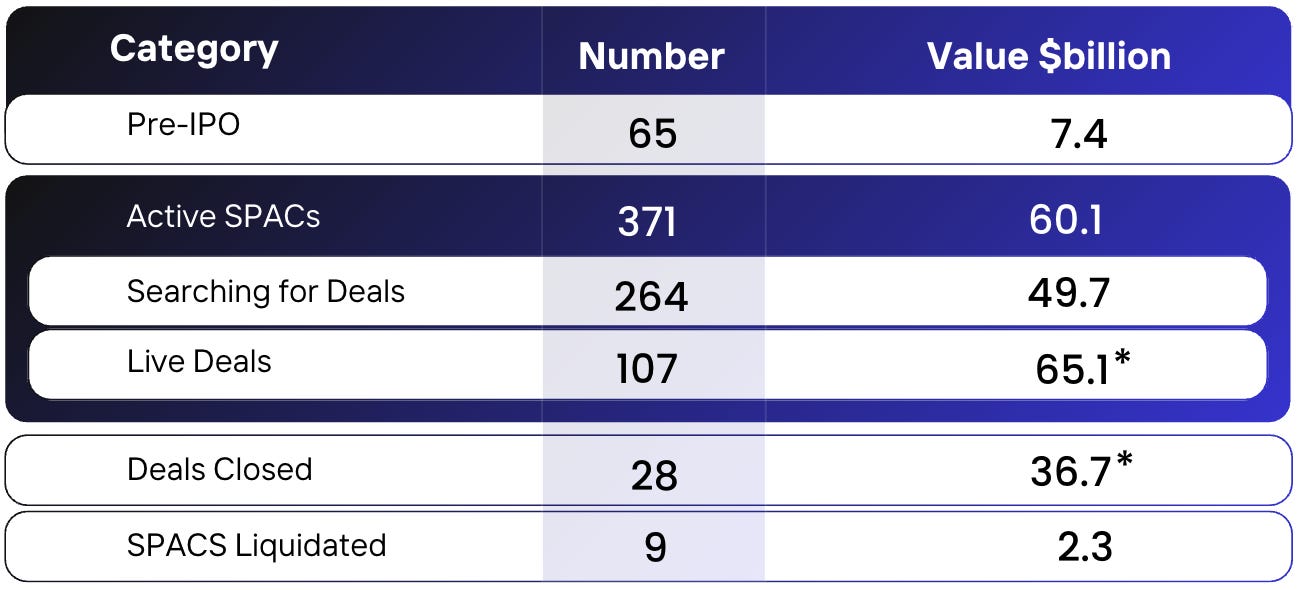
Source: SPAC Research, as of July 31, 2026, *Equity Value
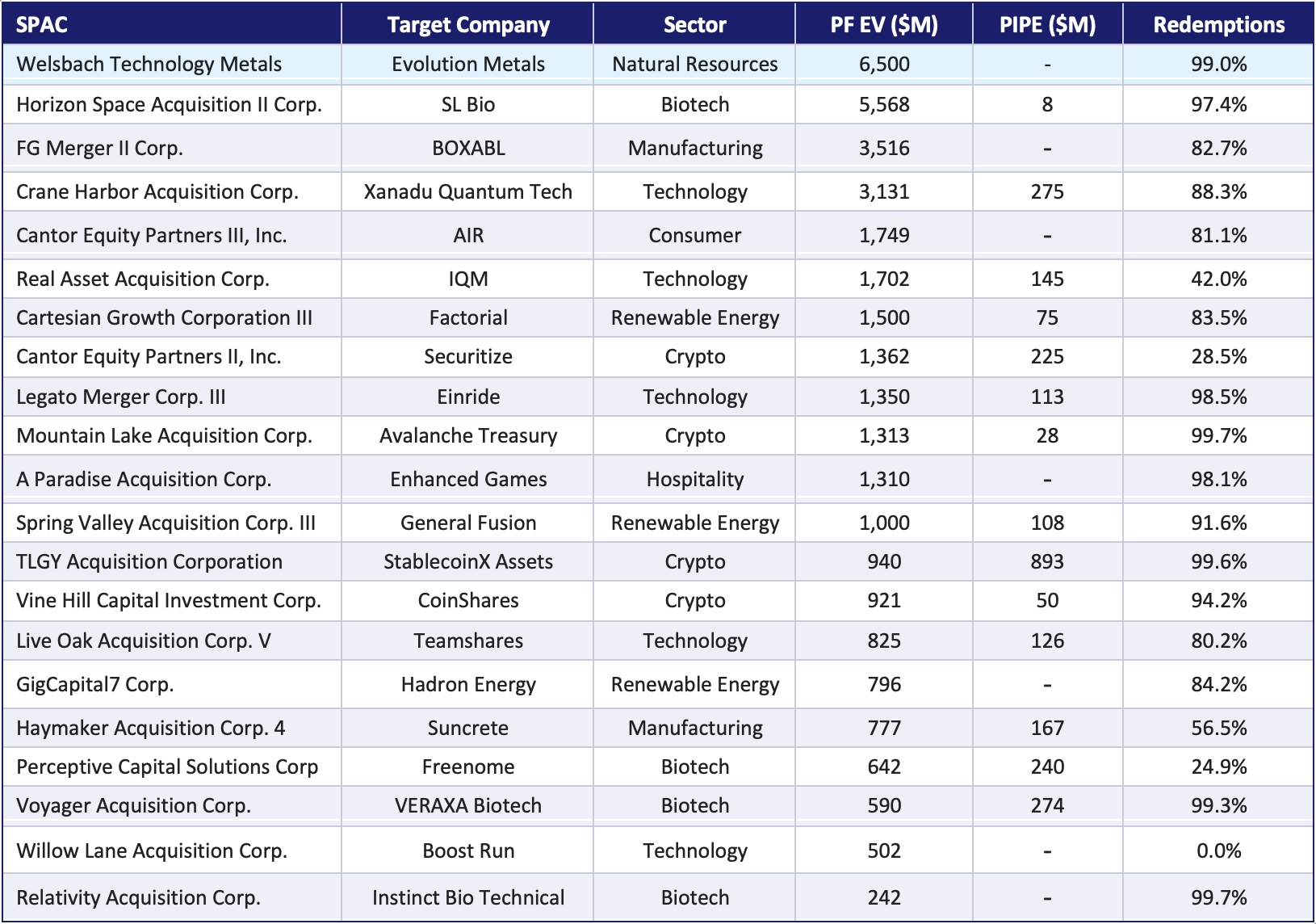
Welsbach Technology Metals Acq Corp and Evolution metals continues to be one of the largest De-SPAC mergers to have consummated this year at a $6.5 billion EV
Sector mix tilts to frontier technology, biotech and crypto. Technology accounts for five of the twenty closings, with biotech and crypto at four each and renewable energy at three. The two largest deals, Horizon Space/SL Bio at $5.6 billion and Crane Harbor/Xanadu Quantum at $3.1 billion, underscore institutional appetite for deep-tech, quantum and digital-asset infrastructure.
Redemptions remain the defining risk. Fifteen of the twenty deals closed with redemptions above 80%, and the recent-20 median is 86.2%. High redemptions strip trust cash at close, shifting the funding burden onto PIPE and alternative financing and pressuring post-deal balance sheets.
PIPE support is selective, not systematic. Six of the twenty deals closed with no PIPE at all. Where sponsors secured commitments, size varied enormously, from $8 million at Horizon Space to $893 million at TLGY/StablecoinX, showing institutional capital concentrating behind specific themes rather than the asset class as a whole
Deal sizes are bifurcating. Pro forma enterprise values span $242 million to $5.6 billion, with a recent-20 mean of $1.18 billion against a median of $873 million. A handful of large quantum, crypto and space transactions pull the average well above the typical deal, a classic barbell distribution
Post-close performance separates quality. Outcomes diverge sharply. Boost Run closed with 0% redemptions and traded near $20, while several near-fully-redeemed deals trade below $2. Low redemptions and committed PIPE are increasingly the best predictors of aftermarket survival
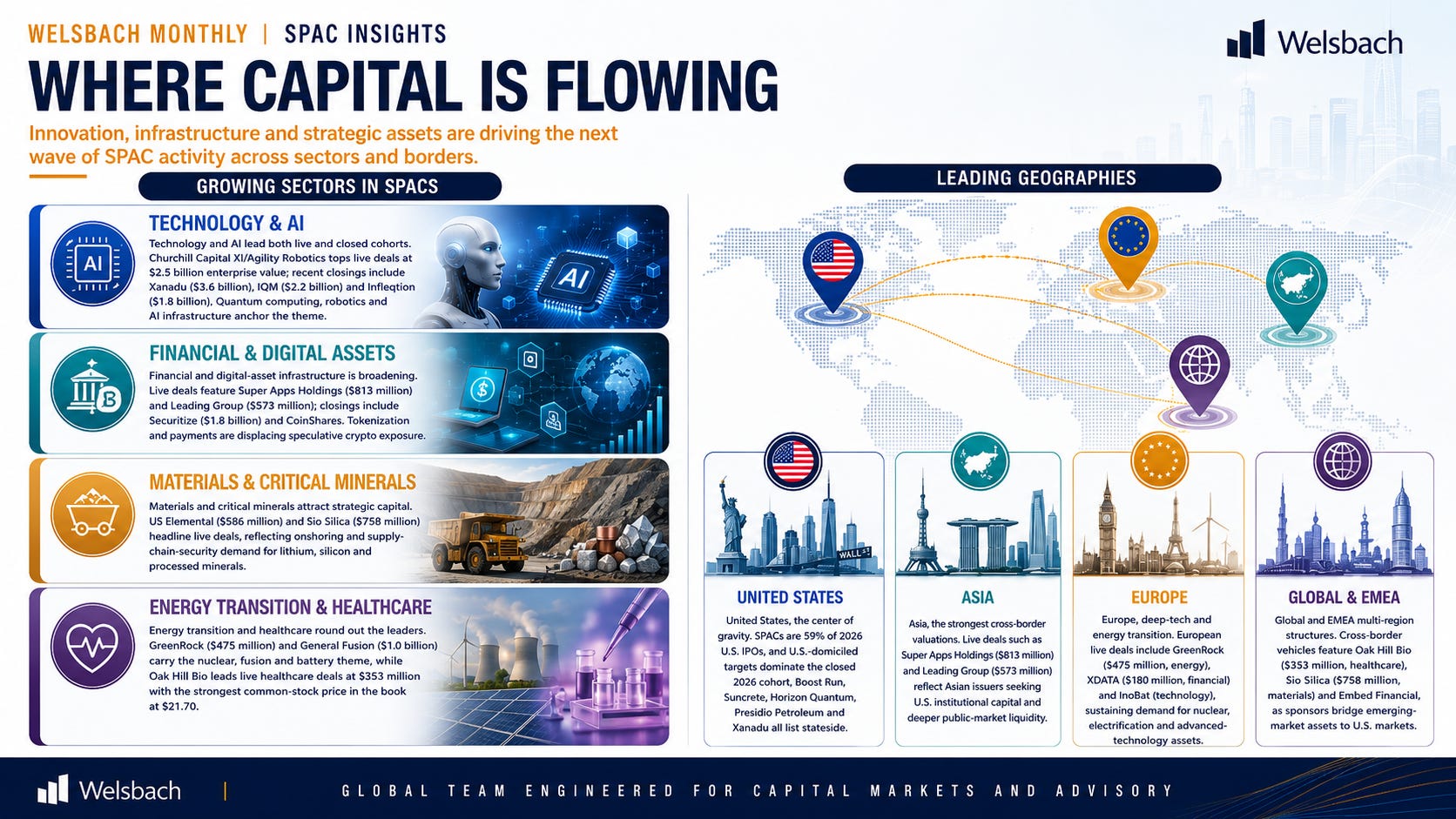
Technology and AI lead both live and closed cohorts. Churchill Capital XI/Agility Robotics tops live deals at $2.5 billion enterprise value; recent closings include Xanadu ($3.6 billion), IQM ($2.2 billion) and Infleqtion ($1.8 billion). Quantum computing, robotics and AI infrastructure anchor the theme
Financial and digital-asset infrastructure is broadening. Live deals feature Super Apps Holdings ($813 million) and Leading Group ($573 million); closings include Securitize ($1.8 billion) and CoinShares. Tokenization and payments are displacing speculative crypto exposure
Materials and critical minerals attract strategic capital. US Elemental ($586 million) and Sio Silica ($758 million) headline live deals, reflecting onshoring and supply-chain-security demand for lithium, silicon and processed minerals
Energy transition and healthcare round out the leaders. GreenRock ($475 million) and General Fusion ($1.0 billion) carry the nuclear, fusion and battery theme, while Oak Hill Bio leads live healthcare deals at $353 million with the strongest common-stock price in the book at $21.70
United States, the center of gravity. SPACs are 59% of 2026 U.S. IPOs, and U.S.-domiciled targets dominate the closed 2026 cohort, Boost Run, Suncrete, Horizon Quantum, Presidio Petroleum and Xanadu all list stateside
Asia, the strongest cross-border valuations. Live deals such as Super Apps Holdings ($813 million) and Leading Group ($573 million) reflect Asian issuers seeking U.S. institutional capital and deeper public-market liquidity
Europe, Deep-tech and energy transition. European live deals include GreenRock ($475 million, energy), XDATA ($180 million, financial) and InoBat (technology), sustaining demand for nuclear, electrification and advanced-technology assets
Global and EMEA multi-region structures. Cross-border vehicles feature Oak Hill Bio ($353 million, healthcare), Sio Silica ($758 million, materials) and Embed Financial, as sponsors bridge emerging-market assets to U.S. markets
The period’s signal is a shift in the balance of risk. Disinflation that looked durable in mid-July gave way to an oil-driven inflation scare, a 4.68% ten-year yield and a Federal Reserve unwilling to signal easing. Growth is cooling toward 1.5%, even as corporate earnings and equity indices hold near highs.
Against that backdrop, capital markets are bifurcating: private fundraising has contracted 30% and concentrated in the largest platforms, while SPACs have reclaimed 59% of U.S. listings and built a $65 billion live-deal backlog.
For founders weighing a public listing, the message is timing and quality. Execution windows are open and unusually deep, but redemptions, PIPE availability and rate volatility will separate the deals that close well from those that merely close.
If you’re interested in how AI is reshaping investment banking, private markets, capital markets and institutional finance, this is a good one to read.
Welsbach Co-Founder Sankalp Shangari turns from where the markets are to the institutions that operate them, and asks how the arrival of artificial intelligence could reshape the workflows, expertise and decision-making infrastructure of investment banking, private markets, capital markets and institutional finance.
In his latest essay, “A Walk Into Goldman Sachs, 2036,” Sankalp Shangari explores how AI could fundamentally reshape investment banking not just by making existing workflows faster, but by changing how financial institutions produce, challenge and ultimately take responsibility for judgment.
Read the full piece and subscribe to Capital Markets Reimagined for future insights and updates.
Welsbach is a leading cross-border SPAC and capital markets advisory firm founded in 2021, focused on connecting high-growth companies, particularly from Asia and other innovation hubs, with institutional capital markets. Leveraging deep regulatory expertise and global institutional networks, Welsbach delivers end-to-end SPAC and capital markets solutions to help visionary companies access public market liquidity.
Exploring growth capital or a U.S. listing? Partner with the Welsbach team to make it happen. Reach Us: Click Here
Website: https://welsbach.group/
Email: contact@welsbach.sg
Comments
Nothing yet. Say the first thing.
Sign in to join the conversation.