
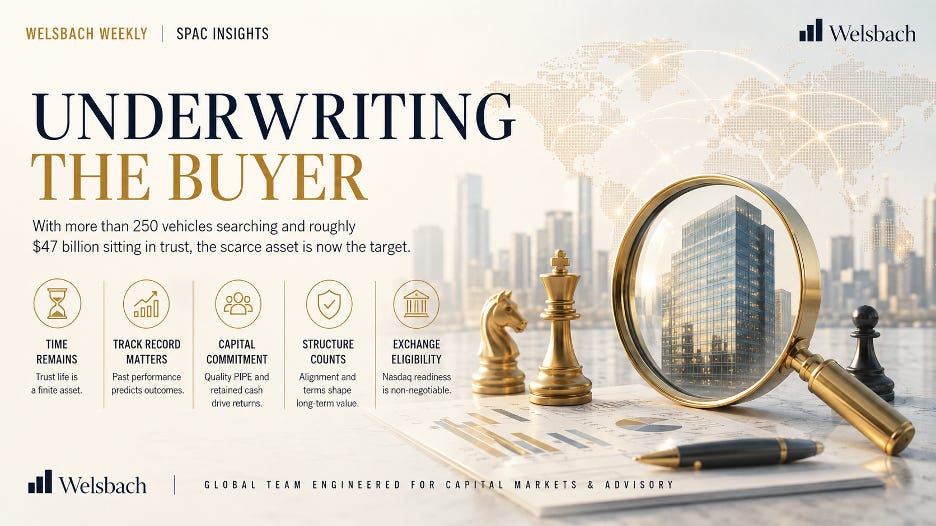
The SPAC market has reopened at scale, and for the first time since 2021 the shortage is targets rather than vehicles. That inversion gives high-quality companies outside the United States real negotiating power and a new way to lose. A SPAC is a counterparty with a fixed expiry date, a sponsor whose economics diverge from the target’s, and a capital structure mostly fixed before the founder arrives. The valuation on the term sheet is the least informative number in the transaction. Remaining trust life, sponsor record, committed capital and exchange eligibility determine what happens after the opening bell.
Founders arrive at SPAC negotiations having been told, correctly, that they will be diligenced heavily. What they rarely prepare for is the reciprocal exercise.
The asymmetry is structural. The sponsor has run this process before, roughly 53% of new SPAC IPOs in the second quarter of 2026 came from serial issuers. The founder is doing it once. The sponsor knows how many months remain on the vehicle’s clock, what the promote is worth at various outcomes, and how the trust behaves under redemption pressure. The founder is negotiating an enterprise value.
The consequences of choosing badly are now measurable rather than theoretical. An analysis of completed de-SPAC transactions, found that deals closing in the preceding 24 months with at least $100 million of straight equity PIPE or retained trust cash posted a median return of +17.2%. Those below that threshold posted a median of −90.3%. The distribution is not a curve. It is two populations.
Three developments reshaped the landscape in the first half of 2026.
First, supply. The vehicle population has recovered to levels last seen at the tail of the previous cycle: approximately 251 SPACs searching, holding roughly $47 billion in trust as of 22 June 2026. Deal flow is concentrating in quantum computing, critical minerals, infrastructure and power, and AI and robotics.
Second, standards. On 15 April 2026 Nasdaq filed rule change SR-NASDAQ-2026-033 with the SEC, raising initial listing requirements for SPACs; the amendments became operative on 15 May 2026. For the Global Market, minimum market value of listed securities rose from $75 million to $100 million. New Rule 5505(b)(4) established a Capital Market pathway requiring at least $75 million in market value of listed securities, $20 million in unrestricted publicly held shares, 400 public shareholders and four registered active market makers. Exchange eligibility has moved from assumption to condition.
Third, redemptions remain the dominant variable. In the six months ended 31 March 2026, a majority of de-SPAC approval votes saw redemptions above 90%, and roughly three-quarters exceeded 80%. Trust cash is a ceiling, not a forecast.
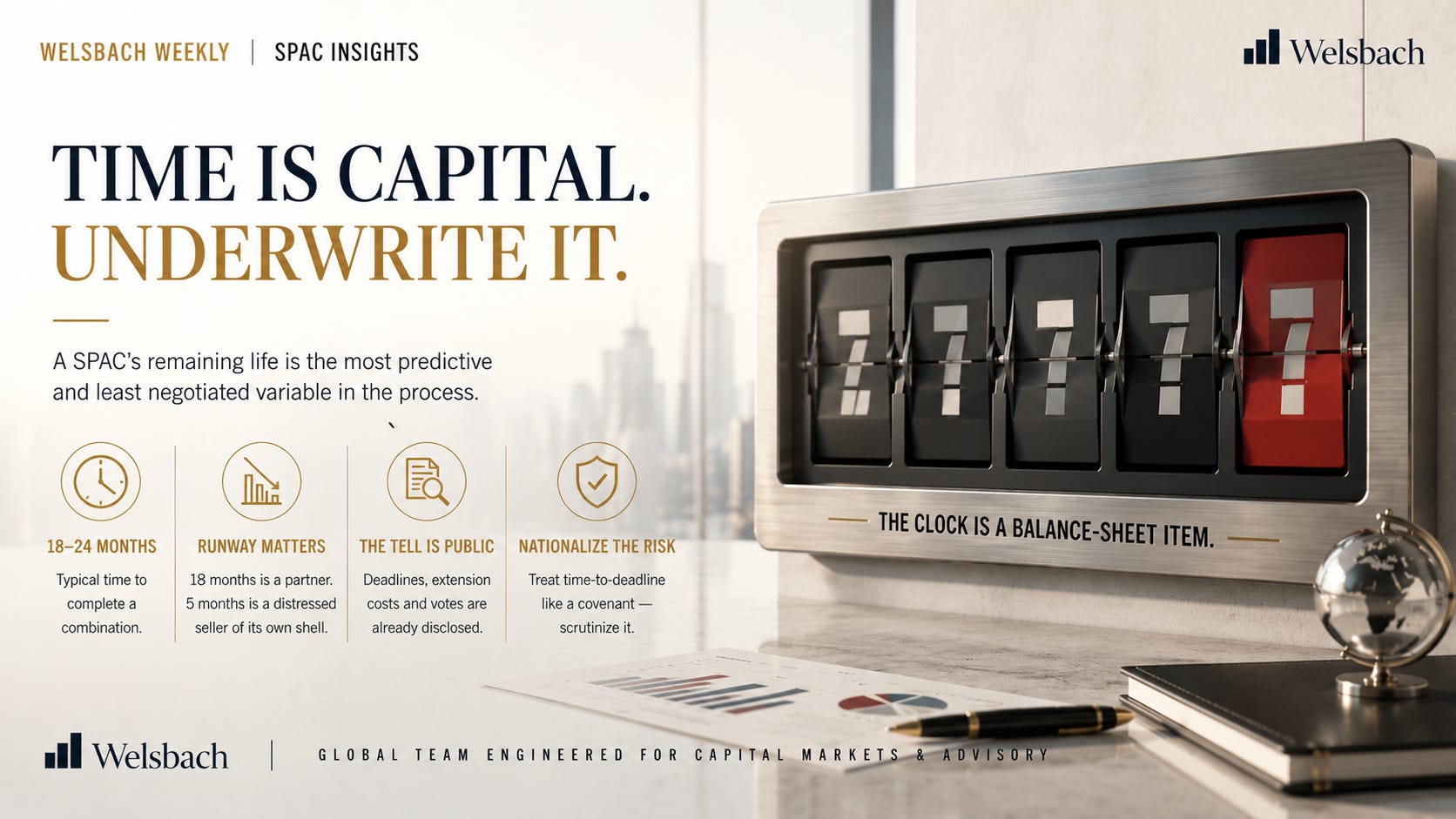
The clock is a balance-sheet item. A SPAC’s remaining life is the most predictive and least negotiated variable in the process. Vehicles typically have 18 to 24 months to complete a combination. A sponsor with 18 months of runway is a partner. A sponsor with five months is a distressed seller of its own shell, and the generosity of its valuation reflects that distress rather than a judgement about the business.
The tell is publicly filed. Extension proxies disclose both the deadline and the price the sponsor is paying to buy time. Quartzsea Acquisition Corp sought an extension to 19 October 2026, funded by monthly deposits of $0.033 per public share. Inception Growth Acquisition proposed extending from 13 August 2026 through as many as six monthly extensions at $0.05 per unredeemed public share. Embrace Change Acquisition and Alchemy Investments each sought twelve-month extensions in mid-2026. None of this is hidden. It is simply not read.
Time-to-deadline deserves the scrutiny founders give a covenant: the deadline, the extension history, cumulative sponsor contributions, and whether further extension requires a shareholder vote, because every extension vote is also a redemption event.
The promote sets the sponsor’s indifference point. The founder shares typically represent about 20% of post-IPO equity acquired for nominal consideration, converting into common stock at closing. The implication is uncomfortable: a transaction that destroys most of the target’s value can still be economically rational for the sponsor. No amount of alignment language in a letter agreement changes that arithmetic. Structure does, promote forfeiture, vesting tied to post-closing trading thresholds, and sponsor lock-ups extending beyond the target’s own. Valuation is the wrong hill.
Sponsor record is a public dataset. Every sponsor's prior de-SPACs are traceable, and their aftermarket performance is the most honest reference a founder will get. Over 90% of companies that de-SPAC'd at the 2021 peak eventually traded below $10. A sponsor whose prior vehicles all sit in that cohort is not offering a comparable product to one whose do not. Worth establishing too: who runs the business after closing. Transactions in which sponsors install new management have tended to underperform founder-led continuity.
Delivery, not conviction. The relevant question is not whether the sponsor believes in the business, but whether it can produce committed institutional capital, a bank willing to run the process, an engaged auditor, and a market-making and coverage plan. The practical test: how much cash reaches the balance sheet under a 90% redemption assumption?
Completion. TLGY Acquisition Corp closed its combination with StablecoinX, which began trading on the Nasdaq Capital Market under USDE and USDEW on 26 June 2026, holding roughly 3,029 million ENA tokens valued at approximately $275 million against about 24 million public Class A shares, a structure in which the asset base, not residual trust, carried the entity.
Repeat sponsorship. Cantor Equity Partners II held its shareholder vote on the Securitize combination on 29 June 2026, while Cantor Equity Partners VII priced a $250 million IPO on 16 June 2026 for Nasdaq listing under CAES. A sponsor operating a numbered series underwrites reputational continuity across vehicles, an incentive a single-vehicle sponsor does not have.
Termination. Compass Digital Acquisition Corp ended its merger with Key Mining and moved to liquidate the trust, in which case warrants and rights expire worthless. Signing is not closing.
Vehicle supply now exceeds credible target supply; the negotiating leverage sits with the company, but it is usually spent on the wrong variable.
Time-to-deadline is the most predictive and least negotiated term. Request the deadline, extension history and cumulative sponsor contributions before discussing valuation.
The sponsor promote means a value-destructive transaction can remain rational for the sponsor. Promote forfeiture and performance vesting are worth more than headline enterprise value.
Model cash delivered under an 80–90% redemption assumption. In the six months to 31 March 2026, most approval votes exceeded 90% redemptions.
Committed capital is the dividing line: deals with at least $100 million in PIPE or retained trust cash showed a median return of +17.2% over the 24 months to May 2026, against 90.3% below it.
Nasdaq’s May 2026 standards make exchange eligibility a modelling exercise, not an assumption.
A sponsor’s prior de-SPACs are public. Their aftermarket performance is the most reliable reference available.
Welsbach advises high-growth companies outside the United States on Nasdaq listings, SPAC and de-SPAC transactions, cross-border capital raising and PIPE financing. Because the firm is independent and represents the company rather than the vehicle, its role in these processes usually begins with the assessment described above: evaluating whether a business is genuinely ready for a public listing, and then evaluating the specific SPAC proposing to acquire it, remaining trust life, extension history, promote structure, prior sponsor outcomes and demonstrated access to committed capital. From there the work is practical.
We help management assemble the diligence record institutional investors and underwriters now expect, structures the capital component so the combined entity closes with balance-sheet cash rather than residual trust, tests exchange eligibility against current Nasdaq standards, and coordinates the auditors, securities counsel, underwriters and investor relations advisers whose sequencing determines whether a timetable holds.
For companies in Europe, the Middle East, Southeast Asia, Australia and Latin America, much of the value lies in translation, reconciling local reporting, governance and shareholder arrangements with what a US public market requires before, not during, the transaction.
The 2021 cycle failed because too much capital chased too few prepared companies. The present cycle carries the same imbalance, but the information environment has changed: extension proxies, sponsor histories, redemption records and trust balances are all public, and the gap between the two outcome populations is documented rather than debated. What remains scarce is not data but the discipline to apply it in the direction founders find least natural, outward, at the party across the table. A company that diligences its acquirer with the rigour it expects to receive is not being difficult. It is running the only analysis that reliably predicts what happens after the listing.
Exploring growth capital or a U.S. listing? Partner with the Welsbach team to make it happen. Reach Us: Click Here
Website: https://welsbach.group/
Contact Us: Click Here
Email: contact@welsbach.sg
Comments
Nothing yet. Say the first thing.
Sign in to join the conversation.