
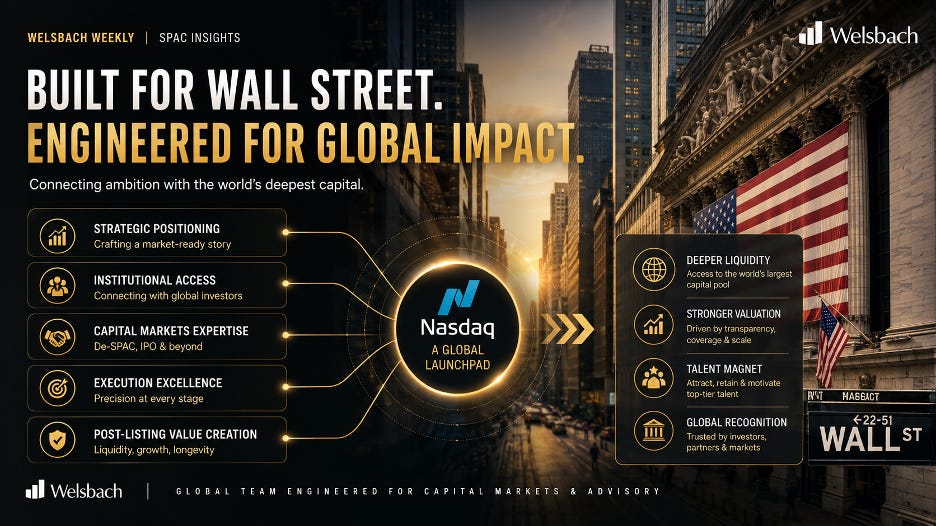
Many exceptional companies build world-class products and generate meaningful revenue, yet remain confined by local capital pools. Their shareholder base is fragmented. Their institutional visibility is limited. The valuation framework applied to them fails to reflect their global potential, because global investors have never had a clean mechanism to participate.
This is the problem Welsbach was built to solve. We help growth-stage and pre-IPO companies bridge this gap by combining strategic capital markets advisory, Nasdaq readiness, SPAC and De-SPAC expertise, institutional investor access, transaction execution, and post-listing liquidity planning into one integrated pathway toward becoming a globally recognised public company.
The question of where to list a company stopped being a geographical one the moment institutional capital became genuinely borderless. A sovereign wealth fund based in Abu Dhabi, a pension fund in Oslo, a growth equity manager in Boston, they all operate in the same market i.e. Nasdaq.
The persistent gap between what a business is worth in its home market and what it could attract in a deep, liquid, globally visible public market is one of the most consequential inefficiencies in corporate finance. The US equity market does not simply provide capital. It provides a valuation framework - one that thousands of institutional investors, sell-side analysts, index funds, ETFs, and algorithmic traders contribute to in real time.
“Capital doesn’t travel toward ambition. It travels toward trust, liquidity, and institutional-grade governance. Nasdaq delivers all three.”
For founders considering a public market pathway, the starting point should not be "which exchange?" It should be "which capital ecosystem best reflects the long-term value of what we've built?"
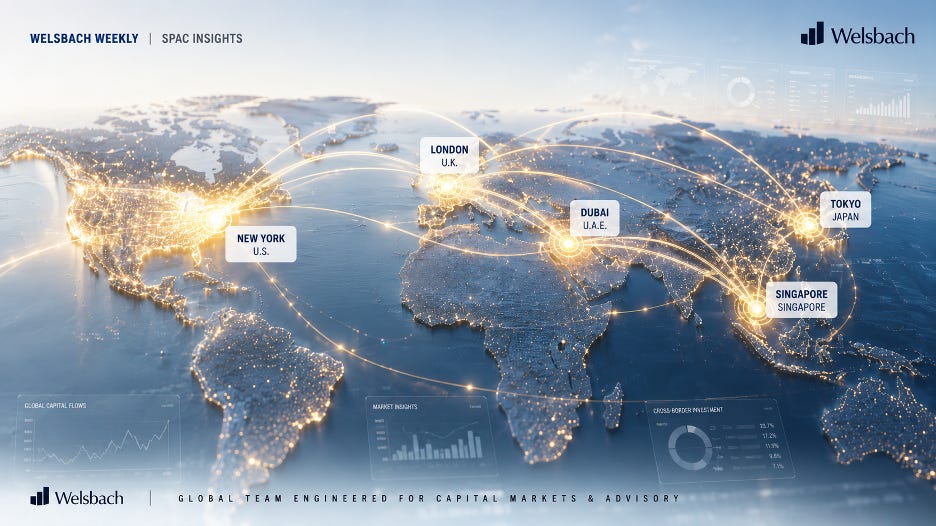
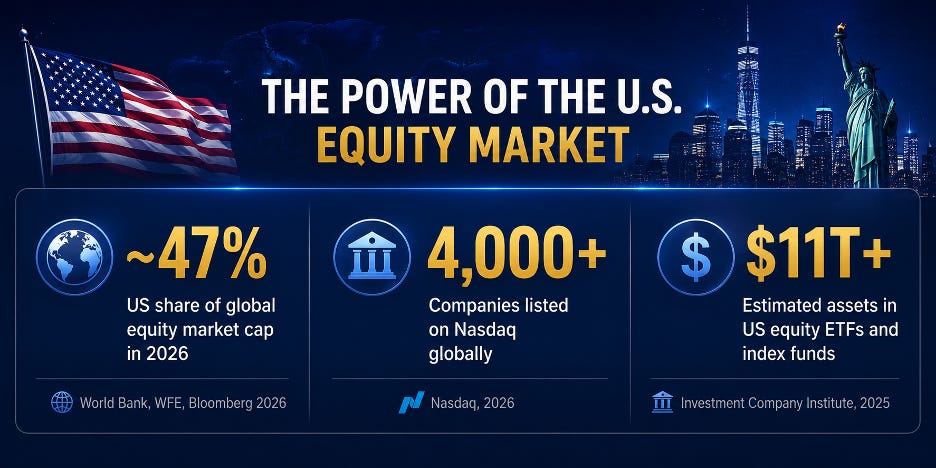
Nasdaq has over 4,000 companies. It is home to Apple, Microsoft, Amazon, Nvidia, and Tesla. It accounts for approximately 47% of all daily US equity trading volume. But to call it an exchange undersells what it actually is: it is the world’s most efficient machine for translating corporate performance into institutional capital.
What a Nasdaq listing provides, beyond the capital raise itself, is an ecosystem that compounds over time:
Institutional ownership: Access to thousands of buy-side funds, hedge funds, and long-only managers who cannot invest in private companies by mandate
Analyst coverage: Independent equity research provides ongoing price discovery, credibility, and a constant broadcast of your investment thesis to investors globally
Index inclusion: Eligibility for inclusion in major indices; Russell, S&P, MSCI, triggers automatic allocation from passive funds managing trillions in assets
Acquisition currency: Publicly traded stock is a financing tool. It allows companies to acquire targets using shares, removing the cash constraints that limit private companies
Employee equity: Stock options and RSUs in a liquid, publicly priced security are transformatively more powerful as talent retention tools than private company equity
Governance signalling: Meeting Nasdaq’s listing standards communicates to global partners, customers and governments that you are operating to the highest international standards
A Nasdaq listing doesn’t change your ticker. It changes your company’s structural position in the global capital ecosystem
The US equity market is not simply large, it is categorically different from every alternative in depth, liquidity, and institutional participation. At roughly $69 trillion in market capitalisation as of 2026, it represents nearly 47% of all global equity value, despite the US accounting for approximately 15% of global GDP.
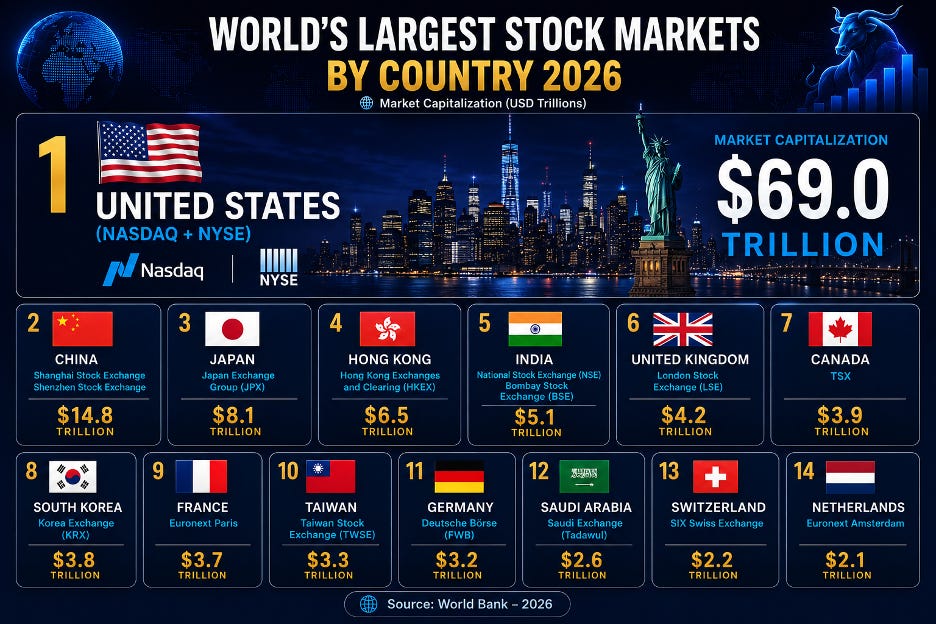
This asymmetry matters strategically. US-listed companies enjoy deeper daily liquidity, broader ETF inclusion, more extensive sell-side analyst coverage per dollar of market cap, and access to the institutional ownership networks of the world’s largest pension funds and sovereign wealth funds.
When a company from Southeast Asia, the Gulf, or South Africa lists on Nasdaq, it does not simply open a new trading venue. It plugs into the world’s most sophisticated capital formation network, one that includes S&P 500 index funds, MSCI global benchmarks, Nasdaq-100 ETFs, and every category of institutional investor that benchmarks against US equity markets
One of the most persistent misconceptions among founders considering a public listing is that the IPO proceeds define the value of going public. They don’t. The proceeds are a single transaction. The listing itself is a perpetual asset.
In practice, Nasdaq listing status changes how every institutional counterparty in the world relates to your company. A fund manager in Norway’s Government Pension Fund Global, managing over $1.7 trillion in assets, can hold your shares once you are public. Without a listing, the conversation never starts.
Pension funds and sovereign wealth funds are mandated to hold only publicly traded, exchange-listed securities. A Nasdaq listing converts a company from ineligible to investable, instantly expanding the universe of potential capital providers by orders of magnitude
Analyst ecosystems drive institutional interest. Once publicly listed, companies become subject to ongoing coverage initiation by sell-side research teams at major banks, providing constant intellectual distribution of the company’s story to fund managers globally
Index fund inflows provide passive but substantial capital allocation. Index inclusion in Russell 2000, Nasdaq Composite, or S&P 500 triggers automatic buying from trillions in passively managed assets, capital that requires no sales effort whatsoever
ETF participation broadens the investor base beyond active managers. The growth of thematic and sector ETFs means a Nasdaq-listed technology or healthcare company may be held by hundreds of funds it never directly engaged

Before a company lists on Nasdaq, it competes for attention in a crowded private market. After it lists, the market competes for it.
This is not hyperbole. The structural effect of a public listing on commercial relationships, partnership conversations, government dealings, and media coverage is one of the most underappreciated returns on an IPO. A Nasdaq ticker creates a permanent, globally searchable reference point for your company’s value, management credibility, and institutional endorsement.
In cross-border markets, particularly in Asia, the Gulf, and Africa, a US public listing carries reputational weight that no private fundraising round can replicate. It signals that your company has withstood the scrutiny of SEC disclosure requirements, PCAOB audit standards, and the daily verdict of the world’s most demanding investors.
Private companies pay for acquisitions with cash or with illiquid equity that requires complex negotiation and independent valuation. Public companies pay with shares that have a transparent, daily-traded market price. This is not a financing nuance, it is a strategic transformation.
The ability to use publicly traded stock as acquisition currency fundamentally alters the M&A possibilities available to a company. Some of the most consequential consolidation plays in technology, healthcare, and industrials over the past decade were only executable because the acquirer held publicly traded stock. Cash-only acquirers are systematically disadvantaged in competitive bid processes.
Beyond M&A, a public listing enables:
Follow-on equity offerings: capital raises at market price, without the discounts and investor-rights provisions of private rounds
PIPE financing: Private Investment in Public Equity allows rapid capital raises from institutional investors, often in connection with strategic transactions, without a new registration process
Convertible debt: public companies access convertible note markets at significantly tighter spreads than private companies, reflecting the liquidity premium embedded in listed securities
At-the-market programmes: listed companies can raise capital continuously at prevailing market prices, providing a permanent capital formation facility that private companies cannot access
Secondary offerings: existing shareholders, including early investors and founders, gain structured liquidity pathways that preserve value rather than requiring a bilateral sale process
The most enduring return from a Nasdaq listing is one that rarely appears in an IPO prospectus: the permanent creation of liquidity for everyone who ever bet on your company.
Early investors, venture capital funds, family offices, and strategic partners all hold positions that require eventual realisation. Private markets have secondary mechanisms, but they are slow, illiquid, discounted, and difficult to execute at scale. A Nasdaq listing converts those positions into freely tradeable securities, providing structured, transparent exit pathways that benefit everyone in the capitalization table.
This is the core argument that founders often underweight: the IPO is not just capital for the company. It is liquidity architecture for every stakeholder that made the company possible.
“The listing is not the exit. The listing is the beginning of the liquidity story, for founders, early investors, employees, and future shareholders alike.”
There is a recurring pattern in the conversations Welsbach has with founders across Asia, the Gulf, and Africa: they know their home market cannot provide the institutional depth, analyst coverage, or valuation framework they need. They have considered Hong Kong, London, and Singapore. They come back to Nasdaq, not from inertia, but from informed analysis.
The data supports the instinct. US-listed foreign private issuers routinely receive meaningfully higher valuation multiples than peers listed on domestic exchanges in the same sector. The liquidity premium embedded in Nasdaq-listed securities, the additional valuation investors assign to the certainty of being able to buy and sell, is not incidental. It is structural.
Nasdaq also provides something no regional exchange can fully replicate: the participation of US retail and institutional investors who allocate meaningfully to listed equities across sectors they understand. A technology company listed in Singapore reaches the Southeast Asian capital. The same company listed on Nasdaq reaches the world.
The SPAC’s reputation was made and nearly undone between 2020 and 2022. During the pandemic-era bull market, Special Purpose Acquisition Companies became the listing vehicle of choice for companies that might not have withstood the rigours of a traditional IPO process. Capital was abundant. Due diligence was, in some cases, perfunctory. Valuations stretched beyond what fundamentals supported. When rates rose and risk appetite contracted, a significant cohort of post-merger companies saw their market capitalisations collapse.
This correction was painful. It was also necessary.
What emerged from that period of reckoning was not the end of SPACs, it was their institutionalisation. The speculative excess of 2021 was driven primarily by inexperienced sponsors, inadequate governance, and investor bases that prioritised short-term arbitrage over long-term value creation. As those participants exited, the structural architecture of the SPAC itself, which was sound, remained.
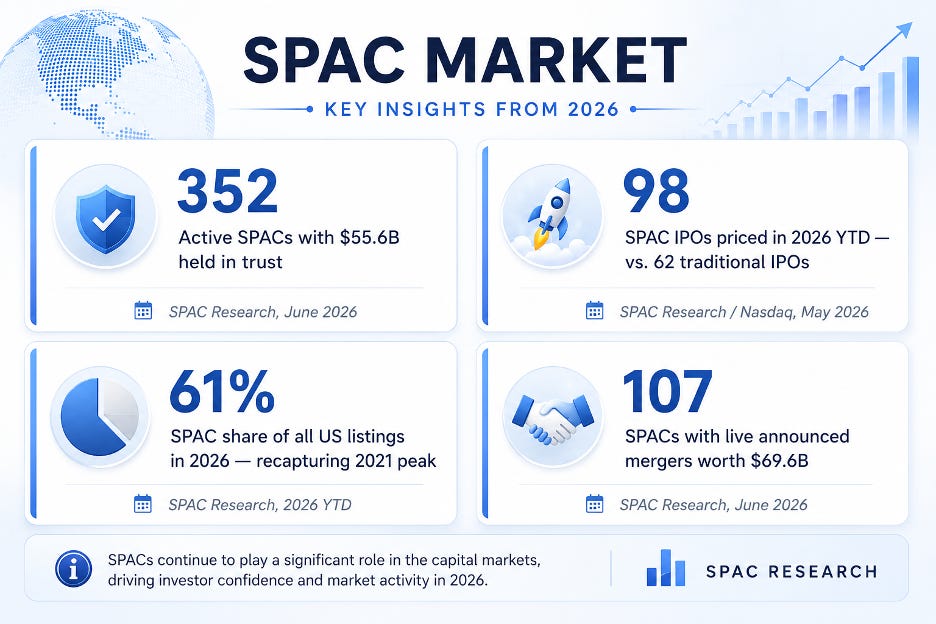
The 2026 SPAC market has recaptured its 2021 peak, but the composition is fundamentally different. Today’s market is dominated by experienced sponsors, private equity firms, sector specialists, and institutional investors who view the De-SPAC structure as a sophisticated capital markets tool. Through the first five months of 2026, 98 SPAC IPOs were priced against just 62 traditional IPOs, underscoring a decisive rotation back into the blank-check structure.
The three principal pathways to becoming a Nasdaq-listed company each serve different strategic circumstances. Understanding when to deploy each is one of the most important decisions in a company’s capital markets journey:
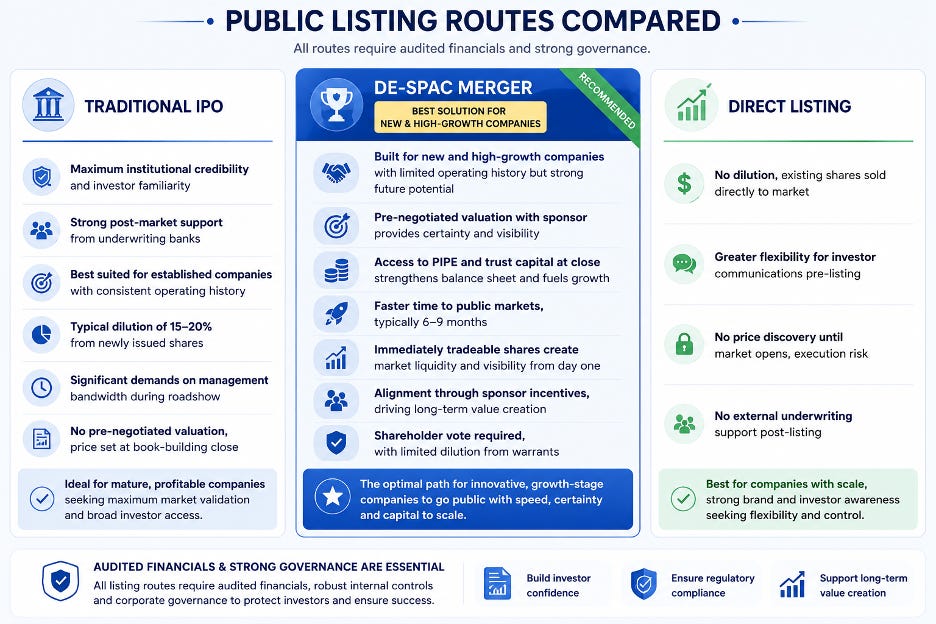
There is no universally optimal listing structure. The correct choice depends on a company’s growth stage, capital requirements, shareholder objectives, transaction complexity, geographic profile, and readiness for life as a public company. What is important is that founders evaluate all three alternatives with full information and with advisors who have executed across all of them.
The most successful public market transactions are no longer defined by the choice between an IPO and a SPAC. They are defined by selecting the capital markets pathway that best aligns with a company’s long-term strategic objectives, investor base, liquidity profile, and readiness for life as a public company.
At Welsbach, we view IPOs, Direct Listings, and De-SPAC mergers not as competing products, but as complementary tools within a broader capital markets strategy, each capable of creating lasting shareholder value when executed under the right circumstances.
The companies that extract the most enduring value from a Nasdaq listing are not those who treat it as a liquidity event. They are the ones who treat it as a platform, the first day of a new phase of institutional relationships, strategic capital access, global visibility, and compounding credibility that a private company, however successful, cannot accumulate.
A Nasdaq ticker is not a destination. It is infrastructure. The question is not whether your company is ready to list. It is whether your company is prepared to become the kind of institution that a listing demands you to be.
That preparation, choosing the right structure, building the right institutional relationships, timing the market with discipline, and constructing the post-listing operating system, is precisely where the quality of your advisory team determines the quality of your outcome.
“The companies that build enduring public market value are not the ones who rushed to the bell. They are the ones who prepared relentlessly for what comes after it.”
Exploring growth capital or a U.S. listing? Partner with the Welsbach team to make it happen. Reach Us: Click Here
Website: https://welsbach.group/
Contact Us: Click Here
Email: contact@welsbach.sg
Comments
Nothing yet. Say the first thing.
Sign in to join the conversation.