
This essay builds on my analysis from episode 20 of Cyfrowe rynki / Digital Markets on the only Polish business television Biznes24, as well as the related Biznes24 article: “Regulations, tokenization and Bitcoin at $70,000.” Watch the episode here:
It should also be read alongside my January essay on the “Visibility Shock,” where I argued that Bitcoin in 2026 behaves primarily as high-beta risk exposure, not as a safe haven.
This text is for information and discussion only. It is not investment advice.
Bitcoin is once again trading around $70,000. That sounds strong until one remembers that the asset was near $126,000 in October 2025. The market is still deep in the psychology of drawdown, caution and selective risk-taking. Fear indicators remain elevated, and most price commentary still revolves around the usual short-term variables: macro, rates, war risk, ETF flows, and retail mood. The market review in episode 20 captured exactly that atmosphere: weak confidence, but improving structure underneath.
Yet the more important story is happening elsewhere.
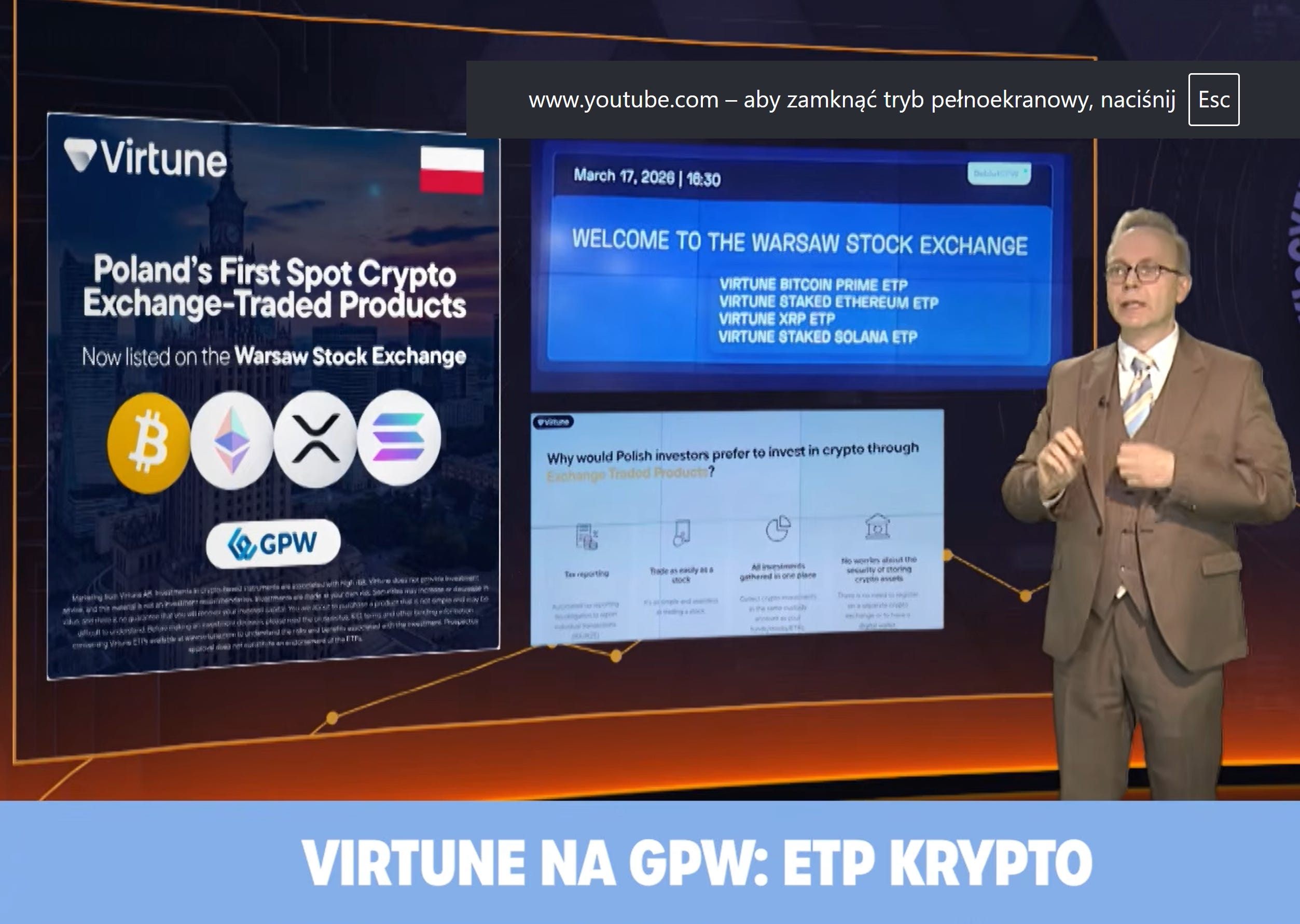
Over the same period, the institutional architecture around digital assets kept getting stronger. In the United States, the SEC and CFTC moved toward a shared working interpretation of digital assets. Nasdaq announced tokenized-equity infrastructure work with Kraken. Mastercard moved deeper into stablecoin rails through BVNK. Revolut advanced its position as a fully regulated banking player. And in Poland, Virtune’s crypto ETPs reached the Warsaw Stock Exchange, including products with staking exposure on Ethereum and Solana. Those were not random headlines; they formed a consistent pattern of institutional absorption.
Traditional finance is no longer asking whether crypto matters. It is deciding which parts of crypto to absorb, regulate and distribute.
On March 9, 2026, Bitcoin’s network mined the 20 millionth coin, in block 939999. That leaves only 1 million BTC still to be issued, with final issuance stretching out toward 2140. The program materials were right to emphasize the symbolic importance of that moment.
But the deeper point is not symbolism. It is constraint.
Most market participants know, in the abstract, that Bitcoin has a hard cap of 21 million. Very few model what happens when that cap is no longer distant, but visibly approaching. And fewer still incorporate the fact that a large part of the already-mined supply is no longer economically available.
According to the estimates cited in the program materials, roughly 2.3 to 3.7 million BTC may be permanently lost. That implies an effective supply meaningfully below the headline 20 million already in circulation. In practical terms, the market is not dealing with a fully usable stock of 20 million coins. It is dealing with a much tighter effective float.
That matters more than most commentary admits.
This chart is the key visual in the argument.
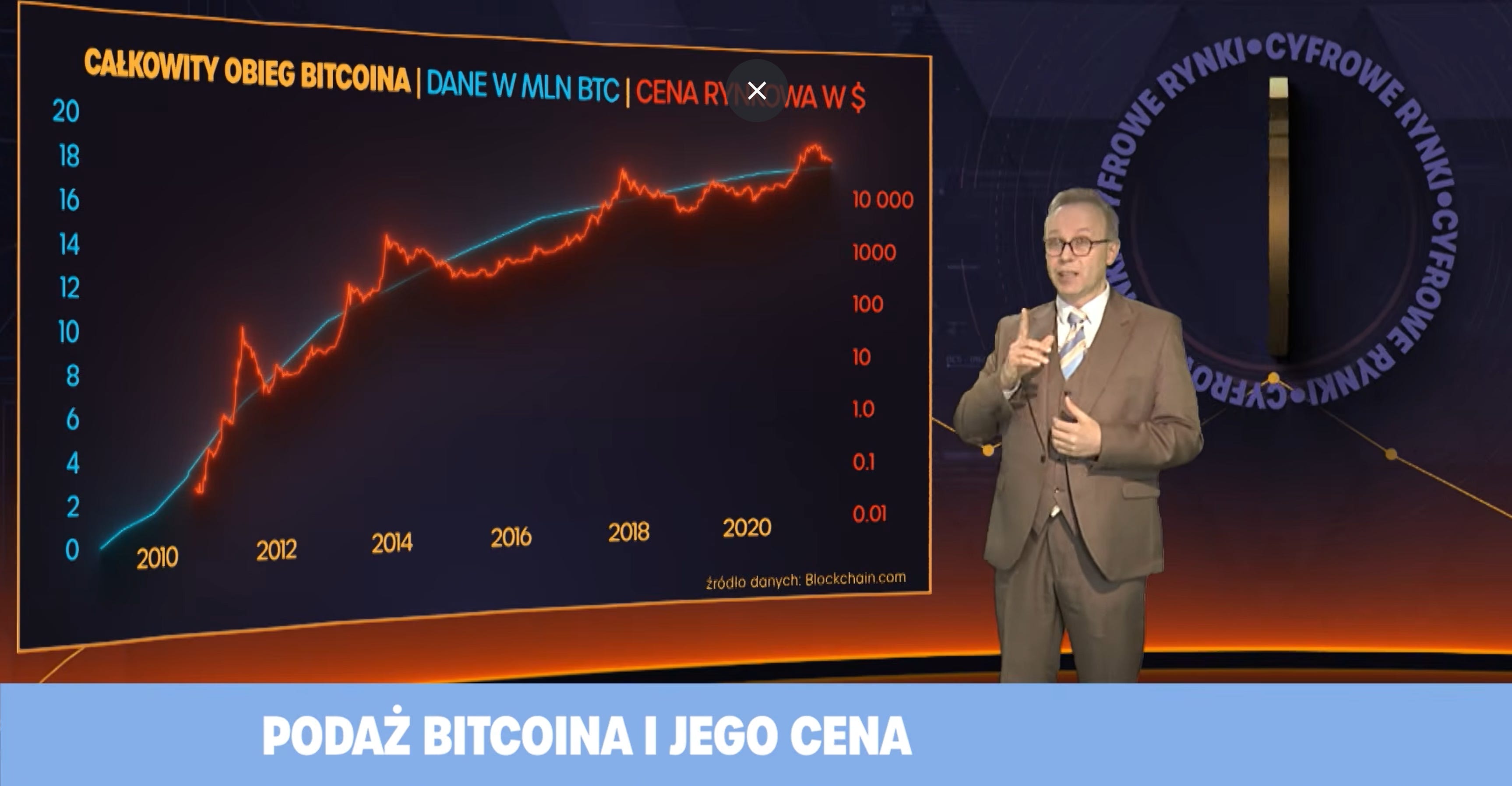
On the left axis, it shows Bitcoin’s total circulating supply in millions of coins: a curve that rises quickly in the early years and then visibly flattens as issuance slows. On the right axis, it shows Bitcoin’s market price on a logarithmic scale. That logarithmic scale is essential: without it, the early price history would be visually distorted and the long-run relationship would be much harder to interpret. The source used in the program was Blockchain.com, and the note about the log scale is important enough to repeat here.
What does the chart show?
Not a simple one-variable explanation of price. Bitcoin’s price is still shaped by demand cycles, leverage, macro shocks, regulation and narrative. But the supply curve provides the structural envelope within which those demand shocks play out. As supply flattens, each new demand impulse operates against a progressively tighter issuance profile.
That is why I would not describe supply as a background condition. I would describe it as the monetary architecture of the asset.
Earlier Bitcoin cycles had supply compression, but not the same institutional access. More recent cycles had institutional access, but under much thicker regulatory fog. What makes this moment different is the convergence of three processes.
Supply compression: more than 95% of total Bitcoin has already been mined, issuance keeps slowing, and the effective float is probably lower than the headline supply suggests.
Infrastructure: tokenization, ETFs, ETPs, stablecoin rails and regulated brokerage access are not speculative narratives. They are access channels. They do not guarantee immediate revaluation, but they reduce friction for capital that previously stayed out.
Regulatory clarification: not complete certainty. But enough operational clarity to reduce one of the largest historical discounts on institutional participation. The SEC/CFTC shift, the broader tokenization push, and even regulated market access in countries like Poland all point in the same direction.
That combination is new.
The market still trades Bitcoin as if it were only a volatile risk asset. In the short run, that remains true. But structurally, it is becoming something else as well: a highly constrained monetary asset that is gradually being connected to institutional distribution.
The wrong question is whether Bitcoin will be at $68,000 or $78,000 next month. The more interesting question is this:
What happens when a fixed-supply system becomes easier for regulated capital to access at the very moment when effective supply is tighter than the headline cap suggests?
That is not a short-term trading question. It is a structural one.
And structural questions tend to matter most before the majority of the market starts treating them seriously.
Three things will determine whether this shift is real or only temporary.
The first is whether regulatory convergence keeps reducing uncertainty in a way that changes institutional behavior, not just headlines.
The second is whether infrastructure starts carrying real volume. Announcements are cheap. Usage is what matters.
The third is whether Bitcoin’s public narrative starts to move away from pure volatility and toward monetary structure. We are not there yet. But milestones like the 20 millionth Bitcoin help force that conversation.
Bitcoin is still being discussed mainly as a story about price.
Increasingly, it should be discussed as a system with tightening supply, improving access, and a shrinking margin for analytical laziness.
That does not eliminate volatility. It does change what serious investors should be paying attention to.
If you find this kind of analysis useful, subscribe.
I will keep tracking how supply, regulation, tokenization and institutional infrastructure reshape digital-asset markets — including from the perspective of Central and Eastern Europe, where some of these structural shifts become visible earlier than the mainstream notices.
Comments
Nothing yet. Say the first thing.
Sign in to join the conversation.