
Europe is building one of the world’s most robust crypto regulatory regimes. That could be a competitive advantage.
It could also become a fixed-cost moat.
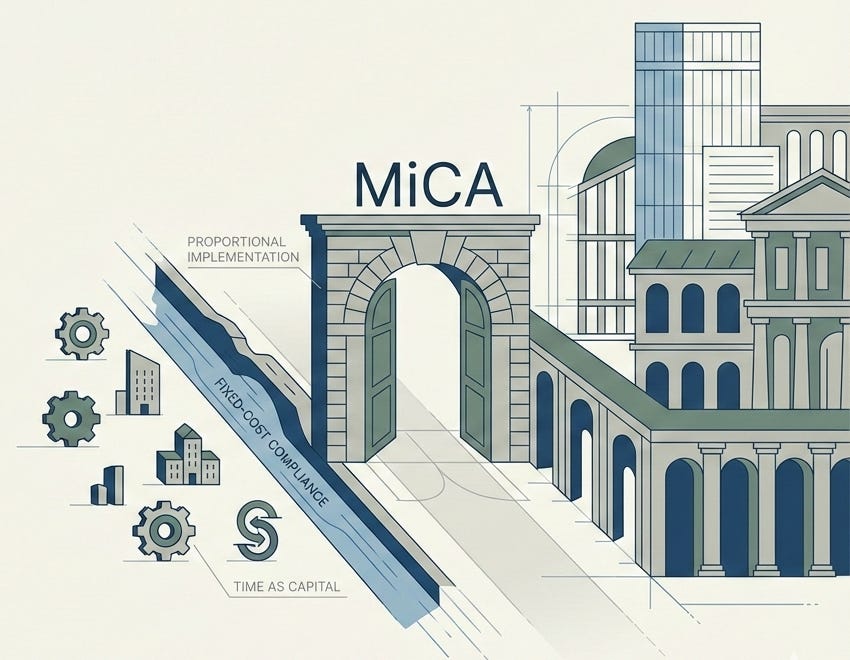
Not because regulation is “bad”, but because fixed-cost compliance architectures create asymmetric barriers. When a €1M venture faces the same baseline obligations as a €100M platform, regulation doesn’t just manage risk—it selects which innovators can afford to enter.
(For the broader proportionality argument, see my earlier essay: https://kpiech.substack.com/p/mica-is-the-entry-regime-europe-still)
MiCA is a Regulation. Member States cannot rewrite the text. But the EU’s real outcome will be decided by how MiCA is operationalised: procedures, timelines, fee structures, supervisory practice, and the interaction with critical infrastructure (especially banking).
MiCA generates three fixed-cost bottlenecks that scale poorly for early-stage firms.
MiCA requires CASPs to maintain prudential safeguards equal to the higher of: (a) permanent minimum capital requirements (Annex IV) and (b) one quarter of fixed overheads (MiCA Art. 67(1)). (EUR-Lex) Annex IV sets minimum tiers (EUR 50k / 125k / 150k, depending on services). (EUR-Lex)
That may be reasonable in principle. The proportionality issue is how it scales.
Illustrative mechanism (not a statistic): a custody-focused venture with €1M in client assets and another with €100M can face the same €125k prudential floor if they provide the same class of services.
This creates a reverse incentive structure: the capital requirement as a percentage of AUM is highest for the smallest, newest entrants—precisely when fixed costs hurt most and when the prudential footprint is typically lowest.
When compliance costs are front-loaded and fixed, regulation does not just manage risk — it reallocates innovation.
(Side note for technical readers: ESMA/EBA Q&A already shows how quickly “fixed overheads” becomes a non-trivial interpretive and supervisory layer.) (eba.europa.eu)
MiCA sets a structured authorisation process: completeness assessment within 25 working days, and a decision within 40 working days from receipt of a complete application (MiCA Art. 63(2)–(3)). In practice, this operates with ‘stop-the-clock’ dynamics whenever competent authorities request additional information or re-assess completeness.
The proportionality risk is not the nominal timeline. It is the operational reality that “completeness” can become an iterative gatekeeping mechanism: requests for missing information, revised deadlines, and practical stop-the-clock effects that turn a 65-day structure into a multi-month uncertainty window.
For early-stage ventures, time isn’t an administrative detail. It is runway. It is fundraising. It is survival.
Delay is a capital requirement by other means.
MiCA requires adequate arrangements to safeguard clients’ crypto-assets and (where relevant) clients’ funds, including preventing their use for the CASP’s own account (MiCA Art. 70). (Judict)
It also contains concrete segregation expectations for custody providers, including segregation of clients’ crypto-assets from the CASP’s own holdings and legal/operational segregation in insolvency contexts (MiCA Art. 67(7)). (EUR-Lex)
Concrete point: building custody controls (key management, access controls), reconciliation and audit trails, and demonstrable segregation workflows costs roughly the same whether the firm manages €1M or €100M. Infrastructure costs do not scale down—the proportionality challenge is how quickly these obligations must be met and how they are evidenced.
A common objection is formal: “You can’t gold-plate a Regulation.”
Correct—Member States cannot add substantive EU-level obligations to the MiCA text.
But Member States can amplify burden through the operational layer: fee schedules, procedural rules, repeated completeness resets, local reporting expectations, supervisory interpretations, and ancillary national regimes that interact with MiCA in practice (e.g., AML interfaces, fit-and-proper process design, IT documentation standards).
MiCA was meant to harmonise market access. Divergent procedures and fee logics can still fragment it into 27 practical regimes.
One observable signal is fee logic: some frameworks scale fees to footprint or complexity, others drift toward flat or quasi-fiscal structures—functionally an entry barrier for smaller entrants.
MiCA creates licensing standards. But licensing is not market access if operational rails are fragile.
Mechanism is simple: where a licensed CASP cannot maintain EUR bank accounts, it cannot reliably pay suppliers, manage fiat-related client flows where needed, or settle operational obligations. In effect:
A licensed market participant without access to payments is a regulated non-entity.
De-risking becomes de-licensing by other means.
This is not an argument for weaker AML/CFT. It is an institutional ask for risk-based banking access protocols: clear guidance that MiCA-licensed CASPs meeting AML/CFT standards should have a rebuttable presumption of bankability, absent specific red flags.
MiCA created licensing standards; Member States need access standards to match.
Procedural discipline
Test: Can an authority reset “completeness” repeatedly without substantive justification? If yes, statutory timelines are illusory.Cost-recovery fee design
Test: Do fees scale with footprint/complexity and supervisory cost—or are they flat regardless of prudential footprint?Banking access protocols
Mechanism: rebuttable presumption of access for licensed CASPs meeting AML/CFT standards; de-risking must be evidence-based, not categorical.Sequencing for early-stage build-out
Example: phased evidencing of segregation infrastructure (basic → enhanced) tied to risk/scale, where EU law allows.
Proportional implementation is not regulatory weakness. It is regulatory discipline.
Poland is among the later jurisdictions to operationalise MiCA nationally. That is politically awkward—but institutionally useful. Late movers can observe early friction points and avoid procedural and fee-driven overreach.
A UE+0 working draft focused on procedures, fees, safeguards, and market functionality (not national add-ons) is currently being prepared with a short expert feedback window before it moves to the parliamentary track.
If you want to review the working draft text and send concrete comments, I can share it directly; for reference, the current working document is here: Google Dosc - Ustawa 2.0
If you work in supervision, compliance, banking, or policy:
What is the single biggest proportionality failure you’ve observed (or expect) in MiCA implementation—and what would fix it without compromising safety?
Comment publicly (so others can react), or message me directly. I will incorporate high-quality inputs into a follow-up analysis.
MiCA is Europe’s most ambitious financial regulation for digital assets. Its success will not be mea of its legal text—but by whether early-stage innovators can afford to enter the market it creates.
Europe can build the world’s safest crypto regime. The question is whether it also builds one where innovation can survive.
Comments
Nothing yet. Say the first thing.
Sign in to join the conversation.