
This essay builds on my recent op-ed in Rzeczpospolita, where I analysed how sanctions, supply chains and friend-shoring affect firms in our region. Here, I extend that argument to what actually matters: capital allocation and board-level decision-making.
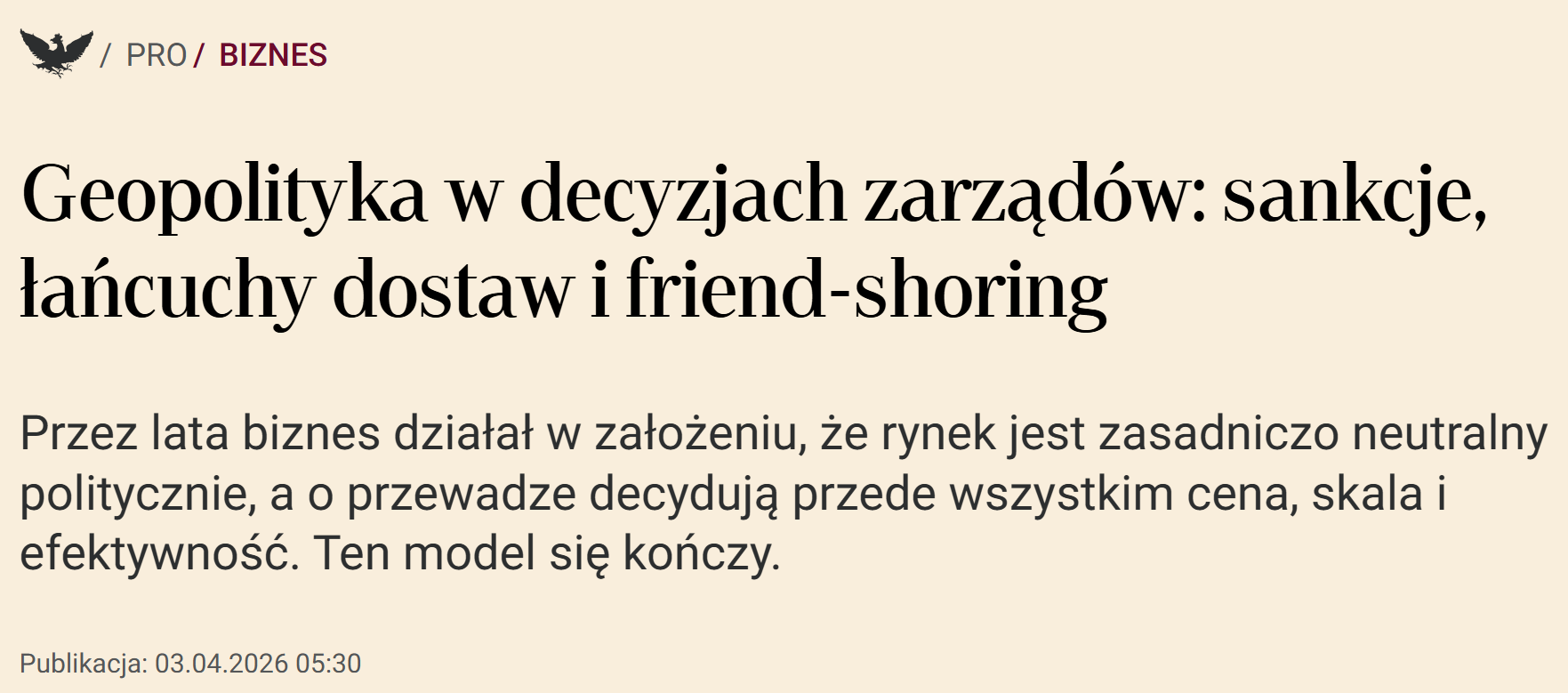
For three decades, global business operated under a powerful assumption: markets are broadly neutral, and competitive advantage comes from cost, scale, and efficiency.
That assumption no longer holds.
Sanctions, industrial policy, and geopolitical fragmentation have not just altered trade flows — they have changed the logic of decision-making. Geopolitics is no longer an external backdrop. It has become a board-level variable, directly affecting margins, financing, and strategic options.
Many executives still treat this as a temporary disruption.
It is not. It is a structural shift — closer to a regime change than a cyclical shock.
In our region, the consequences are already visible. Some firms capture new investment and production flows. Others lose margin because their business models depend on fragile global links.
The core transition is simple:
We are moving from a system optimized for efficiency
to a system optimized for survivability under uncertainty.
This is what I previously described (here, at Substack) as a Visibility Shock.
When supply chains, routes, and regulatory environments become unpredictable, firms lose the ability to see — and therefore to price — their risks properly. What looked efficient ex ante turns out to be fragile ex post.
Sanctions are no longer a legal checklist. They operate across three layers:
direct legal exposure,
indirect (secondary) exposure through intermediaries,
financial and reputational filtering by banks and insurers.
A transaction can be legally compliant and still fail commercially — because it cannot be financed, insured, or cleared. This is the key shift:
sanctions no longer constrain transactions — they constrain business models.
For years, supply chains were optimized for cost. That optimization assumed stability. Once stability disappears, optimization becomes fragility.
Data reflects this shift (data from Capgemini):
nearshoring adoption increased from 42% to 56% in 2025,
82% of firms plan to reduce dependence on China.
This is not cyclical — it is structural.
Our region benefits from this reconfiguration:
large-scale investments in automotive and batteries,
increased role as a production base for the EU.
But this advantage is conditional. Recent developments show both sides:
major investments (BMW, CATL, industrial expansion),
delays and constraints (Intel postponement, pressure in battery sector).
Nearshoring rewards not cost alone, but predictability and capacity.
A new factor is emerging: chokepoint risk. Disruptions affecting routes such as the Strait of Hormuz or the Red Sea directly translate into:
energy price volatility,
shipping delays,
insurance cost spikes.
In such an environment, “cheap” supply chains are often mispriced.
Friend-shoring reflects a deeper shift:
firms are selecting partners based not only on cost, but on institutional and geopolitical alignment.
According to Capgemini:
73% of firms treat friend-shoring as a strategic priority.
This aligns with what I described as Capital Safety Infrastructure (CASI).
Capital no longer maximizes yield first. It minimizes existential risk first.
This has a direct implication: jurisdiction itself becomes a source of value.
For our region, this creates a structural premium. CEE economies are not attracting investment only because they are cheaper. They are attracting it because they are embedded within:
EU regulatory structures,
NATO security architecture,
relatively stable institutional frameworks.
This is not a cost advantage. It is a geopolitical premium.
The traditional question was:
Who is cheaper?
This is no longer sufficient. A rational decision now requires four filters:
Jurisdictional stability
Regulatory endurance
Financial clearance
Operational fallback (real ‘Plan B’)
If a firm cannot answer these questions, it does not fully understand its own risk exposure.
The implications are concrete:
A cheaper supplier may be economically inferior once financing, delays, and compliance are priced in.
Investment decisions must include regulatory and geopolitical stability, not just labor cost.
Export strategies must incorporate traceability and downstream risk.
In short:
cost optimization without resilience is no longer rational.
The biggest mistake today is waiting for a return to “normal”. There is no normal to return to. Geopolitics has permanently entered the balance sheet.
Firms are no longer competing only on efficiency. They are competing on resilience under uncertainty. Those who understand this early will not just reduce risk.
They will be able to price it — and capture the upside of a system being rebuilt.
Comments
Nothing yet. Say the first thing.
Sign in to join the conversation.