
Every strategy carries an implicit theory of what being wrong means, and the durable ones make that theory explicit before the money is at risk.

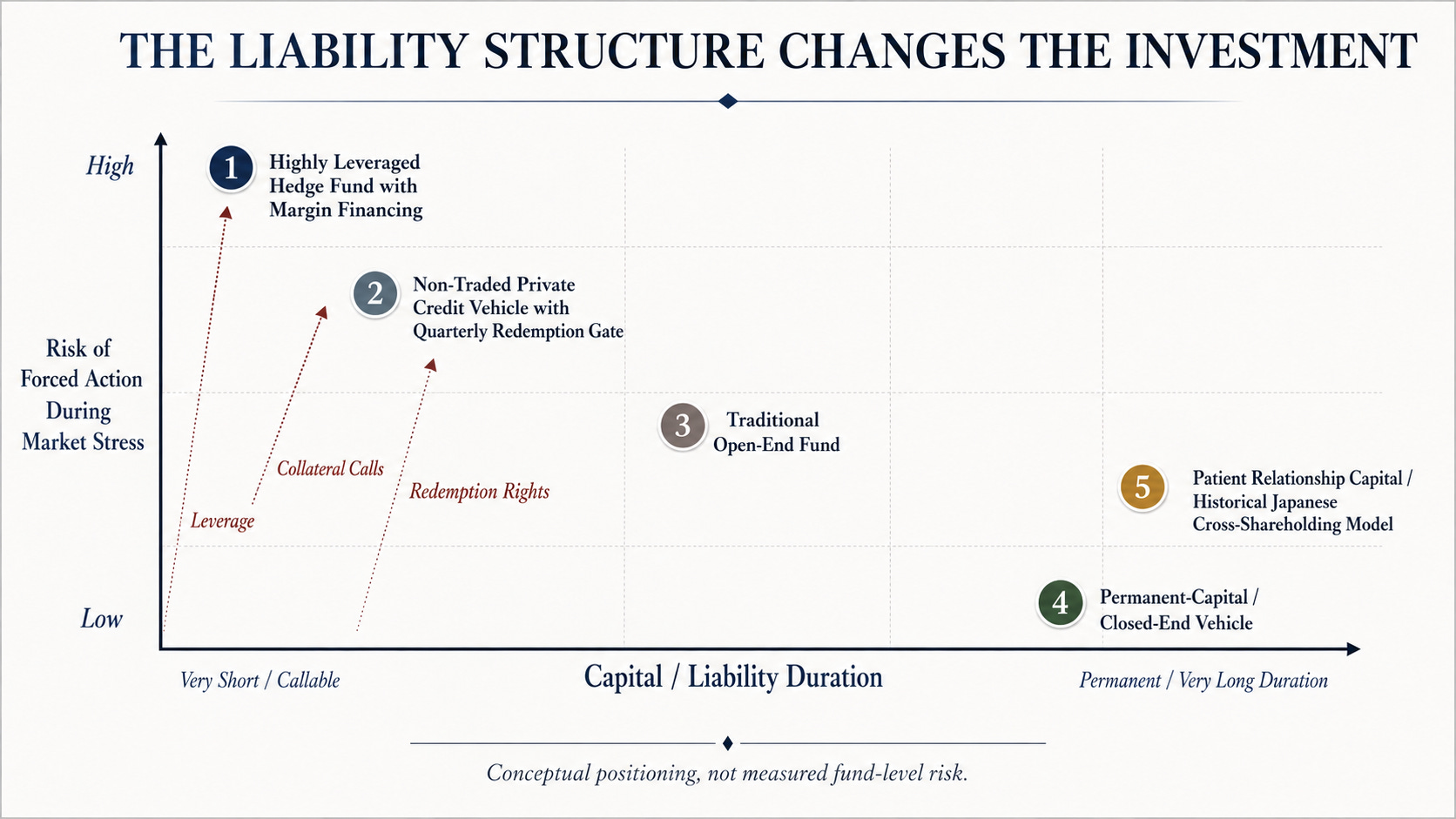
In the summer of 2026 Leopold Aschenbrenner’s Situational Awareness fund, concentrated on artificial-intelligence infrastructure and running with leverage of three to four times on portions of its public-stock book, faced a rapid sequence of margin calls from its prime brokers as semiconductor shares fell. The fund couldn’t raise capital quickly enough, so it sold a large share of its public equity positions to Citadel at a discount, and the value of those holdings dropped by roughly thirty-five billion dollars.
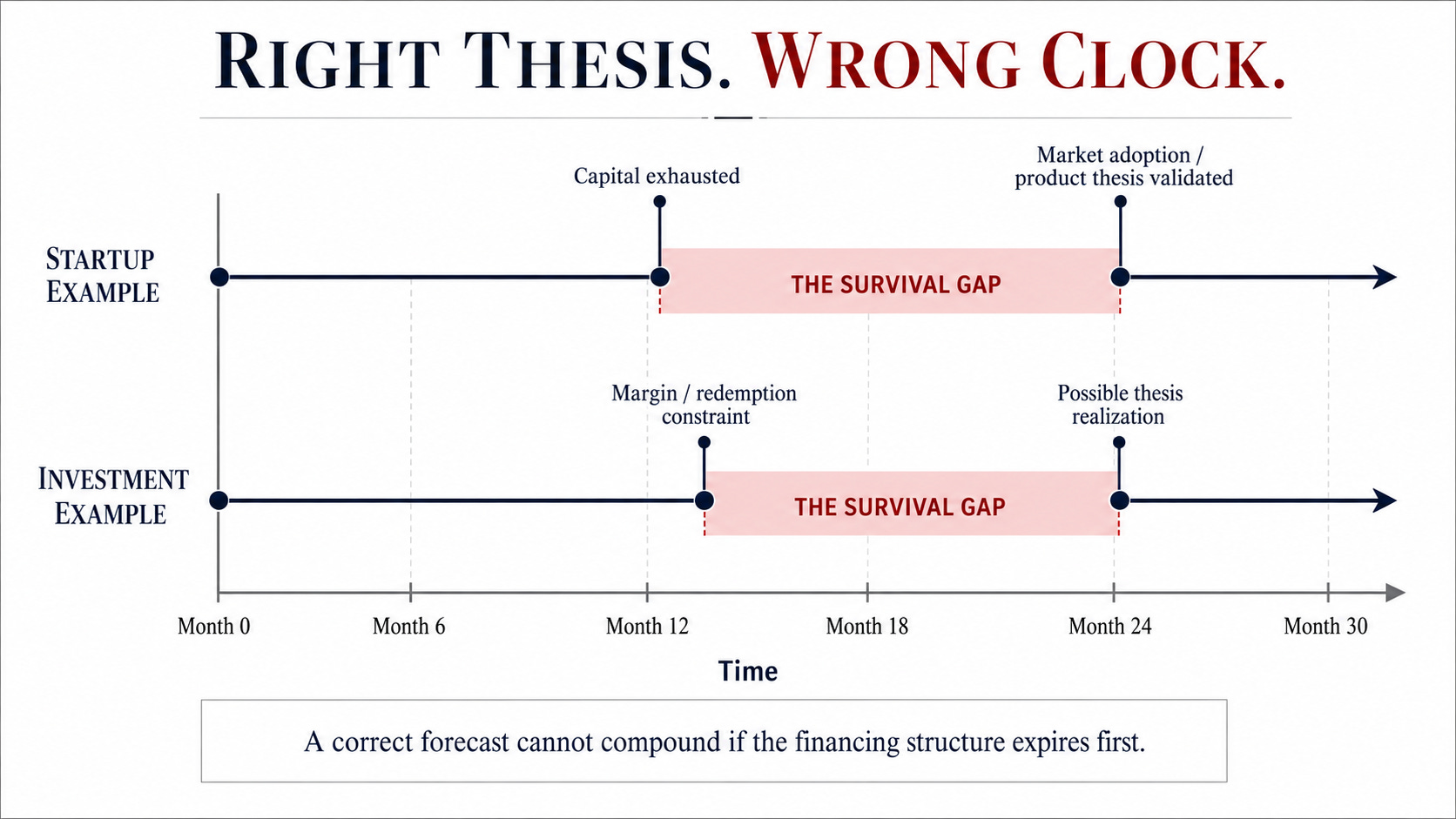
Aschenbrenner may still prove right about the technology’s long-term importance, and that is the revealing part of the episode. The fund required a true thesis about artificial intelligence. It only needed to be wrong about price long enough for its financing terms to force a decision before the thesis could recover. A potentially correct idea about the next decade collided with a capital structure that operated on a much shorter clock.
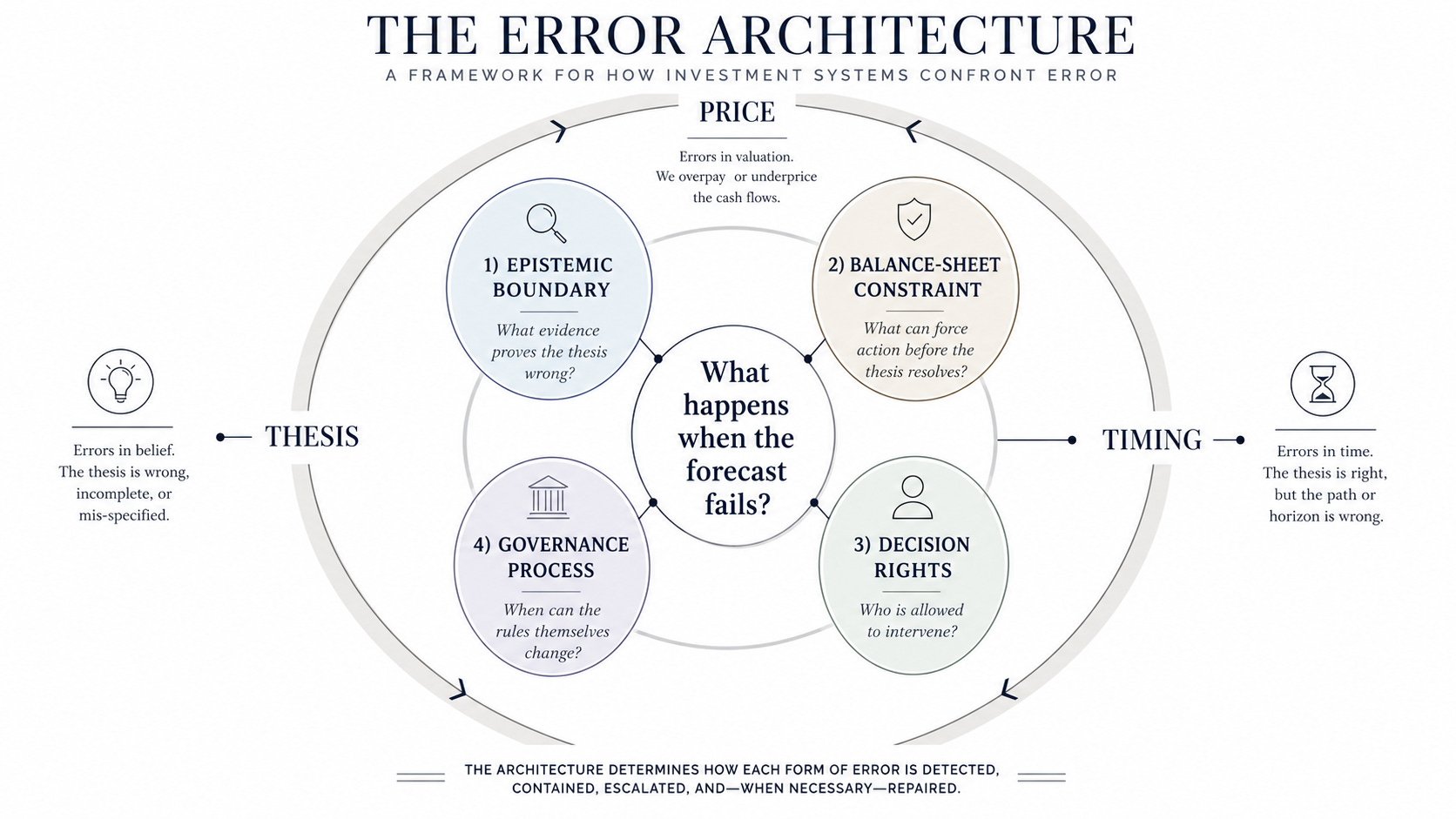
That collision points to a distinction most market commentary collapses into. Being wrong about price is not the same as being wrong about timing, and neither is the same as being wrong about the underlying thesis. Investors whose careers stretch across decades have each constructed what can be called an error architecture: a prior set of decisions about which kind of wrongness will be tolerated, which kind will trigger action, who holds the authority to override the system, and under what conditions the rules themselves may later be amended.
The architecture has four practical components. There is the evidence that would invalidate the thesis. There are the external constraints that can force action regardless of the thesis. There are the decision rights that determine who may intervene. And there is the process, if any, by which the architecture itself can be revised. These elements are rarely glamorous, and they rarely appear in the highlight reels, yet they shape far more of the long-run outcome than the quality of any single forecast.
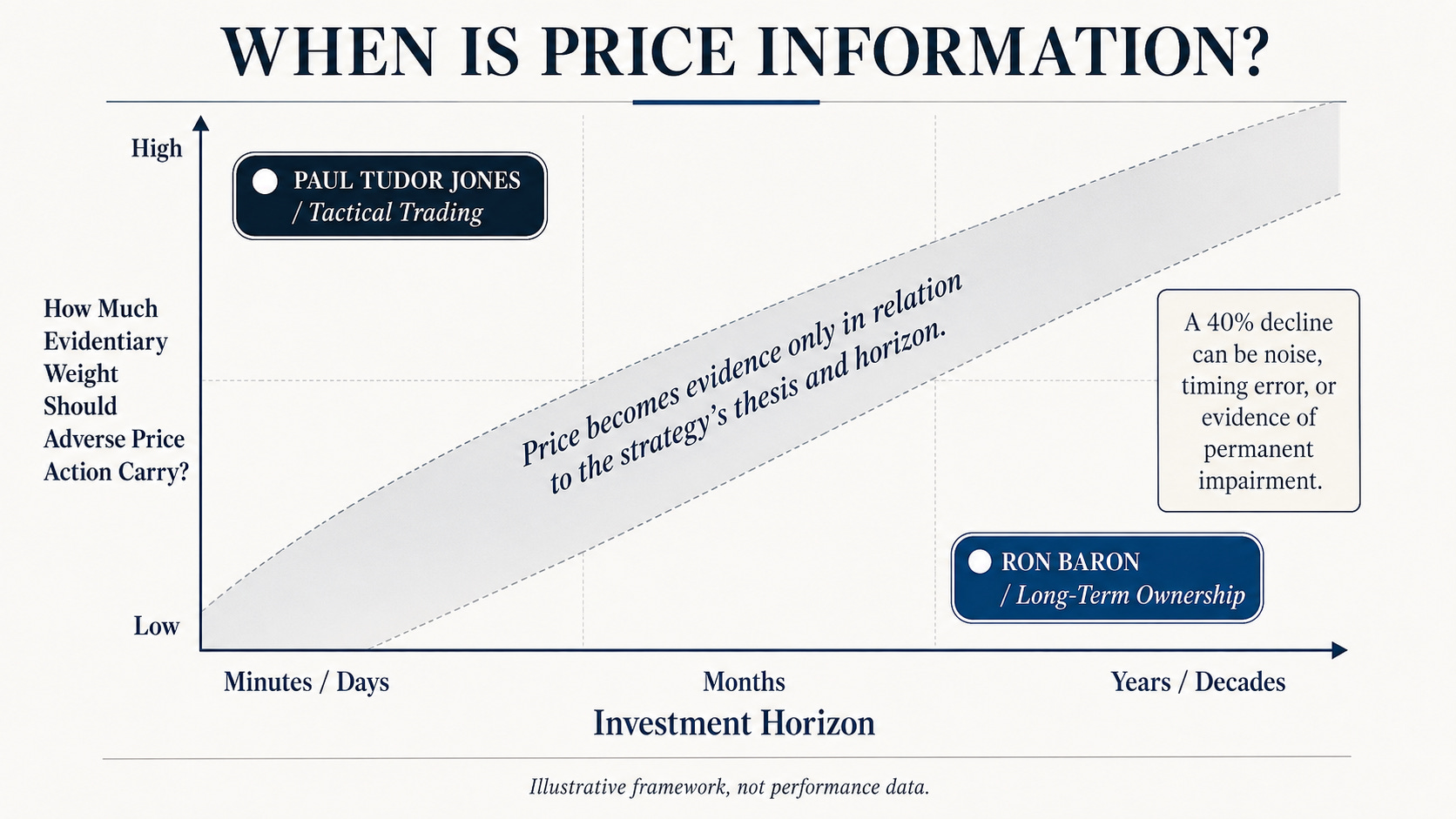
Paul Tudor Jones has spent much of his career treating adverse price action as information that may need to be acted on quickly. He has spoken about the 200-day moving average as a defensive signal, and he looks for trades in which the potential reward is several times the amount risked. The five-to-one idea makes being wrong ordinary rather than catastrophic, because a strategy that risks one unit to make five does not require a high win rate to remain solvent.
Jones is clarifying the game he is playing. When the expected return comes from catching a move in price, a move against you can contain real information, and refusing to leave can convert a manageable mistake into something that ends the enterprise. The exit rule is written before the position is large and before the loss has begun to feel personal. In this architecture, price is treated as potential evidence of timing or execution error rather than as automatic noise.
Ron Baron has taken nearly the opposite approach with certain personal holdings. He has described making an explicit commitment to remain the last seller of investments he believes may need years to mature, Tesla among them. His firm has sold Tesla shares for clients when concentration became excessive, and that distinction matters. What Baron is trying to protect is not the refusal to admit error. It is the temptation to let ordinary volatility destroy a thesis whose relevant horizon is measured in years rather than weeks.
Price can be evidence for one kind of investor and noise for another. The critical question is not whether you call yourself a trader or an investor. It is what observable evidence has been designated in advance as thesis-invalidating. A 40% decline can leave a company fundamentally intact, or it can signal that the economics have permanently deteriorated. Holding forever does not automatically convert permanent impairment into temporary noise, and selling does not create the loss if the business itself has already done so. This architecture is designed primarily to survive being wrong about timing.
Jim Simons approached the problem from a different direction. He has said that at Renaissance he didn’t override the model. The practice sounds like faith in computers, but in substance it is about protecting the integrity of a tested system. Once a human intervenes on a frightening day, the historical record no longer describes the thing you actually own, because you are observing a hybrid in which discretion appears precisely when stress is highest. Simons constrained the human so that the system being lived with would remain the system that had been examined. Decision rights were deliberately limited in order to protect the model against the very form of behavioral override that tends to appear under pressure.
Jim Simons (full length interview) - Numberphile
Ken Griffin learned the capital-structure version of the lesson in 2008, when Citadel’s main funds lost roughly 55% and the firm suspended investor withdrawals. Positions designed to offset one another stopped doing so when the financial system seized. Correlations shifted, some hedges stopped working, and the difference between a sound position and a liquid one became decisive. Afterward, the firm placed greater emphasis on arrangements that reduced the risk of simultaneous tightening across counterparties and on infrastructure that kept the enterprise operable even when previously stable relationships were not.
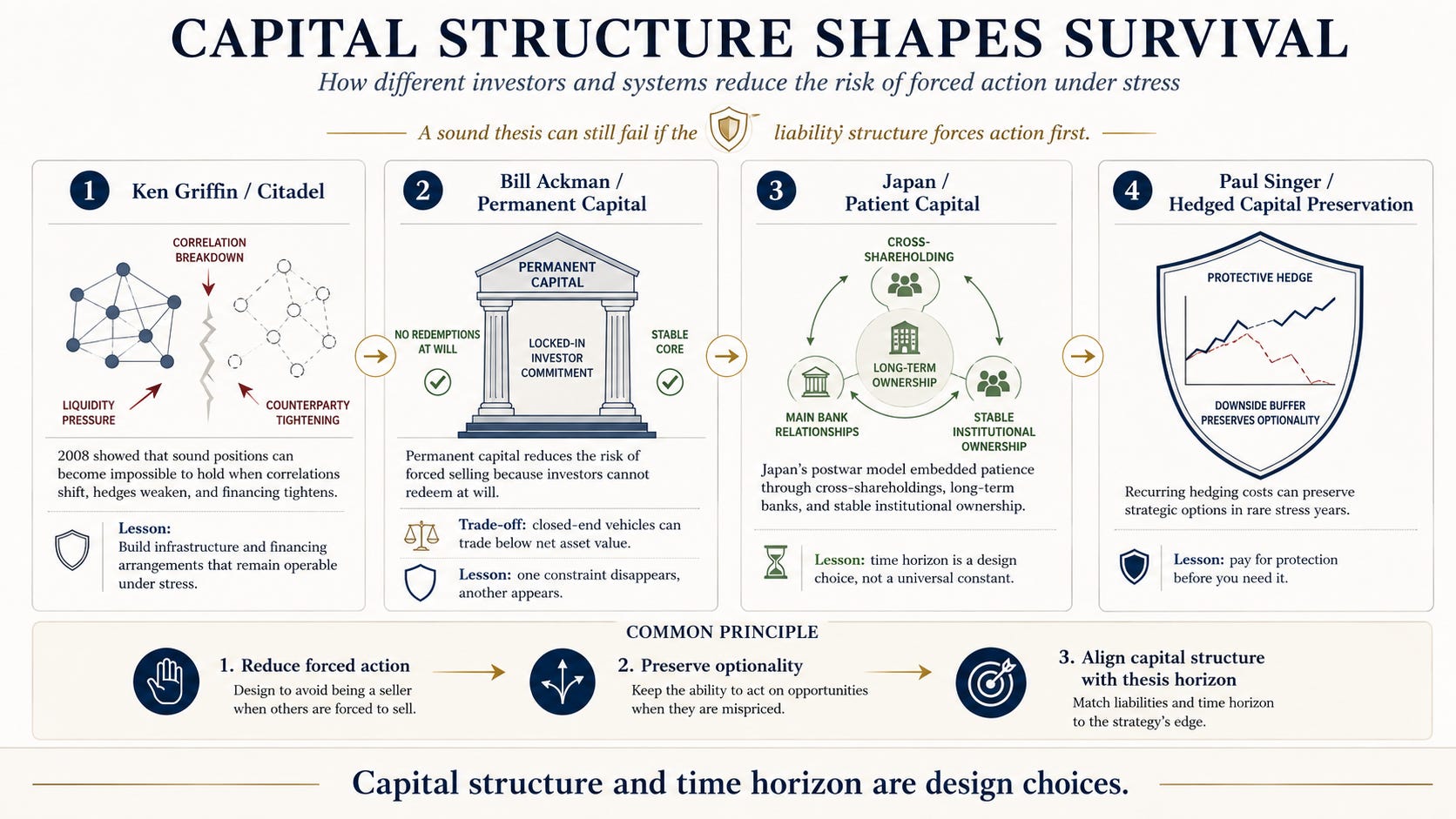
Bill Ackman later arrived at a related solution from the other direction. Much of Pershing Square now rests on permanent capital that investors cannot redeem at will, and that structure removes one common mechanism by which a manager is forced to sell at the worst moment. Yet permanent capital is not magic. Closed-end vehicles can trade at a discount to the value of the assets inside them, so one constraint disappears and another appears.
Japan’s postwar system of patient capital offers a comparative illustration. Cross-shareholdings, long-term relationships with main banks, and large institutional holders historically created ownership structures that could absorb multi-year horizons without the constant pressure of quarterly redemption or activist exit. The system carried its own rigidities and costs, yet it shows that capital structure and time horizon are design choices rather than universal constants.
Paul Singer has long treated capital preservation as a central priority, accepting the recurring cost of hedges so that the firm retains options in the rare years when those hedges matter.
Stanford Leadership Forum 2026: Conversation with Ken Griffin
The same balance-sheet principle reappeared in private credit in 2026. Blackstone’s BCRED, then roughly seventy-nine billion dollars in size, saw redemption requests reach about 10% of shares in the second quarter and limited withdrawals to its 5% quarterly gate. Apollo’s Debt Solutions fund faced requests near 16.8% and was, likewise, capped. A redemption gate does not always force immediate asset sales, but it does shrink optionality. When claims on the fund become urgent at the same moment the underlying loans grow hard to value or dispose of, the manager’s remaining choices narrow regardless of the original underwriting quality. An asset does not exist separately from the claims that sit against it.
Precommitment is not automatically wise. A rule designed to prevent emotional interference can also lock in yesterday’s assumptions. Mechanical stops can produce repeated whipsaws, models can encounter structural breaks, and permanent capital can protect stubbornness as easily as conviction.
Long-Term Capital Management provides a clear historical example. The firm’s sophisticated mean-reversion models and relative-value theses assumed conditions that had held in the historical data, and those assumptions failed when the Asian and Russian crises produced correlations and liquidity conditions outside the models’ experience. The funding architecture, which relied on continuous access to leverage under normal market functioning, amplified the problem. The rules that had been designed to manage risk under one regime became destructive under another.
The Collapse of Long-Term Capital Management | When Genius Failed w/ Clay Finck
The deepest version of the argument is therefore that rules should sometimes change under stress. It is that institutions need both fixed rules and a pre-agreed procedure for amending them. A stop-loss is a rule. A process for deciding whether the stop-loss framework itself remains valid is called governance. An amendment process can itself become dangerous if managers invoke it every time a rule becomes painful, because if every drawdown becomes grounds for revision, the process has simply recreated discretion under another name. The conditions for amendment must therefore be stricter than the conditions for ordinary discretion.
The same logic appears outside pure finance. A startup can correctly identify demand and still fail because its runway is twelve months while market adoption takes twenty-four. A company whose debt all matures in the same window, a bank whose deposits can flee faster than its assets can be sold, or an insurer whose reserves are mismatched to its liabilities is living inside an error architecture, whether the architects intended one or not. Solvency and correctness are not the same condition. A participant can be fundamentally right about the future and still be forced out of the game before that future arrives.
The careers that stretch across decades usually have answers already waiting when the unexpected arrives. The leverage limit was set earlier, the exit evidence was designated in advance, the hedge was already costing money, the redemption terms were already written, the model either permits intervention or it does not, and the manager already knows which facts would kill the thesis.
Before capital is committed, four questions clarify the architecture and map directly onto its components. What evidence would prove the thesis itself is wrong? That is the epistemic boundary. What forces outside the thesis can compel an early decision? That is the balance-sheet constraint. Which decisions is the investor prohibited from renegotiating once stress begins? That is the behavioral protection. And under what conditions may the rules themselves be revised? That is the governance process.
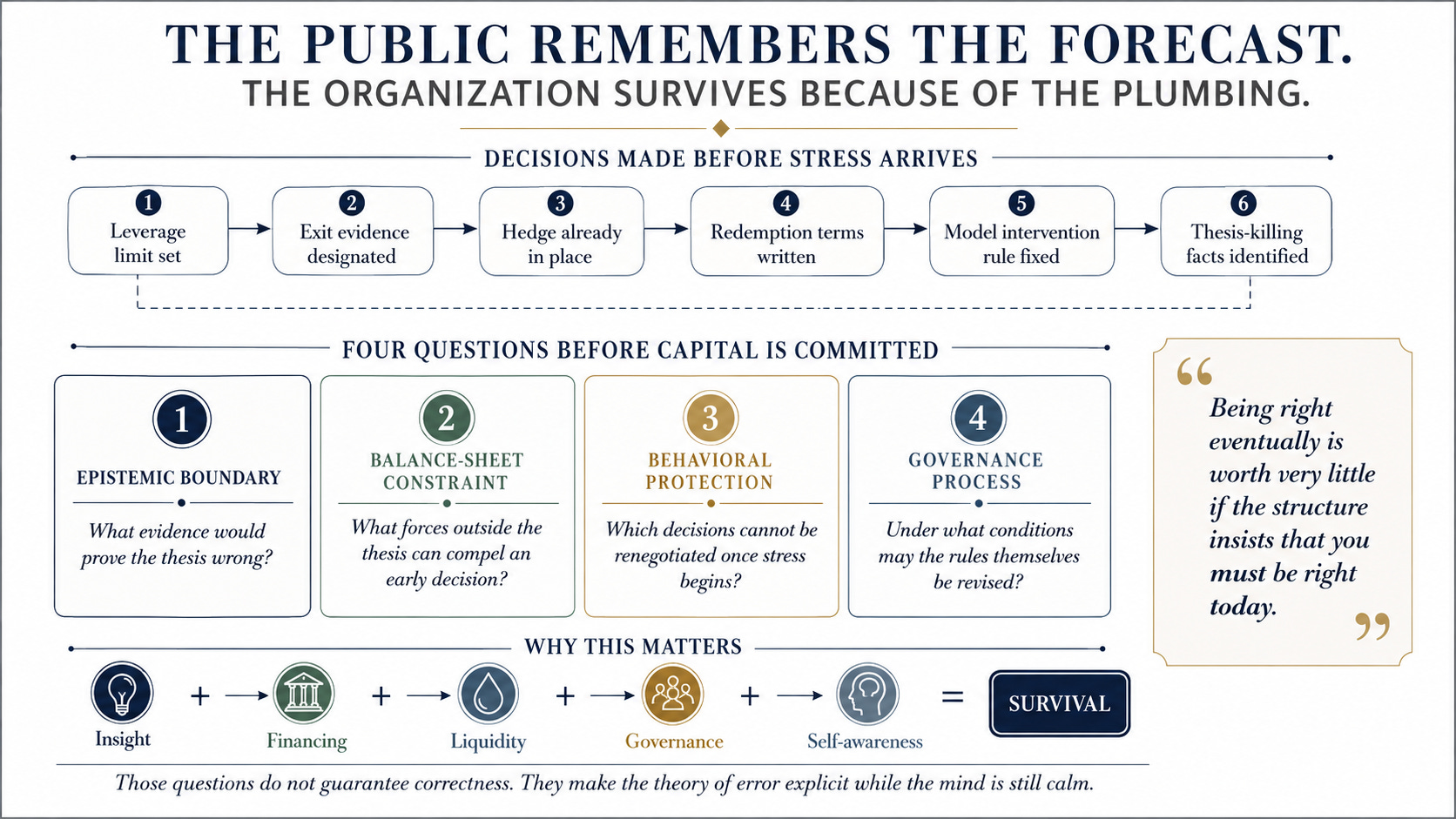
Those questions do not guarantee correctness. They simply make the theory of error explicit while the mind is still calm.
Markets reward insight, and they also conduct a continuous examination of every participant’s financing, liquidity, governance, and capacity for self-deception. Being right matters. Yet being right eventually is worth very little if the structure insists that you must be right today.
The public remembers the forecast. The organization survives because of the plumbing.
Comments
Nothing yet. Say the first thing.
Sign in to join the conversation.