
Economic systems rarely announce the moment when coordination turns into control, because the shift almost always shows up first in the routine paperwork.
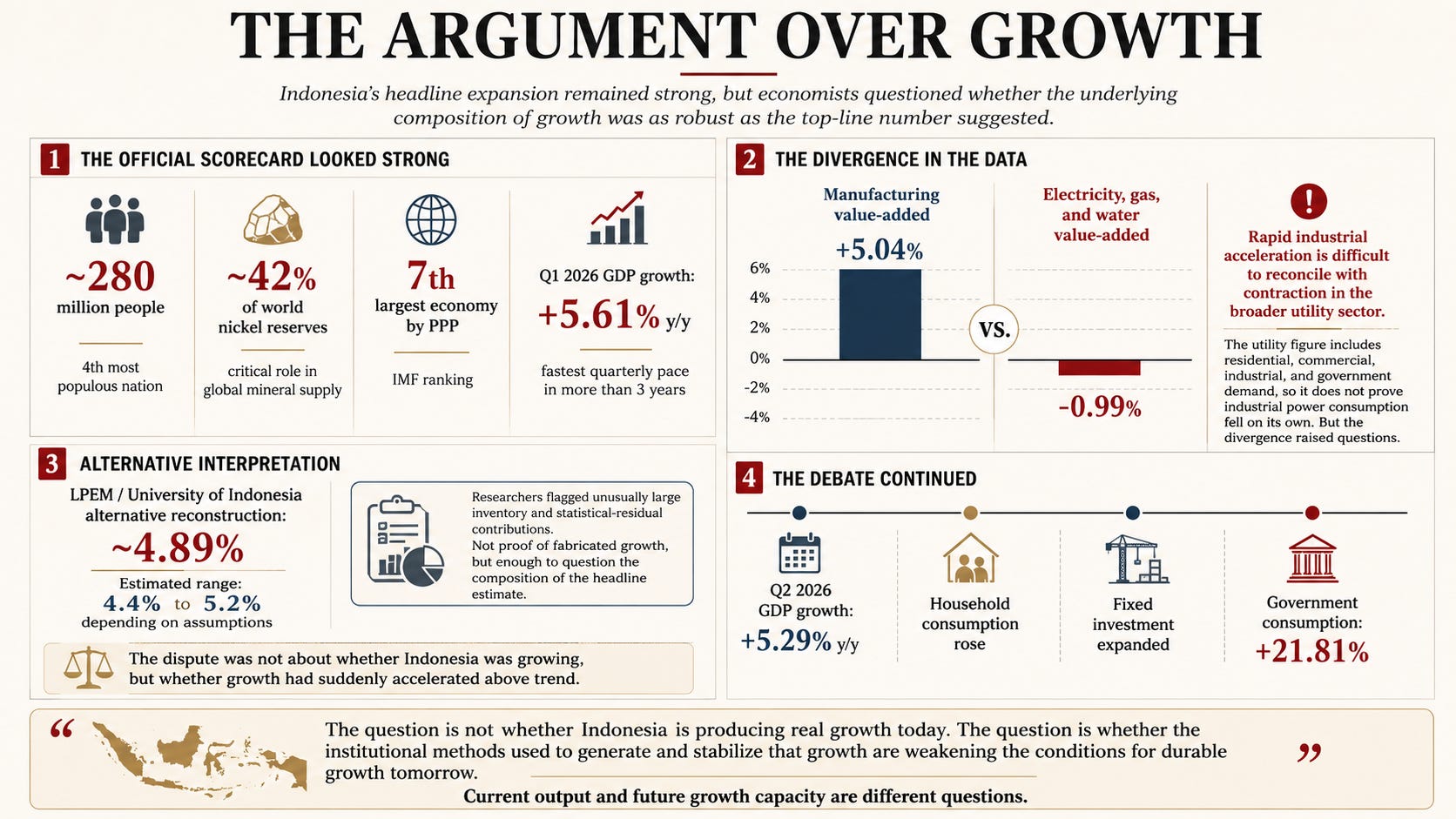
In early 2026, the central bank of Indonesia began circulating a sequence of regulatory circulars. For years, an entrepreneur in Jakarta looking to swap rupiah for foreign currency could buy as much as $100,000 each month without having to demonstrate an underlying transaction. In April, Bank Indonesia lowered that ceiling to $50,000. On June 2, the threshold fell to $25,000, and on July 1, it dropped to $10,000. Over the same period, the documentation threshold for outgoing foreign-currency bank transfers was cut from above $100,000 to above $50,000 in April, and then to above $25,000 from July 1.
The central bank described these adjustments as prudential measures designed to deepen the domestic foreign-exchange market and reinforce rupiah stability amid global uncertainty. Taken together, the sequence reveals a structural tension.
Indonesia entered 2026 boasting enviable headline growth figures, exceptional mineral resources, and a hard-won post-Asian-crisis reputation for fiscal discipline. Yet it also entered the year with persistent currency depreciation, anxious portfolio investors, and a government steadily extending its reach across private trade, commercial banking, and corporate boardrooms.
The illusion isn’t that Indonesia has somehow stopped growing, because the country is plainly expanding. The illusion is that strong aggregate output can easily be mistaken for broad economic strengthening, even when household security and investor confidence are weakening, and when policymakers are becoming more willing to manage the signals that reveal economic stress. The risk is that policymakers begin treating the price of their currency and the movement of capital less as diagnostic signals to be understood and more as variables to be administratively managed.
The Argument Over Growth
The official macroeconomic scorecard looked strong.
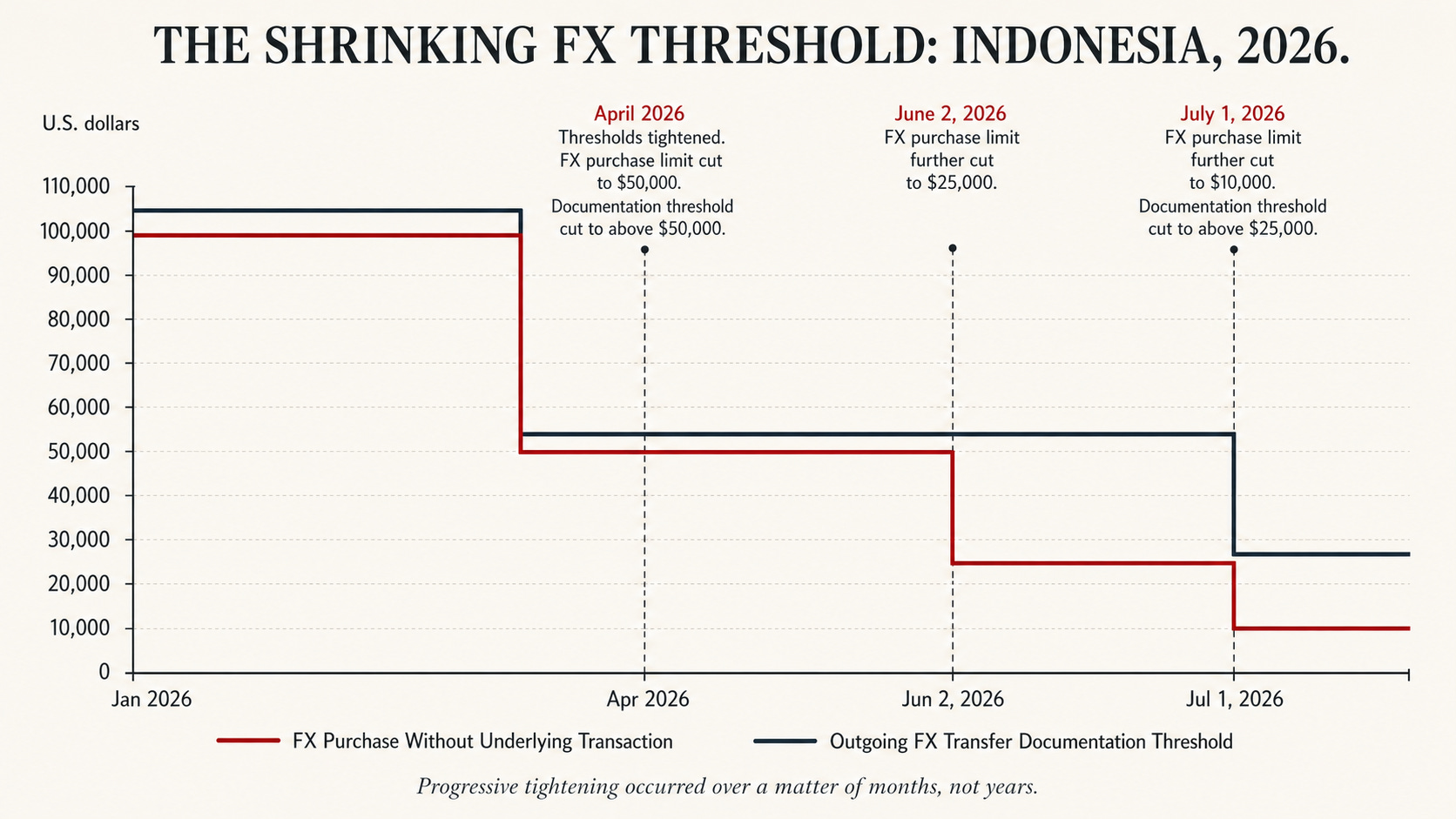
Indonesia has roughly 280 million people, making it the fourth most populous nation on earth. It sits on roughly 42% of the world’s nickel reserves, which puts it right at the center of global mineral supply and makes it a critical player in battery-material supply chains. If you measure its output by purchasing power parity, the International Monetary Fund ranks Indonesia as the seventh-largest economy in the world.
When the national statistics bureau, Badan Pusat Statistik, released its first-quarter figures for 2026, the headline figure was striking: real gross domestic product had expanded by 5.61% year-on-year, the fastest quarterly pace the country had seen in more than three years.
Soon after that announcement, researchers at the Institute for Economic and Social Research at the University of Indonesia began taking the accounts apart.
They noticed an odd divergence in the data. The statistics bureau reported that manufacturing value-added had expanded by 5.04%, but in that exact same ledger, the real value-added for the combined electricity, gas, and water sector had contracted by 0.99%.
That contradiction doesn’t prove that the factory numbers were fabricated. The utility figure bundles residential, commercial, industrial, and government electricity demand together, so it can’t prove on its own that industrial power consumption fell. But the researchers argued that this divergence was difficult to reconcile with rapid industrial acceleration, particularly given manufacturing’s substantial electricity requirements.
The researchers also pointed out an unusually large contribution in the expenditure accounts linked to inventories and statistical residual adjustments. The residual isn’t itself direct evidence of unwanted stockpiles piling up in warehouses; it is an accounting category whose anomalous size led the economists to question the composition of the headline estimate.
The university researchers weren’t arguing that the economy had stalled out, because their alternative reconstruction placed first-quarter growth at approximately 4.89%, within an estimated range between 4.4% and 5.2% depending on baseline assumptions.
The difference is between growth near Indonesia’s recent trend and a sudden acceleration above it.
The debate didn’t end Indonesia’s growth narrative. The statistics agency subsequently reported year-on-year growth of 5.29% in the second quarter of 2026, confirming that robust aggregate expansion continued. The first-quarter accounts had also shown genuine strength: household consumption rose, fixed investment expanded, and government consumption increased by 21.81%.
The dispute is narrower but more consequential: whether the official aggregate reading smoothed over internal vulnerabilities in an economy whose household indicators were telling a weaker story. Current output and future growth capacity are different questions. The issue isn’t whether Indonesia is producing real growth today, but whether the institutional methods being used to generate and stabilize that growth are weakening the conditions for durable growth tomorrow.
The Household Beneath the Aggregate
Gross domestic product doesn’t conceal household weakness by design. It simply measures something different. The masking effect is statistical, not necessarily political.
To see how this divergence looks on the ground, consider Rahmat Hidayat, a 44-year-old former shoe-factory worker in Karawang, West Java. After losing his formal factory job, he turned to selling grilled meatballs, earning less than half his previous income while his family cut spending on food and essential medication. His experience can’t stand in for an entire economy, but it echoes a much broader statistical shift visible in the national figures.
The government categorizes socioeconomic brackets based on household expenditure relative to the national poverty line, defining the middle class as those who spend between 3.5 and 17 times that benchmark. Between 2019 and 2024, the statistical middle-class population shrank by roughly 9.5 million people, dropping from 57.33 million down to 47.85 million, or from 21.45% of the population to 17.13%.
Later estimates from the Mandiri Institute placed the aspiring-middle group, households spending between 1.5 and 3.5 times the poverty line, at roughly 142 million people, or more than half the national population.
These income categories matter because private consumption is the bedrock of the entire Indonesian economy. Official data confirms that the middle class and the aspiring middle class together make up two-thirds of the population, and they account for 81.49% of total household spending.
Shrinking Indonesian Middle Class: Why Are They Struggling?
This demographic contraction coincides with distinct structural pressures across consumption, labor security, and employment generation:
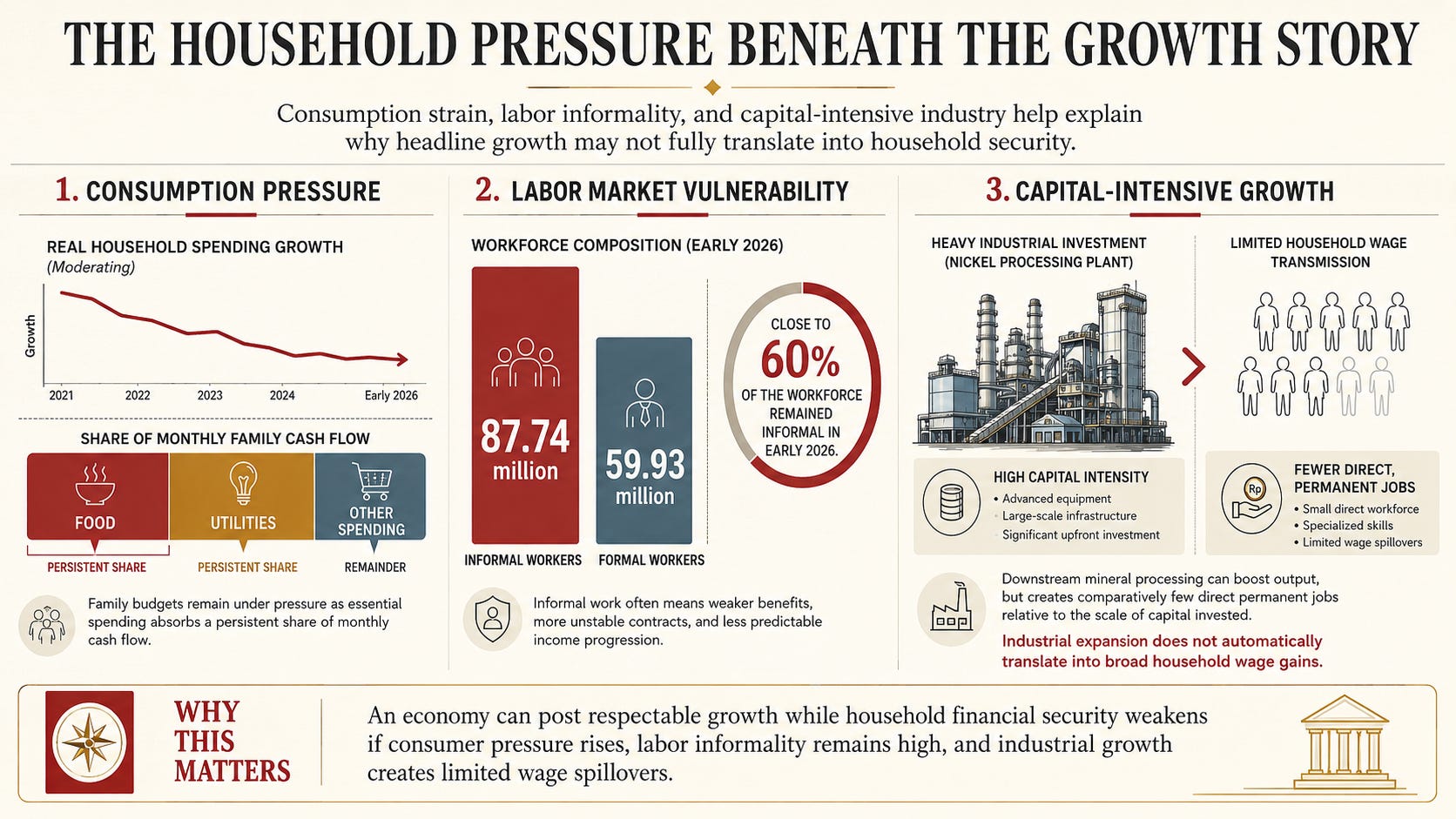
Direct consumption pressure emerged as real household spending growth moderated while staple outlays on food and household utilities consumed a persistent share of monthly family cash flows.
Labor market vulnerability remains acute: national surveys recorded 87.74 million informal workers compared with 59.93 million formal workers in early 2026, leaving close to 60% of the workforce disproportionately exposed to unstable contracts, weaker benefits, and limited income progression.
Downstream mineral processing facilities are heavily capital-intensive rather than labor-intensive, creating comparatively few direct permanent jobs relative to their massive capital requirements, which mutes the broader transmission of industrial growth into household wages.
This explains how aggregate output and household well-being can drift in opposite directions. An economy can post respectable growth rates fueled by public spending and mineral processing while the vast demographic engine responsible for four-fifths of all consumer spending finds its financial margin narrowing by the day.
The Seduction of Success
To understand why political leaders in Jakarta have responded to this squeeze with more centralized direction rather than less, one has to examine the policy experiment that taught them that administrative force could yield extraordinary results.
Indonesia inherited a commodity system in which the extraction of raw materials occurred domestically, while much of the higher-value refining, smelting, and manufacturing activity took place abroad.
The government experimented with mineral export restrictions as early as 2014, loosened them briefly in 2017, and then imposed a total ban on the export of raw nickel ore in January 2020. The European Union challenged the ban at the World Trade Organization, and critics argued that export prohibitions would distort trade and investment.
Instead, the export ban helped catalyze a major boom in foreign direct investment, driven heavily by Chinese industrial groups that poured billions into building domestic smelters and industrial parks. Indonesia’s mined nickel output expanded from around 780,000 tons in 2020 to more than 2.2 million tons by 2024, boosting its share of global mined nickel from just over 30% to roughly 60%. During this same period, the rapid construction of high-pressure acid leach plants and rotary kiln electric furnaces changed physical trade flows: Chinese imports of Indonesian nickel matte jumped from zero before 2022 to 301,000 tons in 2023, while mixed hydroxide precipitate imports rose from zero to 830,000 tons.
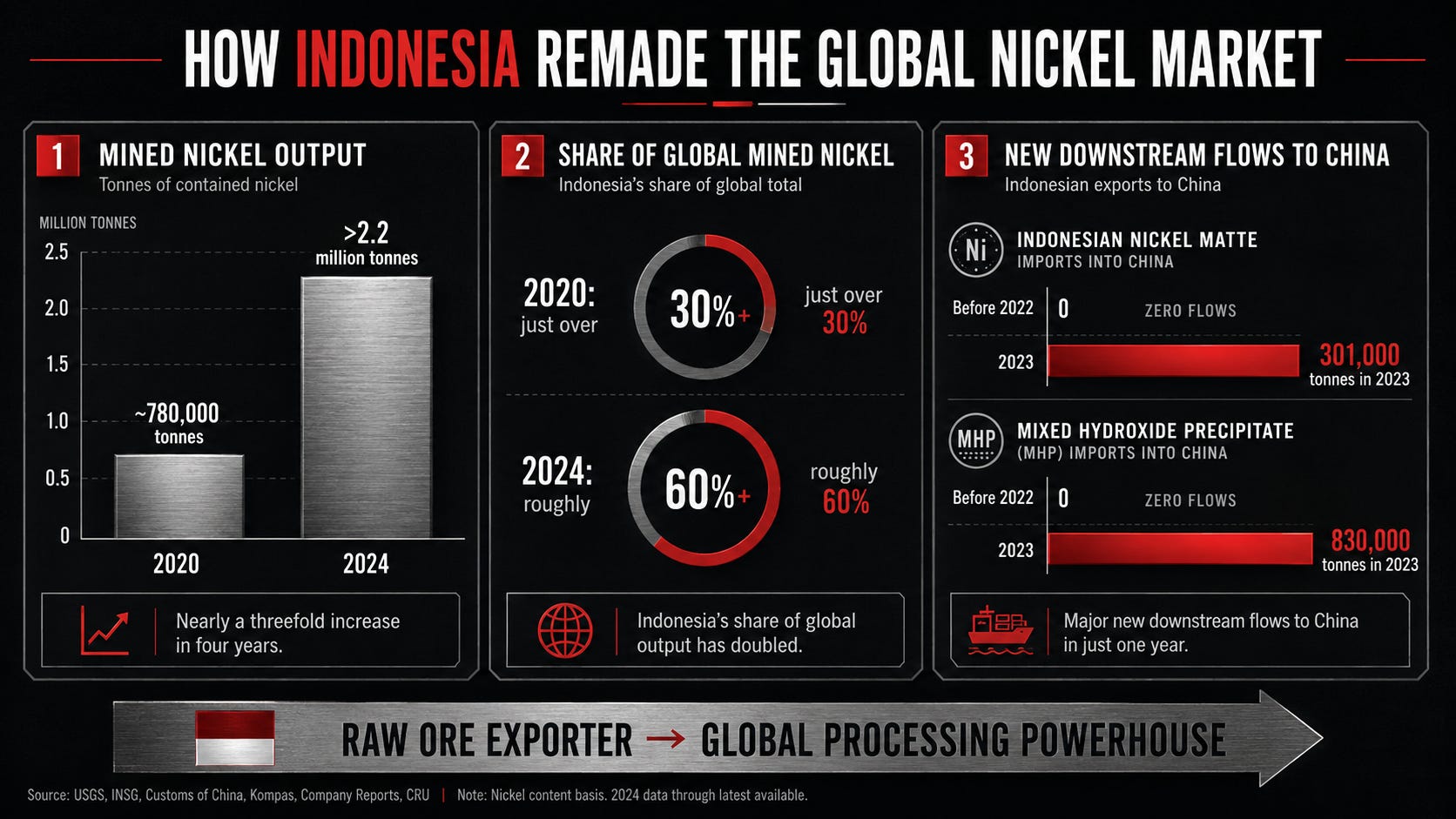
The lesson that political planners took away was clear: market incentives had failed to build domestic downstream capacity on their own, but state restrictions, combined with large-scale foreign capital and industrial expertise, had transformed the country’s nickel sector in half a decade.
The irony was that a policy designed to capture more national value depended heavily on foreign capital and industrial expertise to build the capacity the domestic market lacked.
Nickel demonstrated that control could produce capacity. The next question was whether greater control would continue producing greater effectiveness.
Yet that very triumph carried a hidden warning. Indonesia’s production expansion became a major supply-side driver of a global nickel glut. International nickel prices fell sharply, higher-cost mines around the world were squeezed, and domestic processing margins narrowed. At the same time, global automakers accelerated their shift toward lithium-iron-phosphate battery chemistries that use no nickel at all.
The state had successfully changed the market’s structure, but the market then adapted in ways no decree could fully control.
How China Took Over Indonesia’s Nickel Industry To Fuel Its EVs
The State Expands
The nickel experience provided a powerful precedent for the more expansive economic doctrine pursued under President Prabowo Subianto.
Taken together, recent policies suggest a coherent governing logic:
Indonesia possesses exceptional natural-resource endowments, and it wants to extract maximum national value from them.
Leaving the pricing of domestic minerals to trading desks in London or Singapore leaves the country largely a price taker.
Fragmented state-owned companies are seen as diluting national bargaining power and limiting coordinated use of state assets.
Allowing exporters to park their foreign-currency export proceeds in overseas bank accounts reduces the foreign-currency liquidity available to the domestic financial system.
Decisions that were once left to private companies, commercial banks, and open price discovery were increasingly being pulled toward state-supervised channels.
The institutional centerpiece arrived in 2025 with the creation of Danantara. Rather than acting as a standard sovereign wealth fund that invests budget surpluses, Danantara was established within a new governance structure reporting directly to the president to manage state-owned enterprises with combined gross corporate assets exceeding $900 billion. This isn’t a $900 billion pool of cash, but the combined asset base of a vast network of state-owned enterprises and operating subsidiaries under the structure.
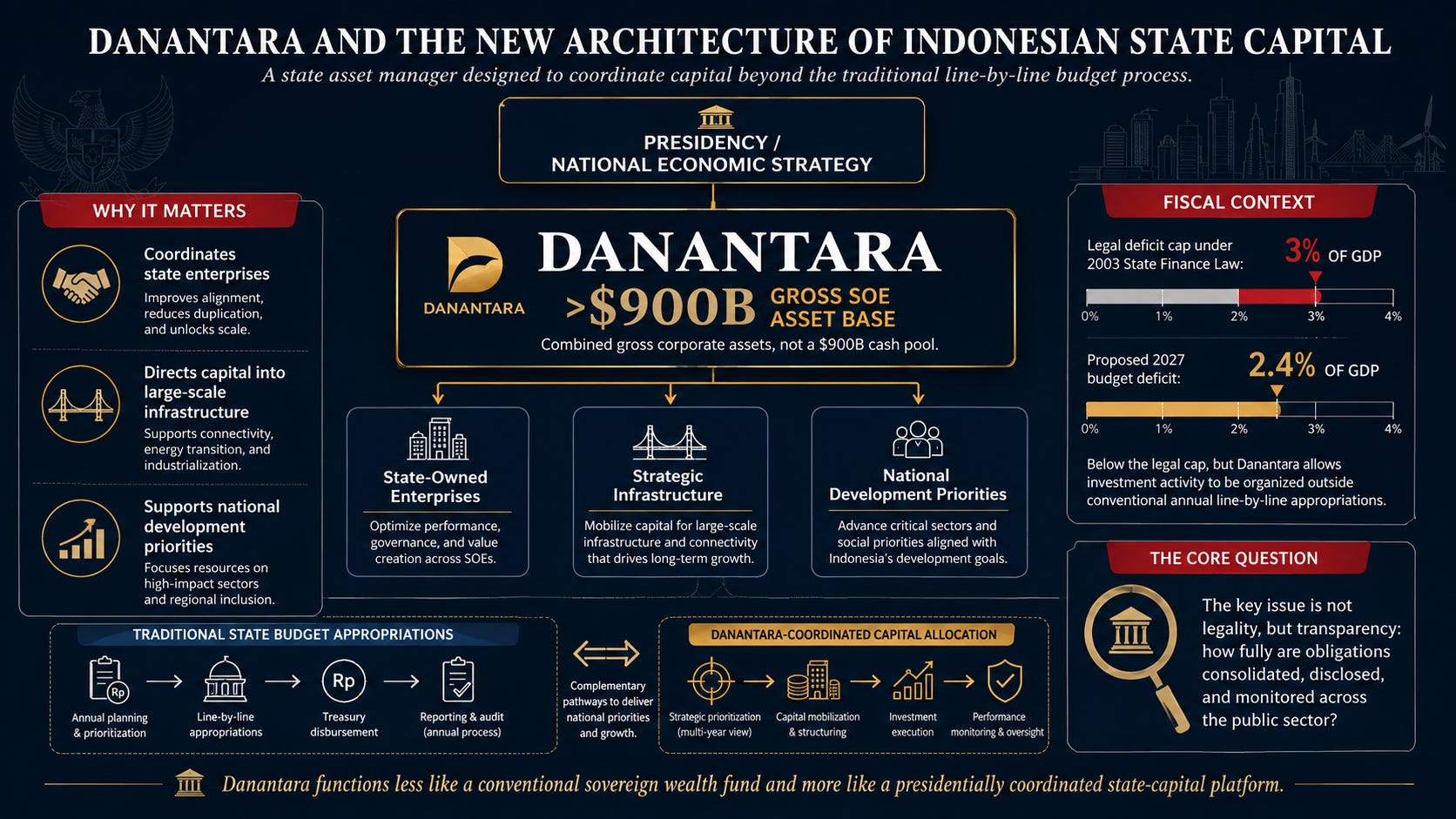
The mission was to coordinate state enterprises, direct capital into large-scale infrastructure, and support national development priorities. Under the 2003 State Finance Law, Indonesia’s annual budget deficit is legally capped at 3% of GDP. Although the proposed 2027 budget deficit of 2.4% sits safely below that statutory ceiling, managing capital through Danantara gives the government a way to organize investments outside conventional line-by-line state-budget appropriations. That doesn’t automatically make the spending hidden or improper, but it shifts more economic activity away from the familiar discipline of annual budget appropriations. The relevant question is therefore not legality, but how transparently these obligations are consolidated and monitored across the public sector.
Yet Danantara’s expanding mandate has raised governance concerns among economists and investors, who note that as of July 2, Danantara was still finalizing its first consolidated financial report following its initial operational setup. Danantara argues that its governance architecture and state-audit requirements are designed precisely to prevent operational conflicts, but the absence of an established public reporting track record creates a risk that commercial discipline and political mandates will become difficult to separate.
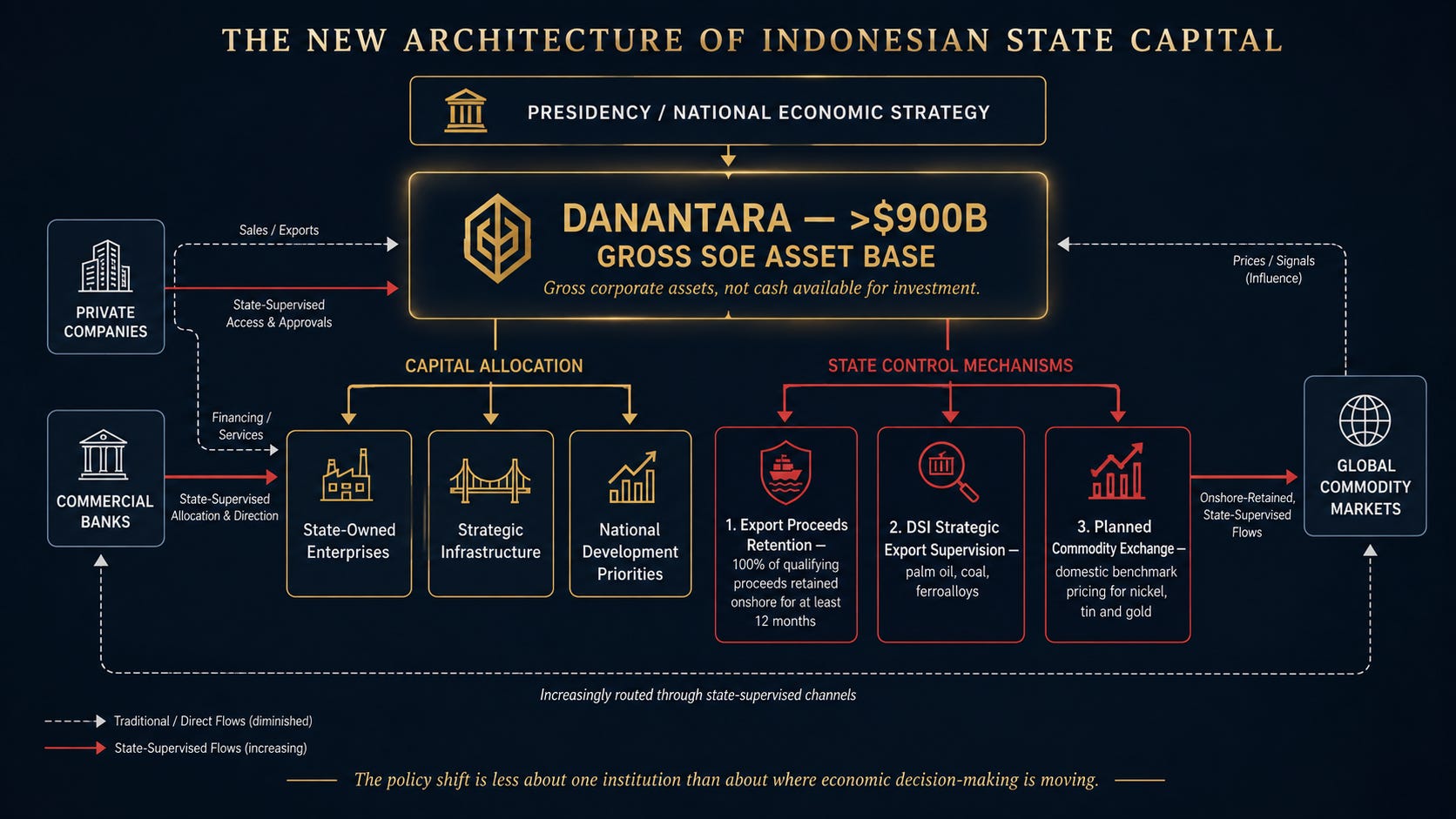
This centralizing impulse spread quickly into trade and currency governance:
Export Proceeds Retention: Exporters of qualifying natural resources with customs paperwork of $250,000 or more were required to retain 100% of qualifying export proceeds inside the domestic financial system for at least 12 months, a substantial escalation from the older rule requiring 30% for three months. The rules permit specified uses for taxes, local operating costs, and loan collateral, but business associations still argued that mandatory retention could complicate international cash-flow management.
Centralized Trade Supervision: In May 2026, regulatory proposals established Danantara Sumberdaya Indonesia (DSI) to oversee export transactions across palm oil, coal, and ferroalloys. After exporters and investors raised concerns about a state trading monopoly, the administration clarified that the agency would monitor transactions to detect under-invoicing and tax leakage rather than displace commercial counterparties. By August, DSI said it had monitored more than 6,500 transactions worth roughly $14 billion.
Sovereign Price Formation: In August 2026, the president announced plans to create a national commodity exchange by early 2027, with the explicit goal of establishing domestic benchmark pricing for nickel, tin, and gold.
A commodity exchange can’t establish pricing power by decree alone. Global pricing benchmarks rely on deep liquidity, broad multi-party participation, enforceable physical delivery, and foreign traders who willingly reference its contracts. Without those conditions, a state-run exchange risks functioning less as a genuine global benchmark and more as a mandatory domestic clearing venue.
The retreat on export-intermediary rules was significant, because it showed that market feedback hadn’t disappeared. Indonesia isn’t yet the closed system described here as a risk. A truly closed system would not have adjusted. The question is whether such reversals remain possible as the system becomes more entrenched and as more agencies, companies, and political constituencies become dependent on it.
Prabowo Says Indonesia Economy on Track for 8% Growth
When the Sensors Turn Red
The most important question in political economy is never whether an ambitious state has the legal power to issue sweeping commands, because governments do that all the time.
What matters is whether the state retains the capacity to recognize when those commands cause harm.
Healthy economic systems depend on diagnostic feedback. Prices, exchange rates, foreign capital flows, bond auction bids, and independent economic statistics aren’t political adversaries; they are sensors. They tell a government whether its plans are generating real productivity or merely building up imbalances behind the scenes.
When an administration responds to friction by continually tightening its grip, it risks initiating a chain reaction that undermines real growth:
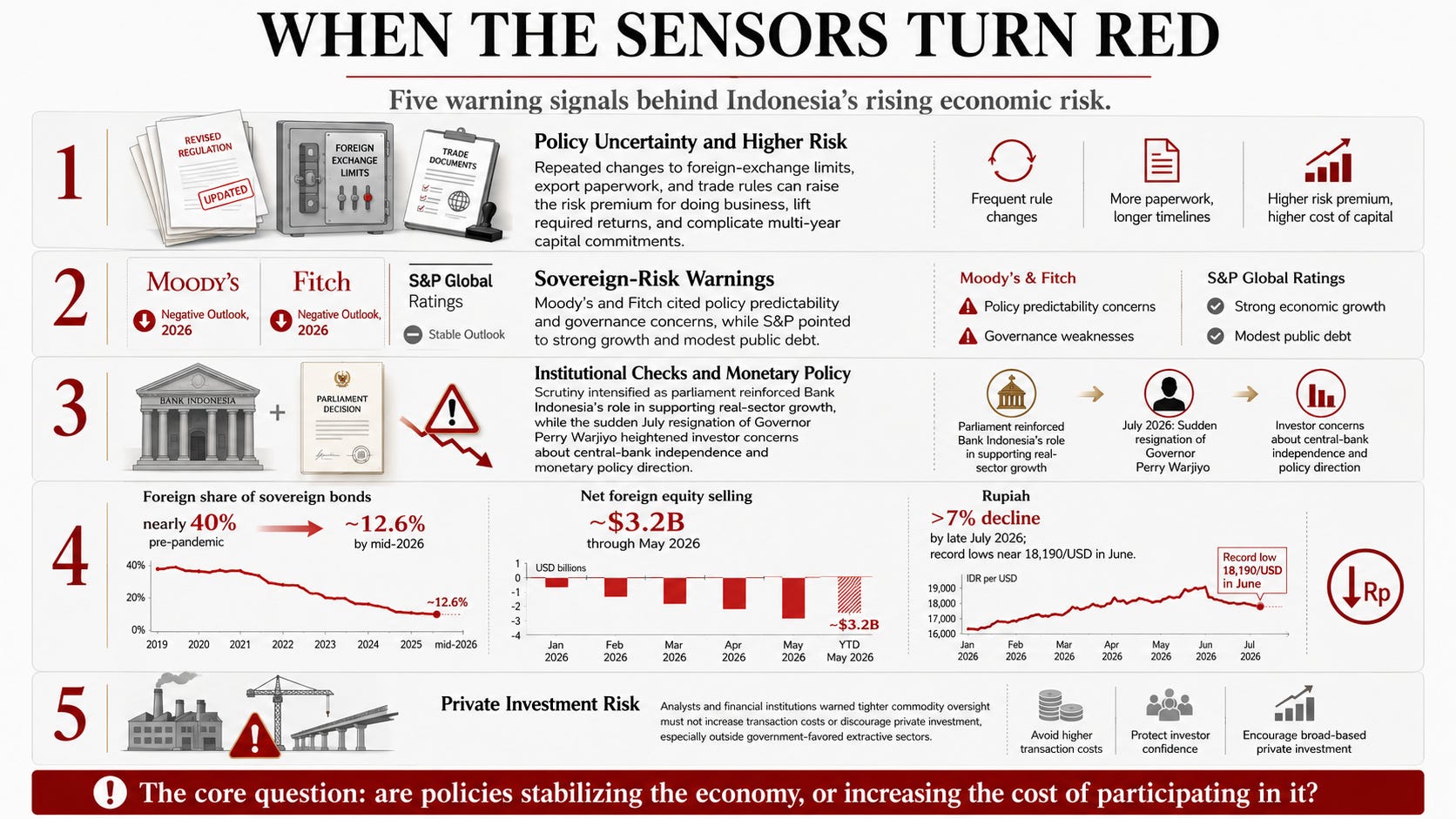
Policy Uncertainty and Higher Risk: Constant revisions across foreign-exchange limits, export paperwork, and trade rules raise the risk premium for doing business in the country, which can lift required returns and complicate multi-year capital commitments.
Sovereign-Risk Warnings: In 2026, rating agencies Moody’s and Fitch lowered their outlooks on Indonesia’s sovereign debt to negative, specifically citing concerns over policy predictability and governance. Conversely, S&P Global Ratings maintained a stable outlook, pointing to strong output growth and modest public debt levels.
Institutional Checks and Monetary Policy: Scrutiny intensified across core economic institutions in mid-2026 as parliament passed legislation reinforcing Bank Indonesia’s role in supporting real-sector growth, while the sudden July resignation of Governor Perry Warjiyo heightened investor focus on central-bank independence and monetary policy direction.
Portfolio Realignment: Foreign investors held nearly 40% of Indonesian sovereign bonds before the pandemic, but by mid-2026, that figure had fallen to roughly 12.6%, a long decline partly reflecting the expansion of domestic institutional ownership. Yet contemporaneous anxiety was evident in equities, where net foreign selling reached $3.2 billion through May amid a sharp market decline. By late July, the rupiah was down more than 7% for the year despite interest rate increases, having touched record lows near 18,190 per dollar in June.
Private Investment Risk: Market analysts and financial institutions warned that tighter commodity oversight must not increase transaction costs or discourage private investment outside government-favored extractive sectors.
Capital markets don’t operate as an ideological monolith. When Bank Indonesia raised interest rates and bond yields adjusted, foreign inflows began returning to local debt in June. In the same month, a Danantara-linked entity issued a debut $1.5 billion dollar bond offering that attracted $4.6 billion in orders from institutional buyers across the United States, Europe, and Asia. International investors were willing to buy an individual security when the yield, structure, and perceived state backing compensated them for the risk. Markets price policy risk continuously rather than issue moral verdicts.
The danger begins when falling prices, capital outflows, or weak auction demand primarily serve as obstacles to policy rather than as information about it.
The issue isn’t whether prudential restrictions can work; they can. The issue is whether they remain temporary responses or become substitutes for correcting the incentives generating capital pressure. If export proceeds are subject to mandatory onshore retention, domestic dollar liquidity improves, but exporters lose operational flexibility. The same principle applies to statistics: methodological challenges need to produce scrutiny rather than institutional defensiveness.
A single capital restriction or a targeted export rule can be a sensible tool during an emergency. But when administrative restrictions accumulate across foreign exchange, physical trade, state assets, and price discovery, the state risks building a closed circuit. In the limiting version of such a system, the government directs economic behavior and then points to that very same behavior as proof that its strategy is working.
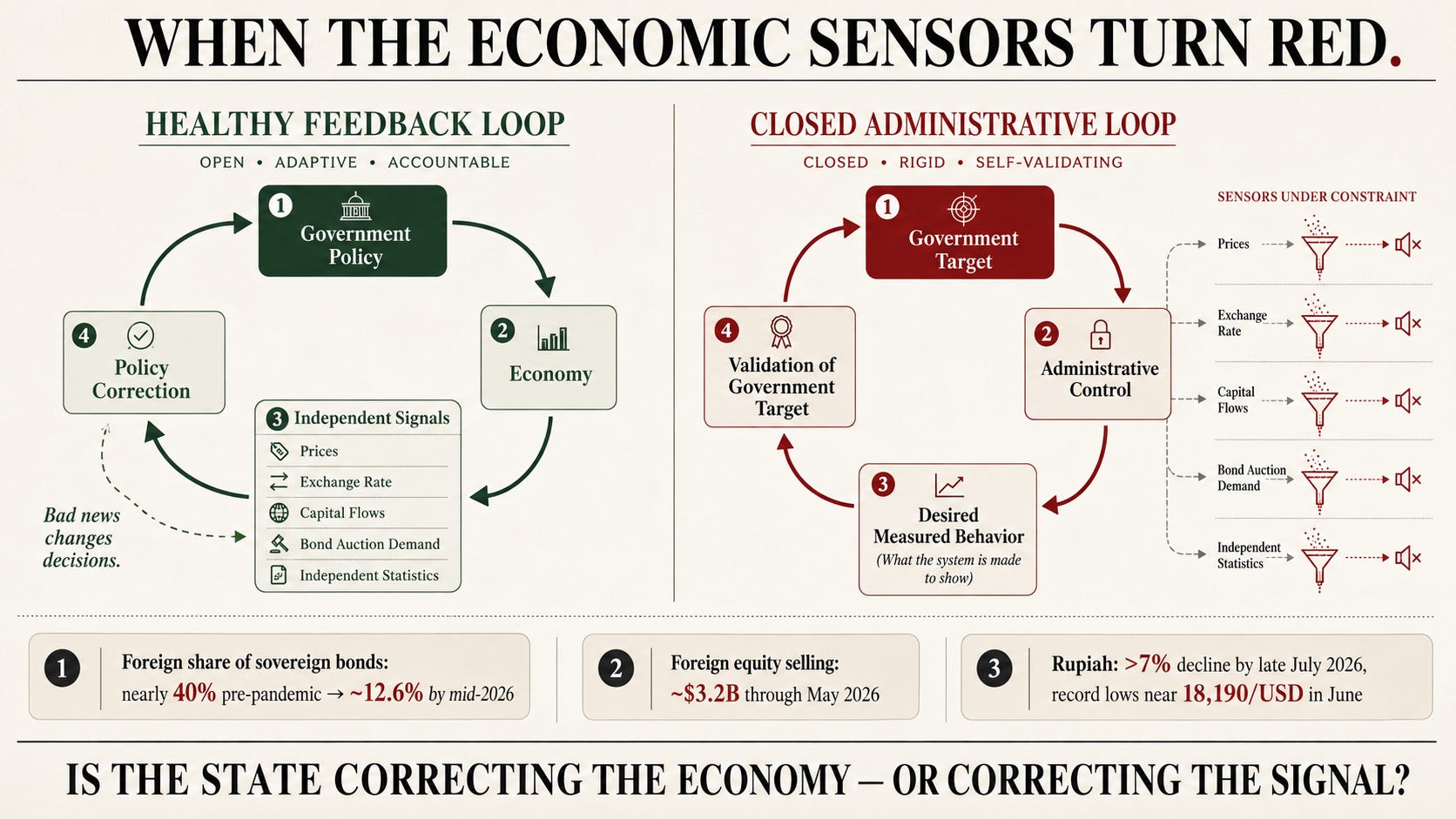
Control measures how much economic behavior a state can direct. Capacity measures whether it can execute policy competently. Effectiveness measures whether those decisions make society more productive and resilient. They aren’t the same thing.
South Korea, like several successful East Asian developmental states, protected and financed favored firms aggressively, but export performance supplied an external benchmark that domestic politics couldn’t entirely manipulate: firms ultimately had to sell competitively abroad.
Over the next two years, four indicators matter more than the headline GDP rate: whether real household consumption per capita returns to sustained growth, whether total factor productivity (the efficiency with which labor and capital generate output) rises alongside mineral processing, whether Danantara publishes audited portfolio returns and consolidated liabilities on a predictable schedule, and whether emergency foreign-exchange restrictions prove reversible.
The great risk for Indonesia isn’t that the state will lose control of its economy, but that it will gain so much control that it can no longer tell whether the system is truly working.
Comments
Nothing yet. Say the first thing.
Sign in to join the conversation.