
“Taste” is praise that erases the work
Outsiders can’t see in. Practitioners stopped trying to let them.
AI is automating the visible — the invisible is what’s left
Hide behind “taste” and you’ll lose the budget argument
The fix: precision over mystique
Hey folks,
For the last few months I’ve been doubling down on the idea that the differentiating factor in a product manager’s success (as well as a designer’s) in the age of AI is their sense of taste and judgment. My pitch has been that it’s the years of working through the friction (that AI is now removing) that builds the experience and expertise to be able to determine what “good” looks like as our ability to create infinite variations at nearly zero cost continues to spread.
A few days ago I was texting with my longtime collaborator Josh Seiden. As usual, he opened up our conversation with a banger:
“I think the words ‘judgement’ and ‘taste’ are shitty terms that non-experts use to describe design and product management.”
His reasoning was that when outsiders watch designers and product managers make decisions, they don’t see what’s behind those decisions. They can’t. The inputs like market research, competitive analysis, user research, positioning strategy, conceptual modeling, design skill etc are invisible to them. So they reach for the only explanation that fits what they can see: a mysterious quality called taste or judgement. My reduction of Josh’s point was that product managers and designers are being positioned as sommeliers, not practitioners.
Josh’s follow up was that designers and PMs resent these terms because they erase the actual work they have done and continue to do. As he implied, “She has great taste” sounds like a compliment. But it’s really saying: I have no idea how she does what she does, and I’m not going to try to find out. And can’t Claude do that too now?
In classic Jeff and Josh fashion (we’ve worked together for nearly 20 years now) I pushed back. I told him I had a competing theory. It was that practitioners have no idea how to present what they do in a way that’s consumable for the people who don’t do this work especially and specifically, the people who need to hire us and fund our teams.
Josh’s response was, “I don’t think your theory is competing. I think it’s the other side of the coin.”
He’s right. So let’s take a look at the “whole coin” and reconcile the conversation over product manager “judgment” in the age of AI.
On one side of the coin, the outside world flattens complex craft into vague soft words like “Taste”, “Judgement” and “Intuition.” These terms feel generous because they are genuinely meant as praise but they function as a kind of mysterious professional fog. They make the work seem inexplicable, unteachable, and therefore unfundable. You can’t build a business case for hiring someone whose superpower is “vibes.”
On the other side, Josh pointed out something sharp. When you enter the design or product field, you’re often told you’re special because you have taste. It’s how the field recruits and flatters newcomers. Many of us internalize it and start to believe the mystique is the point. We stop translating our work into plain language because, somewhere along the way, we decided that translation was beneath us or that it would diminish the magic. To this day, I remember early on in my career working with a turtlenecked designer who would go sit by the artificial lake outside our generic office park in suburban Virginia to “ideate” for hours on end.
The result of all of this faux mystique is that the fog gets thicker from both directions. Non-practitioners can’t see in. Practitioners stop trying to let them.
In an era when AI tools are rapidly automating the visible, executional parts of design and product work, the skills that remain are exactly what organizations need most. These include:
The judgment about what to build
The synthesis of messy user data into a coherent direction
The ability to hold a product strategy and a user need in your head at the same time
…and 1000 other skills
And yet they’re the hardest to explain, budget for and defend in an AI-fueled reorg.
If we keep hiding behind “taste,” we’re going to lose the argument. Not because the work isn’t valuable, but because we never learned how to make the value visible and obvious.
Product managers and designers need to get specific and transparent about how the work gets done. Instead of “I have good taste in UI,” we demystify how the design decisions were made: “I ran five user interviews, identified three competing mental models, and used that to make a call on the information architecture that reduced task time by 30%.”
In place of “I have product judgment skills,” we clarify how we came to our conclusion: “I’ve seen this market dynamic in three other categories and I know which variables predict retention.”
These clarifications might be harder to say and they definitely take longer to get across than mysterious pithy phrases but it’s an honest, defensible and credible approach to telling a compelling story about the craft of design and product management.
Josh and I are still debating how to best present and, given the wave of layoffs lately, defend the work we know is so critical to success. I suspect we'll get to a shared opinion soon enough. But the more I sit with it, the more I think the path forward is the same for everyone who does this work. Stop accepting the compliment of inexplicability. It's too risky, especially for job security. Demand precision both from the folks you work for but also from yourself. And weave that precision into a compelling narrative that explicitly names your skills, experience and expertise rather than simply rolling it up into one magical word.
How would you describe what product managers and designers do if you couldn’t use the words “taste” or “judgment”? About three years ago, I said that product managers are navigators of uncertainty. I’m genuinely curious what language you’ve found that works. Reply and let me know.
First, our Outcome-Centered AI webinar with Josh Seiden. What if we prompted AI for an outcome instead of an output? We explored that question yesterday and shared our process in this webinar.
You can watch the recording here.
Second, I’ve got another session planned on June 9 at 12 EST, with Lucré van der Zwaag focused on what HR, L&D, Talent and Culture leaders need to do to up-skill our teams to survive the AI transformation. This one is going to be a “meeting” rather than a webinar and we’d love for you to bring your stories as well.
Even if you can’t attend, sign up anyway. We’ll send you a recap.
Most of my free time lately has been spent preparing for an upcoming show with a Grateful Dead cover band.
While I’m not a lifelong Deadhead, I have dabbled in their music here and there.
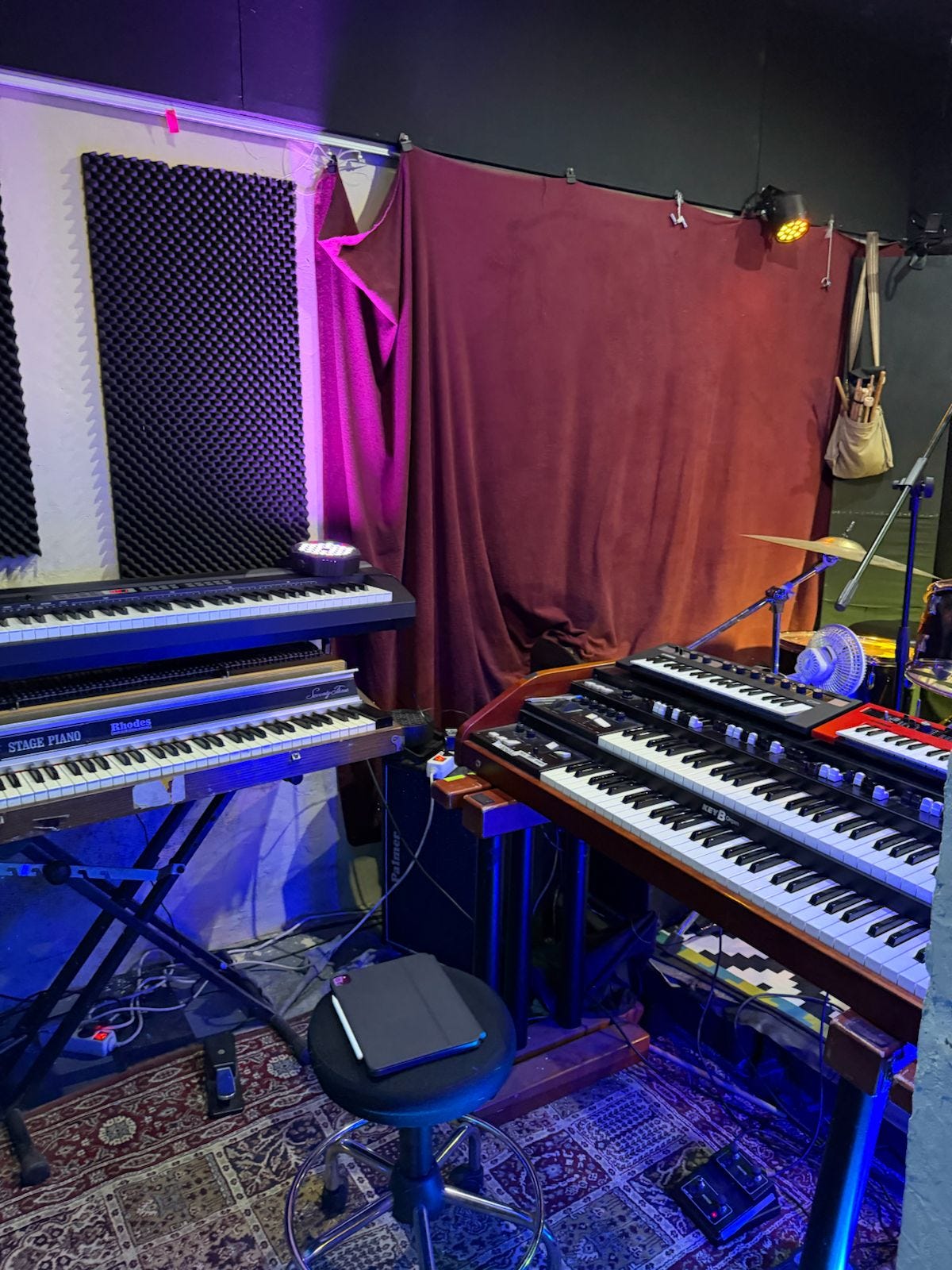
These are shaping up to be a ton of fun and already are basically sold out. I’ll share pics from the gigs once they happen. For now, here’s where we often rehearse for these gigs.
This is my friend’s studio and I have to admit it’s nice to be able to play a real organ rather than a simulated one occasionally. I’m also glad I don’t have to carry it around.
Accelerando by Charles Stross. It's this month's book club book and we're continuing the sci-fi theme. I've not even cracked it. I'm ashamed to admit it but it's the truth. More on the book next newsletter.
The Grateful Dead. Literally nothing else. Prepping for this gig. The link is to our setlist for the first night of this set of gigs coming up at the end of the month.
The Boys, Season 5. This show is a tough watch. I've watched previous seasons but this season is truly getting hard to finish each episode without squinting through hands over the eyes. Not only is it literally gross, it's also just the endgame of a lot of modern day politics, if they involved narcissistic superheroes. I'm not necessarily recommending this show. I've just invested time in the first seasons so might as well finish it out. YMMV.
If you’re looking to sharpen your product management skills, we’ve got several live workshops coming up with our Certified Training Partners.
Here’s what’s coming up.
Interested in working together? Please reach out.
In case you need it, here's a description of what I do.
Comments
Nothing yet. Say the first thing.
Sign in to join the conversation.