
Tool fluency is commoditizing, every team will have it within 18 months
Speed without judgment is accelerated waste, not a competitive advantage
The bottleneck has moved from execution to decision-making
Three signs your team has maxed out the ROI on tool training
The real question: are you making better decisions, or just faster ones?
Hey folks,
Let me take a guess. Your product team has been using Cursor, Claude, and Copilot for six months. They’ve gotten good. Ship rate is up roughly 3x. Their retrospectives are full of all the features, tests, copy, infrastructure, and test coverage they built last sprint. Their velocity charts look like a hockey stick. Sound familiar?
I’m guessing though that, if at the next quarterly business review someone asked, “What outcomes have changed for customers since we adopted AI and tripled our velocity?” — that would be a tougher question to answer.
The team got faster as expected and demanded by their leadership. They did not necessarily get better. And these are becoming the moments when organizations are starting to realize that learning how to use the tools is the beginning of the journey, not the destination.
There are two things most organizations have not reckoned with about AI, and they are two sides of the same problem.
The first is that tool fluency is already commoditizing. Every product team, every engineering org, every marketing function will have it, access to the latest, greatest AI tools, inside eighteen months. The learning curve is relatively short and the internal pressure is massive. The tools are converging. The gap between “fluent” and “not fluent” shrinks every quarter. Whatever competitive advantage tool adoption gives you has a twelve-month half-life, maybe less.
This isn’t a prediction, it’s structural. Every coding assistant, every design assistant, every writing assistant in your team’s stack sits on the same three or four foundation models. The interface layer — Cursor, Copilot, Windsurf, Claude, and whatever ships next quarter — is converging on the same foundations. And whatever prompt-engineering trick your best engineer figures out this month is on someone’s LinkedIn post before the end of the quarter. There is no moat inside the toolchain. There never was.
The second is harder to swallow: speed without judgment is accelerated waste. A team that ships 3x more of the wrong things is not three times ahead. It is three times further behind, paying more for the privilege.
The bottleneck has moved. Most organizations have not moved with it.
What’s scarce now is the thing that does not come out of a model:
The ability to decide what to build when building anything is possible.
The ability to say no to a feature your team can now ship in an afternoon.
The ability to run continuous discovery when a prototype takes sixty minutes instead of six weeks.
The ability to write OKRs that measure whether customers are better off rather than whether your team is busier.
The ability to make provisional decisions without paralysis.
This is the judgment layer. It does not come from a tool. It does not come from a certification or a prompt library. It comes from restructuring how your team is organized, how it decides, and what it is measuring.
And it is the exact skill set that most internal AI training investments are ignoring, not because it’s a hard skill to learn, but because it is not the skill set leaders are asking for.
Josh Clark has written a useful frame for this. Most organizations, he argues, are stuck in what he calls Retool, applying AI to do existing work faster. The real leverage, in his view, sits in the phases that come after: reorganizing workflows, inventing new products, building new business lines. His piece is worth reading because he’s right.
Ultimately though, this isn’t really about “phases.” It’s about the skill set required for putting these new tools to productive, valuable use, not just production.
The harder question is: how do you know when your team is fluent enough with the tools? When has the return on tool training gone to zero? When is it time to stop investing in “how do I prompt this better” and start investing in “what should we be building?”
Here are three signs:
Velocity is up, but outcome metrics are flat. Ship rate, feature count, sprint completion are all trending up. Retention, activation, revenue per user, NPS — flat or drifting down. You built more but the business didn’t improve. That gap is the one that tool training can’t close.
Your engineers have stopped asking “how do I build this?” and started asking “what should I build next?” The bottleneck question has flipped. That’s the most reliable on-the-ground signal that execution is no longer the constraint. If that question is coming from the team and isn’t getting answered well, the gap is in product, not engineering.
Your discovery-to-delivery ratio has collapsed. If you were lucky enough to be able to do it, you might have run a week or two of discovery in the past. Now, you’re lucky to squeeze thirty minutes of discovery per build cycle. The build cycle got so fast that discovery never caught up. A team shipping into a vacuum devoid of validated demand is the clearest form of accelerated waste there is.
If one of these is true, you’re closer to the end of Clark’s Retool phase than you think. If two are true, you’re past it. If three are true, your team is in the zone where more tool training will actively hurt — because it reinforces the habit of building before deciding.
The competitive question for the next twenty-four months is not “are we using AI?” Everyone is.
The half-life on that advantage has expired. The question that actually separates organizations now is this: are we making better decisions about what to build than we were before AI? If the honest answer is “we’re making the same decisions, just faster”, that is the diagnosis. Speed was not the problem. Speed was never going to be the advantage. Judgment is. And judgment is probably not yet on your training budget.
If this is the conversation your organization needs to be having, that’s what Sense & Respond Learning is for. Reply to this email or find me at senseandrespond.co — we run the curriculum that starts where tool training ends.
Since returning from ScanAgile 2026 in Helsinki, I have spent 2 weeks in New York. It was so cold. NYC is such a contradiction. On the one hand it’s chaotic and messy and dirty and frustrating. And, on the other hand, it’s literally got the best of everything in one place. For example, we went to the New World Mall (the food court to be exact) in Flushing, Queens one day for lunch. Queens is the most diverse borough in the world. Every language in the world is spoken there. The New World Mall is a haven for Asian food. We ate so well and at times, it even felt like we were in Asia.

May 13th at 12:00 EST – Outcome-Centered AI
Outcome-Centered AI is a new approach that addresses the issue in this newsletter directly. It treats your outcome — a measurable change in customer behavior — as the test your AI-generated work must pass. Your feature isn’t done when the code ships. It’s done when you can measure that it worked. Join us in two weeks.
Fahrenheit 451 by Ray Bradbury – This was my month to choose our book and I went with a classic, fiction about an alternate timeline that doesn’t feel so alien sadly these days. This book is so beautifully written and prescient of the world to come when it was written decades ago. If it’s been a while or you’ve never read it, grab a copy.
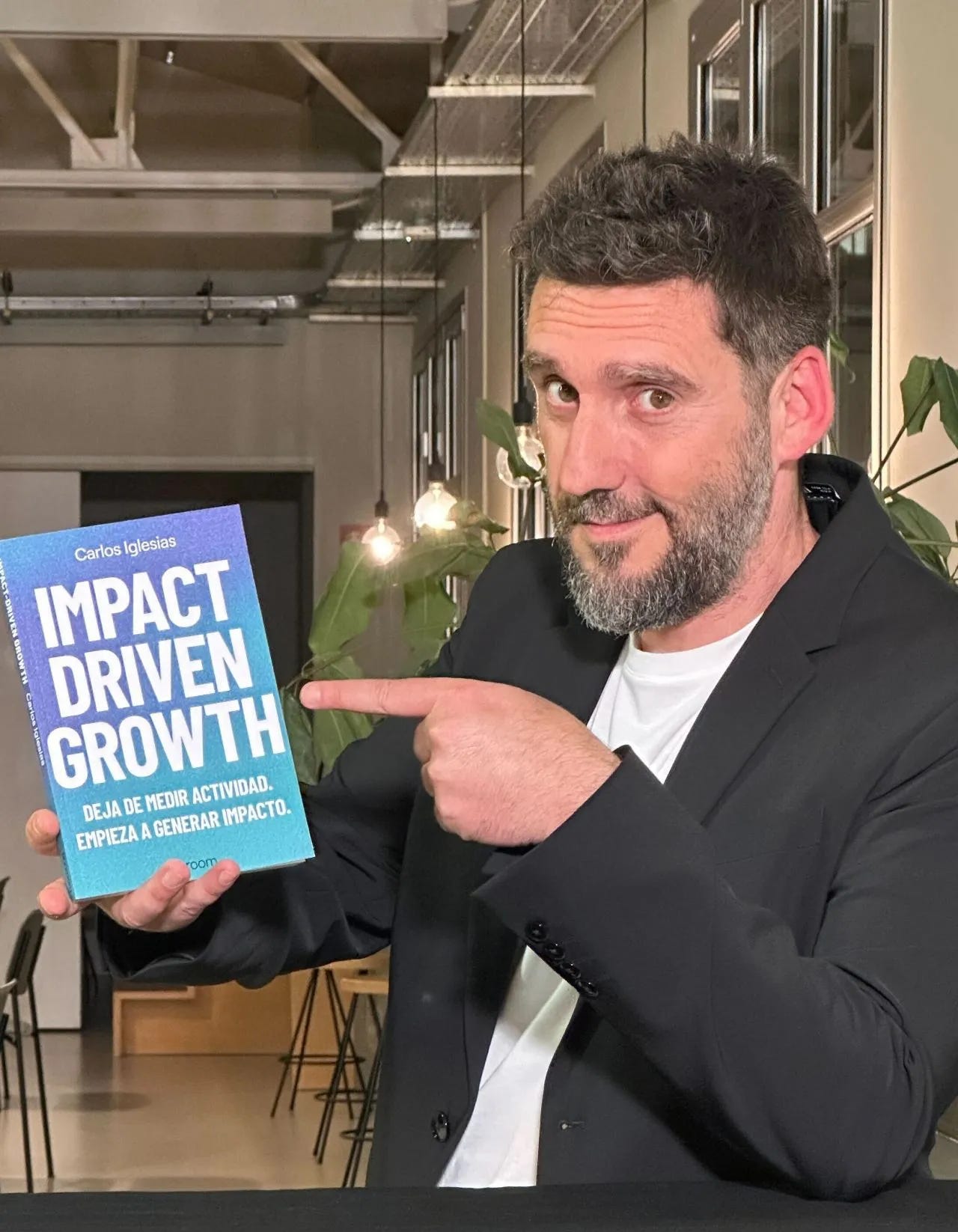
Impact-Driven Growth by Carlos Iglesias (in Spanish)
Carlos is one of our Certified Training Partners at Sense & Respond Learning and his book focuses on a challenge many teams are facing right now: how to stop measuring activity and start measuring real impact.
If your team is getting faster with AI, but struggling to connect that speed to better outcomes, this is worth adding to your reading list.
Angine de Poitrine. In case you missed their viral KEXP video from a few weeks ago, well, here you go. Two Canadian guys in the wildest costumes I’ve seen in a while playing semitonal math rock? Don’t mind if I do.
Many of my favorite shows are back. I’ve started watching the latest seasons of For All Mankind (what if the Soviets landed on the moon first?), Your Friends & Neighbors (John Hamm robbing his wealthy suburban friends), Hacks (Jean Smart as a legendary comedian doing all she can to sustain her career), and our favorite new show DTF St. Louis (suburban murder mystery with a twist, just not sure what the twist is yet). Too much good tv to watch right now.
If you’re looking to sharpen your product management and strategy skills, we’ve got several live workshops coming up with our Certified Training Partners. These sessions are hands-on, practical and designed for teams who want to move beyond theory and apply AI outcome-driven product practices in their day-to-day work.
Here’s what’s coming up:
with Federico Zuppa | 💬 Spanish
May 5, 12, 19 & 26, 2026
📍Live online (Zoom)
Register here
with Hala Saleh
May 25, June 1, 8 & 15
📍 Live online (Zoom)
Register here
with Mihai Olaru & Florin Manolescu | 💬 Romanian
June 2nd
📍 Live Online
Register here
with Jon Urdal | 💬 Norwegian
June 3rd
📍 Oslo, Norway
Register here
with Simon Flossmann | 💬 German
June 22nd
📍 Live Online
Register here
Interested in working together? Please reach out.
In case you need it, here's a description of what I do.
Comments
Nothing yet. Say the first thing.
Sign in to join the conversation.