
Having an opinion, or making a stand against my father, was not encouraged when I was a child. The one phrase I have not forgotten was, “Children should be seen and not heard.”
That may sound quaint today. But in an age when “spare the rod, spoil the child” was considered sound parenting, I was handed several beatings with a stick hidden under the kitchen bench, kept close at hand for whenever I didn’t quite follow the rules, or didn’t quite fit in.
The outcome was simple. I learned to comply and not have a point of view, from an early age, because the patriarch was always right, and the church I attended had a monopoly on truth besides.
I have been trying to find my voice, my human signal ever since, and it has been a lifetime of unlearning. Blending in is not a good way to stand out. Being smoothed over, and having the rough edges knocked off, by my family, by religion, sometimes even by an entire society, is a boring and bland way to live. Being unique and human, especially in an AI world, is all we have.
A few decades later, things changed.And there was a new patriarch in town, and it is just as committed to taking away our messy, glorious humanity. It has one skill my father never had. It can average an entire industry’s opinions into one smooth, agreeable paragraph, and it does it in seconds. Many of us now reach for the “machine” to write for us, and if you use it with a simple copy-and-paste approach, you will blend in with every other voice online.
I have a name for this inoffensive overlord that arrives in a smart suit. I call it the content flood. And the flood is not coming for one writer at a time. It is coming for all of us at once, and the number behind it is bigger than most people realise.
“Seventy-four out of every hundred new pages on the internet today were touched by a machine before a human ever read them.”
That is not a guess. Ahrefs measured it across nine hundred thousand pages this year.
Look at LinkedIn specifically, the platform where this very letter lives, and the number gets worse. A study by Originality AI puts it at fifty-four percent of all long-form posts on the platform likely written by a machine before a human ever touched them.
A friend who writes blog posts for a living told me last month he cannot remember the last time he opened a blank document. The machine opens it for him now. He just signs his name at the bottom and hits send.
That is the flood. Not a metaphor. A measurement.
If you have been reading since the first article, you already know where this series is headed. Each issue has pulled back one curtain on a system quietly flattening what makes you sound like you. We have looked at the algorithm that rewards performance over presence. We have looked at the AI that flatters you instead of challenging you. Today I am handing you the blueprint to build something none of it can touch.
Here is the part worth sitting with. The flood is not evil. It does not hate you. It does not even know you exist. That is what makes it so dangerous. A system needs no malice to flatten you. It only needs scale, and scale is the one thing it has in endless supply.
You did not lose your audience to a smarter competitor. You lost pieces of it to sameness. A thousand versions of the same five ideas, dressed in slightly different fonts, published at slightly different hours, read closely by nobody in particular.
Here is the good news. Nobody is selling it to you, because there is no product hiding inside it. The flood cannot copy identity. It cannot fake a real story. It cannot manufacture expertise earned the hard way, evidence that happens to be true, or a relationship built one honest reply at a time.
I call these five elements the Human Signal Stack. Five layers, built from the ground up. It is not a checklist you tick once and forget. It is closer to a muscle, weak in places you have never bothered to test, strong in places you have been training for years without ever naming it.
Skip one layer and the whole structure feels hollow, even to readers who could not tell you why they scrolled past without finishing. Build all five properly, and the flood has nothing left to flatten, because there is nothing generic left for it to copy.
There are 5 layers that need to be considered when you start building out your online human signal. The challenge is to keep optimizing the human signal that is yours.
Just like SEO which is designed to stand out in search, HSO or “Human Signal Optimization” is designed to stand out in an ocean of online AI slop.
But the first two are are vital.
Identity is the foundation everything else stands on. And your Story is the emotion and your hero’s journey but wearing your name. It is where you reveal what pushed you to cross the threshold from an ordinary world and you have learned, the scars you earned and what you bring back to share with the world.
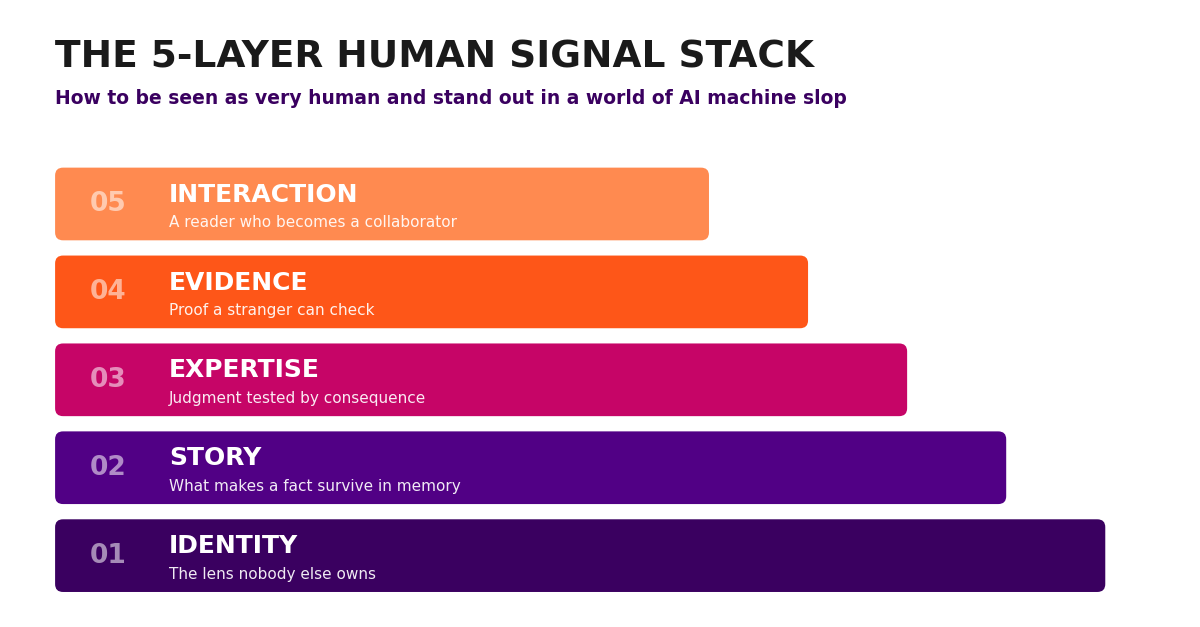
The Human Signal Stack — five layers, none of them generated by a machine.
Identity is the lens nobody else owns. Not your bio. Not your logo. The particular, oddly specific way you see a problem that nobody taught you to see, and that you could not fully explain even if asked.
Packy McCormick writes about the same companies every other business newsletter covers. Same balance sheets. Same funding rounds. Same quarterly numbers everyone else is also staring at on the same morning. Over a quarter million people read his version anyway, and they click and comment at more than a hundred times the typical rate for a business newsletter.
An AI can summarize the filing in seconds, and summarize it well. It cannot supply the wide-eyed, slightly breathless way Packy looks at a spreadsheet and finds a story about the future hiding inside it. Strip his identity out of the writing and you are left with the filing. Nobody subscribes to a filing.
Build this layer by asking one brutal question. If you vanished tomorrow, could a competent stranger produce identical work by next week? If the honest answer is yes, you have built a job. You have not yet built a signal. The fix is not louder. It is narrower, stranger, and unmistakably yours.
Story is the mechanism that makes a fact survive in someone’s memory longer than the scroll that buried it. Strip the story out of any idea and watch how fast people forget it by lunchtime, no matter how true it was.
Heather Cox Richardson writes one letter a night. She takes whatever happened that day and threads it back through centuries of history until the news stops feeling random and starts feeling like a pattern repeating itself. Nearly three million people read her every single night, more than any other publication on the platform she writes on, and she does it without a single sponsor.
She is not faster than a search engine. She is not more complete than an encyclopedia. She is simply the only one telling you why tonight rhymes with a night two hundred years ago, and why that rhyme matters tomorrow morning. That is not information delivered at scale. That is story doing the work information was never built to do.
The tell for this layer is simple. If you removed every story from your last ten posts, would anything be left worth remembering by Friday? If the answer is no, you have been writing content. You have not yet been telling anyone anything.
Here is the sentence that should make every AI doomsayer pause mid-scroll. According to a recent crawl of the open web by the research firm Graphite, eighty-two percent of the articles that chatbots actually cite back to you were written by a human being, not generated by one. The machines built to replace us keep choosing us anyway, every single time someone asks one a question. Maybe, underneath all the noise about replacement, they have better taste than we give them credit for.
Expertise is not information. Information is free now, and getting freer by the week, by the model update, by the new app nobody asked for and everyone is already using. Expertise is judgment that has been tested by real consequence and survived long enough to tell you what it learned.
Lenny Rachitsky spent seven years inside Airbnb’s product team before he ever published a sentence online. His newsletter crossed one million subscribers last year, built almost entirely on readers submitting career questions and Lenny answering from inside real, lived operating experience rather than a search result dressed up as advice. You cannot prompt your way into seven years of consequence. You can only live through it, slowly, and take notes along the way.
Ask yourself, honestly, where your judgment has actually been tested. Not where you read about a topic on someone else’s blog and rephrased it well. Where you got it wrong, in public, with something real on the line, and learned what the wreckage had to teach you. That is the expertise layer. Everything else is just a well-formatted summary wearing a confident voice.
Evidence is proof a stranger can check for themselves, without ever having to take your word for it on faith.
Sahil Bloom walked away from a vice president seat at a three-and-a-half-billion-dollar private equity firm at twenty-eight years old, with no plan beyond a Twitter thread and a hunch. Today, eight hundred thousand people read his newsletter, largely because every framework he teaches gets tested first on the one subject he cannot fake: himself. A marathon run in under three hours. A five-hundred-and-twenty-five-pound deadlift. A New York Times bestseller with his own name on the spine. Numbers nobody can borrow and nobody can fabricate on his behalf.
The flood can generate a confident claim in half a second. It cannot generate a track record, because a track record only exists once enough real time has already passed through it. Build this layer by collecting your receipts in public, week after week, instead of polishing your résumé in private and hoping nobody asks for proof.
The tell here is blunt. If every claim you make would collapse the moment a stranger asked “prove it,” you have marketing. You do not yet have evidence. Identity gets someone to glance your way. Evidence is what gets them to actually believe you once they do.
Interaction is the layer that turns a reader into a collaborator, one reply at a time. It is the one layer the machine genuinely cannot simulate, because real interaction requires two humans paying attention to each other at the same time, with something at stake for both of them.
Anne-Laure Le Cunff built Ness Labs as a newsletter first, nothing more ambitious than that in the beginning. Then her readers kept writing back to say the same thing, in slightly different words each time: they felt lonely, thinking alone, working alone, through a lockdown that had cut everyone off from each other at once. So she built them a room instead of writing them another issue. Five years later, that room is still running, shaped week by week by the very people reading it.
A chatbot can answer your question competently, sometimes brilliantly. It cannot remember that you asked something different last Tuesday, and it cannot become a better version of itself simply because you showed up again. Only a human community does that, and only ever over time, with no shortcut available to skip the waiting.
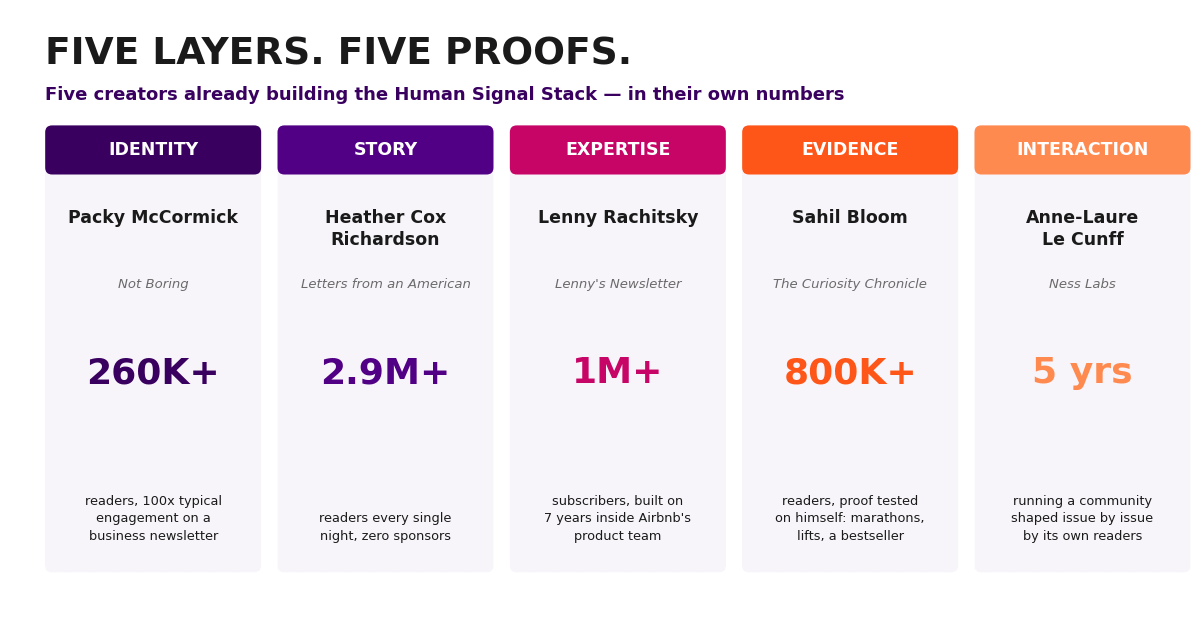
Five creators, five different shapes of proof — none of it generated by a machine.
Having an opinion is not free. It costs you the easy comfort of being agreeable. But it has paid me back twice over, faster than I expected. And here are two surprising benefits of having an opinion
The first payback is motivation. Finding my voice, after a lifetime of swallowing it, did not just feel like relief. It felt like fuel. Compliance, it turns out, was draining a tank I did not know was being drained for forty years. Having a spine again, even a half-rebuilt one, is the closest thing I have found to free energy.
The second payback is attention, and it is the easier one to prove with numbers. The posts where I take an actual stand, where I name the thing in my industry that genuinely makes me angry and that nobody else seems willing to call out, are the ones now pulling twenty to forty comments. Not the polite, ten-comment, “great share Jeff” kind. Real arguments. Real disagreement. Real attention, the kind you cannot fake with a better hook.
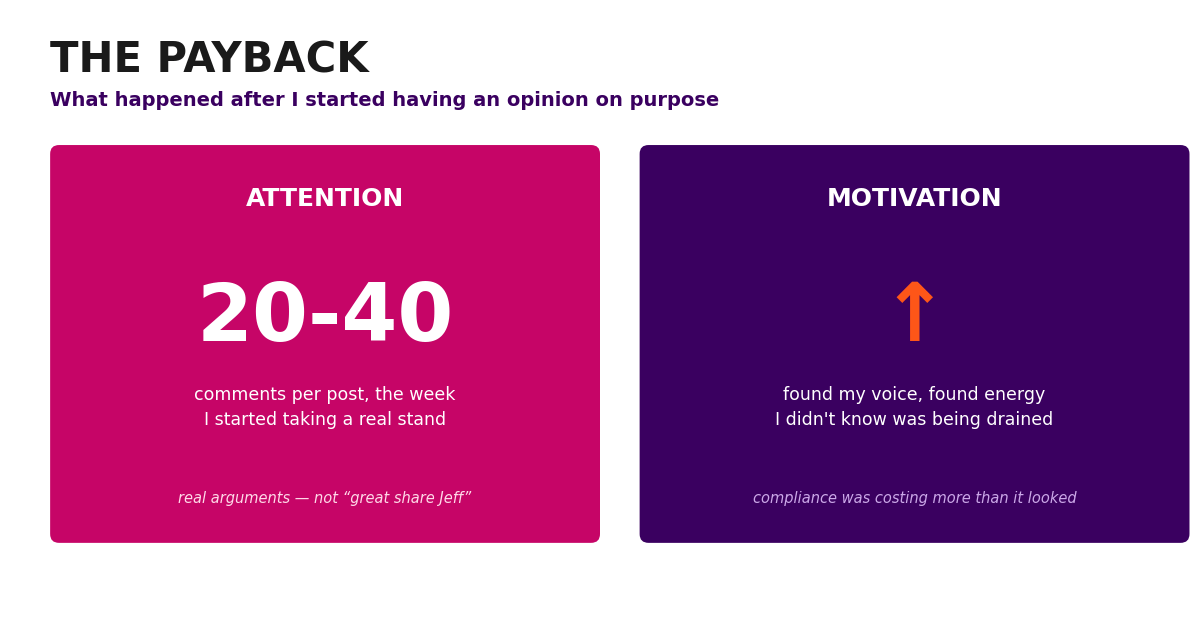
Two paybacks, since I started having an opinion on purpose.
Neither payback is a growth hack, and I am suspicious of anyone who tells you it is. It is older and simpler than that. Humans have always paid attention to other humans who believe something, and looked straight past the ones reciting the safe version of an idea for the fortieth time that week.
Five layers. None of them require permission from a platform, an algorithm, or a model trained on someone else’s sentences and sold back to you as insight.
Here is your homework. Score yourself, honestly, one to ten, on each layer. Identity. Story. Expertise. Evidence. Interaction. Whichever one scores lowest is not your weakness. It is simply your next move, already waiting to be made, whether you make it this week or in five years.
I ran this same audit on myself before I wrote a word of this letter. Identity came back lowest, and it surprised me, because I assumed decades of writing had already fixed it. Building an audience and finding your actual point of view turned out to be two different muscles entirely. You just read what happened the moment I finally started training the second one.
Somewhere out there is the person reading this on a lunch break, in a cubicle, half-convinced the machine has already won and there is nothing left to build that matters. There is. It was never about outrunning the flood. It was always about becoming the one thing in the water it cannot turn into noise.
The flood is not coming for your job. It is coming for your sameness. Build the one layer it cannot touch, on purpose, and let the flood take everything else it was always going to take anyway.
Think deeper. Act wiser. Flourish faster.
— Jeff
No posts
Comments
Nothing yet. Say the first thing.
Sign in to join the conversation.