
In 2016, a journalist called me.
She wanted my opinion on something new. “What did I think of people getting their news from the social media feed?”
Part of me was surprised. The other part, the shadow part was horrified.
That signal then I now realise was the distant sound of a canary in a coal mine.
My advice was simple. Go to the source. CNN. The New York Times. The BBC. Whatever masthead you trust, trust the masthead, not the feed.
In March, 2018 Cambridge Analytica happened. The data analytics firm that worked with Donald Trump’s election team and the winning Brexit campaign harvested millions of Facebook profiles of US voters, in one of the tech giant’s biggest ever data breaches, and used them to build a powerful software program to predict and influence choices at the ballot box.
The illusion died. Social media was never built to be trusted. Facebook was first built to rate “hot” females at a university. What could go wrong?
A decade later, we’re facing a bigger question.
Is anything we read on the web written by a human? Or a machine pretending to be one? Another trust question.
A few years ago, a fringe theory called the “Dead Internet” predicted the web would be filled with fake content, built by bots, for bots.
It doesn’t feel fringe anymore. It feels like the forecast.
Last week I caught myself reading an article and asking a question I’ve never had to ask before. Did a person actually write this? Or did something pretending to be a person write it?
The internet no longer feels merely crowded. Increasingly, it feels synthetic.
Search results, social feeds, and news-adjacent websites are filling with material shaped like human communication, but missing the substance of human experience. It has the headlines, the bylines, the polished cues of authority. Underneath, much of it is not journalism. Not expertise. Not anyone’s name on the line.
It is automated output, engineered to look plausible enough to be clicked, ranked, and monetised.
I call it the content industrial complex. A system that converts AI text, AI images, fake news layouts, expired domains, and ad algorithms into money.
The product isn’t truth.
It isn’t insight.
It isn’t even information.
The product is attention, harvested cheaply and sold automatically, over and over, at industrial speed.
This matters because the web was built on a fragile assumption: that most content came from a person, written for another person. That assumption is breaking. More of the internet is now generated, crawled, summarised, and consumed by machines, talking to other machines.
In that world, the question is no longer just whether information is accurate. It’s whether there’s a real human being behind it at all.
The first sign of the crisis is the scale of the attack.
Before ChatGPT launched in November 2022, AI-written articles were rare enough to ignore. Within 12 months, they were one in three. By 2025, they were nearly one in two.
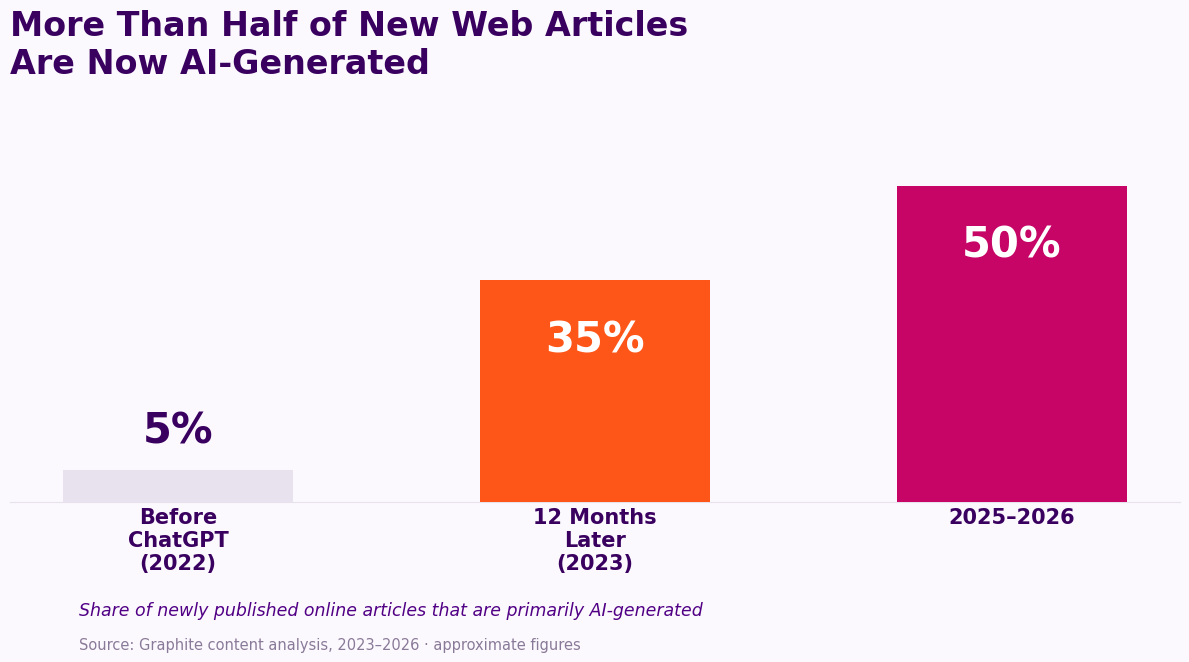
That’s the entire publishing industry, rewired in three years.
This doesn’t mean every AI-assisted article is bad. Serious writers, researchers, and journalists use AI to think faster, structure ideas, and test arguments. That’s a tool in the hand of a human who’s still accountable for the result.
The problem isn’t AI helping humans write. The problem is what happens when the marginal cost of an article collapses to almost nothing, and a certain kind of operator stops asking “is this worth saying” and starts asking “how many pages can we publish before the system notices.”
That’s the moment content stops being communication. It becomes inventory. A paragraph becomes a slot in a sales funnel. A headline becomes a lure.
NewsGuard has tracked more than 3,000 AI content-farm sites, publishing in 16 languages. Most don’t admit they’re AI. Most look exactly like real news, right down to the categories, the trending bar, and the author photo.
This isn’t a few spam sites in a dark corner of the web. It’s a factory line.
The old content farm needed cheap writers in a back room, in a low-wage country, grinding out copy by the hour. The new one just needs a prompt, a template, and a domain.
One investigation, by the ad-verification firm DoubleVerify, found a single operator running a network of more than 200 AI-generated sites.
These were templated prompts. Sensational headlines. Stock-style AI images, never quite right, never quite wrong. The estimated cost to produce each article? Under $2.25.
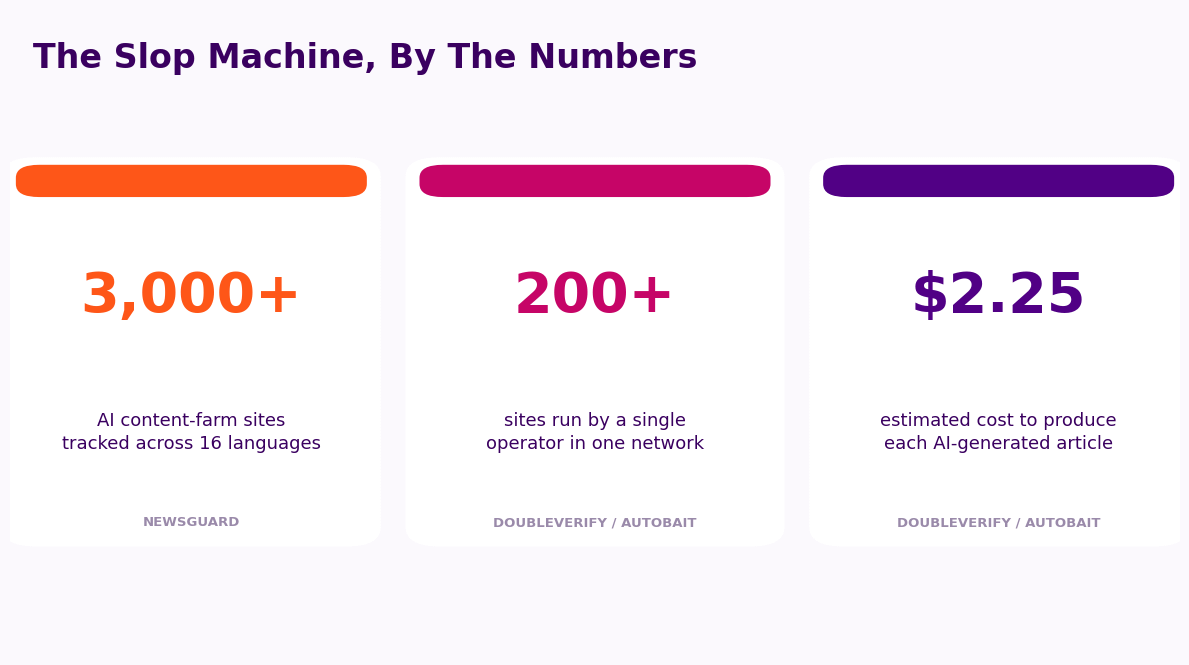
That’s not writing. That’s manufacturing. Industrial scale slop.
Follow the money and the picture sharpens.
The Association of National Advertisers has shown how much budget already leaks into “made for advertising” sites inside the programmatic ad system and sites built less to inform a reader than to manufacture an impression. Familiar, trusted brands end up sitting next to synthetic junk without ever choosing to, and their logo quietly lends it credibility.
The article isn’t the product. The ad impression is the product.
You are the extraction layer.
Programmatic advertising is the oxygen layer of this entire machine. Cut it off, and the incentive to manufacture slop disappears overnight. Leave it running, and the factory content production line never has to slow down.
The danger isn’t that this content looks fake. It’s that it looks familiar.
Clean layout. A trending sidebar. A byline that looks like a journalist’s. Ads from brands you already trust.
None of that is journalism. All of it borrows journalism’s trust, without paying journalism’s price. The reader doesn’t consciously think “this is news.” The trust transfers faster than that, through design, not through evidence.
Think of it as a counterfeit handbag stall. Same logo. Same stitching pattern. Sold at a fraction of the price, because it cost a fraction of the price to fake.
Researchers have tested whether people can tell the difference. In one study, a language model fine-tuned on a modest body of Italian news articles produced text that native speakers struggled to identify as synthetic. Add a realistic AI-generated photo to the mix, and a separate study — MiRAGeNews — found that humans only spotted the fake about half the time. The state-of-the-art AI detection models did worse.
The fake doesn’t need to be perfect. It needs to be good enough to slip past a tired thumb, scrolling at 11pm.
Strip away the noise, and the system has five moving parts.
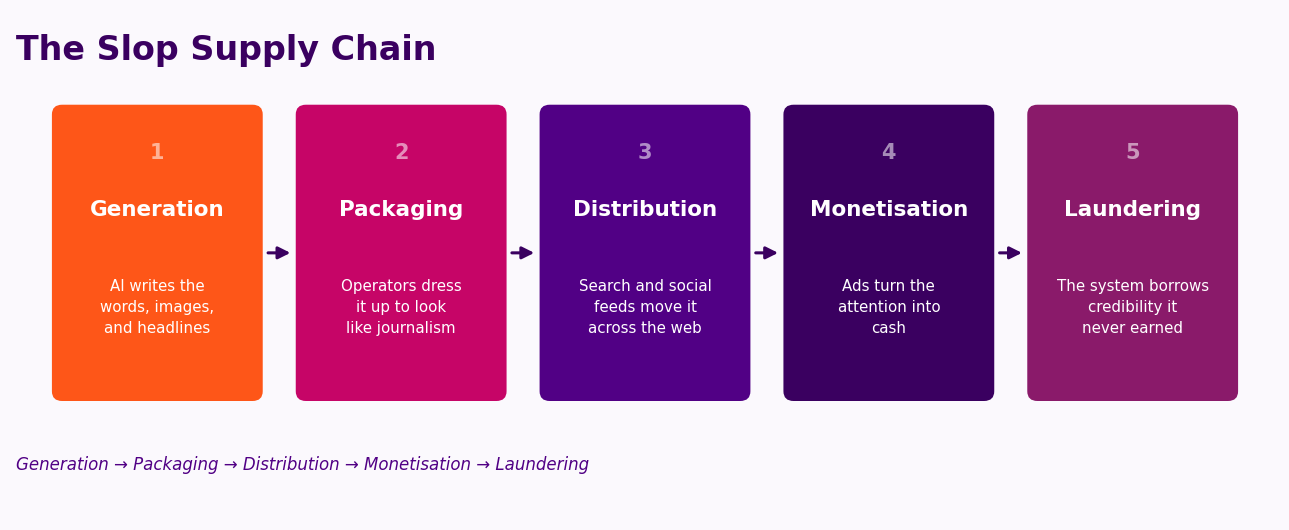
Here’s how the AI slop industrial content machine works:
Generation. AI writes the words.
Packaging. Operators dress it up as journalism.
Distribution. Search and social move it through the feed.
Monetisation. Ads turn attention into cash.
Laundering. The whole system borrows credibility it never earned.
This is not content as expression. This is content as extraction.
And once you see the machine, the old advice, just make more content and starts to look dangerous.
For years the internet rewarded volume. More posts, more keywords, more pages. Now we’re staring at the logical end point of that advice: a web where content exists without experience, language exists without life.
Four things are getting harder for the system to manufacture, and easier for you to look for.
A specific story. Not a generic anecdote, but a moment with a date, a place, a consequence. AI can imitate structure well. It still struggles to invent a single true detail nobody else could know.
A name with something to lose. A byline that’s a real, searchable person, with a body of past work that can be checked against the one in front of you.
A point of view that costs something. An opinion stated plainly, by someone willing to be wrong about it in public.
And a contradiction. Real people change their minds, repeat themselves badly, and occasionally argue with their own past selves in public. The machine is always consistent. Consistency, oddly enough, is starting to look like a tell.
None of these are hard to spot, once you’re looking for them. That’s the whole point of the system. It’s betting that most of us won’t bother to look.
The deeper problem isn’t quality. It’s the origin.
Who made this? What do they know? What have they lived? What do they risk by putting their name on it? What community is watching closely enough to call them out if they get it wrong?
A real journalist can be wrong, and corrected. A real expert can be challenged, and change their mind. A real human can be embarrassed and that’s exactly what makes them worth trusting. Accountability isn’t a flaw in human content. It’s the whole point of it.
Synthetic content carries none of that weight. It can wear the tone of expertise without ever earning it. It can sound certain without ever having been tested.
This is why the human signal, your story, your stance, your name on the line, is becoming the one thing left that a machine can’t fake.
AI won’t make human work irrelevant. It will make generic work worthless.
A summary will be cheap. A lived point of view will be rare. A competent article will be easy. A trustworthy one will be hard to fake.
Information will be everywhere. Origin will be the scarce asset.
The creators, writers, and experts who matter in the next decade won’t be the ones who publish the most. They’ll be the ones whose work carries a body of history behind it. A reputation that can be lost. A community that can call them out. A reason for writing beyond feeding the machine.
It won’t be polish. Machines can polish.
It won’t be volume. Machines can produce volume.
It won’t be structure. Machines can structure.
It will be origin.
A real person. A real story. A real willingness to stand behind the sentence.
To stand out you will need to have some core elements that you maybe haven’t thought about before.
An opinion
A point of view
What do you stand for
And even what are you angry about and who or what system is the villain you’ve been fighting all your life.
I’ve watched this industry change four times now.
I earned my first technology scars and stripes in the PC industry revolution, then it was the web, next was social media and now this. The AI era which has accelerated change and challenged our humanity put promises to augment the human.
Each time, the same lesson resurfaces in a new costume: the tool gets cheaper, and the human gets more valuable, not less.
If you’ve been hiding your real opinion behind a brand voice, a content calendar, or someone else’s playbook, this is the year that stops working.
The web isn’t dying because machines learned to write. It’s dying because we stopped asking who’s standing behind the sentence.
So before you hit publish on anything, ask yourself one question:
Would this survive if a real human had to stand behind it?
No posts
Comments
Nothing yet. Say the first thing.
Sign in to join the conversation.