

Last year Google spent sixty million dollars on something it could have stolen.
It rented Reddit and paid for the content. Not the company, just the conversations. The messy, misspelled, argued-at-2am threads where strangers tell strangers the truth. Or their versions of it.
I was a bit skeptical when I first heard the news as Reddit to me seemed like a platform full of conspiracy theories and fake news and a bit dodgy. It certainly wasn’t Wikipedia. Also it is a platform that I never fully understood.
The other dilemma was that Reddit started to show up at the top of search results and I thought that Google’s mantra was to deliver trusted verified content.
But Google had moved on to prioritise Reddit at the top of its search results because users increasingly demand authentic, crowd-sourced perspectives.
But Google was using Reddit’s content for another reason.
In 2025 Alphabet booked $402.8 billion in revenue and $132.2 billion in profit. Sixty million is 0.015% of that top line. A penny and a half of every hundred dollars. Google earns the whole bill back in about seventy-eight minutes. Before its morning coffee cools.
So the money was never the point.
When a company that size pays for something, the price is a signal. And the signal is loud. It didn’t buy the data because data was scarce. It bought the one raw material it cannot manufacture at any scale, for any budget.
A human being, saying a true thing, in their own voice. The machine went shopping. And the thing it wanted most was us. The human signal to train its large language models. Its AI platform.
For twenty years we were told to write for the machine. That era is ending. And once you see where the value is really moving, you can’t unsee it.
There’s a new acronym at every marketing conference on earth. GEO. Generative Engine Optimization. It is meant to be the next big thing after SEO.
SEO taught you to be findable by Google. GEO teaches you to be cited by ChatGPT, Gemini, Claude and Perplexity. Same treadmill, new referee.
And it’s a very small prize. AI sends about one percent of all web traffic. Nine in ten AI searches end with no click at all. The engine reads your work, swallows it, and answers in its own voice.
The traditional SEO comapnies have leaned it to sell you the idea that being found on an AI chatbot matters. But at 1% it doesn’t. The SEO companies are putting the lipstick on a dying SEO pig. But with a new name. GEO
Let’s look the data behind that futile chase.
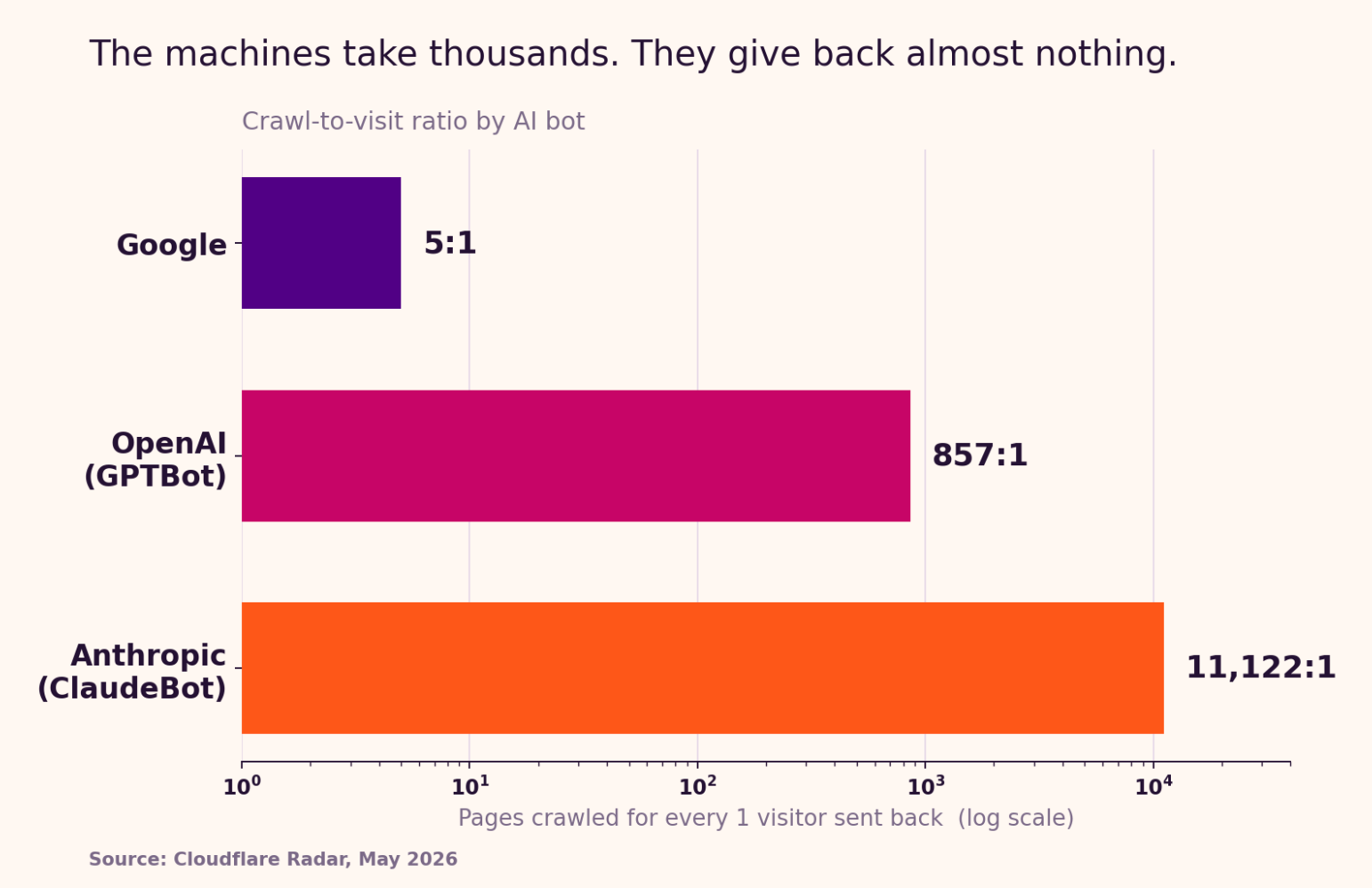
For every visitor Google sends back to a website, it crawls about five pages. OpenAI crawls 857. Anthropic’s bot crawls more than eleven thousand.
Eleven thousand pages in. One human out.
That’s the machine that made the flood. It eats libraries and returns a breadcrumb. And what it prints back into the world is competent, endless, and hollow — the grey paste now clogging every feed.
Here’s the trap.
When competent writing becomes infinite and free, competent writing becomes worthless. The floor doesn’t rise. It falls out.
So the value didn’t disappear. It moved. It moved to the one input that can’t be scraped, averaged, or synthesised.
You.
This isn’t a hunch. It’s already in the receipts. Watch where real dollars are flowing.
We buy from humans, in fact human influencers and not brand ogos.
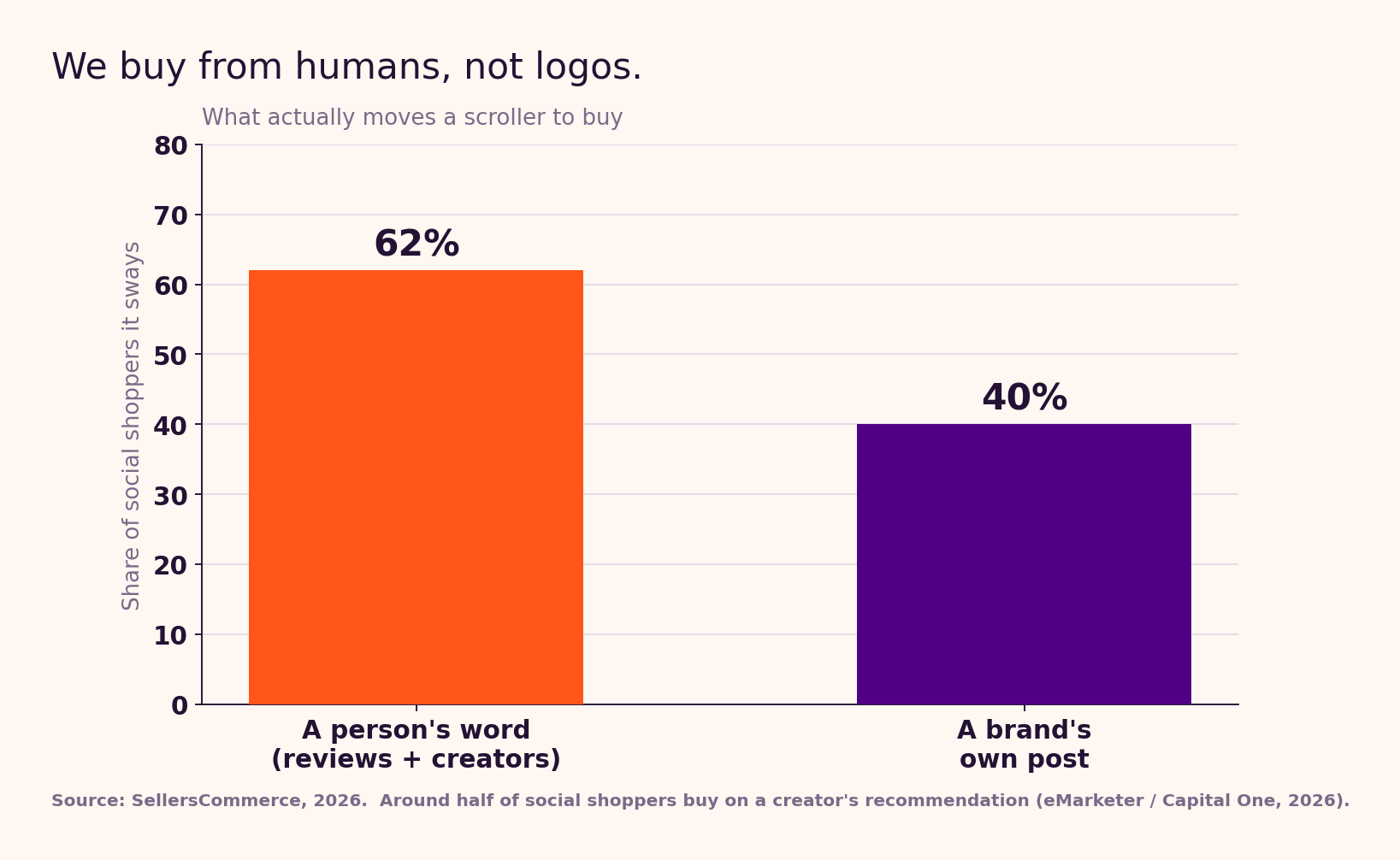
A brand’s own post moves about 40% of social shoppers. A real person’s word and reviews, creators, someone who actually used the thing moves 62%. Roughly half of everything sold to a scroller now moves on the recommendation of a human they trust. Not an ad. A face. A voice. A story.
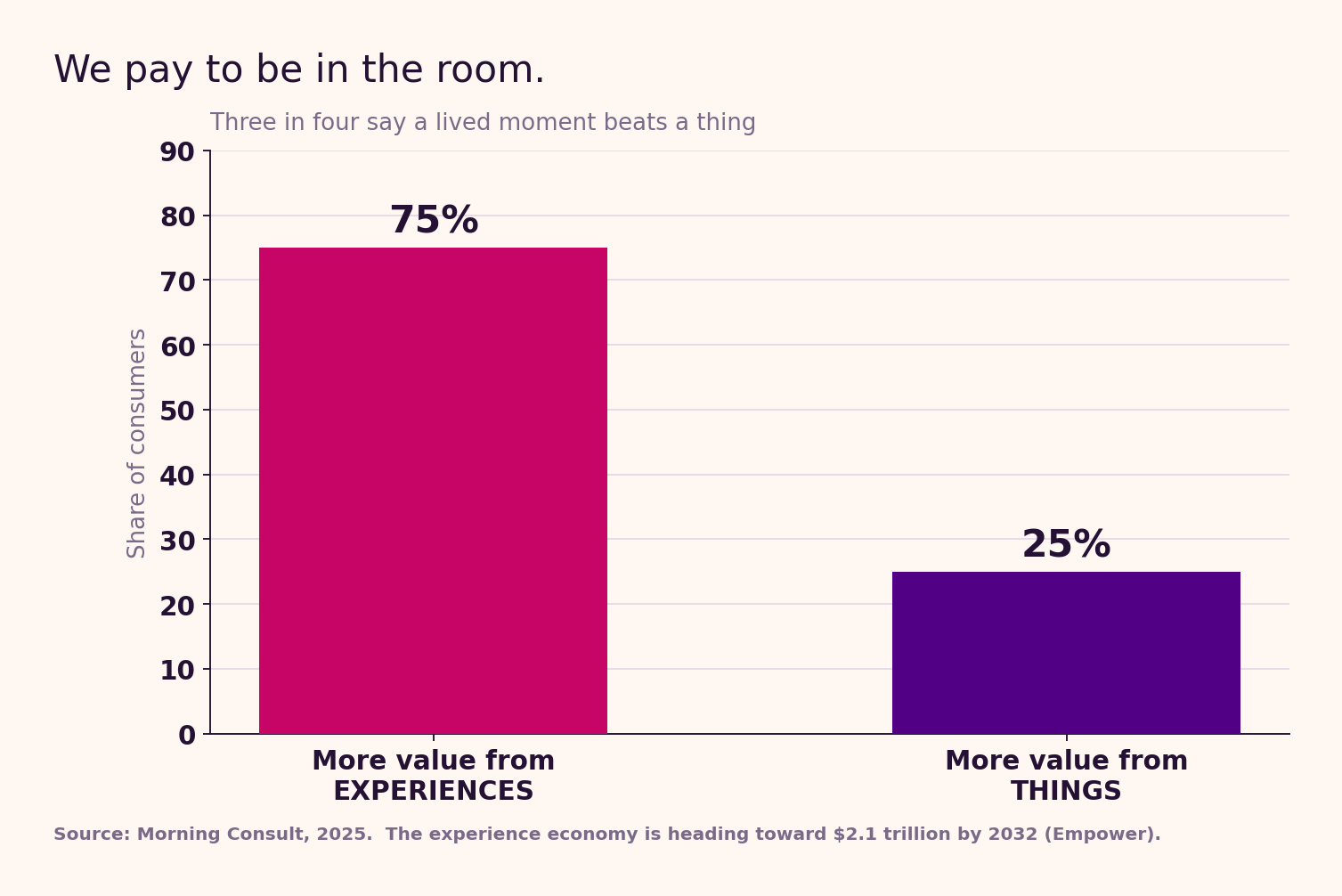
We pay to be in the room, the stadium the convert hall.
Three in four people now say they get more value from an experience than a thing. The experience economy is heading toward $2.1 trillion.
Live Nation drew 159 million fans in a single year. As the screen swallows everything, people are spending more and not less to stand shoulder to shoulder in a real room and feel something real happen.
And the machines themselves and the ones that built the flood are now paying to protect the human underneath it.
Google went shopping for human talk and is pushing to pay Reddit more as that talk proves more vital.
YouTube now auto-stamps a label on AI video even when the creator says nothing and Europe makes it law on August 2.
LinkedIn built a system it calls “AI solving AI” to find generic posts and bury them.
Three different stories. One current running through all of them.
Trust is the last scarce thing on the internet. And only a human can print it.
That’s the whole shift in a sentence. When the machine can fake everything, we pay a premium for whatever it can’t fake. Not the polished thing. The trusted thing.
An AI influencer showed up at Wimbledon last year.
Flawless. Camera-ready. Dressed for the occasion. Thousands scrolled past and felt the small warm pull we feel toward a person we like the look of. Then came the deflating word underneath: she wasn’t real. There was no her. The pull had been for no one.
The machine is coming for the human signal too.
Nearly half of young adults already follow at least one AI influencer. A face that was never born. A voice with no throat. Synthetic creators, virtual spokespeople, a whole cast of humans who don’t exist — built to feel like the trusted friend recommending the thing.
So “be human” is no longer enough. The counterfeit is getting good.
Which means the real dividing line isn’t human versus machine. It’s traceable versus fake. The new trust signal isn’t polish. It isn’t volume. It’s proof of a life actually lived the scar you can point to, the receipt you can show, the story only you could tell because only you were there.
Anyone can now generate the look of a human. Almost no one can fake the evidence of one.
That’s the moat. Not being human. Proving it.
If GEO is writing to be cited by the engine, HSO is writing to be trusted by the person.
Human Signal Optimization.
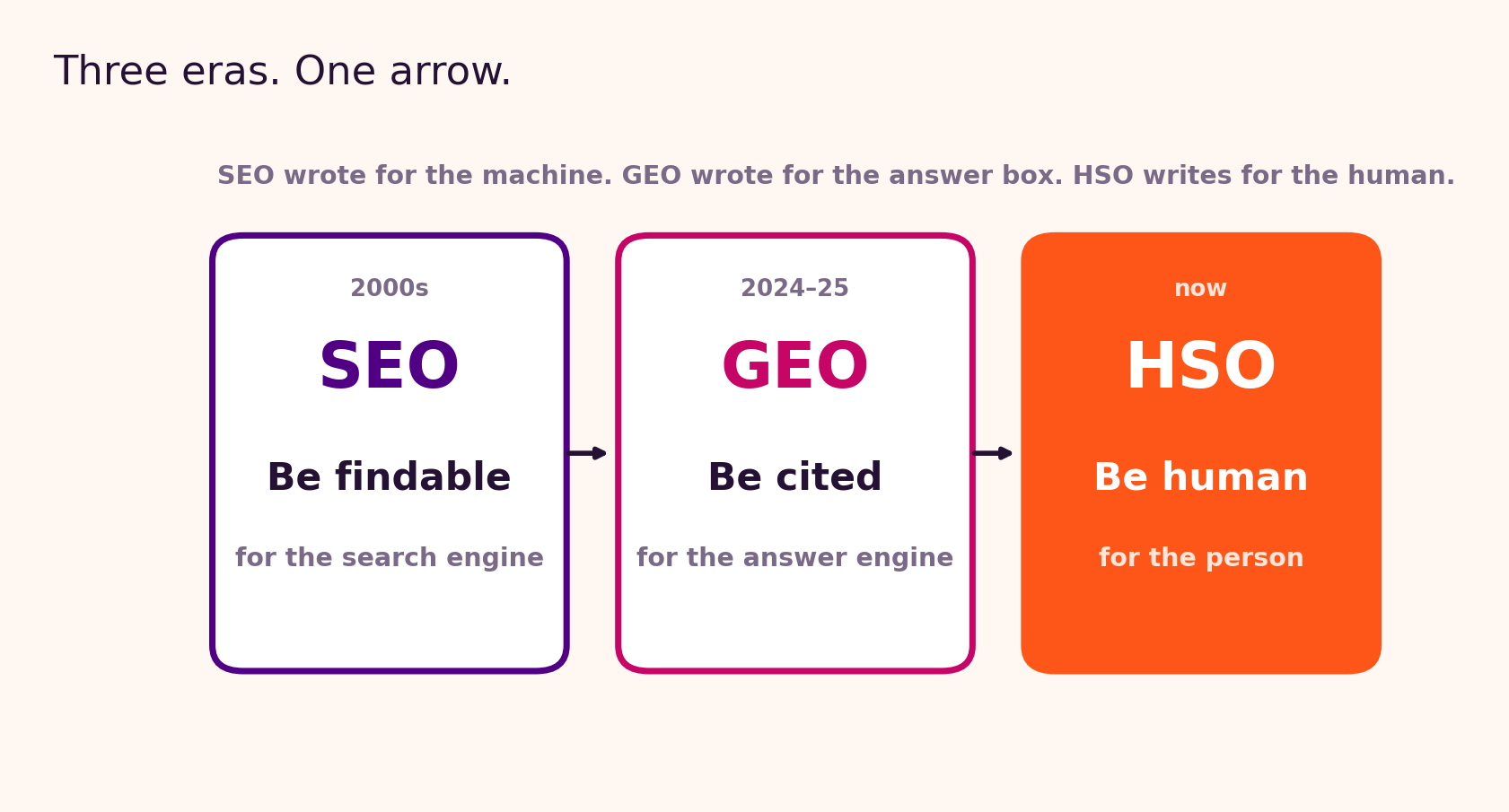
SEO said be findable. GEO said be cited. HSO says be the best human signal and prove it.
We built the framework because SEO and GEO both optimise you toward the same place: the average. Toward what ranks. Toward what gets quoted. And the average is exactly what the machine now prints for free and the feed now buries. Optimising for the average, in 2026, is optimising for the grave.
HSO points the other way. It isn’t a visibility hack. It’s how a real person stays visible and trusted in a web drowning in the fake.
And it has 5 layers. We call that the Human Signal Stack.
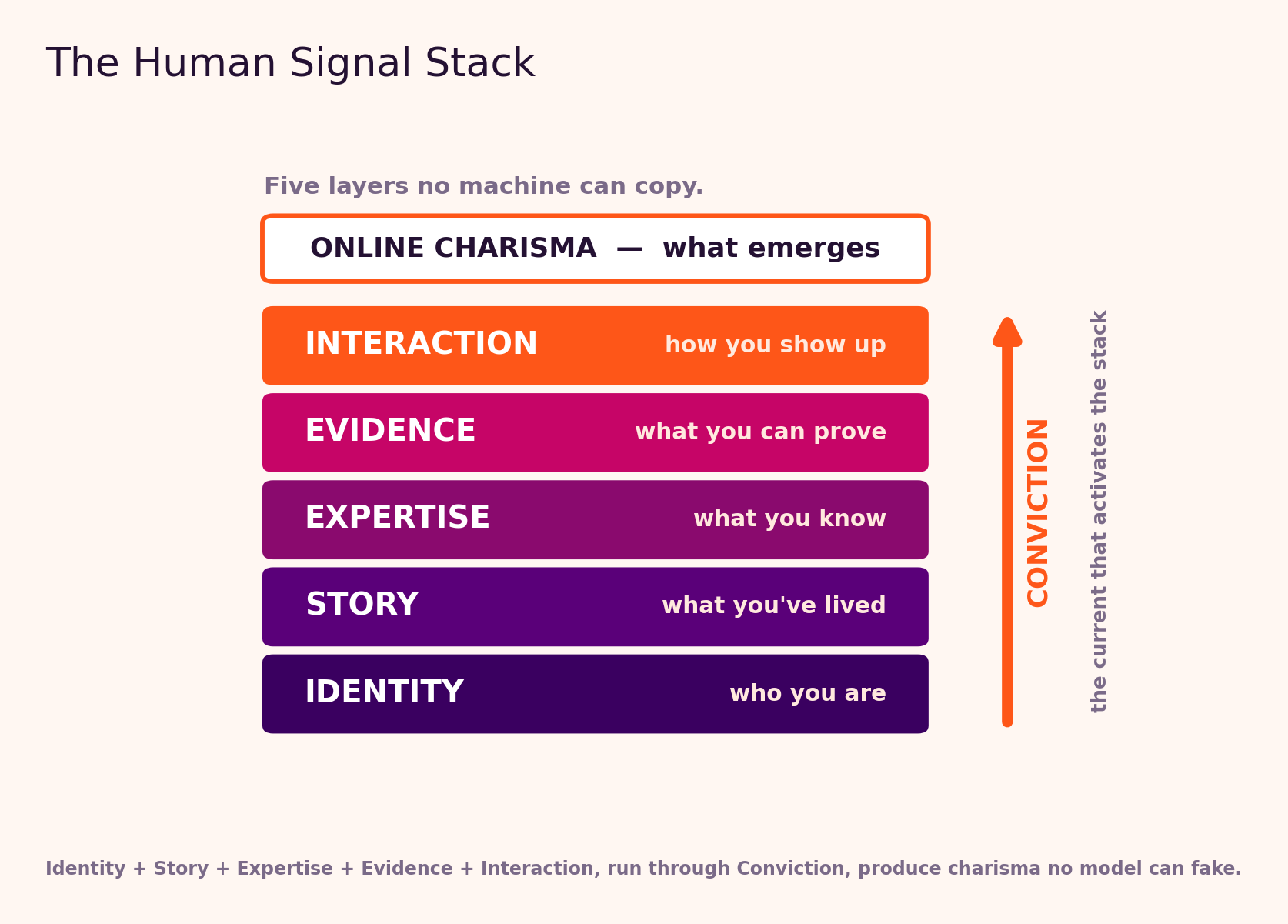
Five layers no machine can copy.
Identity — who you are. Not your title. Your fingerprint.
Story — what you’ve lived. The model averaged a million stories into mush. You have one. A real moment, a real place, a real person is data the model never saw.
Expertise — what you know from doing, not from summarising.
Evidence — what you can prove. The receipts, the numbers, the scar tissue of real work. This is the layer the counterfeit can’t fake.
Interaction — how you show up with the humans who show up for you.
Those five are the structure. What brings it to life is the current running up through them.
Many of us grew up to comply, to fit in and were not allowed to have a point of view. The family was about obeying the rules, working for a company often means fitting in to the culture.
Conviction is about taking a stand for what you believe in and being able to share painful lessons about what life has taught you. What you have discovered what works.
Do you have a scar or two you’re willing to name. An opinion with a spine. The stand you take when everything trained you to comply, to fit the mould, to not stick out.
The AI machine is built to be calm, balanced, agreeable and safe to everyone, alive to no one. Safe is the new invisible. Homogenous. Bland.
The Japanese call it the hammered down nail. Australia culture calls standing out the “Tall Poppy Syndrome”
I know that training from the inside. I spent my early years in a container that rewarded me for fitting in and had no word for the question why.
The bravest thing I ever said out loud was that the world was bigger than the walls I’d been handed. Everything I’ve written since has been a version of that one sentence.
Run the five layers through conviction and something emerges no model can fake.
Online charisma is this. The reason a stranger stops scrolling and feels, in the chest before the brain, a real person is here.
That’s the whole game now. Not for the crawler. Not for the answer box. Not for the feed. For the one reader in a cubicle, scrolling past a thousand identical posts, thinking there has to be more to this than the average.
There is. It’s them. And your job is to prove it’s still possible — by refusing to be averaged first.
Read the signals together and they only point one way.
We buy from humans. We pay to be in the rooms and stadiums where humans have tribal experiences . And the machines that flooded the web are spending real money to find the human hiding in their own flood.
Trust became the scarcest thing online. Humans are the only ones who can make it.
The future isn’t artificial. It runs on the one thing the machine can imitate but never own, a real person, with a real story, standing behind real words.
So stop writing to be found by the machine. It already has more content than it can use.
Start writing to be trusted by the person. That’s the only thing left in short supply.
Be findable. Be cited.
Then be the thing neither the engine nor the counterfeit can ever be traceably, provably, unmistakably human.
The slop is infinite now. The signal is you.
Is your work still feeding the machine? Or has it finally started signalling the human?
Issue #5 of The Human Signal Lab. If it moved something, send it to the one person you know who’s tired of sounding like everyone else.
No posts
Comments
Nothing yet. Say the first thing.
Sign in to join the conversation.