
Anyone who observes education closely, or who simply works within it with any degree of reflection, notices changes that are difficult to put into words. The sense is rarely of a single dramatic rupture. It is more often a slow accumulation of small differences:
a class that takes longer to settle,
a queue at the toilet door that did not exist a decade ago,
a lunch tray returned untouched,
an instruction that must be repeated three times rather than once.
Teachers describe it in staffrooms with a kind of embarrassed vagueness, because the observation feels both obvious and unprovable. Children are supposed to arrive at school having been formed in the small world of the family, ready to be extended into the larger world of society. Increasingly, teachers report that this readiness is not arriving with them. The question this conversation asks is whether that intuition survives contact with evidence, and what follows if it does.
The most quoted body of evidence comes from the United Kingdom, where the charity Kindred Squared has run an annual school readiness survey since 2020. Its sixth wave, conducted by Savanta with 1,076 primary school staff and 1,004 parents of the 2025 Reception intake, found that staff judged an average of 37 per cent of children to be starting school without the readiness expected of them, up from 33 per cent the previous year. The charity’s chief executive, Felicity Gillespie, described a cohort “arriving at the school gate without the basic life skills needed” to engage with the curriculum (Kindred Squared, 2026). The component findings map almost exactly onto the domestic practices examined earlier in this book:
26 per cent of children were not toilet-trained, rising to 36 per cent in the North East;
28 per cent could not eat or drink independently;
25 per cent struggled with basic language; and
32 per cent became overly distressed when separated from a parent.
More than half of staff, 52 per cent, judged that the proportion of unready children had risen again this year. What is striking is not any single figure but the pattern: the deficits cluster in exactly those capacities that are formed at home rather than taught at school.
Yet a perception survey commissioned by an advocacy charity, however carefully polled, is not a measurement of children. It records what teachers believe they are seeing, which is valuable but not the same thing.
For harder evidence we should turn to Australia, where the Australian Early Development Census provides something closer to a national census of child development. Its 2024 cycle covered approximately 288,000 children in their first year of full-time school across some 7,400 schools, with a participation rate of 94.6 per cent, the highest since the instrument began in 2009 (Australian Government Department of Education, 2024).
The trend it records is unambiguous.
The proportion of children developmentally on track across all five domains fell from 54.8 per cent in 2021 to 52.9 per cent in 2024, while the proportion developmentally vulnerable on two or more domains rose from 11.4 per cent to 12.5 per cent, the highest level recorded in the census’s history.
Vulnerability reached record levels in three domains in particular:
social competence,
emotional maturity, and
physical health and wellbeing.
Because the AEDC applies a consistent instrument at three-year intervals across fifteen years, it offers what the perception surveys cannot, namely a defensible claim that children are in fact arriving less developmentally on track than they did a decade ago, and that the deterioration is sharpest precisely in the social and emotional domains.
Why these domains matter is well established in developmental science. The capacities at issue fall under what psychologists term executive function, conventionally decomposed into inhibitory control, working memory and cognitive flexibility (Miyake et al., 2000). These are not peripheral skills.
Moffitt et al. (2011) followed a birth cohort of 1,037 children to the age of thirty-two and found that childhood self-control predicted adult health, personal finances and criminal outcomes, independently of intelligence and social class. Blair and Raver (2015) situate self-regulation at the centre of school readiness itself, arguing that the capacity to regulate attention and emotion is what makes formal instruction possible in the first place. When teachers report that children cannot follow instructions, wait, or manage separation, they are not complaining about manners. They are reporting the absence of the substrate on which teaching depends.
Honesty requires an immediate qualification, and it is a serious one. Teachers have been reporting exactly this for a quarter of a century.
In a foundational American study, Rimm-Kaufman et al. (2000) surveyed kindergarten teachers on the transition into school and found that close to half reported that at least half of their pupils lacked essential capacities, including the ability to follow directions. That finding predates smartphones, predates the pandemic, and predates most of the parenting shifts now blamed for the current alarm. It should temper any account that treats unreadiness as a recent invention. The more defensible reading is not that children were once uniformly ready and have suddenly ceased to be, but that a longstanding minority has grown, that the composition of the deficit has shifted toward the socio-emotional, and that expectations of what schools should absorb have risen alongside it.
There is a further complication that the Kindred data itself exposes. While staff judged 37 per cent of children unready, 88 per cent of parents said their own child was ready, and 35 per cent believed their child more ready than most (Kindred Squared, 2026). Two interpretations compete here and the evidence does not settle between them. Either parents are systematically misjudging their children, which would be significant in itself, or teachers and parents are applying different and incommensurable standards of what readiness means. Most probably both are true. The gap is worth dwelling on because it suggests that the problem is not simply that homes are failing, but that homes and schools no longer share a common definition of what a five-year-old ought to be able to do.
Whatever its cause, the burden lands somewhere, and it lands on teachers.
The Kindred survey estimated that primary staff lose an average of 2.4 hours of classroom time each day to the catch-up needs of children who are not school-ready, of which 1.4 hours is spent on toileting alone (Kindred Squared, 2026).
Fifty-five per cent of staff reported increased stress as a result, 28 per cent lower morale, and 19 per cent higher turnover in their setting. Even allowing generously for the imprecision of self-estimated time, a figure of this magnitude describes something structural rather than incidental. The school day has not lengthened. If more of it is consumed by functions once discharged at home, then something else within it has been displaced. This is the mechanism by which a domestic change becomes an educational one, and it is why the argument of the previous conversations cannot remain a matter of private family preference.
Which brings us to the first of the two questions this conversation must leave open.
If children are arriving less capable of regulating themselves, feeding themselves, separating from their parents and following instruction, and if this is visible across different countries, different instruments and different decades, then the obvious question is not what schools should do about it but what has happened in the homes from which these children come.
The evidence assembled here documents an outcome without explaining a cause. Something has changed in the ordinary daily practices of family life, in the division of household labour, in the structure of the evening, in the assumptions parents hold about what a child of four or five should be expected to manage alone.
What exactly has happened to parenting, and did we choose it, or did it happen to us while we were occupied elsewhere?
The second question is more uncomfortable, and it is the one this conversation has been circling from the beginning. Suppose the crisis is not confined to a single cohort of children but persists across generations. The children whose self-regulation was never scaffolded do not remain children. They become adults, and some of them become parents, and some of them become teachers.
Developmental science gives this concern a real foundation.
Bridgett et al. (2015), in the standard review of the field, document that self-regulation is transmitted from parent to child through both biological and social pathways, with parenting behaviour serving as the principal social mechanism. Deater-Deckard (2014) reaches the same conclusion regarding executive function and attentive behaviour within families.
If regulation is transmitted rather than spontaneously generated, then a deficit in one generation is not self-correcting. It is heritable in the social sense, and it propagates.
The uncomfortable extension is to the profession itself. Here the evidence must be handled with unusual care, because it is genuinely mixed and the temptation to lament is strong.
The most recent international teaching survey provides the sharpest datum.
In TALIS 2024, the proportion of recent graduates reporting high preparedness in subject content, subject-specific pedagogy, general pedagogy and classroom practices declined by roughly six to seven percentage points compared with 2018; only 33 per cent felt prepared to teach in multicultural and multilingual settings, and 44 per cent to support pupils’ social and emotional development. The OECD is careful in its interpretation, noting that this “does not necessarily imply that the quality of initial teacher education has worsened” and may instead reflect more demanding classrooms or a more critical assessment of preparation (OECD, 2025).
That caution is warranted and should be preserved. But the datum stands: young teachers today feel less equipped than young teachers did six years ago, at precisely the moment when the children in front of them are arriving less ready.
Structural pressures compound this. UNESCO and the International Task Force on Teachers for Education 2030 (2024) estimate that 44 million additional teachers are required globally by 2030, and report that “seven out of ten teachers at the secondary level will need to be replaced” by that date. Primary teacher attrition roughly doubled between 2015 and 2022. Shortages of this magnitude exert a predictable downward pressure on entry standards through emergency licensure and out-of-field deployment, so that even where formal requirements are unchanged, the effective capability of the workforce may erode.
Meanwhile, the job itself has intensified.
Hargreaves (1992, 1994) argued three decades ago that teachers’ work was expanding in scope while contracting in discretionary time, and Apple (1986), drawing on Braverman’s (1974) labour process theory, described a parallel deskilling in which prescribed curricula and audit regimes separate the conception of teaching from its execution. Add the emotional labour that Hochschild (1983) first named and that Isenbarger and Zembylas (2006) traced specifically in teaching, and the picture is of a profession asked to do more, with less latitude, for children who need more.
And yet the honest case against the decline thesis is strong enough that it must be stated with equal force.
First, novice struggle is not new; it is one of the most durable findings in the field. Veenman (1984) catalogued the perceived problems of beginning teachers, Corcoran (1981) named the phenomenon “transition shock”, and Huberman (1989) described a “survival” phase in the professional life cycle. What TALIS records may be the perennial condition of the novice rather than a generational deterioration.
Second, where the academic calibre of entrants has been measured directly, the finding has sometimes run the opposite way. Goldhaber and Walch (2014) found that the average measured academic ability of new American teachers rose over the 2000s, moving from around the forty-second percentile of college graduates to approximately the forty-eighth, with the share of new science and mathematics teachers drawn from the lowest ability quintile collapsing over the same period.
Third, even were selectivity to fall, the link between paper credentials and classroom effectiveness is weak and inconsistent (Greenwald et al., 1996).
Fourth, the widely repeated claim that nearly half of new teachers leave within five years, associated with Ingersoll (2001), is contradicted by longitudinal federal data putting the figure closer to seventeen per cent (National Center for Education Statistics, 2015). The provocation, then, must be posed as a question and not smuggled in as a finding.
There is also reason for measured hope, and it should not be omitted merely because alarm is more rhetorically satisfying. Dicke et al. (2015) conducted a randomised controlled trial with ninety-seven beginning teachers and found that targeted classroom management training improved both their competence and their wellbeing, concluding that reality shock is modifiable rather than inevitable (https://doi.org/10.1016/j.tate.2015.01.013). The TALIS finding that only 22 per cent of novices had an assigned mentor in 2018 is dispiriting, but it also indicates enormous unexploited headroom.
On the child’s side, the evidence is more equivocal: interventions targeting executive function produce measurable gains, but meta-analyses caution that effects frequently fade and transfer poorly beyond trained tasks (Melby-Lervåg & Hulme, 2013; Kassai et al., 2019). The cycle is breakable, but not cheaply and not by exhortation.
So the second question stands, and it is sharper than the first. We have been asking, throughout this conversation, what happens when the home no longer forms the child and the school is asked to build foundations it was designed only to extend. But suppose the deficit has now run long enough to complete a full circuit. Suppose the children who arrived unready twenty years ago are the young teachers standing in front of today’s unready children, and the young parents raising tomorrow’s. If both the home and the school are weakening at once, then their deficits do not cancel; they compound, and the institution we habitually treat as the remedy becomes another site of the disease.
What, then, if the teachers themselves, and especially the youngest among them, are arriving less prepared for a task that is simultaneously becoming harder, and who is left to form the formers?
Hasrizal Abdul Jamil
Director of Education
Khalifah Education Foundation
Apple, M. W. (1986). Teachers and texts: A political economy of class and gender relations in education. Routledge & Kegan Paul.
Australian Government Department of Education. (2024). Australian Early Development Census national report 2024. Commonwealth of Australia.
https://www.aedc.gov.au
Blair, C., & Raver, C. C. (2015). School readiness and self-regulation: A developmental psychobiological approach. Annual Review of Psychology, 66, 711–731.
Braverman, H. (1974). Labor and monopoly capital: The degradation of work in the twentieth century. Monthly Review Press.
Bridgett, D. J., Burt, N. M., Edwards, E. S., & Deater-Deckard, K. (2015). Intergenerational transmission of self-regulation: A multidisciplinary review and integrative conceptual framework. Psychological Bulletin, 141(3), 602–654.
Corcoran, E. (1981). Transition shock: The beginning teacher’s paradox. Journal of Teacher Education, 32(3), 19–23.
Deater-Deckard, K. (2014). Family matters: Intergenerational and interpersonal processes of executive function and attentive behavior. Current Directions in Psychological Science, 23(3), 230–236.
Dicke, T., Elling, J., Schmeck, A., & Leutner, D. (2015). Reducing reality shock: The effects of classroom management skills training on beginning teachers. Teaching and Teacher Education, 48, 1–12. https://doi.org/10.1016/j.tate.2015.01.013
Goldhaber, D., & Walch, J. (2014). Gains in teacher quality. Education Next, 14(1), 38–45.
Greenwald, R., Hedges, L. V., & Laine, R. D. (1996). The effect of school resources on student achievement. Review of Educational Research, 66(3), 361–396.
Hargreaves, A. (1992). Time and teachers’ work: An analysis of the intensification thesis. Teachers College Record, 94(1), 87–108.
Hargreaves, A. (1994). Changing teachers, changing times: Teachers’ work and culture in the postmodern age. Cassell.
Hochschild, A. R. (1983). The managed heart: Commercialization of human feeling. University of California Press.
Huberman, M. (1989). The professional life cycle of teachers. Teachers College Record, 91(1), 31–57.
Ingersoll, R. M. (2001). Teacher turnover and teacher shortages: An organizational analysis. American Educational Research Journal, 38(3), 499–534.
Isenbarger, L., & Zembylas, M. (2006). The emotional labour of caring in teaching. Teaching and Teacher Education, 22(1), 120–134.
Kassai, R., Futo, J., Demetrovics, Z., & Takacs, Z. K. (2019). A meta-analysis of the experimental evidence on the near- and far-transfer effects among children’s executive function skills. Psychological Bulletin, 145(2), 165–188.
Kindred Squared. (2026). School readiness survey 2025 (Fieldwork by Savanta). Kindred Squared.
https://kindredsquared.org.uk
Melby-Lervåg, M., & Hulme, C. (2013). Is working memory training effective? A meta-analytic review. Developmental Psychology, 49(2), 270–291.
Miyake, A., Friedman, N. P., Emerson, M. J., Witzki, A. H., Howerter, A., & Wager, T. D. (2000). The unity and diversity of executive functions and their contributions to complex “frontal lobe” tasks: A latent variable analysis. Cognitive Psychology, 41(1), 49–100.
Moffitt, T. E., Arseneault, L., Belsky, D., Dickson, N., Hancox, R. J., Harrington, H., Houts, R., Poulton, R., Roberts, B. W., Ross, S., Sears, M. R., Thomson, W. M., & Caspi, A. (2011). A gradient of childhood self-control predicts health, wealth, and public safety. Proceedings of the National Academy of Sciences, 108(7), 2693–2698.
National Center for Education Statistics. (2015). Public school teacher attrition and mobility in the first five years: Results from the first through fifth waves of the 2007–08 Beginning Teacher Longitudinal Study. U.S. Department of Education.
OECD. (2025). Developing teacher expertise: Results from TALIS 2024. OECD Publishing.
https://www.oecd.org
Rimm-Kaufman, S. E., Pianta, R. C., & Cox, M. J. (2000). Teachers’ judgments of problems in the transition to kindergarten. Early Childhood Research Quarterly, 15(2), 147–166.
UNESCO & International Task Force on Teachers for Education 2030. (2024). Global report on teachers: Addressing teacher shortages and transforming the profession. UNESCO.
https://www.teachertaskforce.org
Veenman, S. (1984). Perceived problems of beginning teachers. Review of Educational Research, 54(2), 143–178.
Whose Child Is It, and What Is Learning For?
·
Jul 27
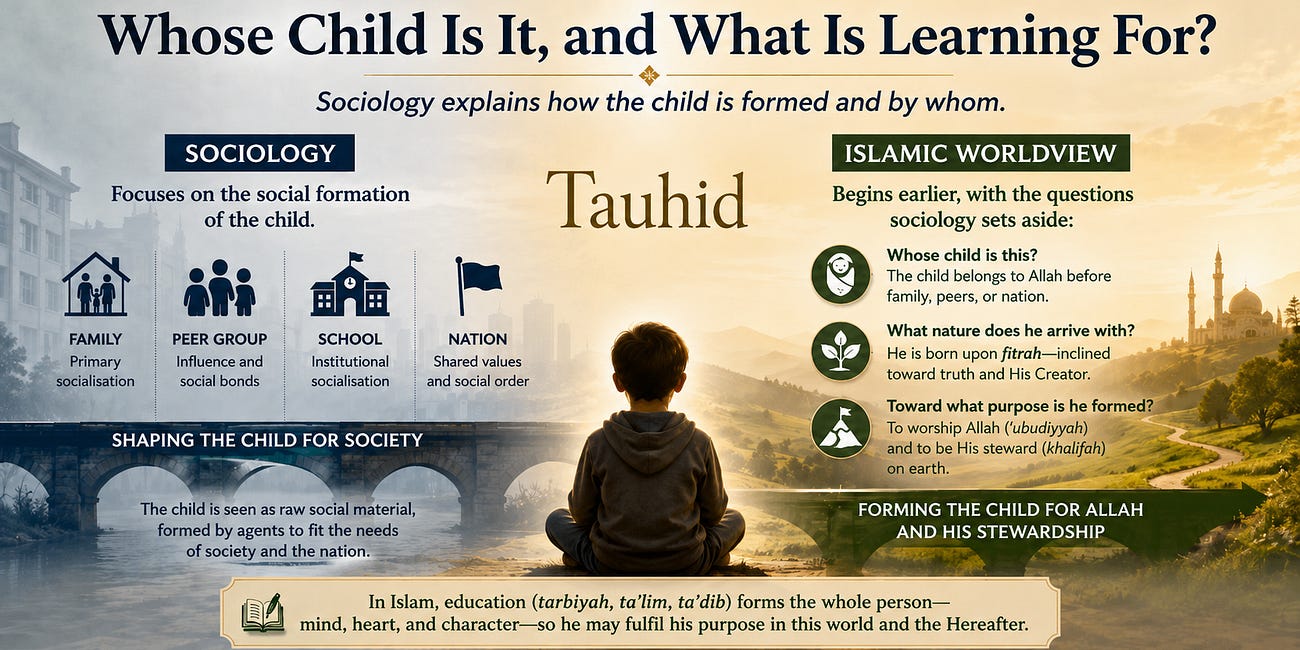
The sociological account described in the first conversation is powerful, but it is deliberately silent on the questions that matter most to a believing parent. Functionalism can tell us how the home shapes the child and how the school widens that shaping into a shared national order, yet it treats the child as raw social material and the nation as the …
Comments
Nothing yet. Say the first thing.
Sign in to join the conversation.