
Emotional dysregulation has always been my hardest ground. Diagnosis did not settle it. Stimulant medication did not settle it. It is the thing I worked on all through my academic journey, right through the master’s, on two tracks at once: as private work at the individual level, and as institutional accommodation within the services my university provides.
For a long time I read that as a personal failure. The literature reads it differently. In Russell Barkley’s model, the self-regulation of emotion is not a character trait sitting somewhere beside ADHD. It is the fifth executive function to develop, the one he calls the mind’s heart, and it is one of the functions the disorder directly weakens. In his own studies, 98 per cent of adults with ADHD reported major problems with emotional control, against 7 per cent of adults in the general community. That is not a rounding error. That is the condition itself.
Medication matters, and mine does help. But Barkley is careful about what it can and cannot do. Stimulants improve behaviour in as many as 75 to 92 per cent of cases and normalise it in roughly 50 to 60 per cent, and only for as long as the medication remains in the brain. It is a temporary correction of a neurological substrate, not a cure and not a character transplant. Which is why the accommodations were never optional extras alongside the tablets. Barkley’s argument is that executive function deficits are disorders of performance rather than of knowledge, so support has to be inserted at the point of performance, in the actual place and moment where a person is failing to use what they already know. Once a week in a counselling room is not where my life happens. My life happens in the seminar, in the deadline, in the corridor, in the hospital ward.
Receiving the news that my brother had been diagnosed with cancer was a huge shock against what was meant to be a dull, slow summer. I had no plan to travel back to Malaysia this year, no annual working road trip.
Coming back to emotional dysregulation: my boss was worried that if something bad happened to my brother, I would be carrying a difficult burden into September, when my PhD starts. She knows me very well. She insisted I must go home and be with him. She was 100 per cent correct.
Two weeks taking care of him in the hospital, supporting his wife and the rest of the family, was both soothing and painful. I love each and every one of my siblings, and watching my brother deteriorate into a worsening delirium, day by day, was hard.
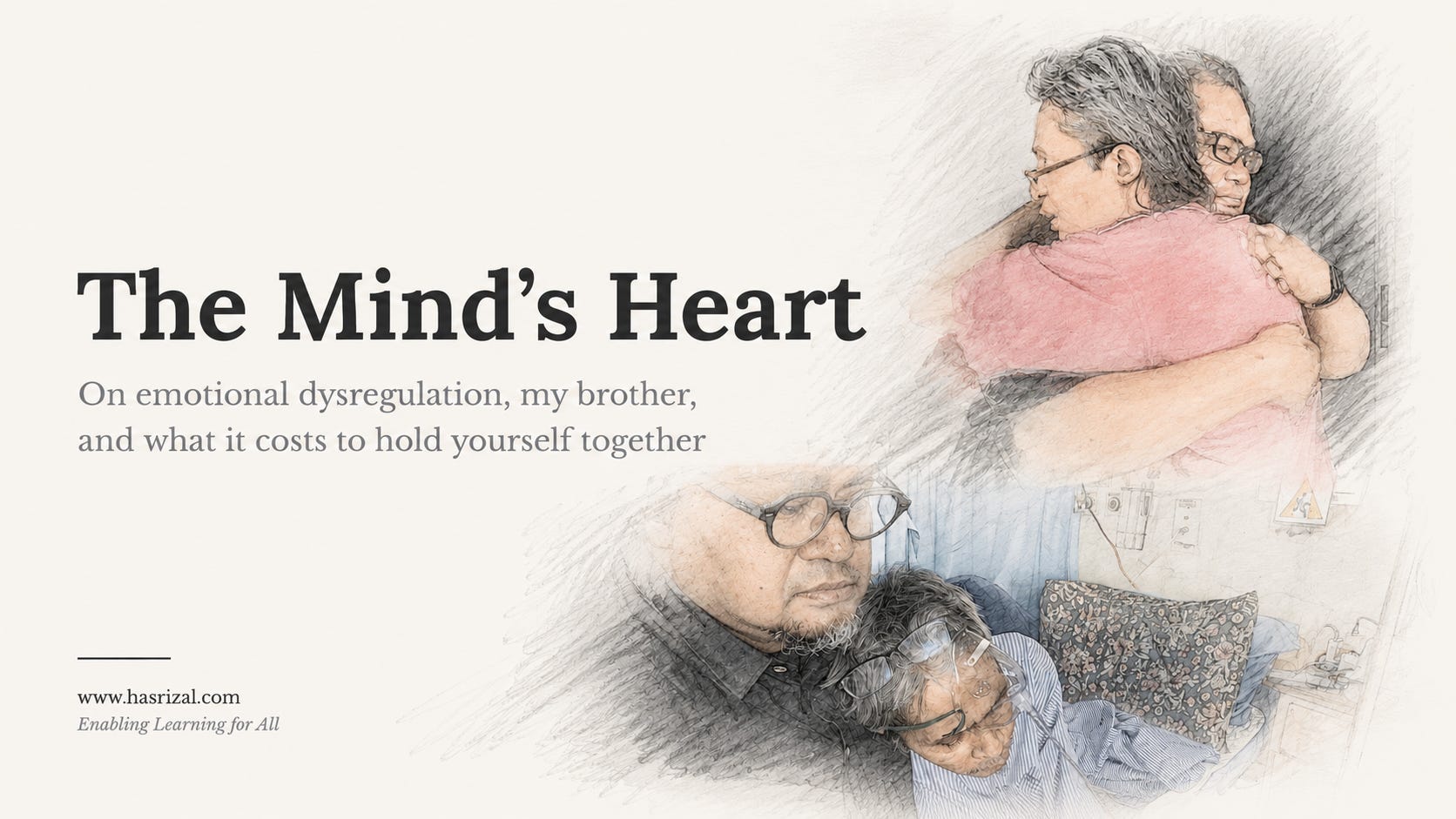
One afternoon he was at his worst. He could not work out how to stand still or how to sit down, because neither eased the pain. I held him and rubbed his back softly. He was crying, whispering into my ear that he was scared, that he could not handle it, that this pain was different from anything he had experienced in his life. Then he said, “thank you for being a good brother to me.”
I had to kill the waterfall of my own sadness. I swallowed everything and kept supporting him, with no tears, giving him nothing of how helpless and hopeless I felt.
That is emotional self-regulation, exactly as Barkley describes it: soothing yourself in the middle of an extreme reaction, using images and words to pull your attention off what has set you off, and deliberately choosing a more moderate emotional tone because it serves something more important than your own relief. It is the ordinary machinery of adulthood. It is also the precise machinery my brain runs badly.
And it is not free. Barkley draws on the research on self-regulatory strength to describe a limited pool of effort that every act of self-regulation depletes, and which stress and illness deplete faster still. Laura Knouse puts the same finding more plainly in her work with Barkley: self-regulation takes energy, and for people with ADHD, engaging willpower may burn through the reserve faster than it does for others. Living well with ADHD, she writes, is a marathon and not a sprint.
I did not feel like an athlete in that room. I felt like a man running on an empty tank and refusing to admit it.
His impairment is worse than mine. More obvious. More disabling. He never had the words for it and he never had the paperwork.
With help I managed to secure from an NGO, funding was directed to him for an assessment. He was worried about his child, so he used it for the child’s assessment instead.
That decision makes complete sense to anyone who knows how heritable this is. Barkley puts the genetic contribution to variation in ADHD traits at 75 to 80 per cent, with some studies above 90 per cent, higher than the genetic contribution to personality or intelligence. Nearly one in three siblings of a child with ADHD will also have it. Between 30 and 54 per cent of the children of adults with ADHD will have it too. My brother was not being irrational. He was reading his own family correctly. He simply chose the next generation over himself, which is the most predictable thing he has ever done.
So my brother lived a far longer stretch of a miserable life than I did, undiagnosed and unaccommodated. What soothed him, he told me, was my diagnosis, my advocacy, everything I have written about ADHD. Somebody had finally put a name to the thing that had been eating him since childhood, even if the name arrived through his younger brother rather than through a clinic.
I was hoping that my appointment as a co-researcher in the Department of Psychiatry at UKM might open a door for him. An assessment. A diagnosis. A file with his name on it.
But this cancer brought a different story.
I am now ten thousand kilometres away from him, and he is fighting his final battle.
Day to day I absorb the updates from home while maintaining my function here, with the PhD about to start. The exhaustion is not metaphorical. It is the depletion Barkley describes, running continuously, with no gap in which to refill. I know what the literature says I should do. Exercise. Breaks. Three minutes of stillness after the hardest moments. Externalise what my own head cannot hold. I do some of it. Some days I do none of it.
I can only ask for one thing.
Ya Allah, soothe my brother and grace him in his final days. Welcome him back to You in all goodness. Amin.
Hasrizal Abdul Jamil | www.hasrizal.com
Barkley, R. A. (n.d.). The important role of executive functioning and self-regulation in ADHD [Guest column]. russellbarkley.org
Barkley, R. A., & Benton, C. M. (2021). Taking charge of adult ADHD: Proven strategies to succeed at work, at home, and in relationships (2nd ed.). The Guilford Press.
Knouse, L. E., & Barkley, R. A. (2025). Living well with adult ADHD: Practical strategies for improving your daily life. The Guilford Press.
Comments
Nothing yet. Say the first thing.
Sign in to join the conversation.