
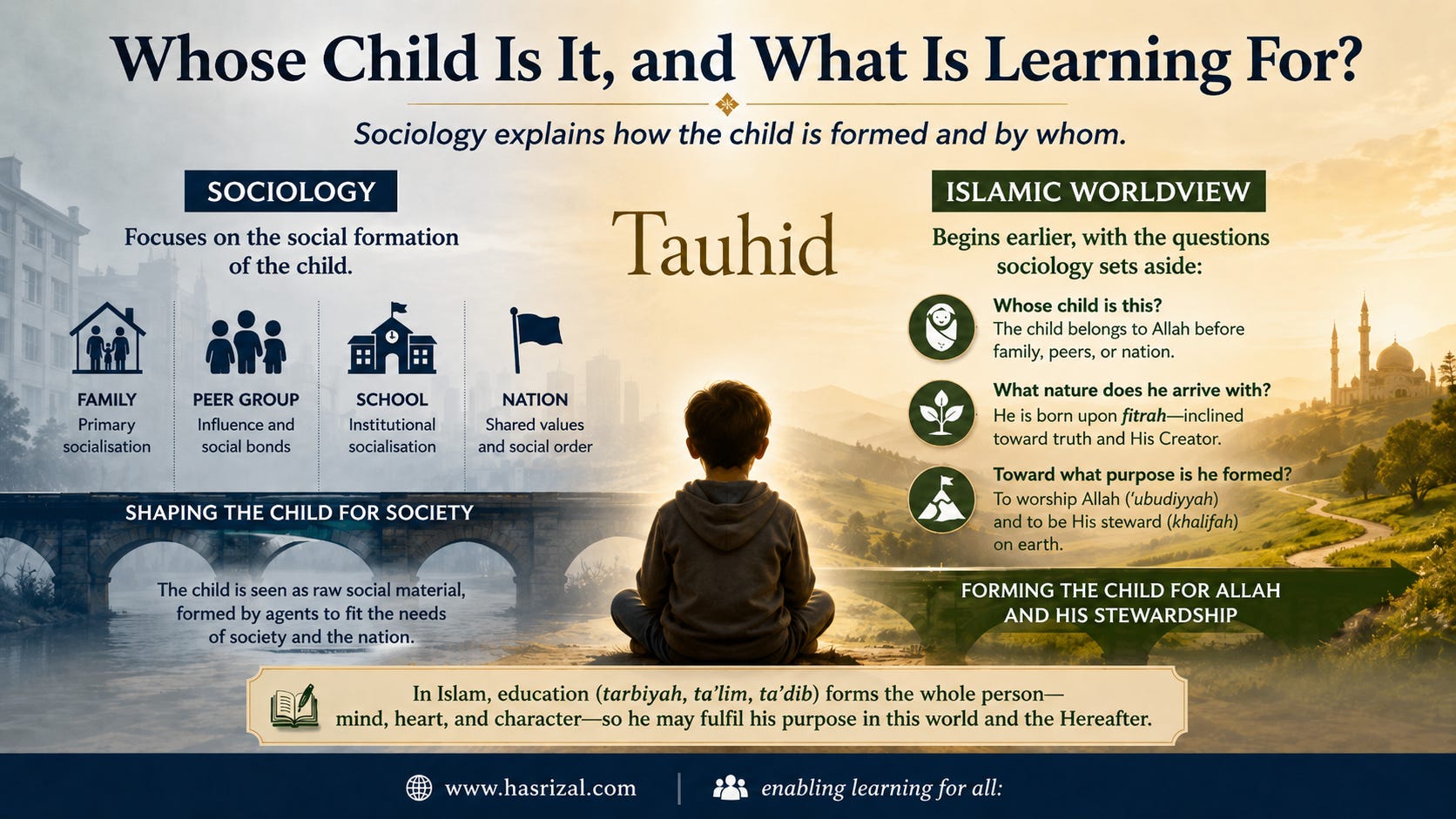
The sociological account described in the first conversation is powerful, but it is deliberately silent on the questions that matter most to a believing parent. Functionalism can tell us how the home shapes the child and how the school widens that shaping into a shared national order, yet it treats the child as raw social material and the nation as the highest court of appeal. The Islamic worldview does not deny this mechanism so much as reposition it. Before the child belongs to a home, a peer group, or a nation, the child belongs to Allah, arrives with a given nature, and is being formed for a purpose that no society is authorised to define on its own.
That given nature has a name in the Islamic tradition, and it reframes the whole discussion of who forms the child. The Prophet, peace be upon him, said:
مَا مِنْ مَوْلُودٍ إِلَّا يُولَدُ عَلَى الْفِطْرَةِ، فَأَبَوَاهُ يُهَوِّدَانِهِ أَوْ يُنَصِّرَانِهِ أَوْ يُمَجِّسَانِهِ، كَمَا تُنْتَجُ الْبَهِيمَةُ بَهِيمَةً جَمْعَاءَ، هَلْ تُحِسُّونَ فِيهَا مِنْ جَدْعَاءَ
“There is no child but is born upon the fitrah. It is then his parents who make him a Jew, a Christian, or a Magian, just as an animal gives birth to a whole offspring: do you perceive in it any mutilation?”
(Sahih al-Bukhari 1358; Sahih Muslim 2658, muttafaqun ‘alayhi)
This narration both confirms and deepens the sociologist’s insight.
It confirms that parents are the decisive early shapers, echoing what Berger and Luckmann called primary socialisation, but it insists that they are not writing on a blank page. The child arrives already oriented toward truth and toward its Maker, a disposition the Qur’an calls fitratallah, the fitrah of Allah upon which He created humankind (Ar-Rum 30:30).
Formation, on this view, is therefore never mere construction from nothing. It is either the nurturing of an original orientation or its deviation. Where the sociologist sees a culture being installed, the Muslim educator sees a nature being either cultivated or bent, and that difference changes everything that follows.
If the child arrives already inclined toward knowing his Lord, then education is not a peripheral service but the first divine address to humanity. The opening words of revelation were not a command to fight, to build, or to rule, but a command to read:
ٱقْرَأْ بِٱسْمِ رَبِّكَ ٱلَّذِى خَلَقَ خَلَقَ ٱلْإِنسَـٰنَ مِنْ عَلَقٍ ٱقْرَأْ وَرَبُّكَ ٱلْأَكْرَمُ ٱلَّذِى عَلَّمَ بِٱلْقَلَمِ عَلَّمَ ٱلْإِنسَـٰنَ مَا لَمْ يَعْلَمْ
“Read, in the name of your Lord who created; created the human being from a clinging clot. Read, and your Lord is the Most Generous, who taught by the pen, taught the human being what he did not know.”
(Al-’Alaq 96:1-5)
That the revelation begins with reading, teaching, and the pen is not incidental. It signals that the knowing of the human being is bound up with his very createdness, and that learning is the arena in which he is dignified above the rest of creation, for Allah asks whether those who know and those who do not know can ever be equal (Az-Zumar 39:9) and promises to raise the people of knowledge in rank (Al-Mujadalah 58:11).
The Islamic tradition names this enterprise through three interlocking words: tarbiyah, the patient nurturing of growth; ta’lim, the transmission of knowledge; and ta’dib, the instilling of adab. Al-Attas (1980) argues that ta’dib is the most comprehensive of the three, because true education is not the filling of a mind but the forming of a person who recognises the right place of everything and acts accordingly. What we call life skills and what we call good character are, in this frame, not two separate problems but one: both are adab, the disciplined ordering of the self toward its proper ends.
The purpose of this ordering, however, reaches beyond the good citizen that functionalism aims to produce. Islam orients the child along two axes at once, and only one of them is horizontal.
The vertical axis is ‘ubudiyyah, servanthood, for humankind was created to worship (Adh-Dhariyat 51:56); the outward axis is khilafah and ‘imarah, the stewardship and cultivation of the earth for which Allah settled us upon it (Hud 11:61).
Read through the maqasid al-shariah, the higher objectives of the Law, education becomes the means by which the preservation of religion, life, intellect, lineage, and property is secured across the generations (Auda, 2008).
Where the functionalist bridge carries the child toward society as its destination, the Islamic worldview carries the child first toward Allah and then, as His steward, back toward the world. The nation is still served, but it is served as a by-product of a higher allegiance, never as the ceiling of a child’s becoming.
Within this architecture, parents are not one socialising agent among several but the first and primary educators, and their charge is heavier than any developmental checklist. The Qur’an frames it in the language of rescue:
يَا أَيُّهَا الَّذِينَ آمَنُوا قُوا أَنفُسَكُمْ وَأَهْلِيكُمْ نَارًا
“O you who believe, guard yourselves and your families against a Fire whose fuel is people and stones.”
(At-Tahrim 66:6)
To guard a family from the Fire is a task of formation, not merely of provision, and it cannot be discharged by feeding and housing alone.
Al-Ghazali captured its weight when he described the child as a trust, an amanah, in the hands of the parents, and the child’s heart as a pure and precious jewel that will take the imprint of whatever is engraved upon it (Ihya’ ‘ulum al-din).
The Qur’an offers the archetype of this engraving in the counsel of Luqman to his son, which begins not with etiquette or industry but with tawhid, warning against associating partners with Allah, before moving to prayer, patience, humility, and conduct among people (Luqman 31:13-19).
The sequence is instructive.
It runs from creed, to worship, to character, to social skill, which is very nearly the inverse of a readiness checklist that begins and ends with whether a child can hold a pencil or eat unaided.
The home, in the Islamic worldview’s visualisation, is the first madrasah, and what it teaches first is not competence but orientation.
This trust, moreover, comes with an answerability that cannot be delegated away. The Prophet, peace be upon him, said:
كُلُّكُمْ رَاعٍ وَكُلُّكُمْ مَسْؤُولٌ عَنْ رَعِيَّتِهِ، وَالرَّجُلُ رَاعٍ عَلَى أَهْلِ بَيْتِهِ وَهُوَ مَسْؤُولٌ عَنْ رَعِيَّتِهِ، وَالْمَرْأَةُ رَاعِيَةٌ عَلَى بَيْتِ زَوْجِهَا وَوَلَدِهِ وَهِيَ مَسْؤُولَةٌ عَنْ رَعِيَّتِهَا
“Each of you is a shepherd, and each of you is responsible for his flock. A man is a shepherd over the people of his household and is responsible for them, and a woman is a shepherd over her husband’s house and his children and is responsible for them.”
(Sahih al-Bukhari 893; Sahih Muslim 1829, muttafaqun ‘alayhi)
Here the Islamic worldview speaks directly to the outsourcing described in the first conversation. When the washing of dishes passes to a helper, when the setting of a bedtime passes to a screen, and when the shaping of character passes quietly to the school, the doing of formation is displaced, but the answerability for it is not. A shepherd who hands his flock to another has not ceased to be responsible for the flock.
This is the deepest divergence between the two frames.
Sociology can describe delegation as an adaptation to modern life; the hadith describes it as a trust that remains lodged with the one who was given it, whatever conveniences are arranged around it.
Schooling, then, is best understood in this worldview not as a replacement for the home but as the community’s shared discharge of an obligation that originates in the home.
The teacher inherits a portion of a prophetic task, for the Prophet himself was sent to recite, to purify, and to teach the Book and wisdom (Al-Jumu’ah 62:2), and the scholar who carries knowledge forward stands within that lineage.
The school extends and refines what the home has begun, much as the functionalist model described, but with a crucial difference in what is being extended.
When the home transmits fitrah nurtured into adab, the school receives a child oriented and ready to be taught. When the home transmits little, the teacher is handed not a formed child to be refined but an unformed one to be built, and is asked to carry an amanah that was never meant to rest on the school alone. The extra burden that teachers describe is, in Islamic terms, the weight of a displaced trust.
Taken together, the two conversations converge on the same sequence of home, school, and society, yet the Islamic worldview reorders its axis, redefines its subject, and relocates its responsibility. It reorders the axis by making the vertical relationship with Allah prior to the horizontal relationship with society. It redefines the subject by seeing the child not as raw material but as a being of fitrah, an amanah, and a khalifah in the making. And it relocates responsibility by binding it to the parent in a way that no delegation can dissolve.
What the first conversation could name only as a social decline, the second names more gravely still, as a neglect of a trust and a loss of the ends that formation was always meant to serve.
And so this conversation closes, as the first did, with two questions that will not let us rest.
The first turns on ourselves. We were once children shaped, well or poorly, by parents who carried this trust before us, yet almost none of us were ever trained to carry it in turn, least of all under the conditions we now inhabit, where helpers, screens, migration, and the relentless pace of dual-income life have quietly taken over the very tasks the trust asks of us. How, then, are we to evaluate our own readiness to shoulder an amanah for which no one prepared us, in a reality harder than the one that formed us?
The second turns on the child. If we were to lift our gaze and see our son or our daughter not merely as a child to be raised or a pupil to be schooled, but as a khalifah of Allah, a steward who will one day answer for a share of His earth, how differently would we then conceive the whole labour of forming them? What would change, in the home and in the school alike, if every child before us were treated not as a citizen in training, but as a khalifah in the making?
Hasrizal Abdul Jamil
Director of Education
Khalifah Education Foundation
Al-Baqarah (2): 30
Hud (11): 61
Ar-Rum (30): 30
Luqman (31): 13-19
Az-Zumar (39): 9
Al-Mujadalah (58): 11
At-Tahrim (66): 6
Al-Jumu’ah (62): 2
Adh-Dhariyat (51): 56
Al-’Alaq (96): 1-5
Qur’anic translations are the author’s own renderings, cross-checked against M. A. S. Abdul Haleem (Oxford, 2004) and M. Khattab, The Clear Qur’an (2015).
Al-Bukhari, M. Sahih al-Bukhari, Kitab al-Jana’iz [Book of Funerals], Hadith 1358; and Muslim, Sahih Muslim, Kitab al-Qadar [Book of Destiny], Hadith 2658. Grade: Sahih, muttafaqun ‘alayhi. https://sunnah.com/bukhari:1358
Al-Bukhari, M. Sahih al-Bukhari, Kitab al-Jumu’ah [Book of Friday Prayer], Hadith 893; and Muslim, Sahih Muslim, Kitab al-Imarah [Book of Leadership], Hadith 1829. Grade: Sahih, muttafaqun ‘alayhi. https://sunnah.com/bukhari:893
al-Attas, S. M. N. (1980). The concept of education in Islam: A framework for an Islamic philosophy of education. Muslim Youth Movement of Malaysia (ABIM); later republished by ISTAC.
al-Ghazali, A. H. Ihya’ ‘ulum al-din [The revival of the religious sciences], Kitab Riyadat al-Nafs wa Tahdhib al-Akhlaq [The Book of Disciplining the Soul].
Auda, J. (2008). Maqasid al-Shariah as philosophy of Islamic law: A systems approach. International Institute of Islamic Thought.
Who Forms the Child Before School Begins?
·
Jul 27
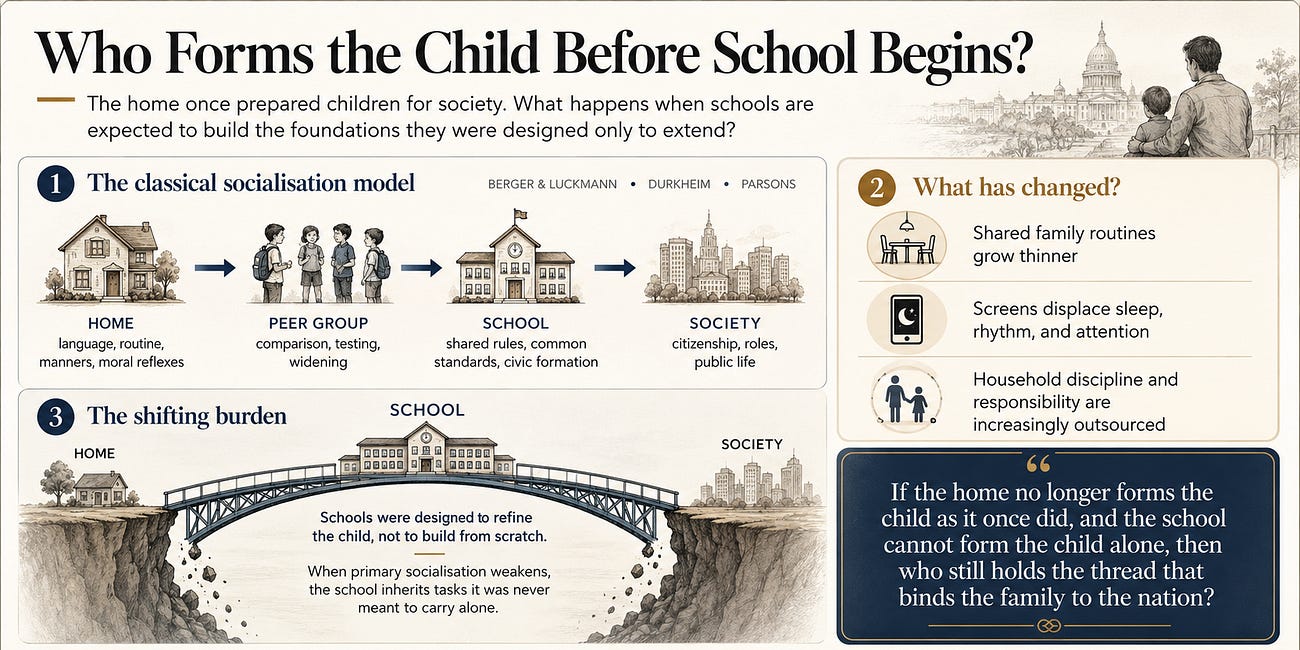
No child arrives at the school gate as a blank page. Long before the first bell, the child has already been made: shaped by a mother tongue, a family table, a rhythm of waking and sleeping, and a set of quiet assumptions about who does what and why. Sociologists have long understood this earliest shaping as primary socialisation, the process through whi…
Comments
Nothing yet. Say the first thing.
Sign in to join the conversation.