
You’ve done keto. Maybe carnivore after that. Bone broth was in your fridge at some point. You’ve had MCT oil in your coffee. You’ve read Ray Peat forum posts at 1am. You looked into TRT. You’ve got peptides in the freezer right now, or you’re thinking about it.
Some of it helped… for a while. Some of it did nothing. A couple of things made you feel worse and you quietly stopped mentioning them. And somewhere in the middle of all that effort, you’re still tired, still not recovering the way you used to, still waiting for labs to actually move, still not back to how you felt five or ten years ago.
Here’s the thing nobody tells you: that’s not a discipline problem. That’s not even a “you haven’t found the right protocol yet” problem. It’s what happens to almost everyone who tries to fix a system by cycling through tools instead of finding out what’s actually broken.
Before I show you the way out, look at the pattern first. Because once you see it, you can’t unsee it.
Health and fitness culture has run through an entire diet, supplement, or protocol roughly every 1–3 years for the last two and a half decades. Here’s the actual timeline:
2000 — South Beach Diet
2003 — Raw food diet
2006 — Master Cleanse (lemon, cayenne, maple syrup)
2007 — HCG diet
2010 — Paleo
2013 — 5:2 intermittent fasting
2015–16 — Bone broth (”the new coffee”)
2016 — Ketogenic diet goes mainstream
2017–18 — MCT oil / Bulletproof coffee
2018 — Carnivore diet
2019 — Keto search interest starts collapsing — down roughly 80% from its peak
2020 — Sirtfood diet, intermittent fasting 2.0
~2020–22 — Ray Peat / “bioenergetics” forums go from fringe to mainstream health-Twitter
~2021 — Circadian rhythm, morning sunlight, cold exposure (Huberman-era biohacking)
2022–23 — NAD+, rapamycin, longevity stacking (Bryan Johnson era)
2023–24 — TRT goes mainstream in men’s health spaces
2024–25 — Peptides (BPC-157, TB-500, GLP-1s) go fully mainstream
2025–26 — Bioregulators — the “next” peptide wave

Notice two things.
First: almost nothing on that list is wrong. Most of these have a real mechanism and a real reason someone felt better on them. That’s not the problem.
Second, and this is the part that matters: the cycle time is shrinking. Diets used to dominate for 5–7 years before the next one replaced it. Now a trend gets maybe 12–18 months before something newer takes its spot. If any one of these were actually “the answer,” the industry wouldn’t need a new one every year and a half. An entire multi-billion dollar content and supplement economy runs on the fact that the last thing didn’t fully work.
With these cycles, you’ve been playing a game that’s structurally designed to never end.
Here’s a question almost nobody asks before starting a new protocol:
Are you willing to do this for the next 30–50 years?
Not eight weeks. Not “for now.” Not “until I feel better and then I’ll stop.”
But, thirty to fifty years.
Because that’s roughly how much runway you actually have left, and your body doesn’t care that a supplement stack was only ever meant to be a phase.
If the honest answer is no, one of two things is true: either you’ve found a genuine short-term tool for a specific, temporary problem (great, that’s what tools are for), or you’re using it as a patch for something you haven’t actually fixed yet, and the moment you stop, you’ll be right back where you started. Worse, usually, because now there’s a new deficiency or dependency layered on top.
You don’t have to take my word for how often this plays out. Look at what happens even to the interventions that do work, in people who were genuinely told to stay on them:
Diets. A landmark analysis of long-term weight-loss studies found that one-third to two-thirds of dieters regain more weight than they lost within four to five years. Among people followed for two-plus years after a diet, 83% ended up heavier than when they started. (R)
GLP-1 medications. In a nationwide study of semaglutide users, 18% had stopped within 3 months, 31% by 6 months, and over half (more than 50%) had discontinued within a single year. (R)
TRT. In long-term tracking of testosterone therapy patients, only about half of topical users and roughly a third of short-acting injection users were still on treatment after just 3 months. Even among people who restarted after stopping, 40–50% dropped off again each cycle. (R)
Supplements and daily medication generally. Real-world adherence tracking shows roughly 60% still following the protocol at 6 months, 41% at 1 year, and around 30% at 2 years. And that’s for things with a doctor and a clear medical reason behind them. Optional supplements fare worse. (R)
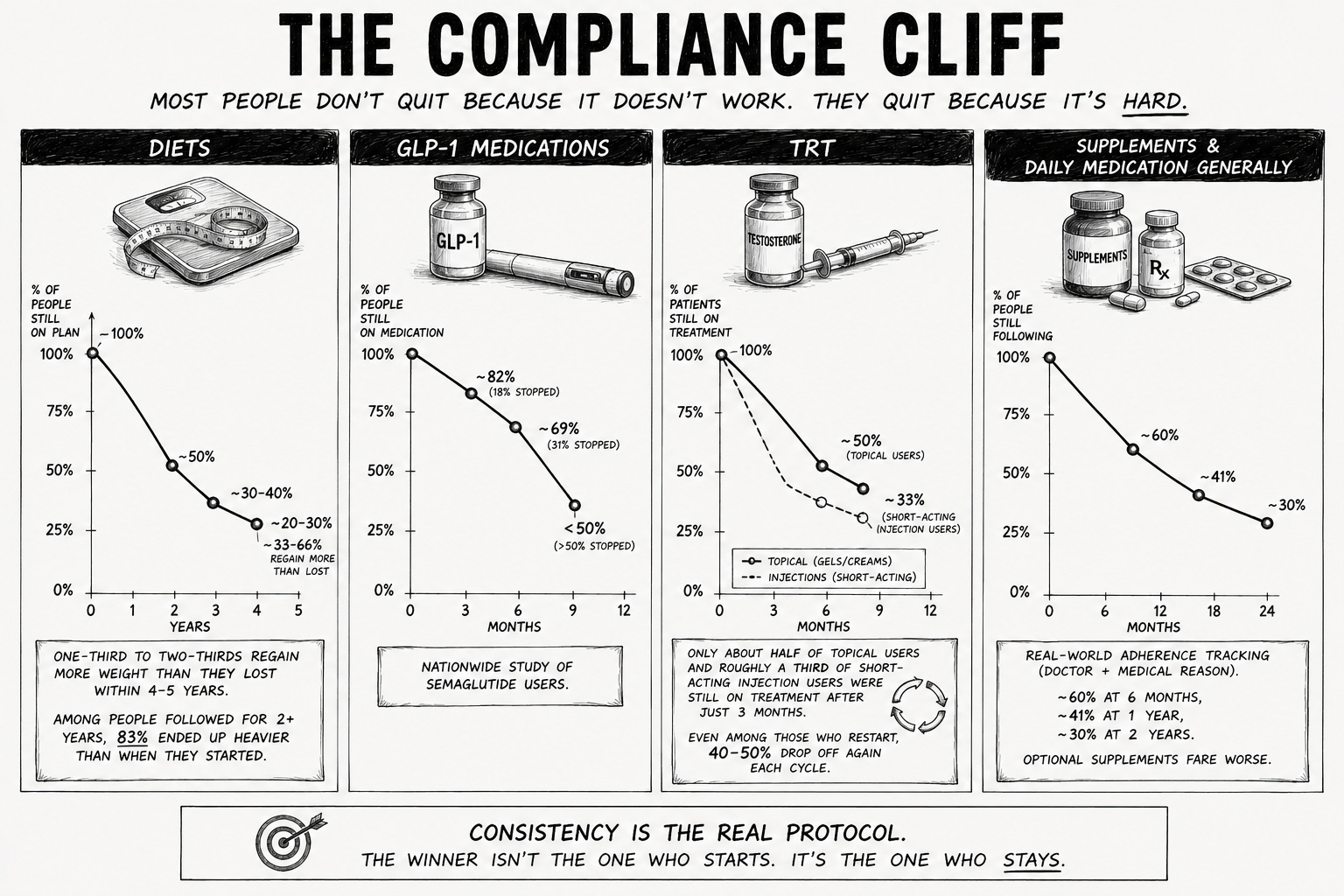
When something is a patch rather than a fix, your body (and your motivation) eventually stops cooperating with it, because deep down, patches require permanent maintenance, and almost nobody actually sustains permanent maintenance for something that isn’t fixing the underlying cause.
The tools that actually work long-term don’t feel like a 50-year sentence. They feel like removing a rock from your shoe. You don’t “adhere” to walking normally again.
Go back to the trend graveyard for a second. Notice what almost every single one of those has in common:
They all operate at the level of the symptom or the tool, not the level of the system.
Keto changes what fuel you burn. Bone broth adds collagen and glycine. MCT oil changes fat metabolism. TRT raises one hormone. Peptides target one pathway. Every single one of these can genuinely help, if the thing it’s targeting happens to be your actual bottleneck. And every single one of them will do almost nothing or backfire if it isn’t.
That’s the trap almost everyone falls into: trying a tool before finding out whether it’s aimed at the right target. You end up with a garage full of things that worked for someone else, on a body whose actual constraint was never diagnosed in the first place.
Your symptoms aren’t random, and they’re not asking for a new trend every year. They’re signals from a system (digestion, nutrient status, stress buffer, thyroid, ferritin, gut, whatever it is for you specifically) and until you know which system is actually failing, you’re just rotating patches on top of a problem that’s still sitting there underneath all of them.
Short version: I didn’t figure this out from a textbook. I lived through the collapse first.
I used to be the guy who needed three drinks to hold a conversation. Sober me was a shell - anxious, twitchy, couldn’t make eye contact with strangers. I told myself that was just my personality. It wasn’t. It was neurochemistry wearing a mask.
Then it got worse. My wife and I moved cities to build something from nothing. No money, no buffer, living in a cold, moldy flat, eating whatever was cheapest or skipping meals entirely. A stranger cut me off in traffic once and I had a full panic response (racing heart, blurred vision, shaking) over a car. My body had nothing left to buffer even a minor stressor with.
Over that stretch I dropped from 95kg to 80kg without trying to. My vision became ultra blurry past 5 meters. Hair shed more than a shaggy dog in summer. Constant dandruff, bacne, dull skin. Every training block ended in an injury instead of a PR. ED and premature ejaculation… in my twenties. Restless, shallow sleep that never felt restorative. Wide awake at 3am for no reason. And underneath all of it, a running commentary that something was fundamentally wrong with me as a person.
None of it was psychological.
The hair loss was chronic stress and nutritional deficiencies.
The injuries were low androgens and anabolic hormones.
The ED and PE were endotoxin-driven sympathetic dominance and low neurosteroids causing vasoconstriction.
The 3am wake-ups were cortisol from hypothyroidism and blood sugar dysregulation.
Every one of them resolved once I rebuilt what I now call the buffer, the reserve of nutrients, minerals, and gut integrity that decides whether ordinary stress bounces off you or takes you down.
I didn’t take that on faith. I tested a lot of superfoods to see how I’d respond to them (blood work, not just how I felt):
5 litres of milk a day for 30 days: cortisol dropped from 479 to 317 nmol/L in 2 weeks, fasting glucose went from ~100 to 85 mg/dL, and a major autoimmune-trigger bacteria (Klebsiella pneumoniae) was eradicated from my gut without touching an antibiotic.
15 oysters a day for 30 days: ferritin dropped from 432 to 282 and transferrin saturation from 51% to 31%, while I was eating roughly four times my normal iron intake. The zinc was outcompeting the iron for absorption.
420g of white button mushrooms a day for 2 weeks: my testosterone-to-estrogen ratio went from 23:1 to 32:1 and hsCRP dropped from 3.9 to 0.6. That’s a result 50mg/week of a prescription aromatase inhibitor never got me.
(And these are just a sneak peak at some of the experiments I did.)
Then I ran the same framework with the men I work with, and the pattern held. An MMA fighter at 300 ng/dL testosterone despite doing everything “right” (30,000 steps a day, multiple sessions a week, strict carnivore) hit 1,000 ng/dL by training less and eating more.
Another man stuck at 300 ng/dL for years, unresponsive to everything he’d tried, hit 700 once we fixed his gut.
A guy with 10-a-day diarrhea for a decade, who’d seen every specialist available to him, resolved it in days by adding a bile acid called UDCA.
All of this is published on my Substack with the actual lab numbers, as I ran each experiment.
This is the sequence that actually ends the cycle. The one this whole series is built on. Not a new trend to add to the graveyard. The order you work through to find out what’s actually broken, so you stop needing a new protocol every 3 months.
1. See the pattern: Groups your symptoms into the system that’s actually failing, instead of chasing each one individually → The Symptom Master Checklist
2. Fix digestion: Nothing else works (not the diet, not the supplement, not the peptide) until breakdown, absorption, and transit are working → The Ultimate Guide on Fixing Digestion
3. Simplify your inputs: Gives you clean feedback instead of guessing which of 15 ingredients is the problem The 1 Protein + 1 Carb Masterclass
4. Get calories right: Lets you manage weight without wrecking thyroid and stress tolerance in the process → How to lose fat without counting calories or tanking your testosterone
5. Actually replace what’s depleted: Fixes the deficiencies “eating healthy” quietly never touched → Why You’re Deficient Despite Eating Well
6. Rebuild your stress buffer: Restores the capacity that makes ordinary stress stop feeling catastrophic → Why You Wake Up Anxious & Exhausted
7. Find your actual bottleneck: Thyroid, ferritin, mold, metals, methylation, histamine. The 14 things that quietly cap everyone’s progress, in the order to check them → The 14 Hidden Reasons You’re Not Getting Results
8. Then, and only then, accelerate: Peptides, nootropics, and everything else on the trend graveyard, used on purpose, on a system that’s actually ready for them → The stack that changes everything
This is the difference between a tool and a fix: a fix, applied to the right system, makes the tools you add later actually work. Often at a fraction of the dose, cost, and time everyone else is throwing at the problem blind.
If you don’t need the whole sequence yet (you just want the fire in front of you put out) start here instead:
Gut & digestion → Fix Slow Transit Time & Constipation → Heal Leaky Gut & Lower Endotoxin → Improve Lactose Tolerance & Digest Dairy Again → Increase Butyrate & Improve Your Gut Microbiome
Hormones & mental function → Fix Hypothyroidism → Maximize DHT → Lower Estrogen Naturally: Block Aromatase / Promote Estrogen Excretion → Fix Anxiety Through Hormones & Neurosteroids → Rebuild a Nervous System That Doesn’t Overreact
Sexual function → Fixing Premature Ejaculation → Fixing Erectile Dysfunction: Part 1 / Part 2 / Part 3
Path A — Work it yourself. Go through the 8 links above, in order. Test each stage on yourself. This works. It’s exactly what I did. It also took years, because I was the test subject and the lab at the same time, with no one telling me which stage I was actually stuck on.
Path B — Skip the guessing entirely. Send me your symptoms, diet, current stack, and labs (if you have them), and I’ll tell you exactly which stage you’re in and which of the 14 bottlenecks is most likely capping you, so you stop adding to your own trend graveyard.
→ Get your personalized health report here
And if you’d rather have a direct line whenever something comes up (a new symptom, a lab result you don’t understand, a protocol you’re wondering whether to trust) annual members get access Ask Hans, direct access to me (all my knowledge installed into one database for instant answers)
You don’t need to try one more thing this year. You need to know which system is actually failing.
Go back through the sequence above. Find your stage. Read that one article first.
That’s how the cycle actually ends.
Imagine you never got a single symptom, and then one day your leg just fell off.
Weird example. But it makes the point: symptoms aren’t the problem. They’re the only reason you find out there is a problem before it gets serious.
Most people treat symptoms like an annoyance to patch.
Headache → aspirin.
Low energy → caffeine.
Poor sleep → melatonin or benzos.
Hair loss → finasteride.
That’s the slow way to get nowhere, because you’re never touching what’s actually driving it.
A slightly better way is to chase the root cause of each symptom individually → magnesium for anxiety, T3 for cold hands, morning sunlight for sleep. This works... a little. Everything improves marginally. Nothing sticks. You add more supplements, try more diets, and six months later you’re in the same place with a bigger cabinet.
Here’s what actually works: stop treating symptoms as isolated events and start treating them as signals from a system. Nobody “just has bloating.” They have bloating + brain fog + poor sleep + low libido. And all four are pointing at the same failing system. Once you can see which system is failing, the individual symptoms stop being confusing. They become obvious.
That’s the idea behind this roadmap. Below is the exact sequence (the one I use with clients, and the one this entire 8-part series is built on) for going from “randomly patching symptoms” to “systematically fixing the thing that’s actually broken.”
More energy. Faster recovery. Looking and feeling better. Labs that actually move. Stronger androgen signaling. Making progress in the gym again. Being around, and being sharp, for longer. It’s all downstream of the same map.
Everyone who successfully fixes their energy, labs, recovery, and hormones moves through the same stages, in the same order. Skip a stage, or work them out of order, and every stage after it gets harder and slower.
Patch Mode: Treating each symptom as its own problem. Most people never leave this stage.
Pattern Recognition: Grouping symptoms into clusters and seeing which system is actually failing.
Digestive Reset: Fixing breakdown, absorption, and transit. Nothing downstream works until this does.
Input Simplification: Reducing meals to 1 protein + 1 carb so your body can finally give you a clean signal.
Caloric Control: Managing weight without wrecking energy, thyroid, or hormones in the process.
Nutrient Loading: Rebuilding what years of “eating healthy” quietly failed to replace.
Buffer Rebuild: Restoring your capacity to absorb stress without it wrecking digestion, sleep, and hormones.
Bottleneck Identification: Finding the one or two things (thyroid, ferritin, metals, mold, methylation…) actually capping your progress.
Acceleration: Layering in tools that only work once the first seven stages are handled.
Find yourself below. Most people reading this are somewhere between Patch Mode and Acceleration and most people don’t know where exactly they are or the order they’re following.
You’re here if: you have a supplement or medication for every symptom, and a new one keeps getting added every few months. Headache → pill. Tired → coffee. Can’t sleep → melatonin. Nothing is actually resolving… it’s just being muted.
The trap: it works just often enough to feel productive. You feel like you’re “doing something,” so you never step back and ask why you needed the patch in the first place.
What moves you forward: stop treating the symptom as the target. Write down every symptom you currently have, without trying to explain any of them yet.
You’re here if: you’ve noticed your symptoms cluster (bloating always shows up with brain fog and bad sleep, or fatigue always comes with cold hands and low libido) but you haven’t connected the dots yet.
The trap: trying to find a separate root cause for every single symptom sends you on a wild goose chase. Different diets, more supplements, more protocols. Marginal improvement on all of them, resolution on none.
What moves you forward: group your symptoms into the 9 clusters (digestion, energy/brain, sleep, nervous system, skin/hair, metabolism/thyroid, inflammation/immune, sexual health, circulation) and notice which cluster is loudest. That’s your starting system.
→ Full breakdown: The Symptom Master Checklist
You’re here if: you’re already eating “clean” and still bloated, foggy, or crashing after meals. You’ve tried removing foods, adding probiotics, more enzymes. Some of it helps a little, none of it fully resolves it.
The trap: digestion doesn’t fail in one place, it fails in a sequence (stomach acid, enzymes, bile, endotoxin, transit). Fixing “gut health” in general, without knowing which step is actually broken, is why most gut protocols only partially work.
What moves you forward: go through the sequence in order. Stomach acid and enzymes first (most people are stuck here and don’t know it), then bile flow, then transit time. Leaky gut is almost always the result of this sequence breaking down, not the starting problem.
→ Full breakdown: The Ultimate Guide on Fixing Digestion
You’re here if: you’ve fixed some digestion basics but still can’t tell which foods are the problem, because every meal has five ingredients in it.
The trap: complex meals feel healthier (”more variety!”), but they make it impossible to get clean feedback from your own body. You can’t fix what you can’t isolate.
What moves you forward: one protein, one carb, per meal. Not because it’s a magic diet, because it turns every meal into a controlled experiment. This alone resolves a surprising amount of “unexplained” bloating and energy crashes.
→ Full breakdown: The 1 Protein + 1 Carb Masterclass
You’re here if: digestion and inputs are cleaner, but body composition still isn’t moving or it’s moving in the wrong direction.
The trap: going too aggressive on the deficit tanks thyroid output and stress tolerance, which stalls fat loss anyway. Or you’re “eating at maintenance” on paper but portion creep, cooking oil, and alcohol have quietly erased the deficit.
What moves you forward: structure, not restriction. Use the simplified meals from Stage 3 to build a deficit you don’t have to think about. Calories are the lever, nutrient quality determines how good the outcome feels, not whether it happens.
→ Full breakdown: How to lose fat without counting calories or destroying your testosterone
You’re here if: you eat well by every conventional measure and you’re still tired, still not recovering, labs still borderline. You’ve done “clean eating.” It wasn’t enough.
The trap: eating whole foods isn’t the same as absorbing them. Soil depletion, anti-nutrients, poor food combining, and genetics all mean the RDA was never actually your number.
What moves you forward: build meals around the five most nutrient-dense foods that exist (liver, oysters, egg yolks, dairy, red meat) instead of trying to hit targets with twenty plant foods that block each other’s absorption.
→ Full breakdown: Why You’re Deficient Despite Eating Well
You’re here if: you feel “wired but tired,” small stressors feel disproportionately large, and things that used to be manageable now feel like too much.
The trap: treating the output (anxiety, poor sleep, irritability) with a supplement instead of rebuilding the underlying capacity to absorb stress in the first place.
What moves you forward: stress isn’t the problem. A depleted buffer is. Restore metabolic safety (enough carbs, enough salt), fix digestion, then restore the specific minerals and compounds that got burned through.
→ Full breakdown: Why You Wake Up Anxious & Exhausted
You’re here if: you’ve genuinely done the work (diet, digestion, stress) and something is still capping your progress. This is the stage where most self-directed effort quietly stalls out.
The trap: guessing. Running a heavy metal detox when the real issue is thyroid. Chasing histamine when it’s actually ferritin. Every wrong guess costs months.
What moves you forward: work through the 14 bottlenecks in priority order → environmental exposure first, then gut, then thyroid, then ferritin, then everything else. One or two of these are almost always the actual ceiling.
→ Full breakdown: The 14 Hidden Reasons You’re Not Getting Results
You’re here if: the foundation is genuinely solid and you’re looking to compound your results faster → peptides, nootropics, mitochondrial support, thyroid acceleration.
The trap: using any of this too early. The same compound that produces a dramatic result in a functioning system produces almost nothing (or side effects) in a broken one.
What moves you forward: layer these in only once Stages 1–7 are handled. This is the reward for doing the work, not a shortcut past it.
→ Full breakdown: The stacks that changes everything
Almost nobody fails because they’re lazy. They fail because they jump straight to Stage 5, 6, or 8 while still standing on Stage 0 or 1. You can’t out-supplement a digestion problem. You can’t out-protocol a bottleneck you haven’t identified yet.
The order matters more than the tactics.
Path A — Work it yourself. Read all 8 parts of this series (linked above, all free). Test each stage on yourself. Track what changes. Find your own bottleneck by process of elimination. This works — it’s exactly what I did. It also took years, because I was the test subject and the lab at the same time.
Path B — Skip the trial and error. Send me your symptoms, diet, current stack, and labs (if you have them), and I’ll tell you exactly which stage you’re actually in and which bottleneck is most likely capping you. No guessing, no six-month detour into the wrong protocol.
→ Get your personalized health report here
And if a question comes up mid-week and you don’t want to dig through 8 articles to find the answer → annual members get direct access via Ask Hans, so you get a real answer instead of a forum guess.
Comments
Nothing yet. Say the first thing.
Sign in to join the conversation.