
👋Hello, my friend —Last week, I shared Part 1 of the body recomposition project I’m currently working on, which focused on nutrition — specifically how I’ve started adding carbohydrates back into my diet after largely avoiding them for years.
I’m now well into that experiment, and so far it’s going well. My energy is up, and my recovery metrics — especially my WHOOP recovery scores — are all trending in the right direction.
This week, I want to talk about the other half of the equation:
Training.
More specifically, what I’m doing for weightlifting, how I’ve structured it, and how I’ve used technology (including AI) to help me build and refine the approach.
Let’s get into it.
If you’ve been following me for a while, you know I’ve been pretty deep in the Peloton ecosystem.
I’ve been riding since 2016. I’ve owned multiple bikes and a Tread. I’ve taken a lot of classes — including > 1000 rides and > 800 strength workouts — and I’ve even had the chance to interview several Peloton instructors on my podcast.
So I’m a fan.
But recently, I decided to go in a slightly different direction with my strength training.
One thing I noticed is that outside of structured programs, I was often doing somewhat random workouts. Good workouts, but not necessarily consistent in terms of hitting the same movements, tracking progress, or building strength in a systematic way.
And I wanted to change that.
When I stepped back, there were two concepts I really wanted to lean into:
1. Full-body training multiple times per week
Making sure I’m consistently hitting all major muscle groups.
2. Progressive overload
Gradually increasing weight and/or reps over time so I’m actually getting stronger — not just getting sweaty.
Those two ideas became the foundation.
So I went to ChatGPT and asked it to design a program for me.
Specifically, I asked for:
two workouts (Workout A and Workout B)
full-body coverage across the week
sessions under 30 minutes
a structure that allowed for recovery between lifting days
It gave me a clean A/B setup that I could alternate throughout the week. (I typically allow 1 or 2 days of rest between lifting sessions).
From there, I took those workouts and built them into the WHOOP Strength Trainer, which lets me log sets, reps, and weights in real time. And it tracks the energy I’m expending as I do all of this.
That’s been a big unlock.
Because now I’m not guessing what I did last time — I have a clean record, and I can build on it.
The way I’m thinking about progression is pretty simple:
Start with a weight I can handle for ~12 reps
Once that feels easy, increase the weight and drop reps (usually down to ~8)
Then build reps back up (8 → 10 → 12)
Then increase weight again
And repeat.
I’m not trying to rush it. I’m not trying to impress anyone with big numbers.
The focus is:
good form
consistency
gradual progress
Even over the last 6–8 weeks, it’s been really satisfying to see the weights and reps steadily increasing.
That’s something I wasn’t getting when my workouts were more random.
I don’t want to overload you with info on specific weights, etc., so instead I’m just screenshotting the two workouts below. By the way, if you’re a Whoop user, and you want to try these workouts, just click the images below, and you can load them directly into your Whoop app.
Where you see “superset,” that just means that I’m not taking a break between sets but directly going to a set of the next exercise. This is mainly to use the time efficiently.
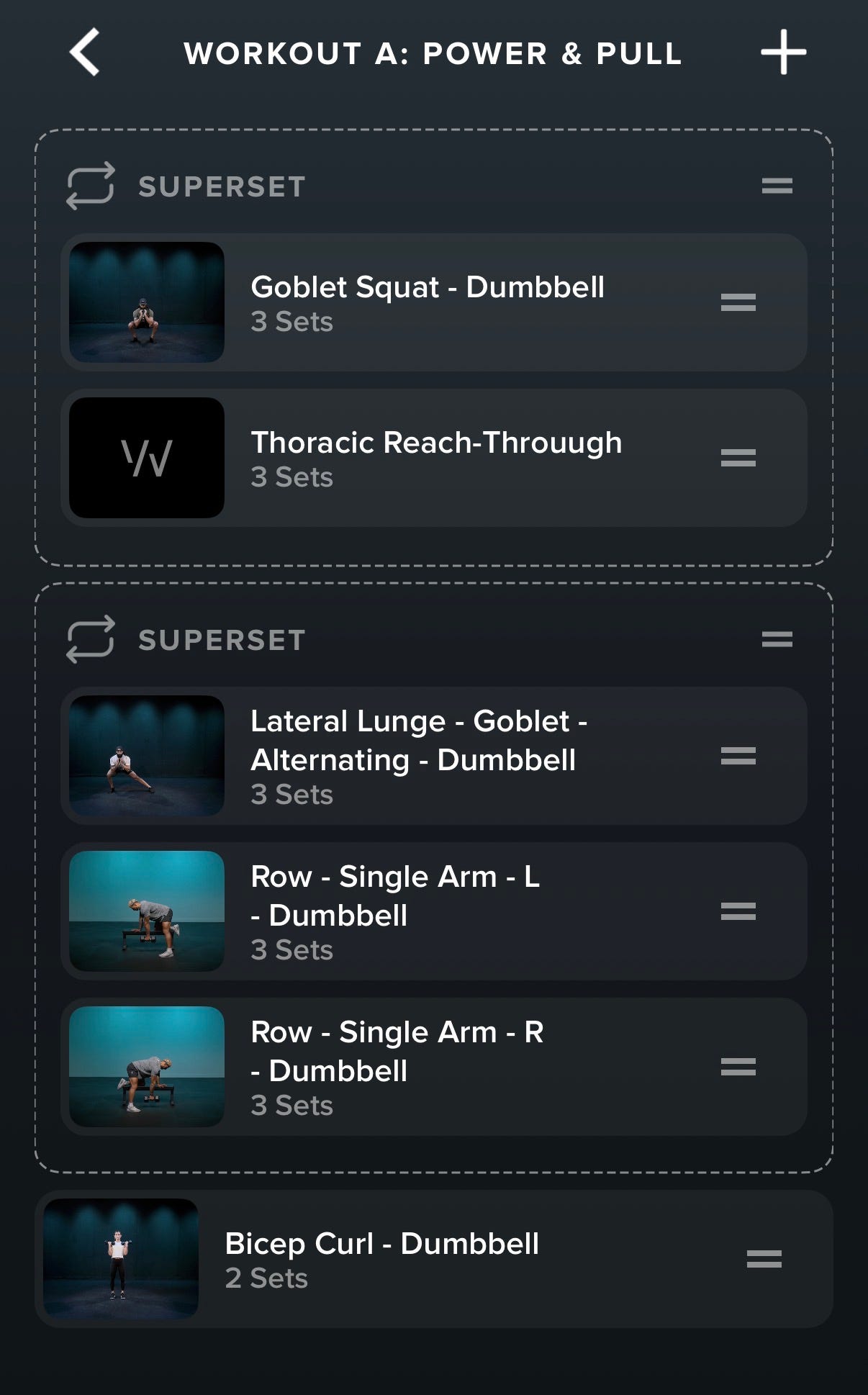
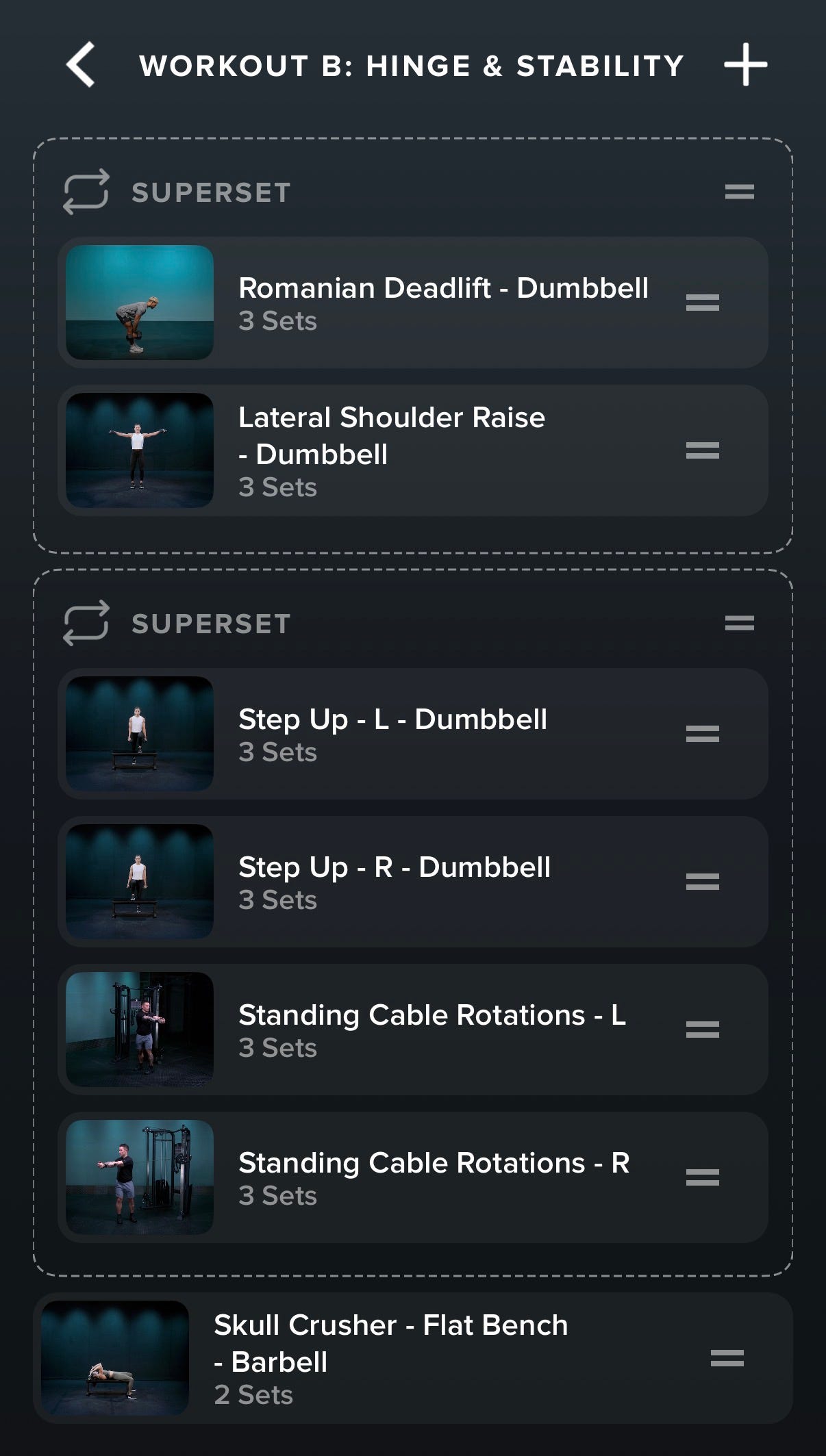
*Note: I’m rehabbing a minor elbow injury at the moment, which makes push-ups and bench or dumbbell press a little tough, so that’s why those are not included.
** I’m actually doing dumbbell woodchops (not cable rotations), but Whoop didn’t have an option for that.
One thing that’s been really eye-opening is how much strain these workouts generate.
Even though my lifting sessions are only about 30 minutes, they often account for almost an entire day’s worth of ‘recommended’ strain on WHOOP. That just means I’m expending a lot of energy lifting.
So I’ve had to be more intentional about how I balance lifting with everything else.
Earlier this year, I was doing more “double session days” — lifting in the morning and then doing intense cardio later.
That’s not inherently bad, but I don’t think I was recovering well from it.
Now, my structure looks more like this:
Morning: ~30-minute strength workout
Midday: light cardio (usually zone 2 — incline walking, easy ride, etc.)
More intense cardio // mix of running, incline walking, Peloton rides
Usually try to hit max heart rate 1x/week (for me ~175 bpm)
I’ve found that multiple HIIT workouts per week wiped me out too much. I was cooked by the end of the day and was much more likely to get sick. I’ve seen the opposite when I’ve tried to be really smart about managing recoveries and not overly punishing my body in the gym.
One other adjustment: I’m being more flexible about what “counts.”
If I play 18 holes of golf, that’s a meaningful strain day.
If I’m playing pickleball, same thing.
On those days, I’m not forcing an additional workout just to check a box.
That’s been an important mindset shift — recognizing that activity is activity, and it all adds up. In fact, my Whoop strain from golf or pickleball rivals or exceeds an intense lifting session.
For a long time, I worked out fasted.
Recently, I experimented with adding a small amount of fuel before lifting — based on some back-and-forth with ChatGPT.
Where I’ve landed is simple:
half a banana before the workout
water with electrolytes while lifting
then finish the banana + have my usual smoothie after
It’s a small tweak, but I do think it helps with energy during the workout.
For the routine I’ve illustrated above, you really don’t need anything fancy:
dumbbells
a bench (helpful but not strictly required)
I have a home gym with basic equipment, but this could easily be done in a regular gym — or even modified with limited equipment.
It’s still early, so I’m not going to pretend I have definitive results.
But a few things stand out:
I’m getting stronger (consistently increasing weights and/or reps)
My arms are getting bigger — for some reason, this is where it shows up for me first // mid-section is much harder to move the needle on
The workouts feel efficient and sustainable
I actually enjoy most of them
There are a couple exercises I don’t love (step-ups and side lunges come to mind), but overall this feels like something I can stick with.
There are a few reasons I’m taking strength training seriously.
1. Long-term function
I think a lot about something Peter Attia talks about: if something is hard at 50, it may be impossible at 80.
So the question isn’t:
Can I lift this suitcase into the overhead compartment today?
It’s:
Am I building the capacity to do it when I’m 80 or 90?
2. Injury prevention
As I look around my peer group, injuries are incredibly common — and often derail people from doing the activities they enjoy.
Building strength — especially in the core, hips, and legs — feels like a form of insurance.
3. Metabolic health
I’m increasingly convinced that having more muscle improves how your body functions across the board:
better insulin sensitivity
better energy utilization
better overall resilience
And for me personally, I’ve probably spent a lot of my life slightly under-muscled — or at my worst, “skinny fat.”
This is my way of addressing that directly.
One last point on technology.
I know there’s debate about wearables and whether we’re overloading ourselves with data.
But for me, they’ve been useful.
If I see:
rising resting heart rate
low HRV
poor recovery scores
That’s a signal.
It might mean I’m fatigued. It might mean I’m getting sick. It might mean I just need a break.
Either way, it helps me make better decisions. Like if I need to back off from training for a day or two.
And that’s really the goal — not perfect data, just better decisions by listening to your body.
If Part 1 was about fueling the body better,
this part is about training it more intentionally.
For me, the combination looks like this:
better nutrition (more balanced macros)
structured strength training
smarter recovery
less randomness
And most importantly:
something that feels sustainable.
I’ll likely share a future update on how this is all trending over time — what’s working, what’s not, and what I’m adjusting.
In the meantime, I’ve got an awesome podcast with a CEO (and friend) who I really admire and respect coming your way very soon. So stay tuned for that.
As always, this is me learning in public and sharing what I’m trying in case it’s useful to you too.
More soon,
Greg
No posts
Comments
Nothing yet. Say the first thing.
Sign in to join the conversation.