
👋Hello, my friend - If you missed last week’s note, Intentional Wisdom Reboot, you can check it out here. And if you did get it, please reply with a quick “got it” so I know it actually made it to your inbox. Special thanks to my wife for helping me figure out that half the responses I got ended up in my spam folder… weird and mildly concerning! But I think replying actually helps with that, so I appreciate everyone doing that.
Anyhow… this week, I want to tell you about an experiment I’ve been running on myself to try to improve my body composition.
The goal is pretty straightforward: gain muscle, lose fat, get stronger, and improve my health overall.
Interestingly, AI has helped me identify a few surprising things that already seem to be making a difference.
So let’s get into it.
When I think about health, my goals are usually some combination of a few things:
longevity
maintaining or building strength
improving body composition
keeping my energy high
preserving enough cardio fitness to feel athletic and capable
In other words, yes, I’d like to lose some fat and add or preserve muscle. But just as important, I want to feel good.
I want to have enough energy to do my job well, train hard, stay patient with my kids at the end of a long day, and not feel like I’m running out of gas by 5 p.m.
That energy piece has become more and more important to me.
This will be at least a two-part series. In this first note, I want to focus on nutrition, recovery, and one big realization I’ve had recently: I think my macronutrient mix has probably been off for a long time.
For years, I’ve leaned heavily toward lower-carb eating.
That mindset probably goes back 20 years or more. I first got pulled in by the South Beach diet. Later on, I went down the Whole30 path. More recently, I’ve experimented with keto-style eating.
For a long time, I’ve been pretty convinced that most people are better off avoiding processed carbs and not being overly afraid of fat. And to be clear, I still think there’s plenty of truth in that.
But I’m starting to think I may have taken that idea too far for my body.
Over time, my diet drifted toward a setup that was consistently high in protein, high in fat, and relatively low in carbohydrates. Lots of eggs, avocados, nuts, Greek yogurt, protein shakes, and other generally healthy foods. Not much junk. Not many processed foods.
On the surface, that sounded like a pretty solid strategy.
But lately, I’ve started to realize that the overall balance may not have been serving me very well.
The first thing that got my attention wasn’t body fat. It was energy.
Over the first part of this year, I noticed that I didn’t feel as good as I wanted to feel.
I was lifting a lot, which I’m a big believer in, and I’ll talk more about that in Part 2. But even though the lifting itself felt productive, some of the metrics I track were moving in the wrong direction.
My resting heart rate was climbing. My recovery metrics weren’t great. My HRV didn’t look great. And more importantly, I could feel it.
I wasn’t recovering the way I wanted to. I wasn’t feeling especially resilient. And I was too often running low on energy later in the day.
That’s a problem.
Because to me, energy is kind of everything.
If my energy is off, that affects how I show up at work, how patient I am with my kids, how hard I can train, how resilient I am when everyone starts bringing home viruses from school — all of it.
So I started asking a basic question:
Is this just what being in your late 40s feels like?
Or is there something here I can improve?
For the last year or so, I’ve been increasingly using AI to help me analyze my own health data.
Not as a replacement for doctors. But more as a smart pattern-recognition tool — and honestly, as a second opinion.
Actually, in my case, two second opinions.
I’ve been using both ChatGPT and Gemini to look at the same data and compare what each one sees. I like having multiple perspectives and using them to cross-check each other.
I’ve fed in things like:
WHOOP data
Apple Health data
8 Sleep data
food logs from Carb Manager
blood work from Function Health
Then I’ve asked both tools to help me think through what might be going on.
What stood out was that both models pointed in a similar direction.
They generally liked a lot of what I was already doing:
high protein
consistent lifting
mostly healthy whole foods
strong interest in tracking and feedback loops
But both also suggested that my macro balance might be holding me back.
More specifically: I was probably eating too much fat and not enough carbohydrates for the amount of training and strain I was putting my body under.
That was a real lightbulb moment.
This is still an experiment, so I’m not presenting it as some grand conclusion.
But here’s the change I’ve made:
I’ve increased carbohydrates pretty significantly and reduced fat by a similar amount.
That probably would have sounded crazy to an earlier version of me.
For years, I’ve tended to view carbs with suspicion and fat with comfort. Not because I was eating junk, but because I had bought pretty deeply into the idea that healthy fats were a kind of free pass.
And I’m no longer sure that’s true.
To be clear, I’m not suddenly anti-fat. I still think foods like eggs, avocados, and nuts can and probably should be part of a healthy diet.
But fat is also extremely calorie-dense. And when you actually track it closely, it becomes obvious how quickly it adds up.
So the shift now is this:
less fat
more healthy carbs
protein stays high
That’s the experiment.
I should be clear here: I’m not adding back processed junk.
I’m not suddenly making room for cookies, chips, and garbage calories. Well… maybe a little bit of that stuff creeps in here and there. But not much at all.
The carbs I’m focusing on are things like:
quinoa
sweet potatoes
chickpeas
apples
bananas
vegetables
In other words: mostly whole, nutrient-dense carbs.
At the same time, I’ve dialed back some of the foods that had quietly become bigger contributors to fat intake than I realized:
lots of nuts
more eggs than I probably needed
dark chocolate at the end of the day, which had become a serious habit
Protein remains high, but I’m trying to dial it in on leaner sources like chicken, whey protein, and Greek yogurt. Still eat red meat, just trying to do so more sparingly.
So this isn’t a total dietary overhaul. It’s more like a rebalancing.
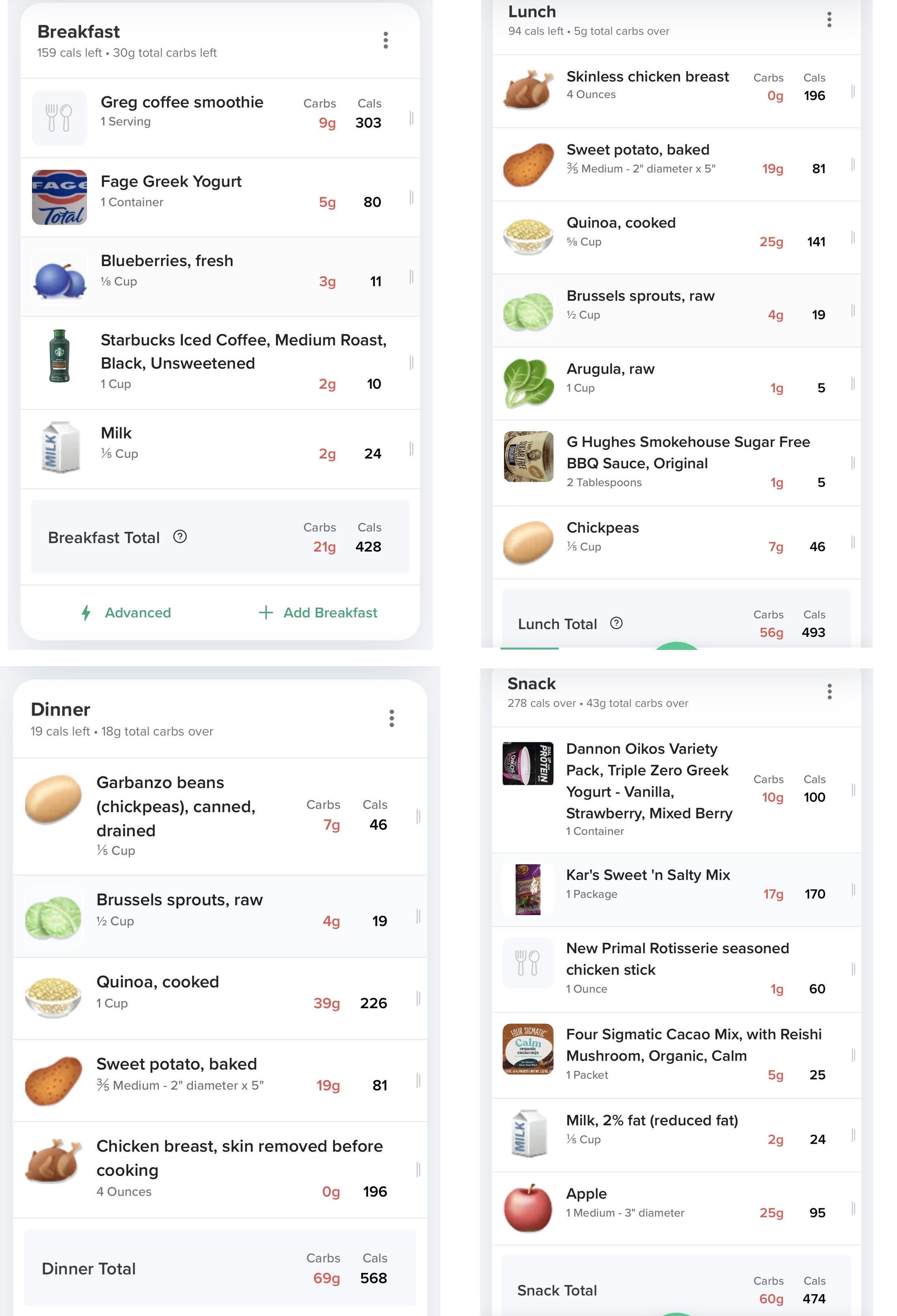
Below is an actual day of eating from the Carb Manager app. If you’re wondering, my coffee smoothie includes: Iced coffee, sugar-free almond milk, frozen avocados, cacao powder, whey protein powder, and collagen powder.
Current macro goals:
Calories ~2000 (Whoop says I burn 2300 on average, so purposely in deficit to burn fat)
Carbs: 171g / Protein: 171g / Fat: 65g — current bodyweight ~175lbs for reference.
One thing I’ve learned from all of this is that there probably isn’t a one-size-fits-all answer.
A few years ago, I interviewed Chris Cornell on my podcast, and he’s had incredible success going ultra-low-carb. I’m talking about life-changing results. For him, that approach seems to work extremely well.
My experience has been different.
When I’ve experimented with keto, I didn’t feel especially good on it. My energy wasn’t great. And at one point my lipid panel went pretty haywire while I was eating that way. Once I moved away from keto, it normalized again.
This has made me more open to the idea that different people may respond very differently to different macronutrient mixes.
And for me, at least at this stage of life, I think I may be circling toward something that works better for me.
I try not to get too attached to any one philosophy. I’d rather keep testing things and paying attention to what actually works for my body.
At least for now, I’m tracking everything pretty closely.
That’s not something I necessarily want to do forever. But when you’re trying to make changes, I think tracking can be really helpful.
I’m using Carb Manager to log food and monitor my macros. I like it because it has a big food library, barcode scanning, and relatively low friction.
I’m also using WHOOP to monitor the other side of the equation: sleep, recovery, resting heart rate, HRV, and overall strain (aka calories expended).
None of these tools are perfect.
But they’re useful directionally, especially when trying to hit a mild caloric deficit relative to the energy I’m expending.
It’s still early, so I’m not declaring victory.
But the early signs are encouraging.
My weight is slightly down.
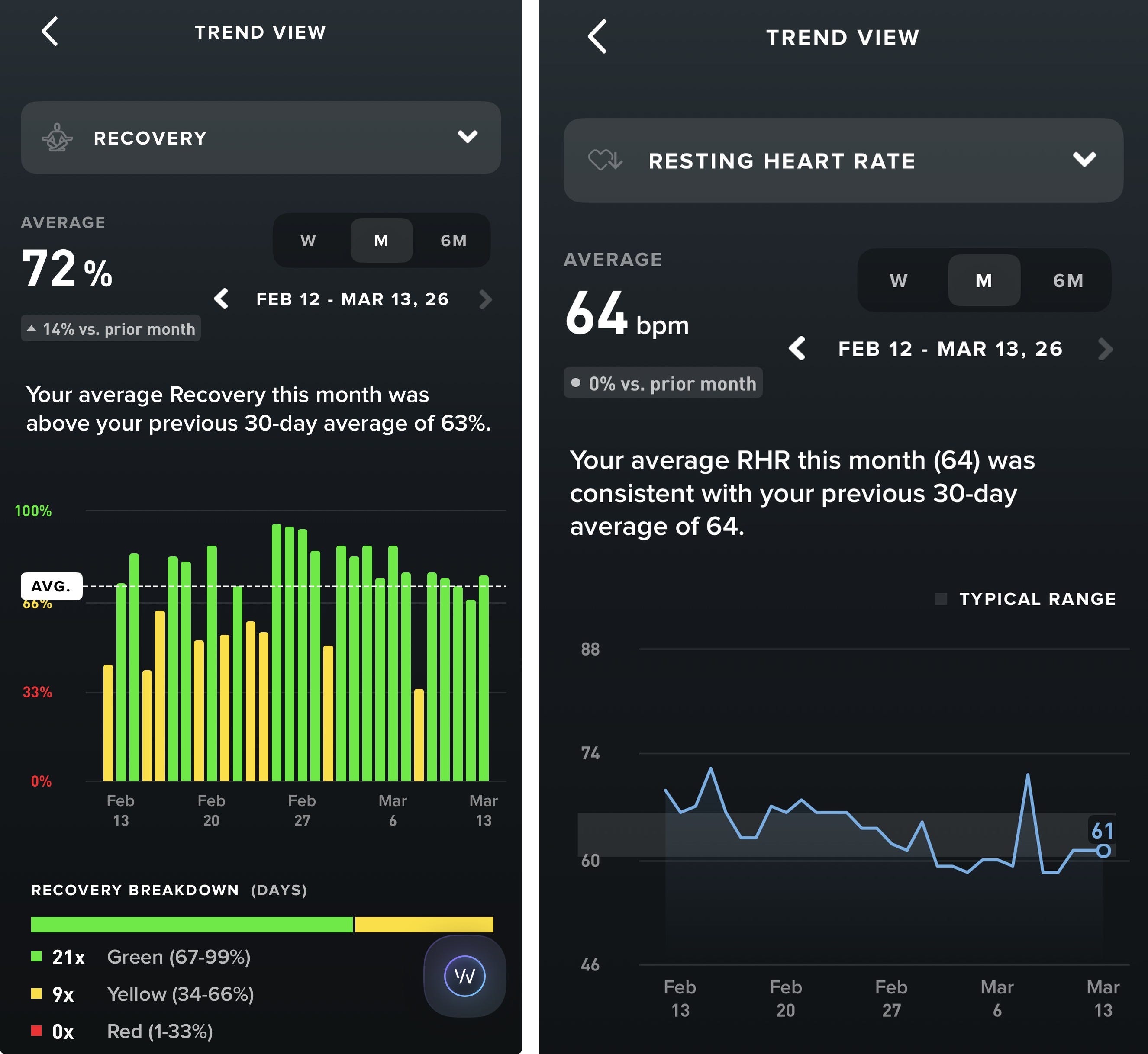
My resting heart rate is trending in the right direction.
My recovery metrics have improved quite a bit.
And the biggest thing of all: my energy feels much better.
That’s probably been the most noticeable change so far.
I don’t feel like I’m running out of gas at the end of the day. I feel steadier. More resilient. More like I’ve found a mix that my body responds well to.
Below are Whoop charts for recovery and resting heart rate. I started increasing carbs around Feb 25th, and you can see recoveries have improved since. The two blips in recovery (and one big spike in RHR)? You guessed it: Alcohol consumption. Very clear reminder how much work your body has to do to clear poison from your body. The RHR is still a little high, but I’ve had several readings this week in the high-50s, which I’m psyched about. Want to get that to continue to trend lower.
One other thing that has helped a lot is meal prep.
Partly out of necessity — because spring sports have turned our weeknights into chaos — my wife and I have been prepping a lot of food on Sundays.
Things like:
chicken
Brussels sprouts
quinoa
sweet potatoes
chopped vegetables
That gives us mix-and-match options for lunches and dinners during the week.
It’s not glamorous, but it works.
And it reduces decision fatigue, which is a big deal.
So that’s the current state of the experiment.
The big shift for me has been this:
I’ve stopped automatically vilifying carbs, especially when they come from high-quality whole-food sources. And I’ve become more skeptical of the idea that you can just pile on healthy fats without consequence.
At least for me, that doesn’t seem to be true.
So right now I’m focused on:
higher carbs
lower fat
high protein
whole foods
a slight calorie deficit
better recovery
better energy
So far, I really like what I’m seeing.
Next week, I’ll share Part 2 and walk through the training side of this project, including the lifting routine I’m following and how I’ve used AI to help me build and refine it.
As always, this is just me learning in public and sharing what I’m trying in case it’s useful to you too.
More soon,
Greg
No posts
Comments
Nothing yet. Say the first thing.
Sign in to join the conversation.