
👋 Hello, my friend,
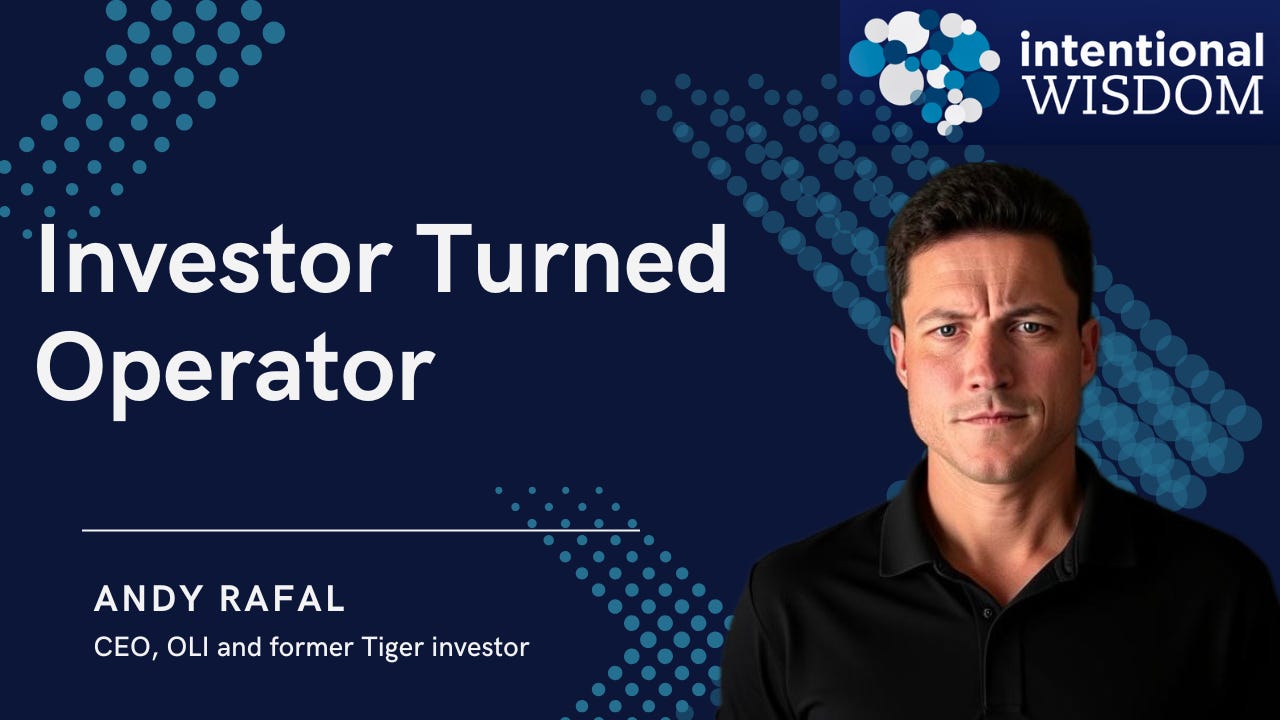
This week, I’m sharing a few lessons from a just-published podcast conversation I had with my great friend, Andy Rafal.
Andy is the CEO of OLI, a 50+ year-old chemical engineering software company operating at the intersection of AI and the physical world.
But before all of that, he started his career as a hedge fund investor at Julian Robertson’s Tiger—one of the most successful firms of its time—before making a pretty unconventional leap into operating.
Before I get into the lessons, I want to say something upfront:
Andy is one of the smartest and most thoughtful people I know.
And interestingly, when I sit down to write this newsletter, I often try to picture one specific person I’m writing to—just to keep it grounded and useful.
Andy is one of the people that I commonly think of.
Which is probably the highest compliment I can give.
One of the things I’m trying to do more of with Intentional Wisdom is highlight people like Andy.
Not necessarily the most famous names…
…but people who are doing meaningful work, thinking deeply, and have insights that are actually useful in the real world.
Less focus on virality.
More focus on resonance.
Andy is exactly that kind of person.
So with that, here are a few lessons that stuck with me from our conversation.
Let’s get into it.
Andy’s early path wasn’t linear.
Law school → passed the bar → chose not to practice → went into investing.
What stood out to me:
“You learn as much by finding what’s not a fit as you do by finding what is.”
I think a lot of us feel pressure to get it right early.
But in reality, the path is messy—and that’s where the learning happens.
As an investor, Andy spent years analyzing companies.
But becoming a CEO was a completely different game.
It’s one thing to evaluate decisions from the outside.
It’s another thing to make them with incomplete information and real consequences.
That gap is enormous.
And honestly, it’s a good reminder:
It’s easy to critique. Much harder to build.
One of Andy’s investing stories really stuck with me.
A position went from looking great… to very wrong… very quickly.
What mattered wasn’t the mistake—it was the response.
They updated their thinking and moved on.
Simple in theory. Very hard in practice.
Because most of us want to defend our original view.
The better question is:
“What do I believe now, given what I know now?”
Andy described his favorite opportunities as ones where:
There’s a simple insight
Most people are missing it
And you can “pull the thread” to see how big it becomes
He gave the example of early work behind what became Keurig—not just a coffee product, but a recurring revenue model.
That idea translates beyond investing.
When something feels interesting, there’s usually more there—if you’re willing to go deeper.
When Andy stepped away from investing, he didn’t rush into the next thing.
He took time.
Three months to think, reflect, and reset.
He described it as one of the most valuable periods of his life.
We tend to optimize for constant motion.
But sometimes the better move is to pause and ask:
“What do I actually want to build next?”
When Andy first got involved with OLI (a company his father founded), it wasn’t immediately “his.”
That evolved over time—especially during COVID.
That period forced a shift:
Stepping fully into leadership
Reimagining the company
Taking true ownership
Ownership isn’t about title.
It’s about commitment.
We also talked about AI.
One thing that stuck with me:
AI works best in clean, digital environments.
The physical world is much messier.
In fields like chemistry and engineering:
Data is imperfect
Systems are complex
Context matters
Which means AI can be powerful—but also confidently wrong.
That’s an important nuance.
There was one part of the conversation that stuck with me maybe more than anything else.
Andy talked about his dad—who founded OLI—and how strong he was on the human side of the business.
Understanding people.
Connecting with people.
Building trust.
Andy said he’s historically been more focused on strategy, numbers, and analysis…
…but is increasingly realizing how important that human element really is.
That resonated with me.
Because I think it’s easy—especially for those of us in demanding roles—to get caught up in:
Targets
Metrics
Execution
…and forget that at the end of the day, it’s all built on relationships.
In some ways, that’s actually a big part of why I’m doing this podcast and writing this newsletter.
It gives me a reason to slow down…
to connect with people I respect…
and to have more thoughtful, human conversations than we typically make time for day-to-day.
I’m really grateful to Andy for taking the time to do this.
If you get a chance to listen, I think you’ll get a lot out of it:
And I’d also recommend subscribing to his Substack—he’s just getting started sharing his ideas, and they’re well worth your time.
As always, I’d love to hear what resonated.
Just hit reply and let me know.
—Greg
No posts
Comments
Nothing yet. Say the first thing.
Sign in to join the conversation.