
There’s a shift happening in game design, similarly as in multiple other areas of game development.
We have built systems, loops, economies, and live operations that aim to e.g., simulate living games. We add content, tune numbers, design progression, and carefully orchestrate player journeys.
But at the end of the day, most games are still something I call as “static machines”.
Instead of this, what if the game itself was not static anymore? What if the game was actively observing, interpreting, and reshaping itself around the player in real time? In the era of AI raising its head, this is where the idea of an AI Game Master raises its head more than ever.
No. This is not a narrator. Not a helper. Not a content generator. No, no, and no. This is more deeper integration of AI on the systems level, referencing e.g., what I’ve wrote already in the past:
This is a system that sits across every layer of the game and continuously reshapes it through another level of emergency, which can be achieved when imagination becomes limitless, whilst the technological layer enabling such limitlessness becomes realizable.
Note: This isn’t just another “AI slop” outcome article, focused on producing something in low quality. This is an exploration, which hopefully sets in place forces that result in us getting exciting new games, with differentiating experiences.
Traditional game design is about building systems that produce outcomes. When we look into this new suggested direction; an AI Game Master flips this.
It’s not only about systems producing outcomes. It’s about a system that observes outcomes and then reshapes the system itself. This is closer to how “a human dungeon master” operates. They don’t just follow rules. They read the table, feel the tension, and adjust the experience.
Here, the difference between human and AI is scale. An AI Game Master can do this across millions of players, across every session, across every system layer at once. Human-operated systems comes with its limitations (of course, when system design hits its sweet spot, even with limitations, you can create awesome stuff, which I acknowledge still whilst I’m writing this article).
This has implications everywhere:
Core gameplay
Meta layers
Economy
Monetization
Live operations
Everything becomes dynamic.
At the core loop level, most games operate on fixed patterns, e.g.,:
Explore → Fight → Loot → Upgrade → Repeat
Even in more advanced systems, the variation is authored or parameter driven.
With an AI Game Master, the loop itself becomes fluid. It can stretch tension, compress pacing, and redirect player intent.
Instead of designing encounters, you design possibility spaces. The AI Game Master decides when to introduce friction, when to create relief, and when to break expectations.
In e.g., an extraction context, this can become extremely powerful. A run is no longer just a sequence of encounters.
It becomes a guided emotional arc:
The system can detect that the player has had e.g., three safe runs in a row and inject risk.
It can notice hesitation and push opportunity.
It can turn a routine run into a story.
The real potential is when regular steps are no longer predictable.
Meta systems are usually where games can lose their illusion of life.
They most often are also e.g., spreadsheets with UI:
Progression trees
Upgrades
Collections
Currencies
An AI Game Master changes this by turning meta into a responsive system:
Instead of static progression, the system can reshape available paths based on player behavior.
Instead of fixed rewards, it can create contextual rewards that align with player intent.
And much more. This connects closely to the idea of progression vectors I have written about before:
Different players move through the game with different motivations and directions. The challenge has always been serving these vectors without fragmenting the system.
The AI Game Master doesn’t choose one path. It adapts the system, so multiple vectors can exist at the same time, without breaking coherence. It observes how a player engages and bends the meta around that behavior.
One player might experience a progression that leans into risk and high stakes. Another might see a system that emphasizes collection, completion, and stability. Same game. Different reality. At their best, these systems doesn’t just offer hyper-personalization but also honor multi-archetype systems design, which I’ve also covered in the past:
This is where things get interesting (and, possibly, also dangerous).
Game economies have traditionally been designed as controlled systems:
Sources
Sinks
Inflation control
Conversion loops
Monetization sits on top of this as a set of entry points:
Offers
Bundles
Time pressure
With an AI Game Master, the economy is no longer static. It becomes situational.
The system understands context:
What the player is trying to do
What they value
Where they struggle
Where they succeed
Instead of offering the same bundle to everyone, the system can create opportunities that align with the player’s current state. This is not just about personalization, it’s structural adaptation.
In its best format, it ties back to vector based thinking (mentioned above). Instead of pushing players into predefined funnels, the system supports multiple archetypes at once and allows them to coexist inside the same economy (also referred above).
A risk driven player might see systems that amplify high stakes loops. A builder might see systems that deepen crafting and base growth. A collector might see systems that expand rarity and completion. The economy becomes multi layered but still unified.
The risk? I think it’s obvious. If done poorly, this becomes manipulation. If done well, it becomes “alignment”.
The difference is whether the system is extracting value from the player or creating value for the player. One comes with a proper engagement profile, another comes with a churning point.
If you introduce an AI Game Master, you are no longer designing “closed” systems. You’re designing systems that expect “intervention”.
This changes how you build everything:
Systems need to be interpretable
Systems need to expose levers
Systems need to be modular
The AI Game Master needs to understand what is happening and what it can safely change. Let’s think about a layer above that.
A system that can:
Shift risk reward calculations
Introduce new objectives mid run
Change e.g., extraction conditions
Trigger social conflict
This is not about adding content. It is about creating systems that can be recombined and redirected. Design becomes less about authoring outcomes and more about defining boundaries. Boundaries, and rules; yes, they should exist in your designs.
Live ops today is scheduled design.
Events
Seasonal content
Limited time modes
Even the most advanced systems still rely heavily on planning and manual tuning.
An AI Game Master turns live ops into a continuous process:
Events don’t need to be scheduled → they can emerge.
Difficulty doesn’t need to be globally tuned → it can be locally adapted.
Content doesn’t need to be pushed → it can be generated or recombined.
The game becomes a live service in the literal sense:
Always reacting
Always adjusting
Always evolving
This also changes how teams operate. For example, by this, designers are no longer only creating content → they are shaping the behavior of the system that creates content.
Let’s explore this topic through a practical Extraction RPG Simulation concept, which I’ve produced here to showcase what I mean by AI being the Game Master.
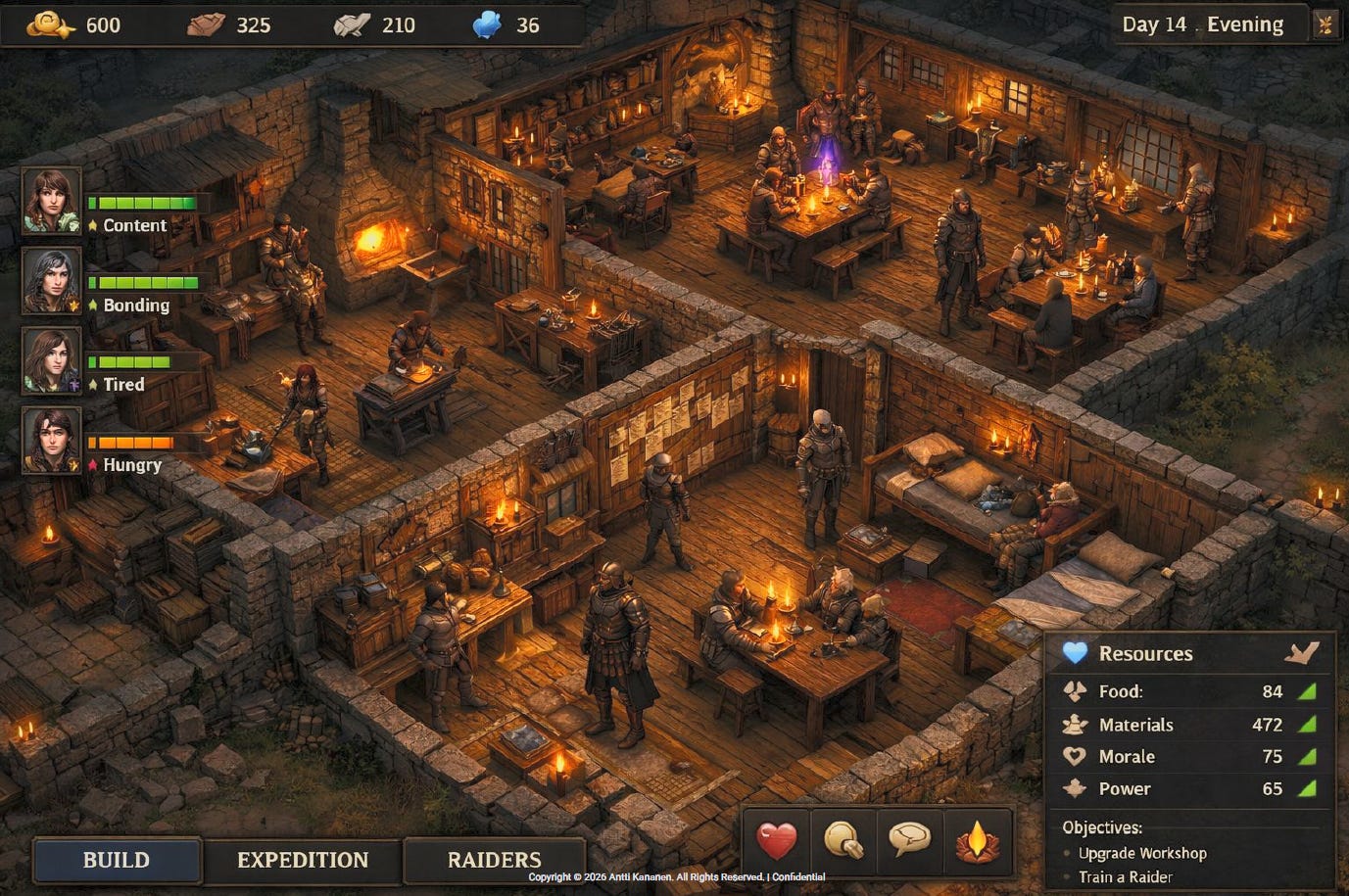
In this concept, the core loop is structured around sending squads into dangerous realms; whilst AI Game Master would be observing their behavior, and, eventually, resolving outcomes.
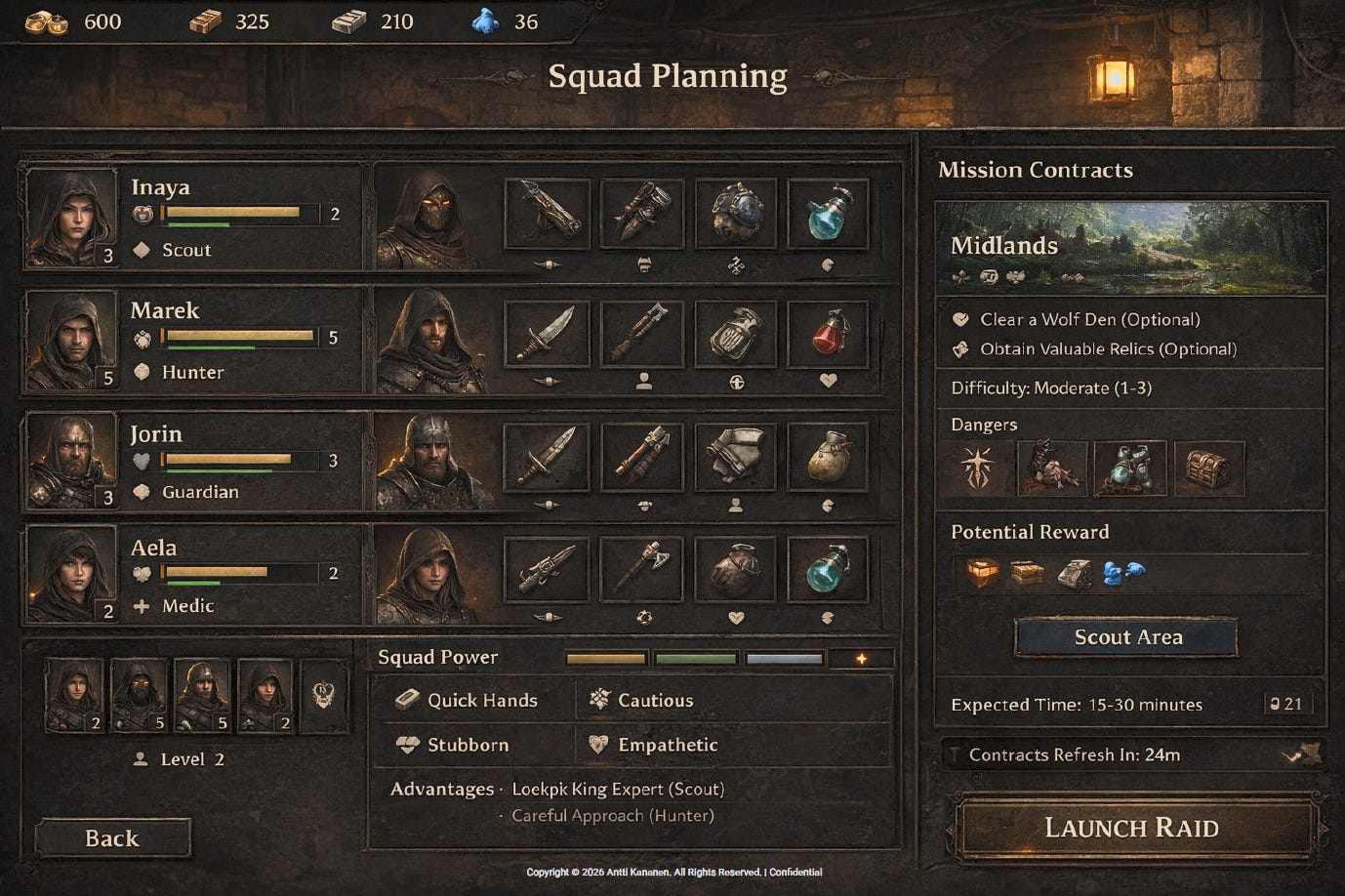
The experience here isn’t just single player / campaign experience, it can be easily stretched to a real multiplayer experience with synchronous multiplayer for matches between players’ squads.
The system includes:
A hybrid extraction RPG structure with risk and reward loop
Autonomous characters with needs, traits, and memory
A base layer with social simulation and multiplayer interaction
This is a “game premise” / “foundation” that fits properly for an AI Game Master.
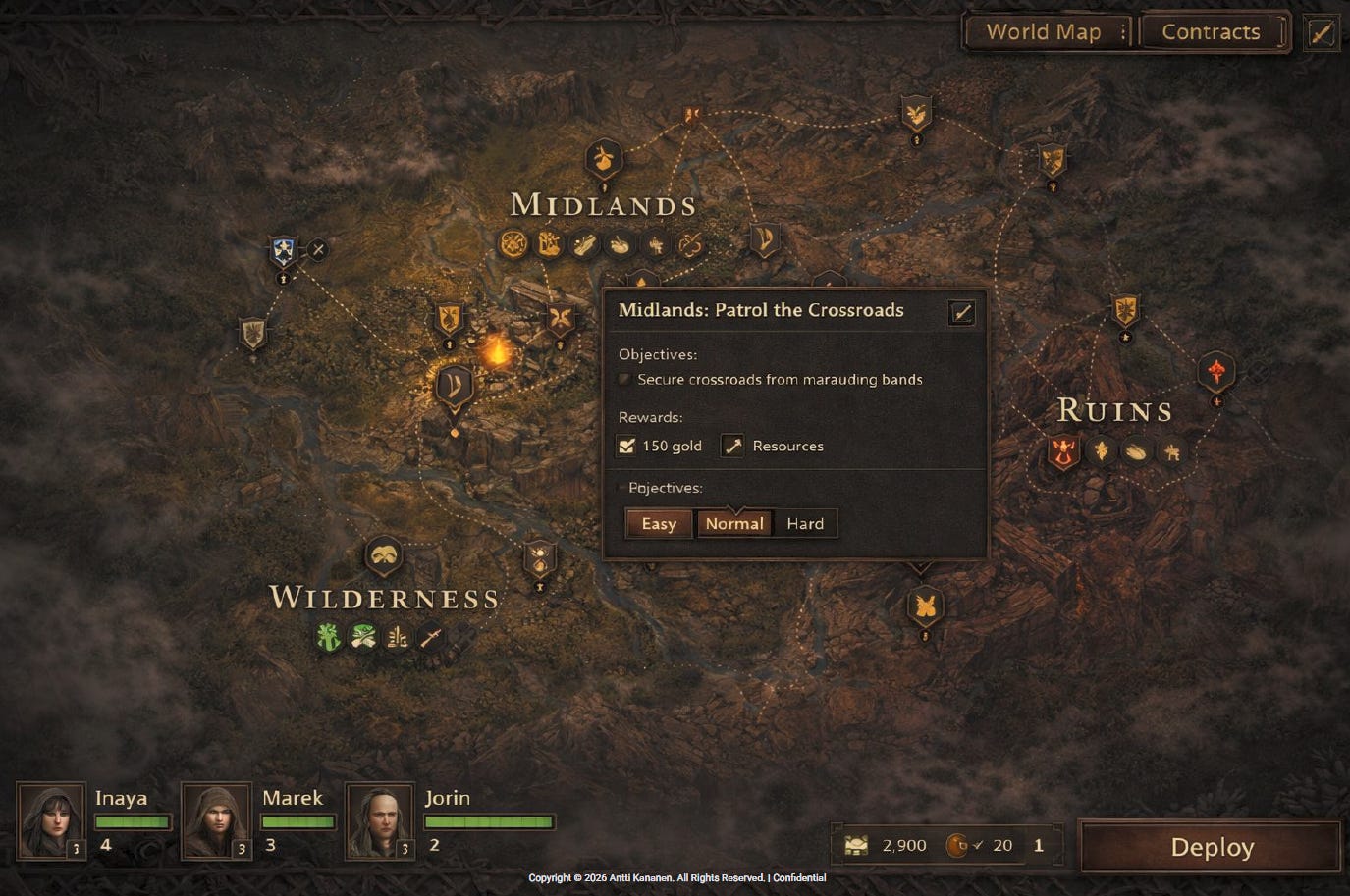
During a raid, the AI Game Master observes:
Squad composition
Health and morale
Loot value
Recent player history
…and also runs the whole social and multiplayer “simulation”. Of course, if wanted, player-led controls or intervention controls can be added to the core gameplay.
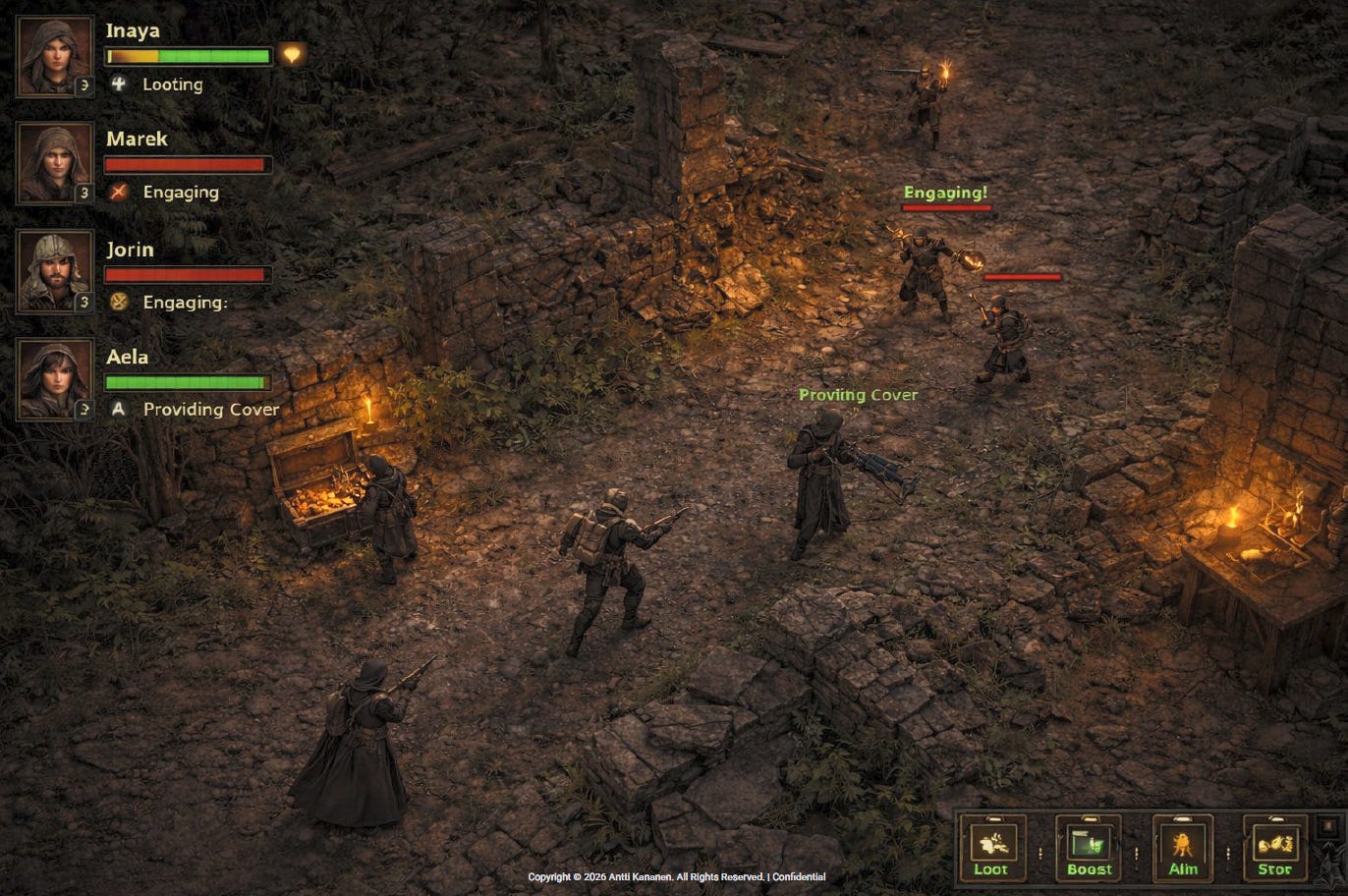
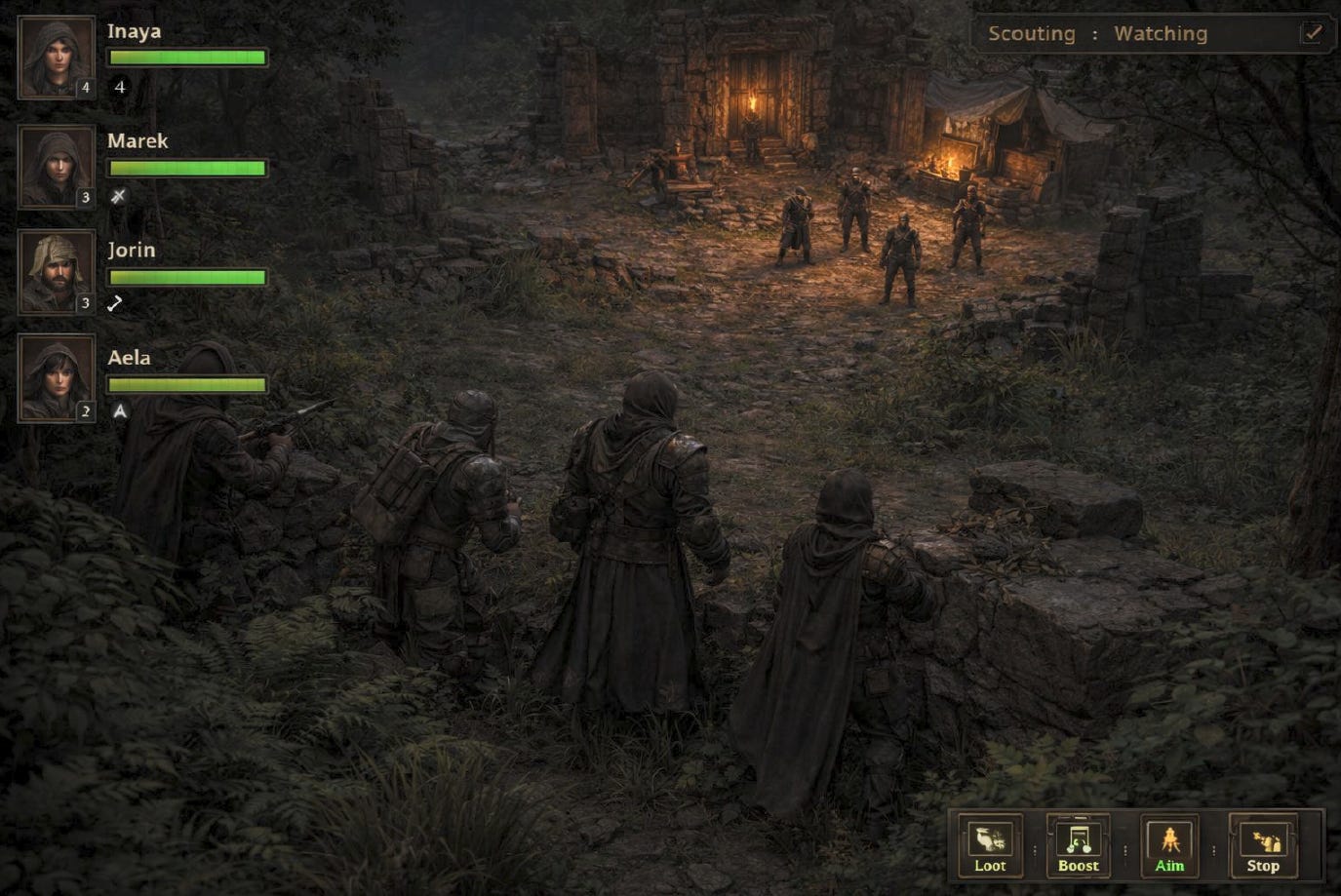
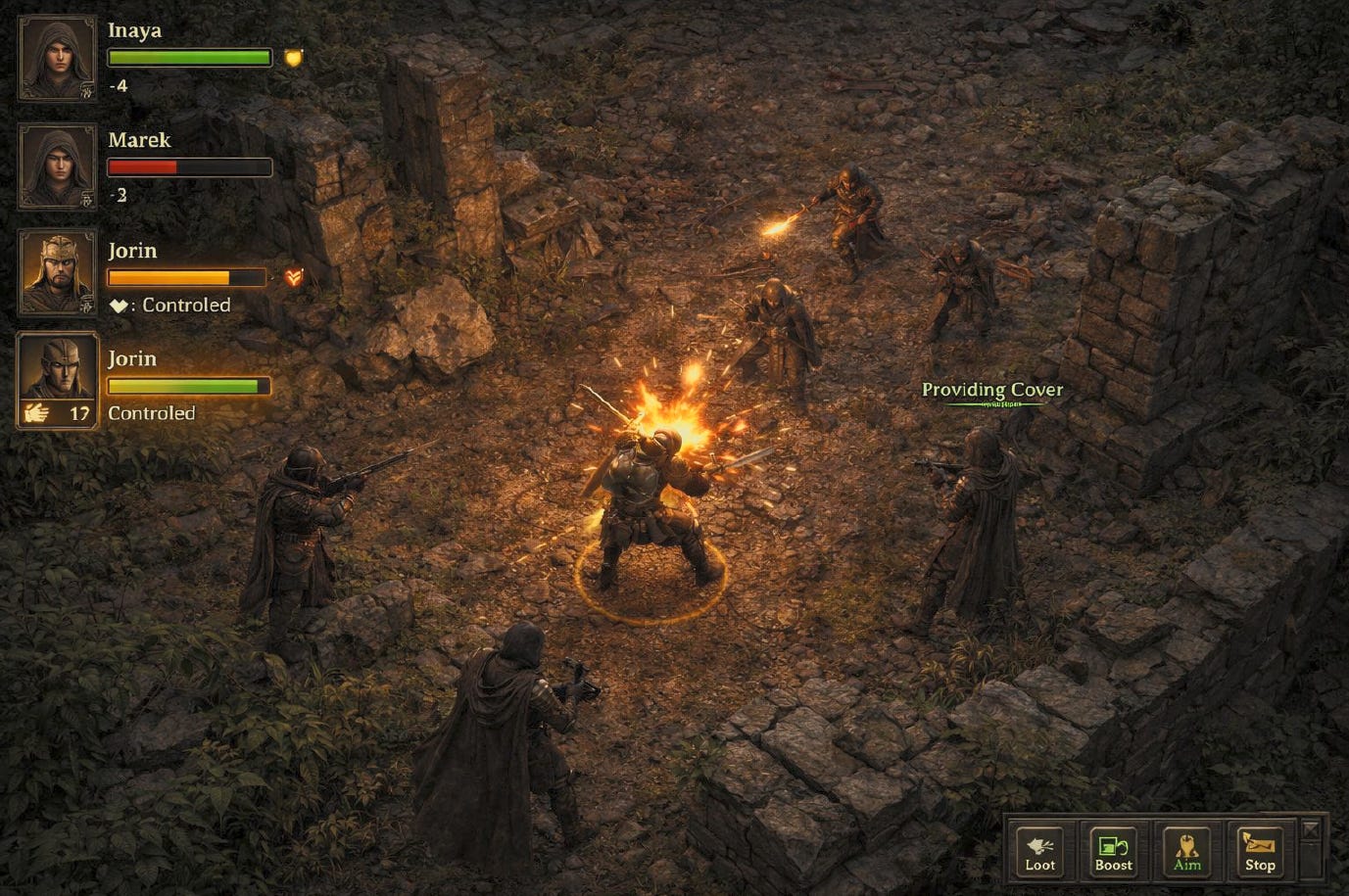
Instead of fixed encounters, which would be the traditional “design”, the AI Game Master directs the experience completely:
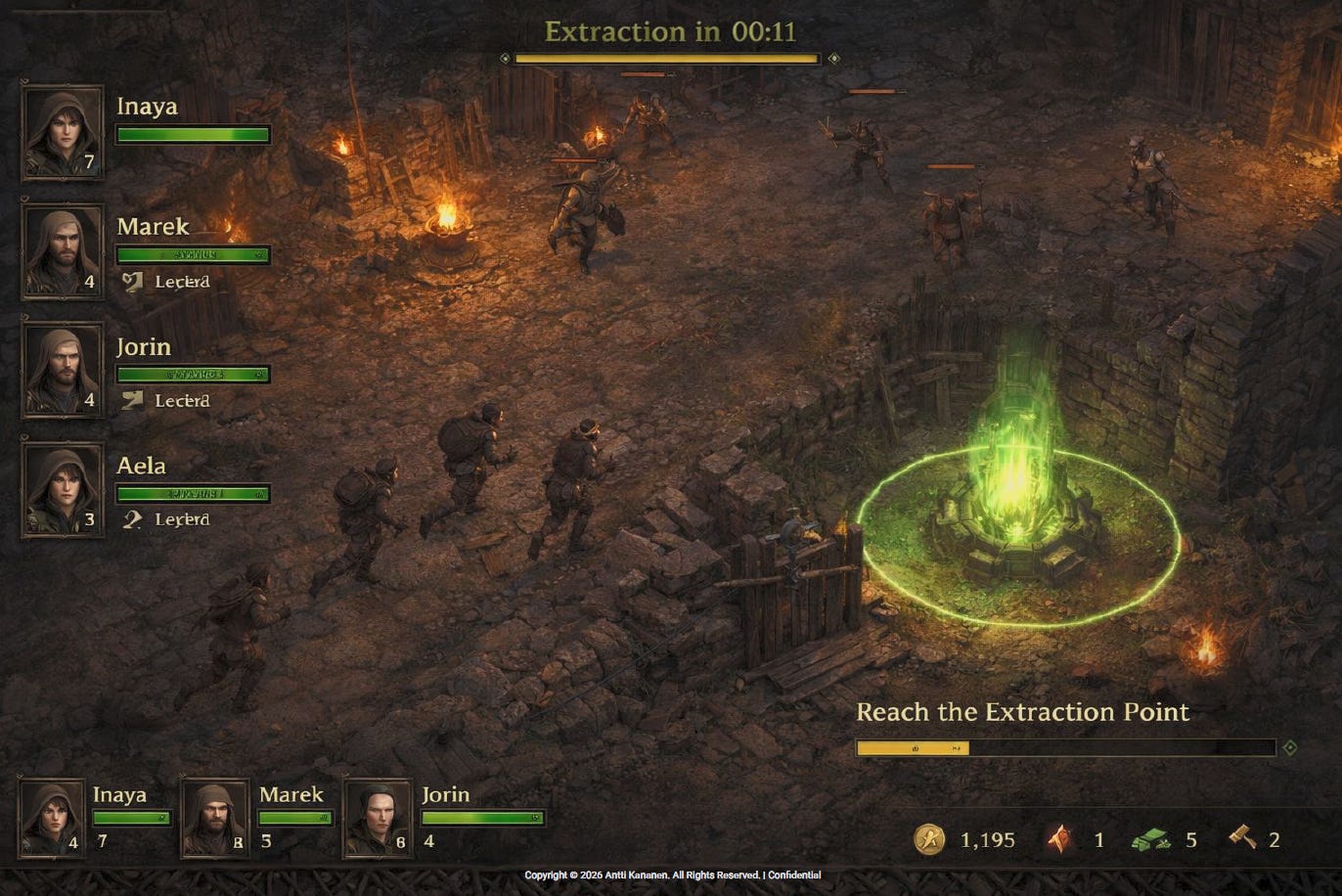
A squad that is overloaded with loot might want to extract quickly, whilst they could trigger increased enemy attention.
A high tension run might introduce a rare opportunity that forces a player-made intervention, if such control is designed being part of the core gameplay. Do you risk everything for a potential breakthrough, or secure what you have?
Back at the base, the system continues.
Raiders remember what happened.
They form relationships.
They demand better equipment.
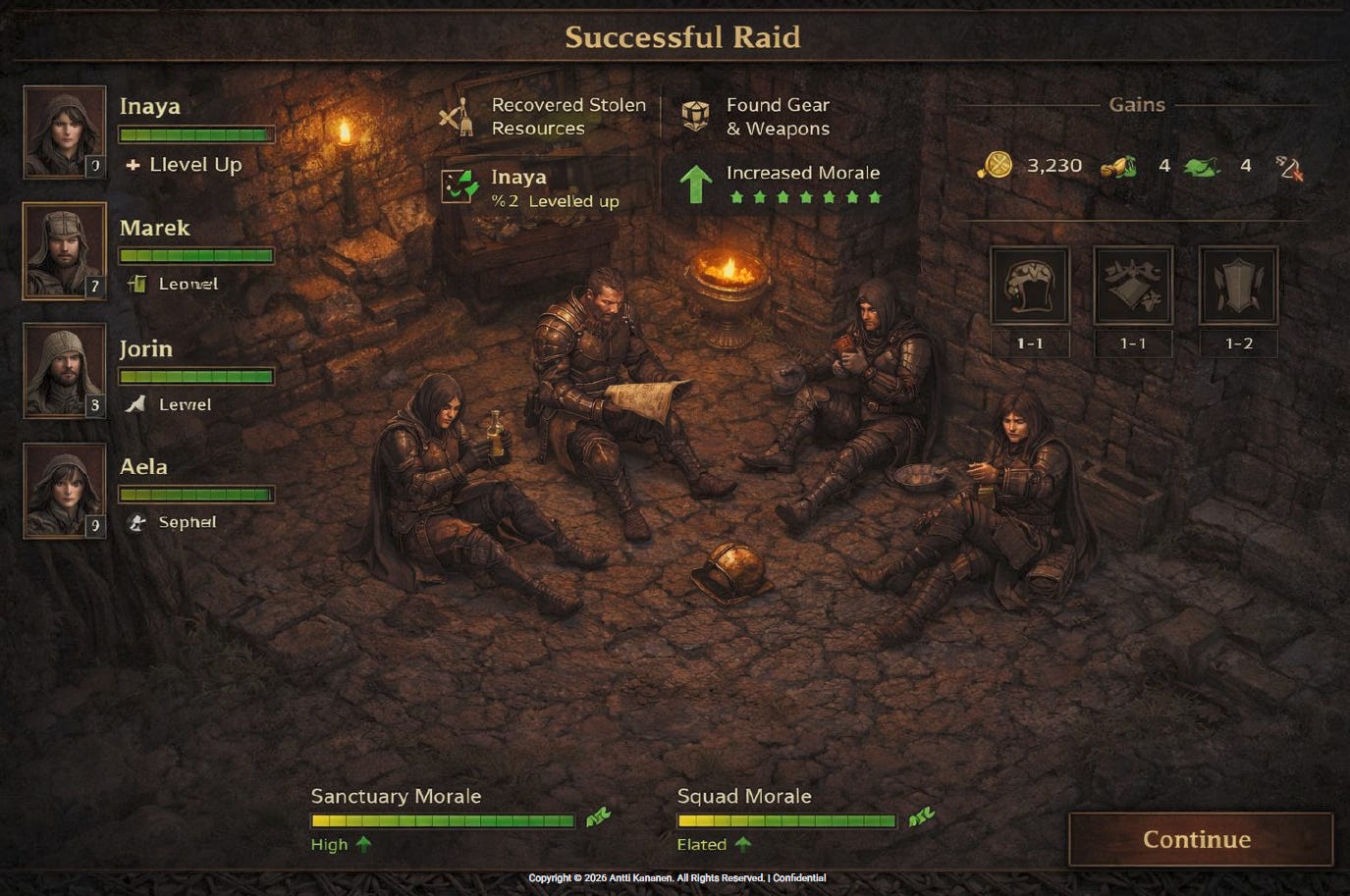
Raiders have needs, personalities, and memory that affect their decisions and behavior.
The AI Game Master connects these layers. It creates continuity between runs. It turns isolated sessions into an ongoing story, with depth on meta layers that the player can interact with.
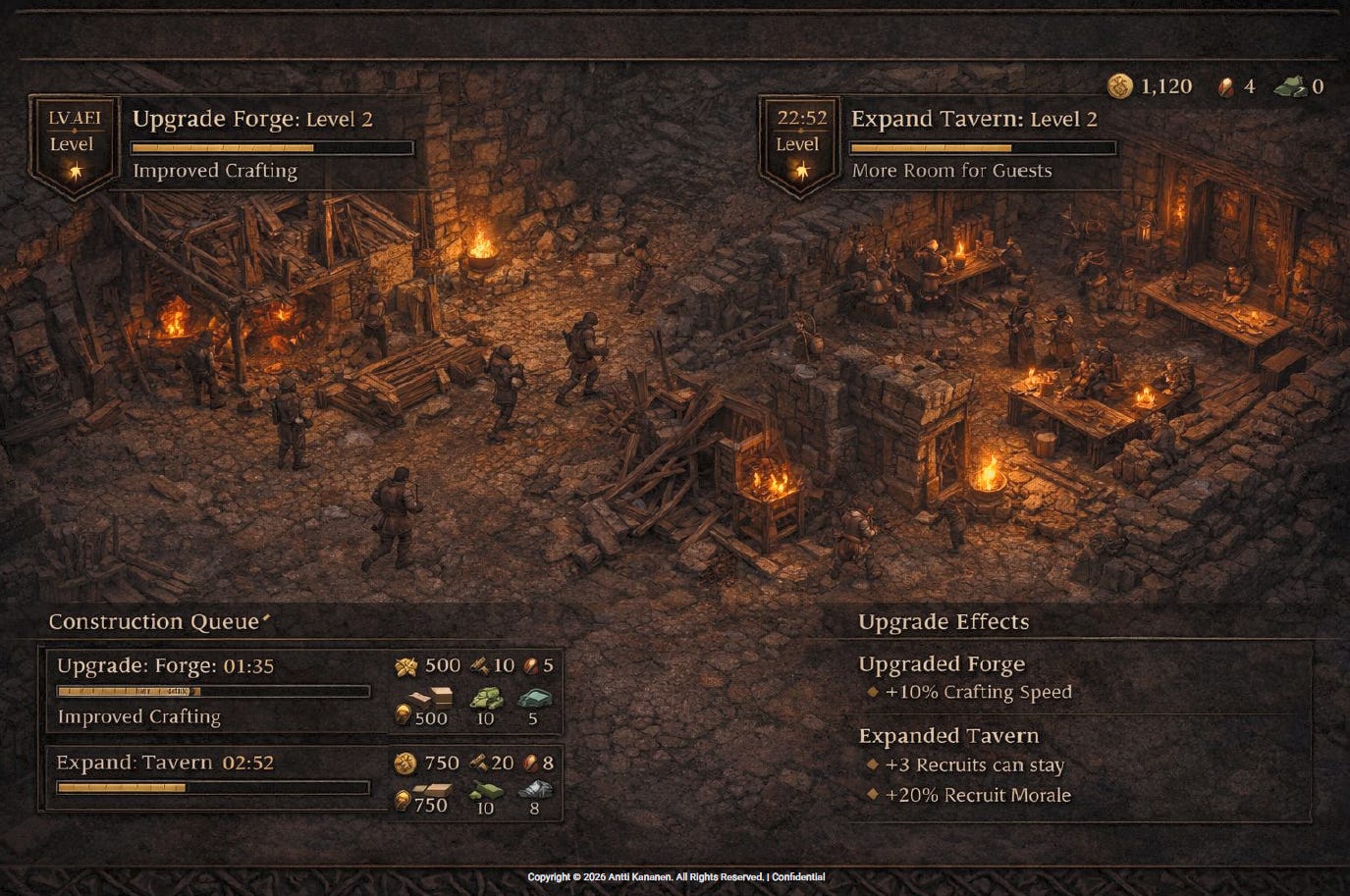
The result isn’t just a game loop. It’s a living system that produces stories as a byproduct on top of which the player interaction layer stays living and focused on what is wanted to be left for players to explore.
The biggest mistake would be to treat AI Game Master as an add on. A narrator on top of a static game. A content generator for quests. This misses the point.
The actual opportunity is to let it reshape the entire game:
Core loop
Meta
Economy
Live ops
Everything becomes part of “a directed” system. The game stops being a product and starts behaving more like “a real simulation”. Not a simulation of e.g., physics or systems; instead, a simulation of experience.
We have spent years building systems that try to feel alive, and have spent lots of cash to achieve this. AI Game Master could be a step toward systems that can be affordable and sustain some form of “healthier” studio economies.
Side Note: No, I don’t want AI to replace people. Instead, I want AI to amplify them and studios to sustain a better future for our industry. This article could be, in this sense, very inspirational for e.g., an upcoming studio, who is bold enough to try out something different, which could theoretically result to a proper outcome, enabling them to scale and grow at all sides, incl. headcount considerations.
As I see it, the challenge is not technical even anymore. It’s more philosophical. Are we willing to leverage AI? Are we willing to give up control? And so on.
The moment we open our mind for a new shift in game-making, we are no longer designing games. Instead, in best scenarios, we are designing worlds that “design” themselves, resulting to new exciting experiences.
Comments
Nothing yet. Say the first thing.
Sign in to join the conversation.