
Before diving in; this isn’t a new topic, and I’m far from the first to explore it. Couple incredibly sharp economists, designers, and thinkers have already touched on spectatorship, and spectator monetization as a topic, before me. What follows here, is my own high-level synthesis and personal exploration, built on industry experience, personal research, conversations, and experiments.
For years, and years past those years, spectatorship in games has been passive.
You’ve watched eSports. You’ve watched streamers. You might have chatted. Maybe even donated.
What you might not have done, whilst some may have already, in a format of “baby steps”, influenced someone’s gameplay through a stream, through stream’s “direct” engagement and/or monetization systems.
With the latter in mind, the question raises up: “What happens when spectators are no longer just observers, but actors inside the system?”
We’re already seeing fragments of this future.
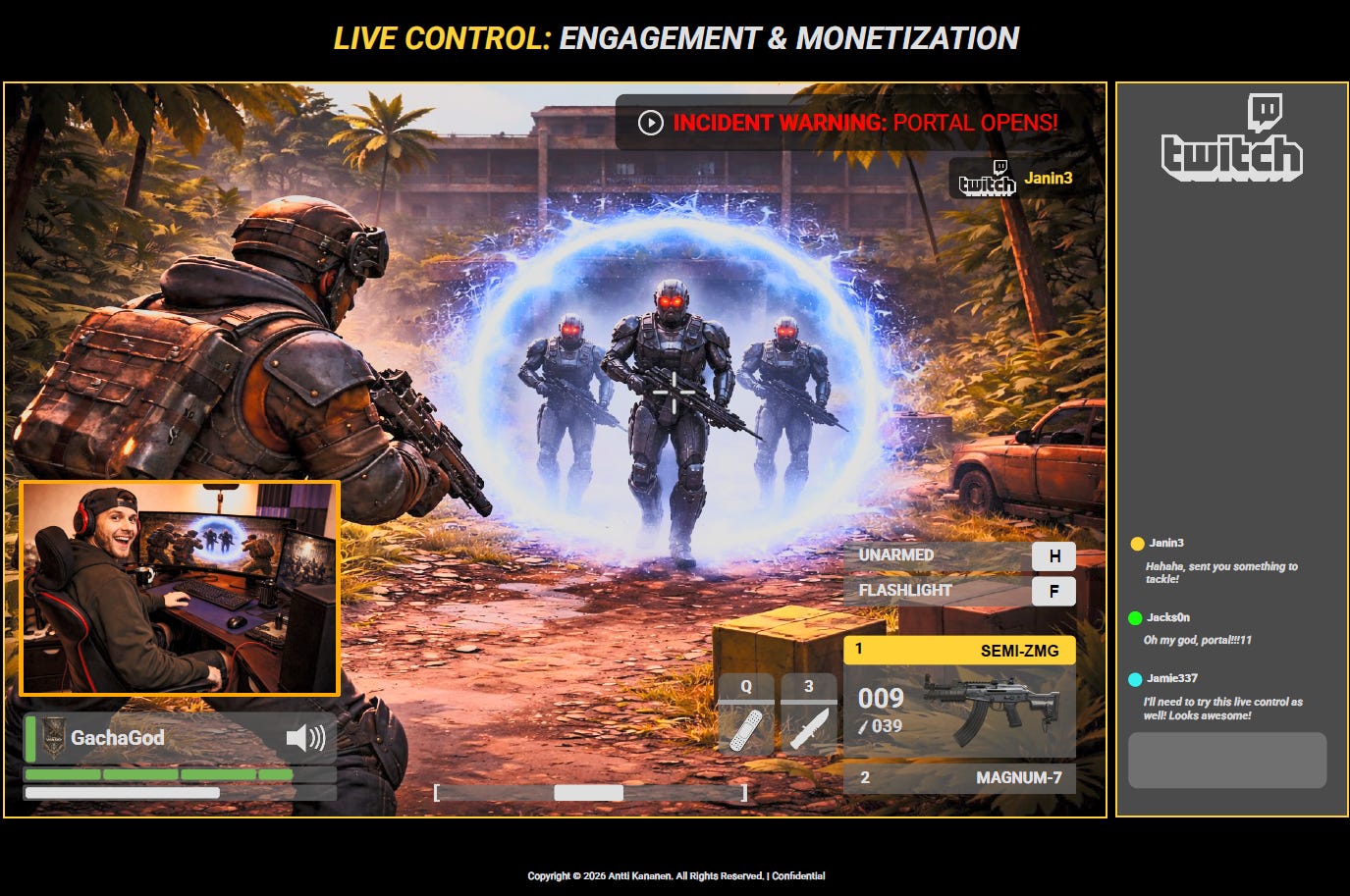
Gone deeper, I think the question is not just if spectatorship becomes a core design pillar for some games, but when and who executes it properly to the end as a foundational pillar for their game, incl. all sides of game economies tied to it.
For spectatorship to exist; platforms like Twitch have already laid the foundation.
Twitch Bits, donations, and subscriptions are not just monetization tools; they are already existing interaction systems:
Viewers spend to signal support or effect gameplay through emergent events
Streamers react (shoutouts, gameplay choices, emotional responses)
Feedback loop, at its best, potentially reinforces some spending
But fundamentally, this is still external to gameplay, or added layer; instead of a layer built to foundational layers of games with first integrations.
Even in cases where Bits trigger effects (alerts, sounds, overlays, etc.), the interaction is:
Surface-level
Non-systemic
Detached from the game’s core economy
So, the leap we haven’t fully made yet is:
Spectator acting, and also spending, through spectating a stream, in a way that these actions directly impact gameplay, systems, outcomes, and economies as core part of a proper-scale game and its business model.
Platforms like CrowdControl.live are early “signals” of where things can be going.
They allow viewers to e.g.,:
Spawn enemies
Give items
Modify difficulty
Influence moment-to-moment gameplay
This is important, but still largely “tactical” and reactive to its nature.
Despite what we’re seeing already, I see the in-depth opportunity goes beyond the surface level:
From event-based triggers → to systemic influence
From chaotic fun → to structured economies
From stream gimmicks → to core game loops
And… having this all as a core part of a game and its experience, on a proper scale. Crucially, this doesn’t even need to rely on third-party platforms.
Developers can, if seen fit for their business cases, e.g.,:
Integrate through Twitch’s API directly
Build web-based control layers
Create cross-platform participation systems (browser, mobile, second-screen)
Technically, and if wanted to be pushed this far, this opens the door to something much bigger:
Parallel spectator economies running alongside, or integrated deeply to, with e.g., the player and/or game economy.
Despite all the developments, as I see it, spectatorship is still underdeveloped as a primary business model (side note: at least based on my research, but there could be some movements already in motion; at least I know couple indie projects who look into it, at least on a paper).
Yes, some games have integrations:
Voting systems
Minor Twitch interactions
Occasional event triggers
However, these are lightweight features, not foundational systems (and interconnections).
We don’t yet have:
Games designed from the ground up for spectatorship economies
Monetization loops where spectators are “first-class” participants
Long-term progression systems for viewers
This is “surprising”, because the demand and early services exists to a certain extent; which could be taken further by some bold takes definitely.
Not to forget this, there are, of course, mentions in blogs, and some direct conversations that I’ve had around the topic, about couple companies that have been trying to crack this space with new multiplayer concepts built around spectatorship and spectatorship monetization.
Whilst these projects have been exciting to be read, and heard about, some of these projects have been paused; not because the idea failed, but because e.g., the market conditions did (e.g., due to tightened funding landscape, or other reasons).
Given these, it’s important to note that spectatorship systems are:
Complex
Cross-disciplinary
Difficult to crack right way economically
…which makes them seen potentially as “a high-risk” in the current macro environment by people who don’t really get the whole funnel and/or economies’ potential behind the model. But this doesn’t reduce the model’s potential; as all advantages still exists, from first actual movers (on a healthy game and longevity basis) to followers on it.
Spectatorship fits naturally into F2P models:
Viewers can, potentially, even spend without installing the game
Acquisition funnel expands dramatically
Social virality compounds monetization
Spectators become:
Soft-converted users
Pre-players
Economic participants without onboarding friction
This can be incredibly powerful model, if executed properly, within F2P.
More interestingly, spectatorship can unlock new value layers in premium games:
Extend engagement beyond purchase
Create post-purchase monetization without breaking the premium promise
Turn players into performers and spectators into co-creators
When done right, hybrid models emerge, e.g.,:
Premium entry + spectator-driven live economies
This isn’t limited to Twitch.
We’ve already seen early forms of participatory monetization across platforms, e.g.,:
Live gifting influencing creator or simplistic game behavior
Interactive streams where audience actions shape outcomes
Real-time voting systems affecting content direction
This works from Twitch to TikTok to YouTube, and further.
While not always even gameplay-driven, the pattern is clear:
Audiences (are willing to) pay influence outcomes.
And, yet, gaming is underutilized frontier for this behavior, even despite what we’ve seen already, like simple streamed games based on this model.
In my own work and explorations, I’ve been thinking about spectatorship not as a feature, but as a core design axis.
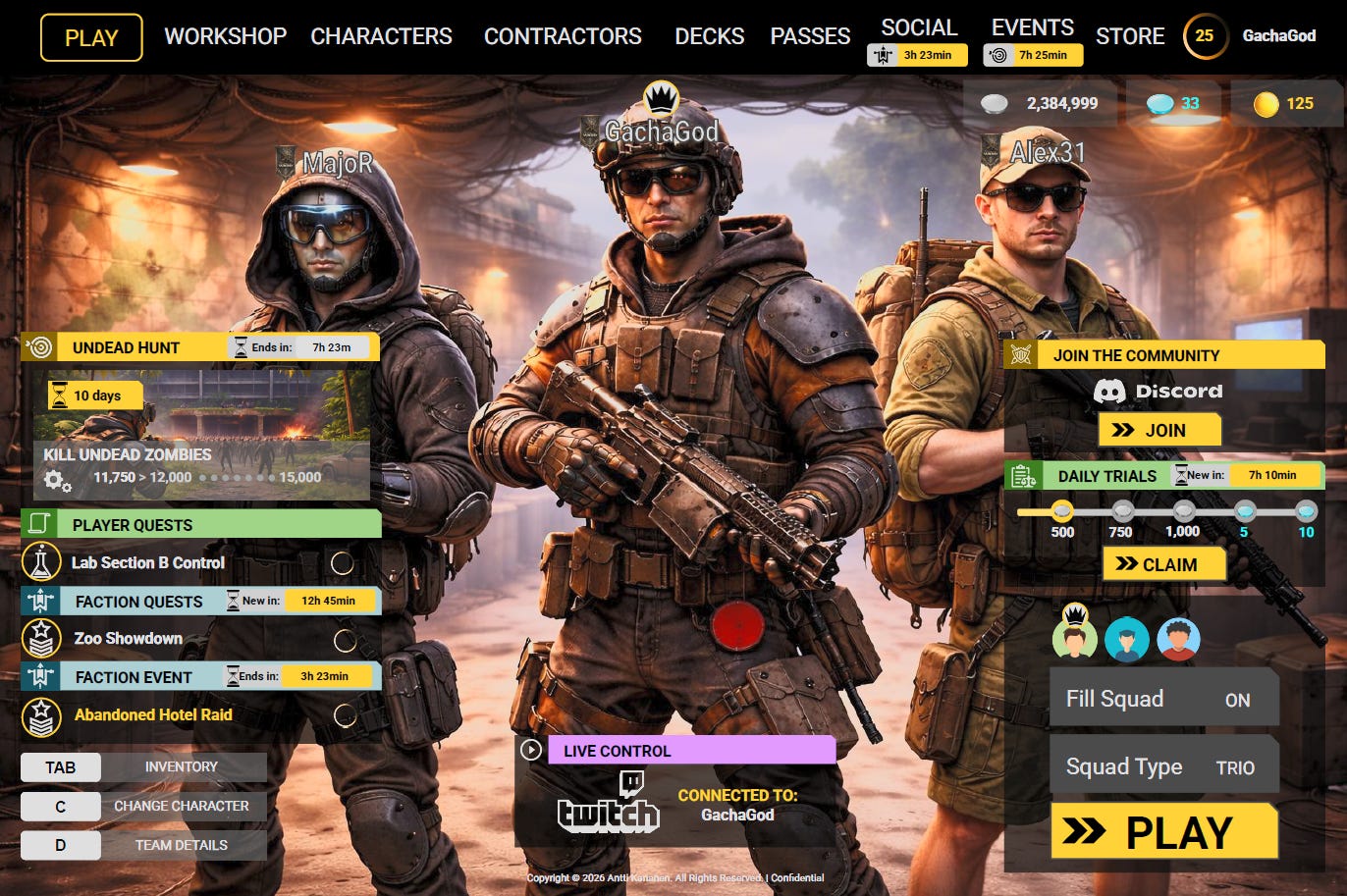
The idea is not just interaction, but with “live control” over the game state, by spectators, the model can e.g.,:
Trigger dynamic events by viewers
Create environmental shifts influenced by the audience
Have monetization loops tied directly to these actions
Form into full-scale progression and economy systems, tied to both ends: the game’s end, and spectating’s end
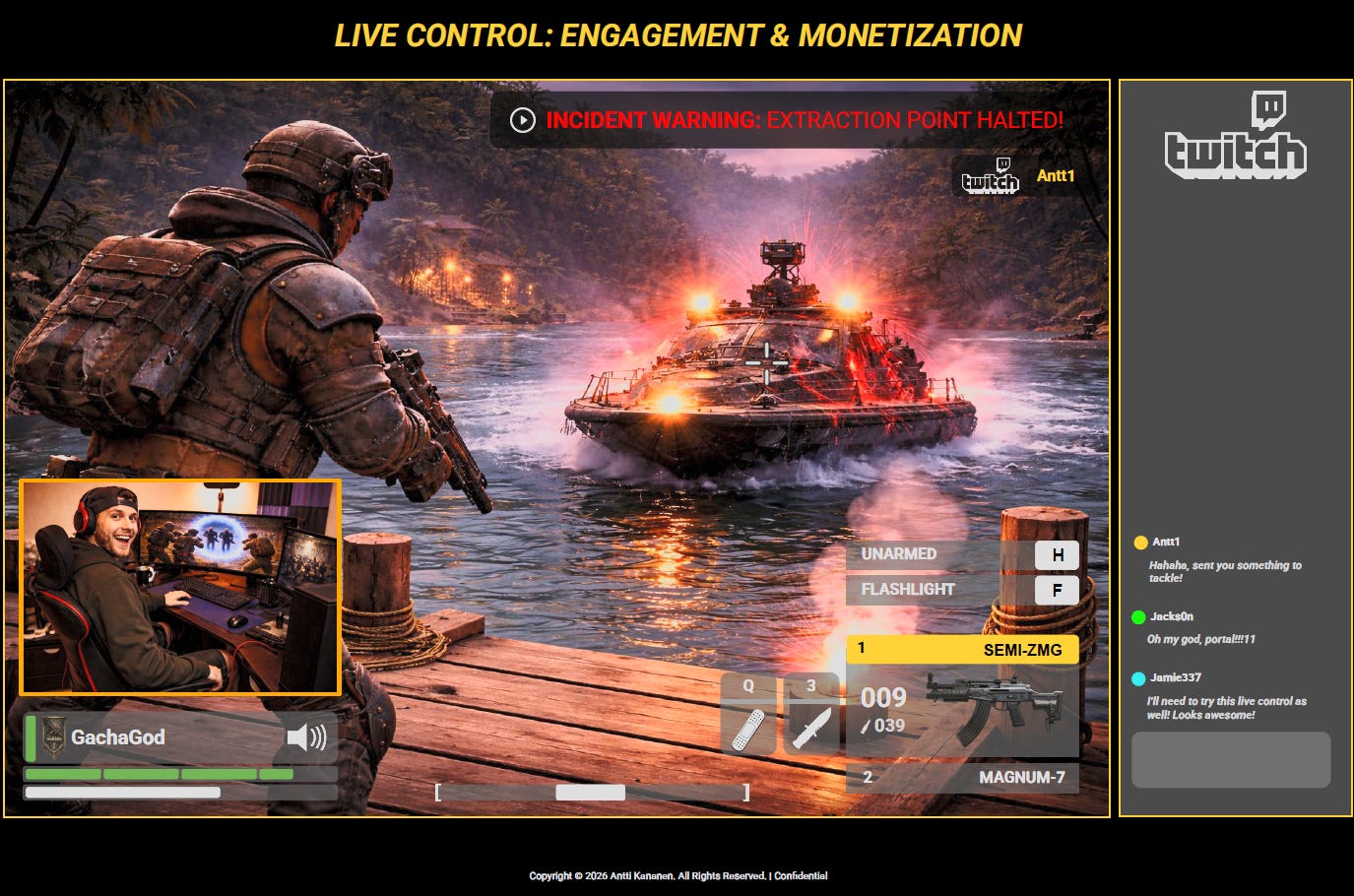
Games’ can very much blend e.g., AI-driven systems with live audience interaction, introducing player-driven and audience-influenced multiplayer and monetization systems at scale.
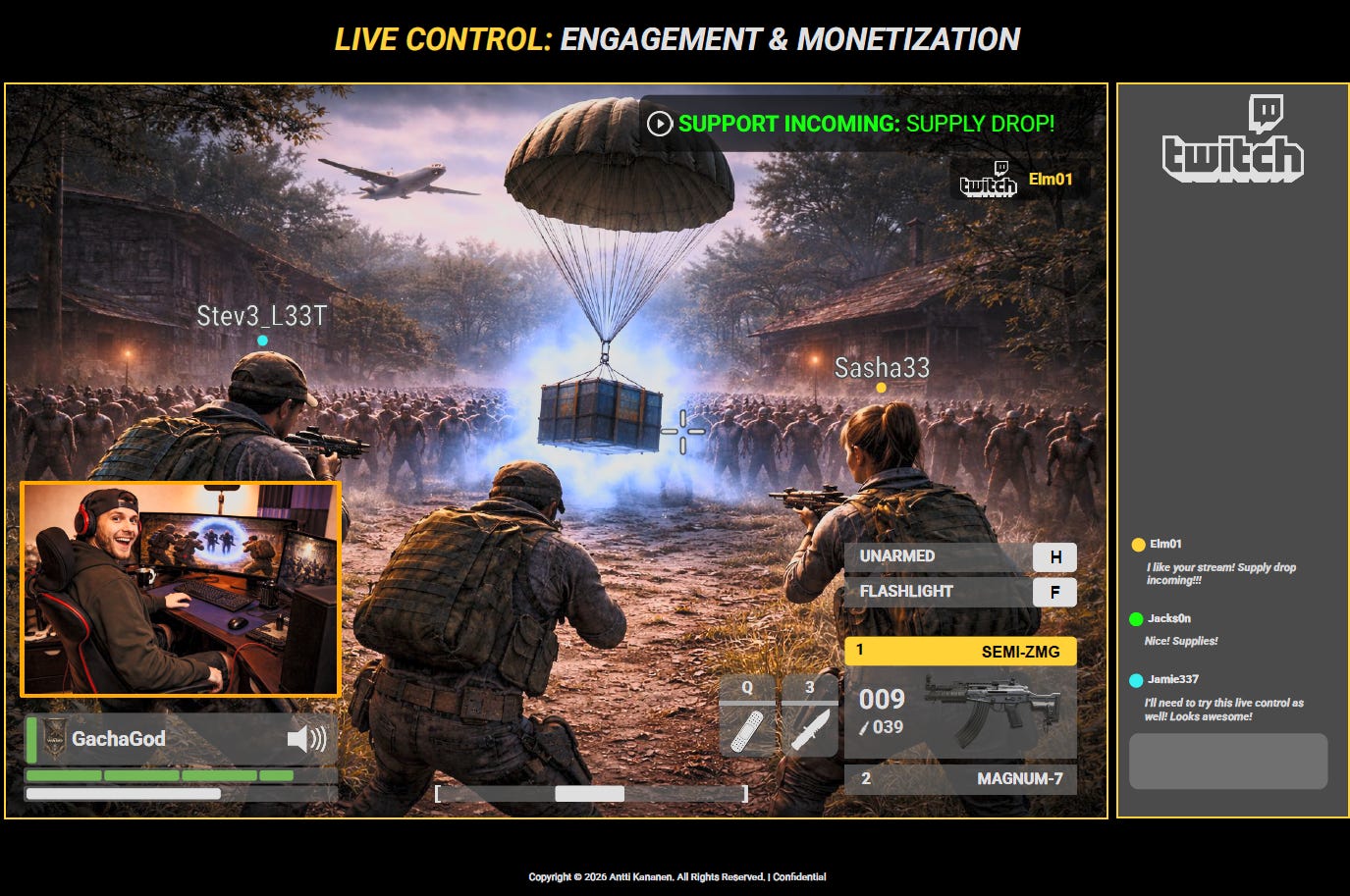
This is the direction that I believe matters most. Not gimmicks. Not overlays. A real systemic integration.
Spectatorship can exists on a spectrum; from effects to economies. Below is a list of “depth” on high-level, including notes on where we are standing.
Alerts
Sound triggers
Visual effects
Events, such as spawning enemies
Giving buffs/debuffs
Modifying difficulty
Influencing game economies
Affecting progression systems
Altering matchmaking dynamics
Spectator progression
Viewer-owned assets
Cross-session influence
Social, e.g., spectators form factions
Compete or cooperate at scale
“Influence entire worlds” over time
We are currently hovering between Level 1 and Level 2, whilst the real (monetary / large-scale) opportunity is I’d say within Levels 3–5.
This is a much larger topic to discuss, which I’ll go through, maybe, as a topic of its own. So, instead of a too deep dive, let’s just focus on the core message.
Spectatorship is not just a feature, and it might be part of a broader shift toward:
Social monetization
Systemic participation
Emergent economies
Players are no longer the only “users”. Viewers are “no longer passive”. Communities definitely aren’t passive. Players, as well as viewers (and viewer-players), want to be very closely part of the experience and a game more deeper. This got “more validation”, I’d say, through a recent event I attended personally, where both presenters and the audience (audience of game developers) discussed a lot about how players want to be involved more and how e.g., UGC, mods, and multiple other fronts are raising their heads more as part of the experience, on top of having communities being deeply involvement in everything.
Considering these, and many other factors, eventually, the distinction between different business models as well as ways how people get involved with games they play may integrate more deeply together.
Note: Some hints of what I’m discussing shortly about can be found from my previous article about Proximity Design in Game Design:
Despite where we are, I believe someone will crack this model.
Why and how? Because it has layers that aligns with:
Human behavior (e.g., influence, participation, social signaling)
Platform evolution (streaming + interactivity)
Monetization “expansion” (beyond players) / entrepreneurial monetization exploration
And when it happens, it won’t look like a Twitch plugin, a donation overlay, or a gimmick feature. It will look like a game where the audience is part of the system, and the system is designed around them.
Spectatorship today is where free-to-play was many years ago; understood in fragments, misapplied in execution, and massive in potential.
The question is no longer if spectatorship becomes a core pillar. I’d say the question is:
Who builds the first truly scalable spectator-native game (economy)?
And more importantly, what does it feel like when you’re not just watching… but shaping the game itself?
This is not just a monetization or game experience shift, it also, when done right, shifts engagement as well as distribution and live ops to far into the future.
Comments
Nothing yet. Say the first thing.
Sign in to join the conversation.