
The games industry has been surprisingly lazy when it comes to social design around some of its segments and markets.
Not lazy in production values, content pipelines, monetization systems, or live operations. We’ve become incredibly efficient at building retention loops, scalable economies, progression systems, optimized engagement structures, and high-frequency live ops.
But, when it comes to understanding actual human social behavior and translating that into meaningful game and systems design, we’re still operating at a surface level. Most social game design isn’t actually social. Underestimating or not prioritizing social design, among many other things, is at least partially one of the reasons why we’re seeing some of the current events taking in place in our industry.
We often “confuse” interaction with social depth.
A clan donation feature is considered social. Sending lives or decorations to another player in a puzzle game is considered social.
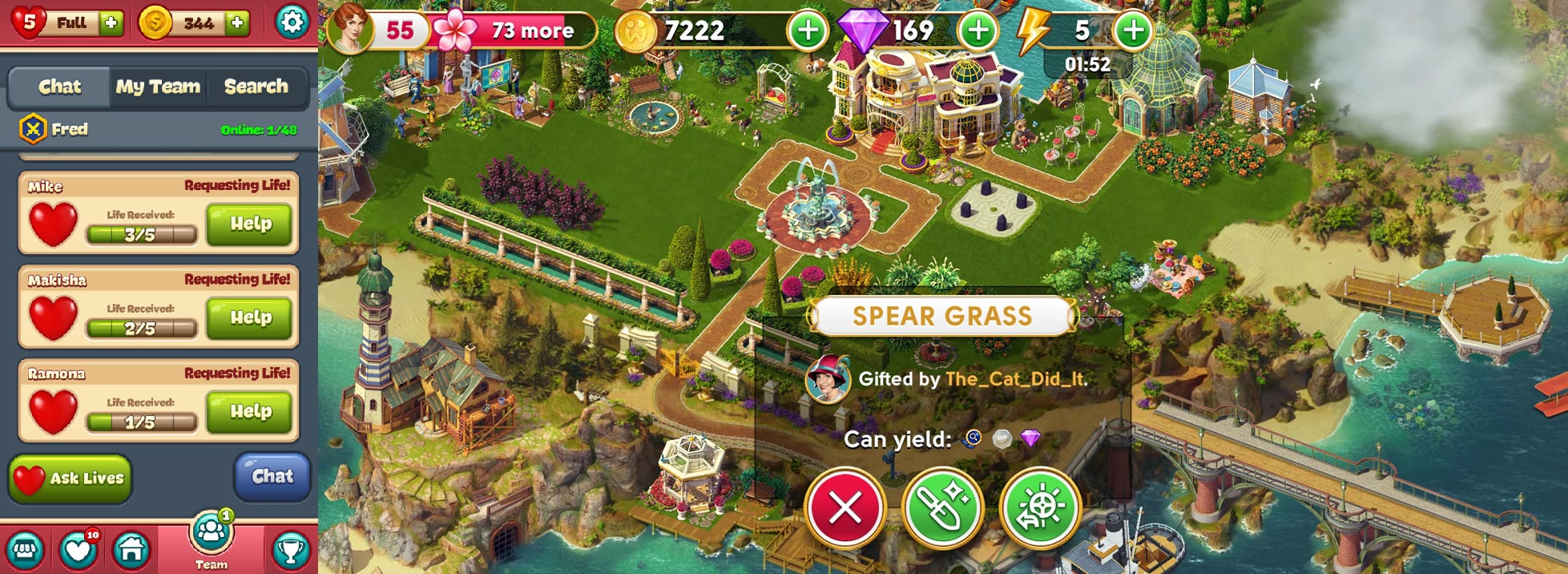
Snapshots from Toon Blast and June’s Journey.
Continuing, lightweight co-op events are considered social. Leaderboards are considered social. Even many so-called “community events” in games ultimately come down to players individually contributing points into a shared meter, without having players truly interacting with one another in meaningful ways.
These systems are not bad. But, they are lazy design solutions when it comes to what social truly could be in games.
Some of these systems are elegant and well-designed for what they are trying to achieve. But, when we compare them against how humans actually behave socially in the real world, the gap becomes obvious very quickly.
Humans attend events to be entertained, to meet friends, to meet new people, to observe others, to gain social status, to feel part of something larger, and sometimes simply to exist around other humans. Social behavior is emotional, expressive, spontaneous, messy, and in some cases e.g., identity driven.
Most games still barely scratch the surface of this.
Ironically, some of the deepest social experiences in games still come from genres that accidentally allow human behavior to breathe naturally. MMORPGs, sandbox games, roleplay servers, and social deduction games often create stronger social memories not because their systems are more advanced, but because they create environments where players can socially live and move.
That distinction matters enormously.
One of the most underestimated concepts in game design is social presence. The feeling that other humans exist around you. Not just as teammates, or opponents, but as part of “a living social environment” (multiple formats of such can exist).
You can already see this desire emerging in communities around games like ARC Raiders. Many players are not only talking about extraction mechanics or combat systems. Some simply want social hubs where they can see other players existing together. They want downtime spaces, identity spaces, and ambient social environments where the world feels socially alive. This is one of the reasons, on top of deeper meaningful mid to end-game systems missing from meta side, why the game has seen ongoing “churn” in its engagement. Like literally, if you put in let’s say 100 to 150 hours, at least, past that there’s not much meaningful things to do.
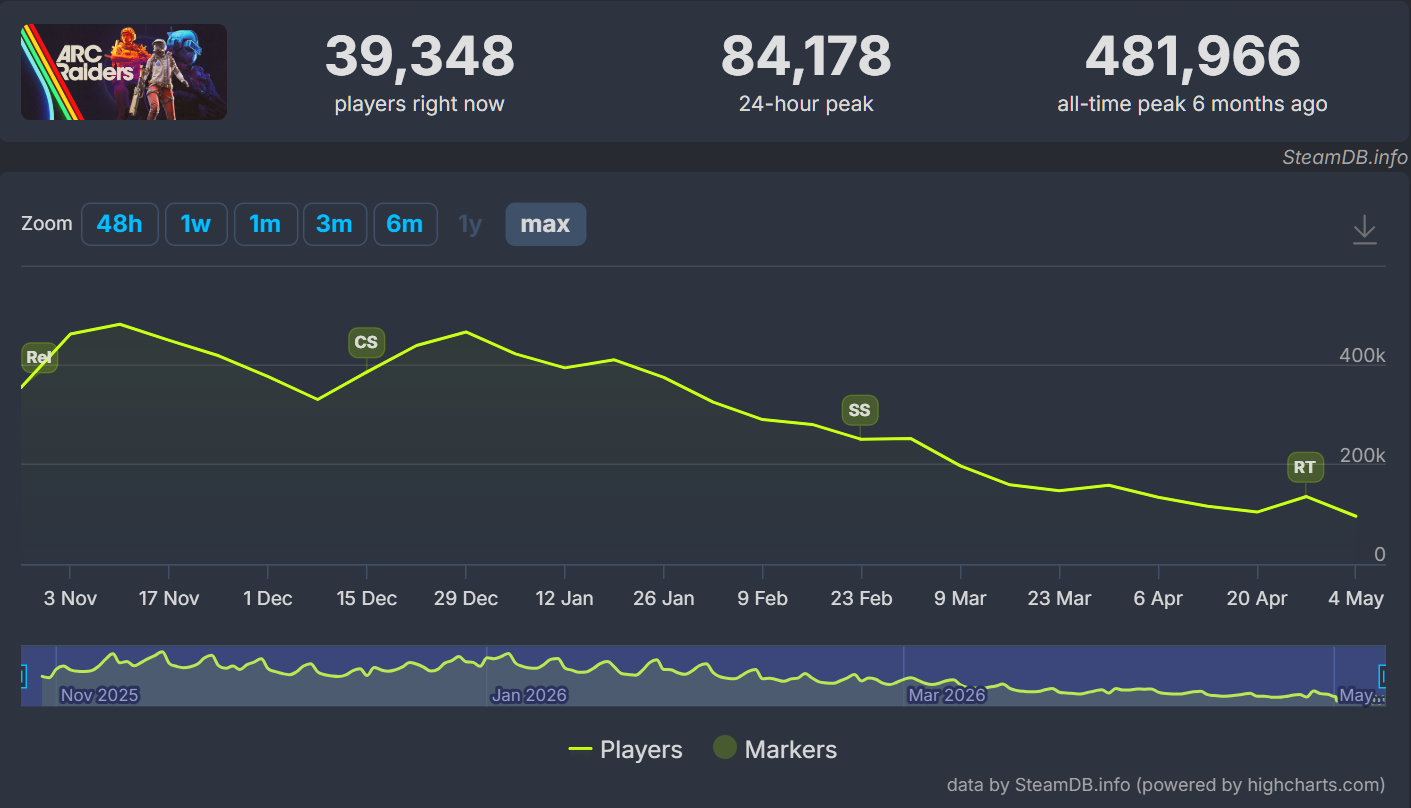
Current engagement data from ARC Raiders, from SteamDB.
Humans naturally seek social presence. Social media companies understood this years ago (although, now, I don’t think some of them anymore does, like when you look into Facebook, it’s full of Ads and “recommended” content instead of any social interaction, on top of which if they add (or added already) AI agents to supplement the circulation of content, they’re going to dig a grave for themselves at some point, when people finds out how unmeaningful as a platform it becomes when they’re on a hunt for more revenue by any means; which shows a lack of understanding, well, social design). Games, surprisingly, largely did not understood it to even this level.
Note: Something I’ve wrote here that relates to presence, if you’re curious to explore more this topic:
This is where the comparison with other industries becomes extremely interesting, if you have “certain lenses” on, when you look into things creatively.
While games were becoming masters of progression systems and retention mechanics, the app ecosystem was mastering human interaction systems. Social platforms optimized for e.g., identity expression, visibility, proximity, discoverability, reputation, conversation, parasocial behavior, and creator ecosystems. They became somewhat sophisticated at understanding why humans socially engage with one another.
Then, on top of this, apps started learning from games.
Gamification is raising its head everywhere. Systems, progression, engagement structures, rewards, retention mechanics, and live servicing is spreading across the app economy.
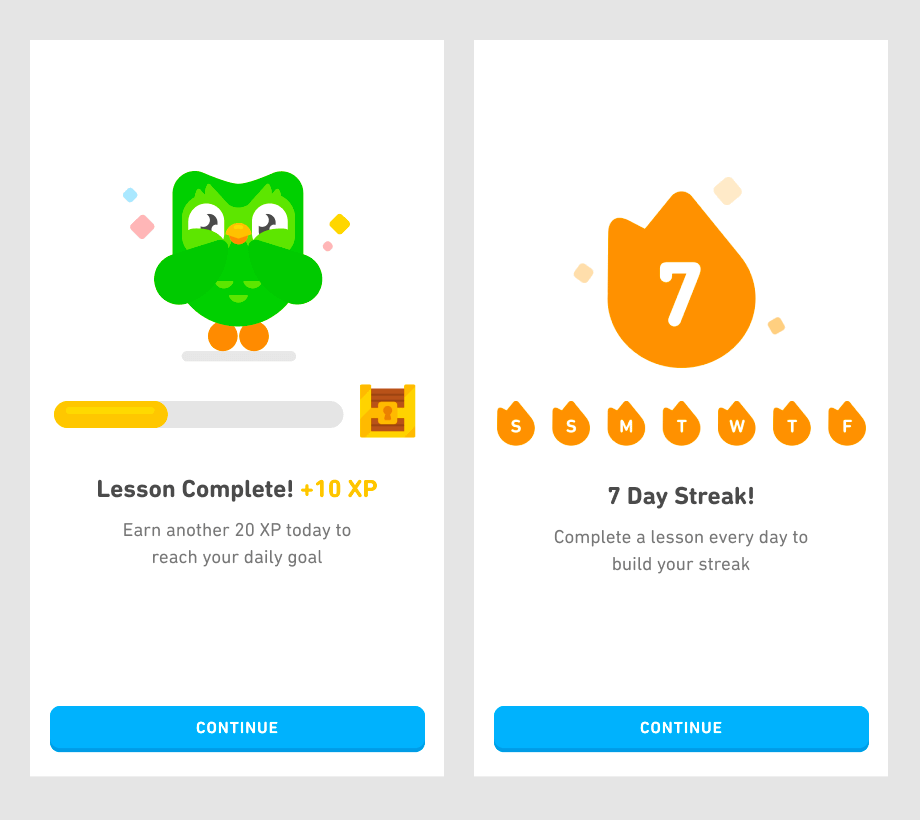
As an example, Duolingo has been exploring gamification deeply as part of its experience.
At the same time, games barely have evolved toward becoming more socially native, or even taking inspiration from app-like experiences (or, to say, going for “applifying” themselves).
The crossover mostly happened in one direction. Apps became more game like while games largely have been lazy to become more socially sophisticated, among other things they could have expanded towards to.
This becomes especially obvious when you look at the mobile market. Many mobile games still rely on social systems that feel detached from how people actually behave socially in digital environments today. Meanwhile social apps, creator platforms, and even productivity apps continuously evolve around human interaction, self expression, and community dynamics. I’ve literally attended some events where developers talk about social side of things, but it’s just talk without execution (probably partly because there’s not much capital flowing for innovation as well, when instead of that it’s flowing towards e.g., the ecosystem in Turkey, and probably next to just another ecosystem, e.g., Southeast Asia; though, considering Deconstructor of Fun’s latest article (Why Apps Are Beating Games for Investments: https://www.deconstructoroffun.com/blog/why-apps-are-beating-games-for-investments), app-like games could be possibly cracking doors for becoming “a thing” for investors, if you creatively approach the pitch and premise).
Games still often treat social systems as additional features instead of foundational design philosophy.
You build the game first. Then you attach clans. Then gifting. Then chat. Then a leaderboard. Then co-op. Then social events.
But humans do not separate social behavior from experiences the way games often do. Social behavior is embedded into how we experience environments themselves.
This is why I believe the future of social game design needs to move far beyond the traditional thinking we currently operate with.
Games should increasingly learn from real world social behavior and from platforms outside the games industry itself.
Take something as simple as decoration systems in puzzle games. Right now many decoration focused games already lightly touch social identity by allowing players to customize spaces. But, what if those systems would evolve much further?
Like, as an example, literally, you could have e.g., a Puzzle game with a decoration meta game, on top of which it could have social media feed integrated into the whole experience beyond what we’re seeing now in e.g., decoration games and their metas. This type of approach would be already, at least, one step towards more social compared to what we’ve seen, even when it takes just small inspiration from social media apps.
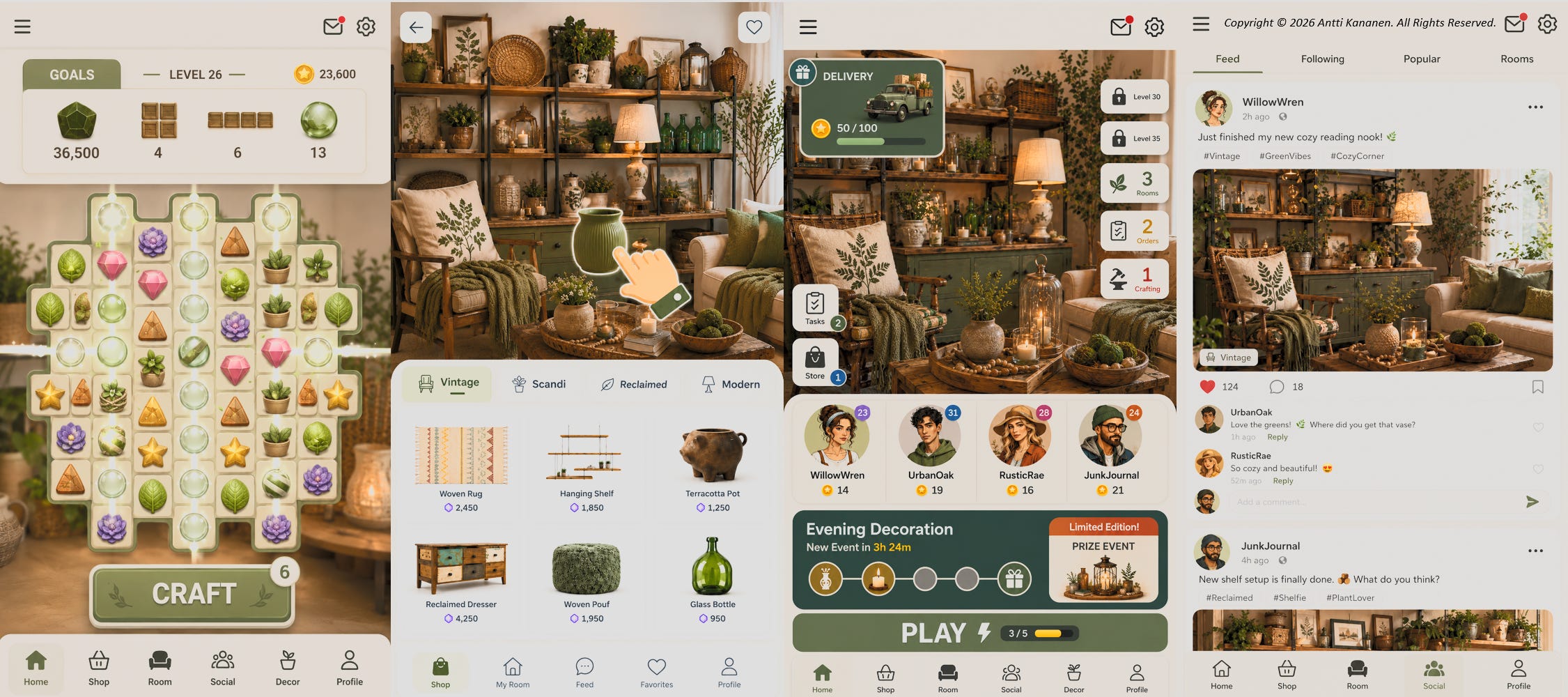
A quick concept for a Puzzle meets Social App game.
As a part of this experience, think about players being able to follow each other based on aesthetic taste. See in your mind discoverable feeds where players showcase decorated spaces. Think about commenting systems, trends, seasonal social movements, creator identities, and/or community driven design cultures emerging around those environments. Suddenly the decoration layer is no longer just a monetization mechanic or progression sink. It becomes a socially expressive ecosystem. On top of that, you could add a simple or deep puzzle core to it, taking benefits also from segments such as Match-3 or Merge.
And honestly, this should not even sound “radical” anymore.
Social media platforms already proved how powerful e.g., identity, expression, and discoverability are. Games simply have not deeply integrated those learnings into core game structures yet, and, when looked to meta game, same kind of applies in most cases.
What makes this especially interesting is that games already contain infinitely richer interaction possibilities than traditional social platforms. Games contain progression, economies, identity systems, cooperative structures, competition, spatial environments, achievements, emotional experiences, and much more all inside the same ecosystem.
Yet despite all of this potential, even some multiplayer games still feel socially less alive than social media applications (though, as mentioned earlier, some of these social apps definitely try to self-bury them underground).
We’re, as I started with, lazy on this front, or don’t just understand the underlying potential.
The opportunity here goes far beyond engagement metrics.
Proper social design can fundamentally transform distribution, retention, monetization, live operations, and long term ecosystem resilience.
One of the biggest opportunities sits inside live servicing itself.
Right now many live ops systems are still primarily content scheduling systems. New event. New pass. New shop refresh. New leaderboard. New limited time activity. When it comes to social systems, they are more artificially social than actually social, which of course on some extent works for e.g., F2P mobile games industry, but definitely leaves even cash on the table.
Genuinely social systems create something much more powerful than scheduled engagement. They at their best create self-propagating engagement, which amplifies everything from distribution to engagement, and to monetization as well when done right.
Humans generating experiences for other humans. Humans generating emotional momentum. Humans generating aspiration, identity, culture, and participation loops organically. Or, just simply, humans meeting each other and, just, communicating as a starting point, vs. what we’re seeing on the “artificial social front” currently.
This is where the real scalability of social systems lies.
Traditional content pipelines scale through production resources. Social ecosystems partially scale through community / human behavior itself. One could say, with proper social design, a human starts becoming part of the operating system instead of being just a player using it.
As we’re driving this route further, and when we look into e.g., social status, it can be stated that social status systems remain massively underexplored in games.
Status is one of the strongest motivational forces in human civilization, yet games still often reduce status into rankings, cosmetics, spending visibility, or skill ratings.
But humans socially signal through far more dimensions than this.
People gain social value through taste, influence, leadership, contribution, social connectivity, creativity, reliability, humor, storytelling, mentorship, and countless other forms of social capital.
Games barely explore these layers. Although, some upcoming games aim to explore these fronts, like one from Northern Lights Entertainment startup studio, called Nebulae, which aims to combine political systems with MMO design.
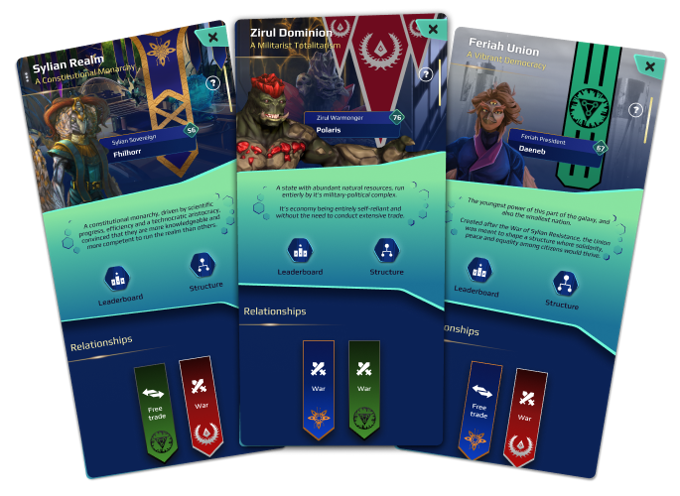
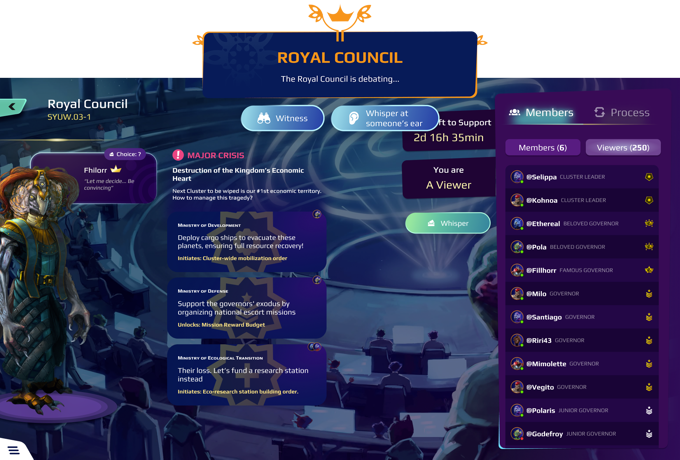
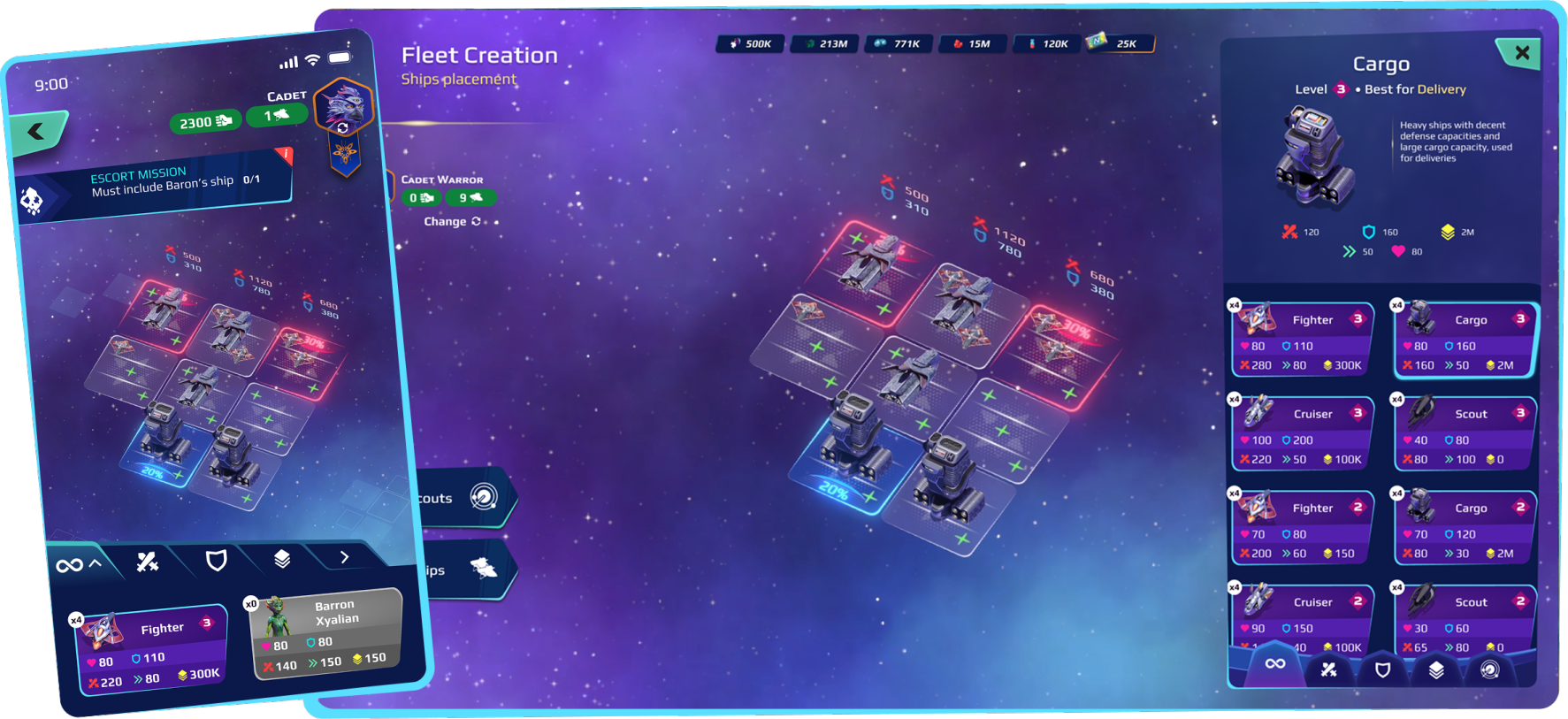
Snapshots from Nebulae, from the game’s website and its Kickstarter page.
On the social front with social status, there are lots of things open to be explored. Like think about ecosystems where community organizers become socially influential. Where tastemakers become discoverable. Where players gain reputation for helping others. Where event organizers become important social figures inside the ecosystem. Where players develop actual social careers inside games.
At these example points, the experience stops feeling like isolated entertainment software. It starts feeling more like a living society.
This is also where web gaming feels strangely underdeveloped.
The web as a medium offers enormous flexibility for social UI and UX experimentation, yet many web games and browser portals still behave like isolated game containers from an earlier internet era.
You could easily build e.g., social sidebars, integrated creator feeds, live community windows, discoverability systems, contextual discussions, spectator systems, and/or social overlays directly beside gameplay itself.
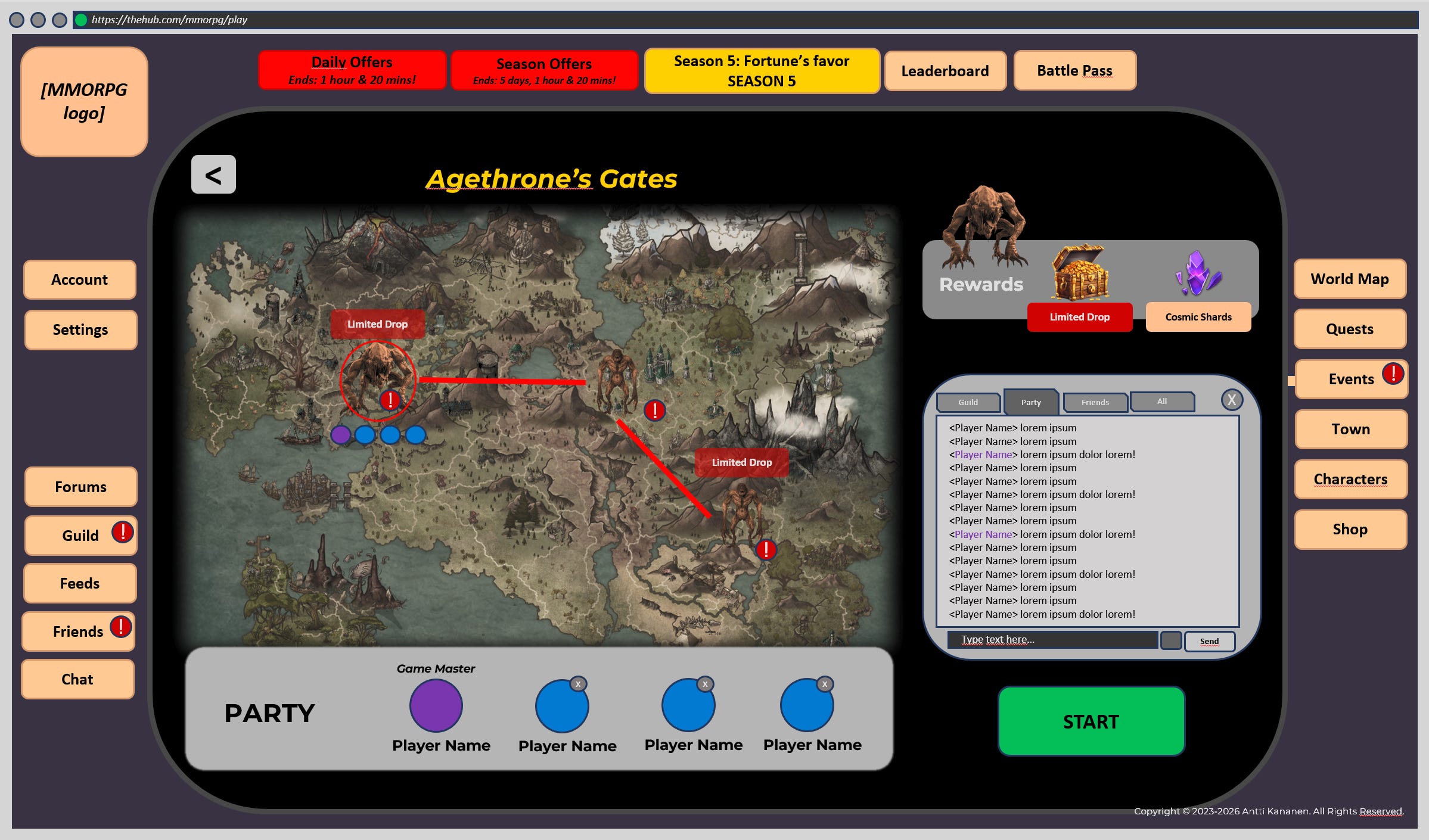
Quick mockup about how screens space could be used with modern web games (which we probably will need to wait for years for, given we haven’t seen in past e.g., 20 years anything innovative here in my opinion).
Even more social games such as MMORPGs could benefit enormously from more experimental social interface design. Like, think about social feeds existing alongside the game world itself. See in your mind live player storytelling systems, community driven event discovery, and/or creator ecosystems integrated directly into the environment instead of existing purely outside the game on third party platforms. Maybe also interacting with “social feeds” you could progress the game and/or some of its systems?
The screen space exists. The technology exists. The behavioral demand already exists. What often doesn’t exist yet is enough design ambition around social systems themselves. Let’s see how much we need to wait for something innovative to come here. It might take a while as when I’ve talked about my opinions on this even with some of the web platforms, which resemble what we had already 20 years, or more back, they just raise their eyebrows for the idea and keep doing same things they’ve kept doing. Of course, I get why, because it brings money as old platforms have died, so there’s the opportunity just to push out content instead of innovating at the moment. Hope we’ll get past this at some point towards more creative space.
One of the biggest “gaps” the industry still makes is “focusing too heavily” on social mechanics while underestimating social environments.
Humans behave differently depending on environments.
A music festival creates different behavior than a business conference. A sports arena creates different social energy than a café. A nightclub creates different emotional dynamics than a classroom.
Lots of games rarely think deeply enough about these environmental emotional dynamics. They absolutely should.
What kind of social behavior does your environment encourage? What kind of emotional tone does your space create? What kinds of spontaneous interactions naturally emerge there? What types of social friction or opportunities exist?
Social systems are not only mechanics. They are emotional architectures.
Sometimes modern games accidentally optimize too much of the humanity away.
Many systems today optimize interaction efficiency instead of emotional depth. Faster matchmaking. Faster progression. Faster rewards. Faster transactions. Less friction.
But meaningful social experiences often actually emerge from “imperfection”, downtime, unpredictability, awkwardness, observation, repeated exposure, tension, rituals, and spontaneous interaction. It’s not just positive things that cause them.
Some of the strongest memories players carry from online games were never fully scripted by designers. They emerged socially. Ever heard of emergent design?
That is the part of the industry I believe we still fundamentally underestimate and should explore more.
As we’re exploring this topic, of course, all isn’t lost as I’m constructively pointing out our laziness. One of the most interesting recent developments is the rise of so called “friendslop” games and lightweight co-op experiences.
A lot of these games are still rough around the edges. Many are mechanically simple, chaotic, intentionally unserious, or built around streamer culture and friend group entertainment.
As we’re seeing more of them floating to market, they are revealing something extremely important in parallel. They are putting social interaction closer to the core experience itself.
The traction many of these games generate is not purely coming from progression systems or mechanical mastery. A huge amount of their appeal comes from shared emotional moments between players. Laughter. Chaos. Embarrassment. Coordination. Failure. Improvisation. Social storytelling. That matters more in these games than some other systems they have there.
For years, the industry has been obsessed with optimizing friction away from multiplayer experiences. Remember when every publisher or investor said co-op games won’t succeed? Yeah, it was a thing. But, as we’ve seen, many of these newer co-op games are proving that social friction itself can actually be part of the entertainment. Even when the mechanics are relatively simple, the human dynamics become the real content layer.
This is why so many of these games spread so naturally on streaming platforms, Discord groups, TikTok clips, YouTube videos, and social media in general. They generate highly shareable human moments. In many ways, these games are exposing how hungry players are for socially driven gameplay again.
Most friendslop games today are only scratching the surface of what socially native game design could eventually become. The systems are often shallow, the progression is limited, and the long term social structures are still primitive.
But the underlying direction is important. These games are rediscovering something the industry partially “lost”, or just forgot.
That players themselves can become the most important source of entertainment. And because of that, I increasingly believe the entire friendslop and social co-op market is widely open for a defining leap forward.
In many ways, it can be said feeling similar to e.g., the early battle royale era before PUBG transformed the space. There were already games and mods exploring the concept, but nobody had fully crystallized the format into a larger cultural product yet.
The same opportunity exists here. Someone will eventually take the emotional chaos, proximity dynamics, social storytelling, and improvisational interaction of modern co-op and friendslop games and evolve them into something much larger and successful.
This will be something with deeper progression. Something with stronger social ecosystems. Something with long term community structures. Something with more meaningful social identity and persistence. Something where social systems and gameplay systems become inseparable.
And, when that happens, I think the industry may could, at least a bit more, start understanding that social design is not just an extra feature category. It is one of the biggest unexplored gameplay frontiers games still have, even it is in many ways self explanatory for us (which might be also why we think we’re good on social design when we’ve not taken it as far as we could).
In connection to social and communities, we often talk about UGC, AI generated content, creator economies, and infinite content generation as the future. But, I increasingly think the bigger evolution is socially reactive ecosystems.
Games that understand humans socially. Games that evolve culturally. Games that allow communities to shape emotional realities together. Games where players themselves become one of the most important layers of content.
Because ultimately, which is a strange thing to say, the most powerful content humans consume has always been other humans.
When you zoom out far enough, the future opportunity becomes very obvious.
The games industry has become extraordinary at designing mechanics, economies, progression systems, monetization structures, and retention frameworks. But compared to the complexity of actual human social behavior, many of our social systems still feel primitive.
The studios that truly crack this next generation of social design will not simply build better multiplayer games. They will build socially alive worlds. Worlds where identity matters. Where reputation matters. Where social proximity matters. Where culture emerges naturally. Where players emotionally invest in communities instead of only progression. Where systems self-propagate socially. Where live operations become community- / player-driven instead of purely developer-driven.
And, the studios that figure this out first could unlock entirely different levels of engagement, retention, monetization, distribution, and long term ecosystem sustainability. Not because they manipulated players better. But because they finally started designing closer to how humans actually behave socially.
This, in my opinion, is the real frontier ahead for games. Not adding more social features. Building games that are genuinely social by design. It’s that simple.
Comments
Nothing yet. Say the first thing.
Sign in to join the conversation.