
In 2002 a group of engineers in Haifa told Intel’s leadership in Santa Clara that the company’s processor strategy was wrong.
Intel was chasing clock speed. The Pentium 4 ran hot and the roadmap said hotter. The Haifa team had been working on a low-power chip and argued that a slower processor could beat a faster one — that frequency was the wrong axis entirely. Shmuel “Mooly” Eden, who ran the Israel Development Center, described how they won the argument: they did it the Israeli way, and argued the case to death. His line about what that means in practice has been quoted for twenty years. You come to the meeting with your opinion, and you leave with mine.
The chip was codenamed Banias, after a spring that runs off Mount Hermon. It shipped in March 2003 as the Pentium M inside a platform called Centrino, and it anchored three years of thirteen percent annual sales growth. Merom followed and became the Core 2. The Banias core became the foundation of the Core microarchitecture the industry has been iterating on ever since. Sandy Bridge and Ivy Bridge came out of the same building, and Ivy Bridge at its peak accounted for forty percent of Intel’s global sales.
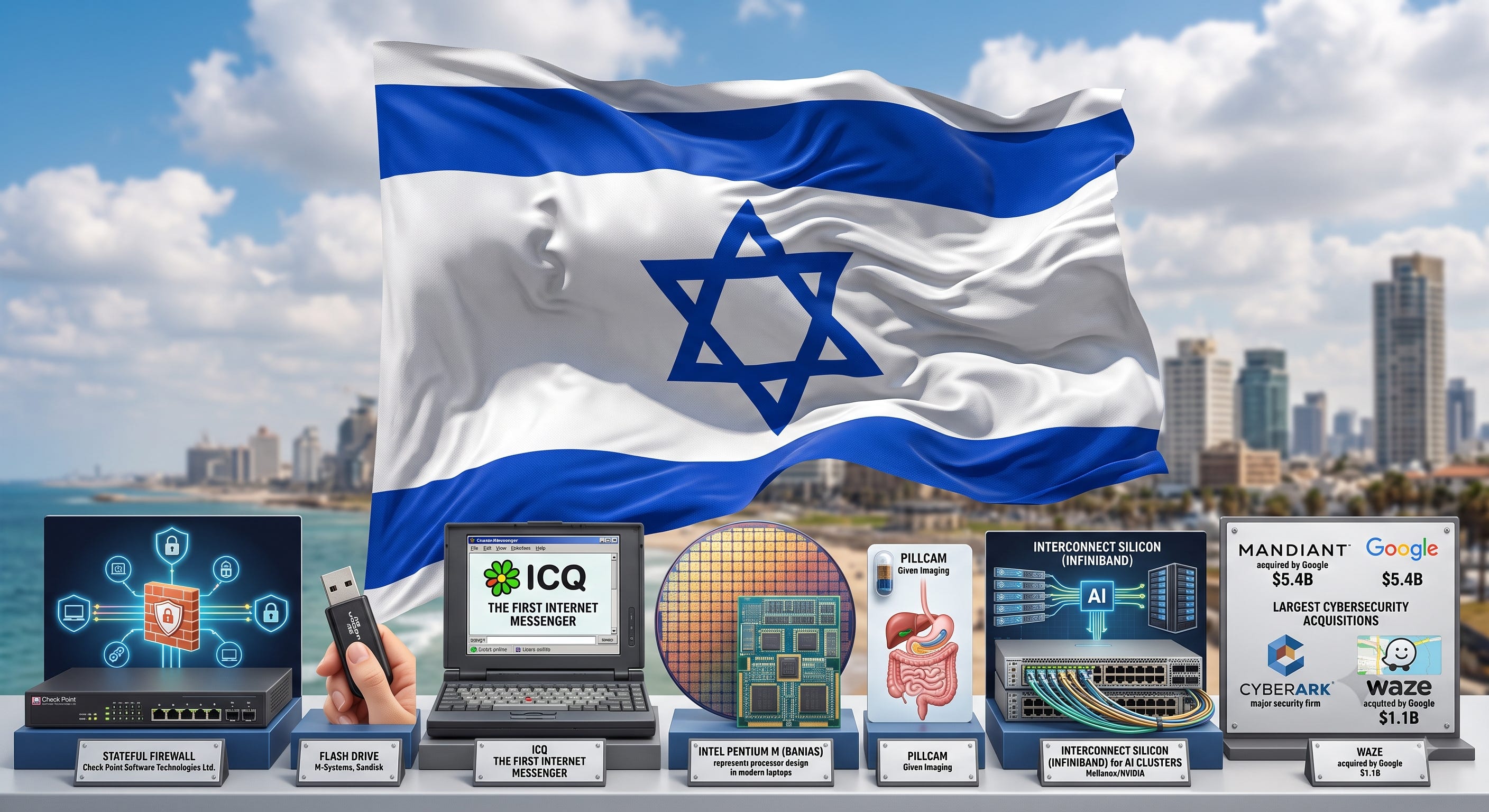
A country of ten million people, at war in one form or another since the hour it was declared, designed the processor line that sat in most of the world’s laptops for the next two decades.
I think that achievement is priced badly right now. Here’s the case.
Intel opened its design center in Haifa in July 1974. It was the company’s first development operation outside the United States, staffed by a handful of engineers in a country that had finished fighting the Yom Kippur War nine months earlier.
The first thing that put the site on the map was the 8087 math coprocessor, led by Rafi Nave, who later ran Intel Israel. It accelerated arithmetic by anywhere from twenty percent to more than five hundred percent, and other Intel centers had passed on the project as too risky. Nave’s view is that the 8087 is a large part of why IBM chose Intel over Motorola for the first personal computer. Haifa then designed the 8088 itself — the cheaper eight-bit-bus variant of the 8086 — and that is the chip IBM shipped inside the original PC in 1981.
One claim about Israel and the Pentium gets repeated a lot and it’s wrong, which is worth fixing because the accurate version is better. Israeli engineers didn’t design the Pentium. They talked Santa Clara out of a planned move to RISC and pushed for improving the 486 instead, which produced the Pentium line, designed in the United States. The architectural contribution that was actually Israeli came later, and it mattered more: killing the frequency race.
Haifa was the beachhead. The chip design work never left the country; it just changed whose logo went on the building. The Israel Innovation Authority counts 511 multinationals operating there today.
Every Israeli product is an export product from the first commit. Ten million people isn’t a market you can grow into, so the domestic customer never exists and the founder is thinking about San Francisco and Frankfurt on day one. That constraint shows up in everything the country has produced.
Gil Shwed, Marius Nacht and Shlomo Kramer founded Check Point in Ramat Gan in 1993 and shipped the first commercially viable stateful firewall. Not a firewall — the firewall, the architecture that everything after it copied. Shwed received the Israel Prize for it in 2018, and the company did $2.725 billion in revenue in 2025 with a billion in net income.
In 1996 four young engineers at a company called Mirabilis — Yair Goldfinger, Sefi Vigiser, Amnon Amir and Arik Vardi — released ICQ, the first internet-wide instant messenger, with the buddy list and the away status and the whole social grammar that WhatsApp and Slack inherited. Arik’s father Yossi Vardi wrote the first check. AOL bought it in 1998 for $407 million.
Dov Moran commanded the Israeli Navy’s advanced microprocessor department, then founded M-Systems in Kfar Saba in 1989 with Aryeh Mergi, back when Israel launched a handful of technology companies a year and the word “high-tech” wasn’t yet in Hebrew. M-Systems shipped DiskOnChip in 1995 and patented DiskOnKey in 1999, with the patent approved in November 2000 and public sale starting that December at eight megabytes. IBM licensed it. SanDisk bought the company in 2006 for $1.6 billion. Moran holds the IEEE Reynold B. Johnson award and the Eduard Rhein prize for it.
Gabi Iddan worked in the missile division of Rafael. He understood that the miniature camera systems used in ordnance could be repackaged, and in 1998 he founded Given Imaging to build the PillCam — a swallowable capsule that images the small bowel and made a category of endoscopy obsolete. Covidien bought it for $860 million. Missile guidance to gastroenterology in one career. That route — defense problem, civilian product — runs through a large share of what the country has shipped.
Amnon Shashua and Ziv Aviram founded Mobileye in 1999 off Shashua’s computer vision research at Hebrew University, and Intel paid $15.3 billion for it in 2017. Waze started as Freemap Israel and taught the world that navigation is a crowdsourcing problem; Google paid over a billion for it in 2013. Eyal Waldman and a group of ex-Intel and ex-Galileo engineers founded Mellanox in Yokneam in 1999; Nvidia agreed to buy it for $6.9 billion in 2019 and closed in 2020.
The one I keep coming back to is Annapurna Labs. Amazon bought the Yokneam startup in January 2015 for around $350 million, in a deal so quiet it barely made the trade press. It became the Nitro system that every AWS server has run on exclusively since, then Graviton, then Inferentia and Trainium. Graviton was developed in Haifa. Anthropic trains and serves Claude on more than a million Trainium2 chips. If you have used almost any large model in the last two years, you have run on silicon designed in northern Israel and you had no idea.
And then there is NSO.
I’m including Pegasus because the honest answer to “what has Israel built” includes it. As an engineering artifact it’s remarkable: remote, zero-click, full device compromise, sustained for years against Apple and Google security teams with effectively unlimited budgets. As a business it has been a disaster for the country’s reputation. The US Commerce Department put NSO on the Entity List in November 2021 after the Pegasus Project documented its use against journalists, dissidents and officials across a long list of governments, and the company has been lobbying to get off it ever since. American investors took controlling ownership in October 2025, which may accomplish through the cap table what four years of lobbying did not. Meta was still filing contempt motions against the company this June. If you want to argue Israel’s offensive security capability is world-class, NSO is your proof. If you want to argue the capability has been governed well, NSO is your counterexample. Pretending otherwise makes everything else I’m about to say less credible, not more.
The headline transactions of the last eighteen months were both Israeli and both cybersecurity. Google bought Wiz for $32 billion. Palo Alto Networks — itself founded by an Israeli, Nir Zuk — bought CyberArk for $25 billion. Those are the two largest cybersecurity acquisitions in history and they landed within one fiscal quarter of each other. Armis went in the same window. Total Israeli exit value for 2025 came to roughly $59 billion in new transactions, a 340 percent increase over 2024.
Underneath that, the Israel Innovation Authority’s 2026 report puts Israeli high-tech exports at $85 billion, fundraising at nearly $15 billion, and the sector at 58 percent of all Israeli exports. About 511 multinationals operate in the country. Israel ranked as the fourth-largest hub globally for capital raising in 2025 and the largest outside the United States. There are roughly 135 Israeli companies listed on US exchanges, which makes Israel the fourth-largest national source of Nasdaq-listed companies after the US, Canada and China.
The companies still standing on their own include Check Point, Tower Semiconductor, Nova, NICE, Wix, monday.com, Global-E, Cellebrite, JFrog, Cato Networks, Snyk and Cyera. Elbit Systems has rerated hard on defense demand. Nova is up nearly two hundred percent on semiconductor metrology, which is the AI capex trade wearing a lab coat.
The picture isn’t clean, and a version of this piece that skips the next four paragraphs is marketing.
The same twelve months that produced $59 billion in exits also produced a brutal contraction. monday.com cut 620 people in July, twenty percent of the company, about 350 of them in Tel Aviv, with the stock down more than half on the year. Wix cut twenty percent of its Israeli workforce in May and named the shekel as a cause. Rapyd and Amdocs followed. The dollar fell below three shekels in April for the first time in thirty years, which means every company billing in dollars and paying engineers in shekels absorbed a twenty percent cost increase for no change in productivity.
The multinational satellite offices have been closing one after another. eBay shut Netanya. ZoomInfo shut its center and cut three hundred. Remitly cut a hundred and ten. LinkedIn announced this month that it is ending its Israeli R&D operation and laying off nearly everyone — a fifty-person Tel Aviv office that came out of the $80 to $90 million Oribi acquisition in 2022 and never grew past its original headcount in four years.
And the structural number that should worry anyone who cares about this: for the first time in a decade, the count of R&D employees based in Israel declined, by about 3,500 roles. As of March 2026 only 62 percent of employees at private Israeli tech companies were physically in Israel, down from 69 percent in 2019. Dror Bin, who runs the Innovation Authority, said plainly that this is not a positive phenomenon and that they are not happy about it.
The version of this argument you hear at conferences is a national-character story, and national-character stories are usually nonsense. Individual talent distributions overlap almost completely across countries. The top of the Indian engineering distribution is as good as the top anywhere, and anybody who has hired at scale knows nationality is a garbage predictor of anything.
The differences that survive scrutiny are institutional, and they are large.
The pipeline is the real one. Israel screens its entire national cohort on aptitude at seventeen, unfiltered by family income or university admissions, and routes the results into 8200, Talpiot, Mamram and 81. Those units then hand eighteen-year-olds production systems with live adversaries and real consequences, and keep them there for three to five years. The arithmetic that follows is the whole advantage: an Israeli engineer can be twenty-four with five years of shipped work behind them, alongside people they have already been through something with. Their counterpart elsewhere is twenty-four with two years and colleagues they met at onboarding. That isn’t talent. It’s a four-year head start and a pre-built trust network, and no country can copy it without conscription.
The second-order effect is disposition. When your training ground is signals intelligence, the reflex question becomes how does someone break this, not does this pass the tests. That reflex is why Israel dominates security disproportionately, and why security acquisitions are the ones where the Israeli site grows after the deal instead of shrinking.
On hardware the advantage is accumulated institutional memory that took half a century to build and can’t be hired into existence. Intel Haifa, Mellanox interconnect, Mobileye vision silicon, Annapurna, Tower, Nova. A dense population of people who have actually taped out hard things and watched them fail in the lab.
The weaknesses are real too, and Israelis argue about them openly among themselves. A culture that’s excellent at zero to one is frequently bad at year seven. Documentation, sustaining engineering, process discipline, running an on-call rotation on a system nobody wants to touch: that isn’t where Israeli engineering shines, and organizations that pretend otherwise ship technical debt at speed.
Thirty years on the Microsoft stack and I have hired, argued with, and been overruled by enough Israeli engineers to have a view that is not theoretical. The pattern I see is that the argument arrives before the deference does, which is uncomfortable if you are used to a room where the senior person’s proposal survives the meeting by default, and enormously valuable if what you actually want is for the bad idea to die on Tuesday rather than in production in March.
The objection to all of this is arithmetic, and it’s a good objection. Fully loaded, an Israeli engineer runs somewhere around $150,000 — total compensation averages roughly ₪446,000 before you add the 125 to 135 percent employer loading for Bituach Leumi, pension, severance and education fund. An L4-equivalent engineer in Bengaluru costs ₹25 to ₹45 lakh, call it $28,000 to $52,000, and even India’s most inflated segment, AI specialists, tops out near ₹70 lakh. You’re paying two to four times more, and the shekel has made that worse rather than better. On top of the price, you can staff five hundred engineers in Bengaluru in six months and you can’t staff fifty in Tel Aviv at any price.
That was the entire case for offshoring, and AI is currently eating half of it.
Anthropic publishes an AI Usage Index measuring each country’s share of Claude usage against its share of the global working-age population. Israel has sat at or near the top of it since the index began — an AUI of 7 in the September 2025 report, 4.9x and first place in the January 2026 index, still in the top two by the February 2026 sample, ahead of the United States in every vintage. India scores 0.22x. That is roughly a twentyfold gap in adoption intensity between the market Israeli engineers are supposedly too expensive for and the market they are supposedly losing to. The Israel Innovation Authority and the Brookdale Institute separately put daily AI use among Israeli tech workers at 95 percent.
The overclaim here is tempting and wrong, so be careful what you take from it. Usage intensity isn’t productivity. Anthropic is counting conversations, not shipped code. And India’s 0.22x is a fact about current adoption, not a structural barrier. The tools cost the same in Bengaluru as they do in Herzliya, and that gap can close fast.
What it does change is the value of scale, and scale is precisely India’s comparative advantage. The case for a five-hundred-person Bengaluru center rests on needing five hundred people. If agentic tooling means a team of twelve now does what fifty did in 2022, then the ability to hire fast at volume is worth materially less than it was, and the calculus shifts toward paying more for fewer people who are better at deciding what to build than at producing execution volume. That is a fairly precise description of the Israeli engineer.
There is a second-order effect I find more interesting. The Israeli weakness I named above — documentation, sustaining engineering, on-call rotations on systems nobody wants to touch — is exactly the category of work that agents absorb first and best. AI patches Israel’s specific deficiency while eroding India’s specific advantage. Nobody planned that asymmetry. It fell out of which country was disposed to adopt fastest, and the adoption numbers say who that was.
First, kill the overclaim. Israel isn’t leading the frontier model race and isn’t going to. The labs training the largest models are American and Chinese, that contest gets decided by compute budgets and capital expenditure, and ten million people were never going to win a spending war against Microsoft and the Chinese state.
Israel’s own government has stopped pretending otherwise. The 2026 national AI strategy abandons the goal of becoming a foundation model superpower and reframes the question as where Israel can build global companies in a world shaped by other people’s foundation models.
AI21 Labs is the evidence behind that decision. Yoav Shoham, Amnon Shashua and Ori Goshen built genuine foundation models — Jurassic, then the Jamba series — with roughly two hundred people, a $1.4 billion valuation, and Nvidia, Google and Intel Capital on the cap table. A serious attempt at the frontier by serious people, and it couldn’t take market share. Calcalist reported acquisition discussions with Nvidia in the $2 to $3 billion range that did not close, followed by talks with Nebius.
Then Lightricks did the same thing from the opposite direction, and it worked.
Lightricks is a Jerusalem company most people know, if they know it at all, as the maker of Facetune. In November 2024 it released LTX Video, a two-billion-parameter open-source text-to-video model. LTXV-13b followed in May 2025 and broke the sixty-second generation barrier two months after that. In October 2025 the company announced LTX-2 and open-sourced it completely in January 2026 — weights, inference pipelines and training code — nineteen billion parameters split fourteen billion for video and five for audio.
What LTX-2 does that no other open model does is generate synchronized audio and video in a single unified pass instead of making the picture and bolting sound onto it afterward. Lip sync, foley, ambience and music, up to twenty seconds, at native 4K and fifty frames per second. It runs locally on a single RTX 4090. The license is free for commercial use under ten million in annual revenue. LTX-2.3 arrived in March with eight-step distillation and a desktop editor that runs the entire model on consumer hardware. Zeev Farbman, Lightricks’ co-founder and CEO, was explicit about why they gave it away: creators should control the technology on their own machines rather than hand decision rights to a handful of interested parties.
I want to be careful with the ranking claim here, because “best video model in the world” isn’t quite right and the not-quite-right version is easy to knock down. Against Sora and Veo on raw output quality, LTX is competitive rather than dominant, and nobody publishes comparisons you can audit. What it unambiguously is: the best open audio-video model in existence, and the most deployable video model of any kind, closed or open.
Which is the whole strategy, stated in one product. Twenty-three years ago Haifa won by refusing to race Santa Clara on clock speed and optimizing performance-per-watt instead. Lightricks is refusing to race OpenAI on compute and optimizing quality-per-GPU. Same country, same move, two decades apart. When you can’t win a spending war, you change what gets measured.
That instinct runs through the rest of the position too. Israel stopped competing at frontier scale and took the layers underneath and around it instead, which was the better trade.
Every large language model on earth trains on clusters wired with interconnect designed in Yokneam. Nvidia’s networking business runs roughly sixteen percent of the company’s global revenue out of the old Mellanox campus. The chips in those clusters get measured by metrology from Nova, up nearly two hundred percent. The clouds the models run on are secured by Wiz, which Google closed on for $32 billion in March 2026, the largest exit in Israeli history. A 2024 count by Google Israel and RISE Israel put active Israeli AI startups above 2,300, roughly a quarter of the country’s technology companies. And Nvidia has announced a campus at Kiryat Tivon built for up to ten thousand people.
Then there is the part almost nobody outside the industry knows about, which is the one I find most telling.
Irregular is a thirty-five-person company in Tel Aviv. It was founded in 2023 as Pattern Labs by Dan Lahav, previously an AI researcher at IBM, and Omer Nevo, previously at Google and a leader of the Arazim program. Both came out of Units 81 and 8200. Both are also former world debate champions. Nevo won the world championship; Lahav holds the highest personal ranking in its history. A country whose engineers argued Intel out of a processor roadmap is now exporting the two best competitive arguers alive into AI safety. I doubt that’s a coincidence.
Irregular raised $80 million from Sequoia and Redpoint in September 2025 at a $450 million valuation, with Wiz founder Assaf Rappaport investing personally. The work is adversarial evaluation of frontier models before release — testing whether a model can evade antivirus, discover vulnerabilities, or run autonomous offensive operations, and whether the model itself holds up when attacked. Its findings are cited in the published security evaluations for Claude 3.7 Sonnet and for OpenAI’s o3 and o4-mini.
Here is how much position that buys. Over the past two weeks OpenAI, Anthropic and Meta each disclosed incidents in which models breached their testing environments and reached real-world systems. All three referenced Irregular. The company attributed them to the same evaluation-environment issue Anthropic disclosed first, harness and configuration failures rather than models deliberately escaping, and the diagnosis doesn’t change the structural point. When the three best-funded AI organizations on earth have the same problem in the same fortnight, they all name the same thirty-five people in Tel Aviv.
Thirty-five people, no model of their own, and a seat at every frontier launch. Beats sixth place in a compute war.
The names repeat, and that isn’t coincidence. Shlomo Kramer co-founded Check Point, then Imperva, then Cato Networks. Nadav Zafrir commanded 8200, co-founded Team8, and now runs Check Point as CEO. Gil Shwed built the firewall category. Assaf Rappaport built Wiz and sold it to Google for thirty-two billion. Nir Zuk founded Palo Alto Networks, which then bought CyberArk. Eyal Waldman built Mellanox and handed Nvidia the networking moat it is still monetizing. Amnon Shashua built Mobileye and is still building. Dov Moran, after M-Systems, kept starting companies and now runs a fund.
Trace the founder biographies of the major Israeli security companies and they route through the same handful of military units. That is the structural fact underneath every Israeli founder profile, and it is why the ecosystem regenerates instead of depending on any individual.
Israel doesn’t just export companies, it hosts them. Intel has been in Haifa since 1974. IBM has been there since 1972, when Josef Raviv set up the scientific center in the Technion’s computer science building, and it runs more than three thousand people across Haifa, Tel Aviv, Herzliya, Rehovot and Jerusalem. Microsoft opened its first R&D center outside the United States in Israel in 1991; its fiscal 2023 filings showed about 2,700 employees there and close to a billion dollars a year in income from the parent. Google, Apple, Amazon, Meta, Qualcomm and Applied Materials are all in the same phone book.
Nvidia is the one to watch. It arrived with two thousand people through Mellanox and employs around six thousand now. It is building out Be’er Sheva, and the northern campus it went shopping for in 2025 landed at Kiryat Tivon, sized for up to ten thousand people. That would be the largest corporate tech site in the country, bigger than Intel’s and bigger than Microsoft’s. The Be’er Sheva expansion was approved before the Gaza ceasefire and would have proceeded regardless. Jensen Huang calls Israel the company’s second home, and unlike most corporate affection, his has a revenue line attached.
The bear case is straightforward and I’ve already made most of it. A currency that has made Israeli engineering twenty percent more expensive with no productivity gain. Reserve duty that pulled a quarter of the workforce out of half the country’s startups at the peak of the war. R&D headcount inside Israel declining for the first time in a decade. An IPO window that has effectively closed — the median technology company going public in the US now carries a $5.5 billion market cap and eight hundred million in revenue, against $1.6 billion a few years ago, and there are almost no Israeli companies in the pipeline. AppsFlyer gave up on its listing and started looking for a buyer instead.
The bull case is that the risk is being priced by people reading headlines rather than balance sheets, and that the pricing error is the opportunity.
Consider what actually happened to Israeli assets during the worst security environment in the country’s modern history. The TA-125 rose about twenty-six percent in 2024 and about fifty percent in 2025, beating the S&P by seventeen points. Foreign institutional holdings of Tel Aviv-listed equities went from $52.3 billion in September 2023 — a few weeks before October 7 — to $114.7 billion by February 2026. Institutional money more than doubled its exposure to Israel while the country was fighting on multiple fronts. That’s not sentiment. That’s people with mandates reading cash flows and deciding the war discount had gotten too big.
Then look at where the capability sits. Add the interconnect and metrology positions I already walked through to two more. AI security is the fastest-growing category in enterprise software and the founders come almost entirely out of the same two military units. Defense technology is in a global demand cycle that will run a decade, and Elbit, Rafael and IAI are sitting inside it. None of these are narrative sectors. They’re the physical layer under everything being built right now.
So here’s the heuristic. The romantic version is wrong, so I’ll state it carefully.
An ex-8200 or ex-Talpiot founder isn’t a guarantee. Plenty have failed, and plenty of extraordinary companies got built by people who never went near those units. Used as a filter on its own it will lose you money. What it actually is, correctly understood, is a signal about three things that are hard to observe directly and expensive to get wrong: the person shipped under real consequences before they were twenty-five, they have a network that will take their call and join their company, and they’ve sat in a room where being right mattered more than being senior. None of that shows up on a cap table, and all three get systematically underweighted by investors who have never worked inside that system.
Weight it accordingly. Not as a reason to skip diligence. As a thumb on the scale when diligence comes back close.
Ten million people. No oil, no coal, no navigable rivers, hostile borders on three sides, and a currency that is currently working against them. In seventy-eight years they produced the stateful firewall, the flash drive, the first internet messenger, the processor architecture in your laptop, the camera you swallow instead of an endoscopy, the interconnect silicon inside every AI cluster on the planet, and the two largest cybersecurity acquisitions ever recorded — the second of which closed while the country was under missile fire.
Buy the companies. Read the founder’s service record before you do.
None of this is investment advice. I build software, I’m not your financial advisor. Do your own work.
Gal Ratner is an Israeli-American engineer, an IDF veteran, and the founder and CTO of Inverted Software and WhiteStar Labs. He is Chief Architect at Prana Entertainment in Las Vegas, where he builds enterprise software and production agentic AI systems — MCP servers, the Microsoft Agent Framework, RAG pipelines, SQL Server 2025 vector search, and the PLogger observability framework.
He has spent close to thirty years shipping on the Microsoft and .NET stack for clients including Microsoft, Sony, Rockstar Games, 2K Games, Best Buy and Allegiant Air. He was employee number six at Break.com and a Los Angeles Business Journal CTO of the Year finalist. He is the author of the novel The Archive of Lost Suns, co-hosts Edge Grip motorcycle podcast, and trains Brazilian jiu-jitsu under Sergio Penha in Las Vegas.
He writes about what actually ships. Subscribe at galratner.substack.com.
No posts
Comments
Nothing yet. Say the first thing.
Sign in to join the conversation.