
I have never hidden how I write.
0:00
-46:34
Every article on this Substack is written with AI assistance. So is most of my code. So is my novel. In April I published a piece here called “I Wrote an Award-Winning Novel in One Hour.” In it I explained that The Archive of Lost Suns had been generated by a 31-billion-parameter Gemma model running on a local Ollama instance, and that my entire creative contribution was one prompt. I also explained that I had invented a company called RAM Tech for the sole purpose of giving myself an award for outstanding memory management. The subtitle listed the parameter count and the RAM footprint. That was not a confession dragged out of me by an investigation. It was a joke I told on myself, on purpose, with the receipts attached.
I use Claude, GPT, Gemini, and DeepSeek. I run open models locally through Ollama when I would rather a request not leave the building. I use them for research, for structure, for arguing with me at one in the morning when there is nobody else awake to argue with. Then I go through the draft and take out everything that sounds like a machine wrote it, which takes longer than people think, and which is the part nobody gives you credit for because when it works you cannot see it.
In August I wrote a piece about Zillow laying off roughly 500 people while the CEO explained the company would be more efficient without them. Somebody submitted it to Hacker News. It got 20 points and 18 comments, and then it got flagged.
I want to be fair about the criticism, because some of it landed.
One commenter, tptacek, said the piece would have been better as just the prompts, and that the underlying story was a company doing a discretionary reduction in force. He allowed that AI-assisted pieces earn their place on HN when they carry a genuinely interesting technical idea, and said his objection was that this one did not. Another commenter, infecto, called it AI slop and then made an actual argument in the next line: it is 7 percent of the workforce. A third, tofuziggy, said he got too distracted by the AI-generated image at the top to read the AI-generated article.
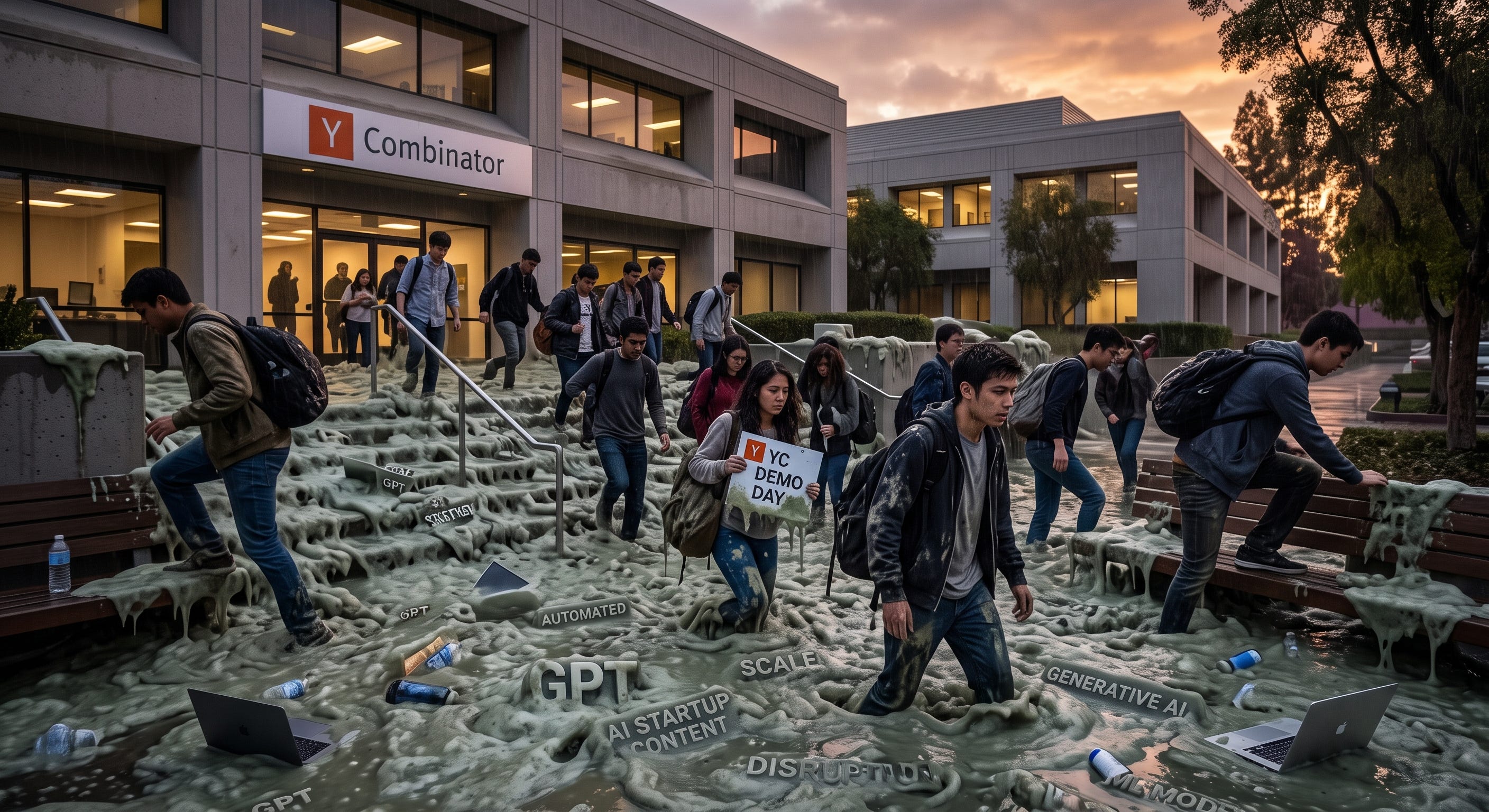
The image was an unforced error and I own it. Two separate people led with it before anyone touched a sentence, which means I handed them permission to stop reading above the fold. The 7 percent number is a real counterargument and I should have engaged it in the piece instead of leaving it lying there for a stranger to pick up. The complaint that the story was thin is at least arguable.
None of that is what got the post flagged, though. Flags arrive without reasons attached, but the thread makes the objection plain enough, and it had nothing to do with the 7 percent or the thinness of the story. The sentences smelled wrong, so the piece went away.
While I was getting flagged for writing with a model, here is what was happening to engineers who refused to use one.
Brian Armstrong told Stripe cofounder John Collison on the Cheeky Pint podcast that after Coinbase bought enterprise licenses for GitHub Copilot and Cursor, he was told adoption would take a quarter or two. He posted a mandate in the main engineering Slack channel giving everyone until the end of the week to onboard, and said he would host a meeting on Saturday for anyone who had not. Some of the people on that Saturday call had good reasons, like having just gotten back from a trip. The ones who did not were fired. Armstrong now says roughly 40 percent of daily code at Coinbase is AI-generated and he wants it above 50.
Tobi Lutke posted an internal Shopify memo to X in April 2025, ahead of a leak, titled “Reflexive AI usage is now a baseline expectation at Shopify.” It informed every team that before asking for headcount they must demonstrate why they cannot get the work done with AI, and that AI usage questions were being added to the performance and peer review questionnaire. Lutke wrote that opting out was not feasible, that people were welcome to try, and that stagnation is slow-motion failure.
Julia Liuson, president of the Microsoft division that owns GitHub Copilot, emailed managers that AI is now a fundamental part of how the company works and that using AI is no longer optional. Managers were told to fold it into their reflections on an individual’s performance and impact, with a formal metric under consideration. The division that sells the tool made the tool mandatory for the people who build it.
And Eric Vaughan of IgniteTech replaced close to 80 percent of his staff between 2023 and the first quarter of 2024 over exactly this. He instituted AI Mondays, on which nobody was allowed to take customer calls or work on budgets. He put 20 percent of payroll into a mass learning program. He told Fortune he still got flat refusals, so he said goodbye to those people, that changing minds was harder than adding skills, and that if he did it again he would start with the replacements. The detail that should interest you is which department dug in hardest. It was not sales and it was not marketing. It was the technical staff.
Now hold that against what happened to writers over the same stretch.
In March, Becky Tuch of Lit Mag News posted an excerpt from a New York Times Modern Love essay and said it read exactly like AI slop. She had no evidence beyond the prose itself. The tells people seized on were parallel constructions and the rule of three, the same stylistic pattern-matching that later got applied to me. Somebody ran the excerpt through a detector. Writer Ann Bauer pointed out that the column has had one editor for two decades and the essay simply sounded like him. Public Books editor Dennis Hogan said accusing writers of AI use without evidence was a bad road to go down. It went down that road anyway.
The writer, Kate Gilgan, had written about losing custody of her son during her alcoholism. When The Atlantic reached her, she said she had not pasted model output into the piece but had used ChatGPT, Claude, Copilot, Gemini and Perplexity for, in her words, inspiration and guidance and correction. She described using AI as a collaborative editor rather than a content generator, and argued that it had done no more for her than a human editor would. That is roughly my position too, and it did nothing for her.
Two weeks later Hachette pulled a horror novel. Shy Girl by Mia Ballard had sold about 1,800 print copies in the UK and was scheduled for a US release through Orbit. Readers on Goodreads and YouTube raised suspicions, the Times assembled evidence, and Hachette cancelled the American edition and discontinued the British one, noting that it requires authors to disclose AI use, which makes it a contract violation rather than merely a taste violation. Ballard denies using AI at all. She says a freelance editor she hired for the self-published version introduced it, that she is pursuing legal action, that her mental health is at its lowest, and that her name is ruined for something she did not do. Her social accounts are gone. The Times called it the first commercial novel from a major house pulled over evidence of AI use.
The Times also cut ties permanently with the freelance critic Alex Preston, who had written six reviews for the paper since 2021, after a reader noticed his January review of Watching Over Her overlapped with a Guardian review published four months earlier. Preston admitted using an AI tool to draft it and failing to catch the borrowed passages. The Times Guild then wrote management to say the paper’s AI standards were woefully inadequate.
I want to separate that last case from the others, because it is the one that deserved what it got, and it did not deserve it for the reason people think. Preston did not get fired for using a model. He got fired for shipping unreviewed output that turned out to contain somebody else’s sentences. That is a review failure. In my world the person who merges it owns it, and nobody files a bug against the autocomplete.
This morning I drove to work listening to the CEO of Y Combinator explain how AI is changing what startups build.
Garry Tan has been making this case in public for over a year. At YC demo day he told CNBC that for roughly a quarter of the batch, 95 percent of the code had been written by AI, and that what it means for founders is that you do not need a team of 50 or 100 engineers, you do not have to raise as much, and the capital goes further. He told the AI Engineer World’s Fair that back in 2013 he was an engineer shipping about 14 usable lines of code a day, and that his output now is on the order of 400 times that. At Startup School this summer he was pitching what he calls personal AGI, agents you own and carry between ventures and roles, compounding your context over time, with the message underneath it being that the barrier to starting a company has collapsed and you should go start one.
He has also described how he writes. He told Andrew Warner on Mixergy that he took the scripts from his best-performing YouTube videos, fed them to a prompt, and now gets a finished three-act script in minutes where it used to cost him several hours.
So the man who runs the company that owns Hacker News generates his own video scripts with a model, sells AI-written codebases as the reason founders no longer need to hire, and tells people who cannot find work to go build something instead. I was flagged on his platform while driving to a job, listening to him make the case for the exact thing I was flagged for.
Hacker News now bans AI text outright. The guidelines were updated to say do not post generated or AI-edited comments, and that HN is for conversation between humans. The moderator, dang, confirmed the ban covers submissions as well, and floated adding a flag-reason menu so people can specifically report content as AI-generated. He has observed that readers are developing allergic sensitivities to anything that sounds like a model produced it, and that a class distinction is forming between writing that uses these tools and writing that does not. He is right on both counts, which is what makes the rule work and also what makes it a filter on who gets to sound credible.
Hacker News is a Y Combinator property. A quarter of YC’s Winter 2025 batch shipped codebases that were more than 95 percent AI-generated. Stack Overflow banned AI-generated answers in 2022 and its own 2025 developer survey found 84 percent of respondents using or planning to use AI tools. The same building has one rule for the artifact that compiles and another for the artifact that gets read.
The honest defense of that split is that code has an external oracle and prose does not. Tests pass or they do not, production stays up or it falls over, and nobody reviewing my pull request cares which keystrokes were mine because the acceptance criterion sits outside my hands. Prose has no such judge. A reader has nothing to evaluate but whether a mind was behind the words, so provenance becomes the proxy for quality. That is a real difference and I am not going to pretend it away. There is a second reason and it is cruder: reading costs the reader something. Generation got cheap and attention did not, and people are defending the only budget they have left.
There is even research on the shape of it. Studies of disclosure find that admitting AI involvement hurts perceived quality far more when the model generated content than when it edited, and hurts argumentative writing more than creative writing, because readers hand the machine credit for the logical structure and the evidence. Reported argument, in other words, is the format that takes the biggest hit, and it is the only format I write.
AI writes better than I do. Not marginally, and not in a way I expect will close.
English is my second language. I grew up in Israel and I learned English the way most Israelis learn it, which is well enough to argue in and not well enough to be graceful in. I am fluent in something like ten programming languages and English is not one of the ten. If you want to see my unassisted writing, the Internet Archive has snapshots of galratner.com from around 2011 and 2012, back when I was running Inverted Software out of Los Angeles and ShoppingCart.NET was the most downloaded .NET shopping cart in the Microsoft app gallery. What you will find there is technical writing. How to do the thing, in code, with the code in the post. That genre has a mercy built into it, which is that the reader either gets a working build or they do not, and nobody grades your commas on the way there.
An essay is nothing but the commas. There is no build. There is no test suite. The only proof that the argument holds is the sentence it arrives in, and I spent thirty years developing an instinct for one of those things and none at all for the other. So yes, the model lifts me over my own ceiling. That is the entire justification for the tool on the engineering side. Armstrong bought Cursor and Copilot licenses because they lift his engineers over theirs. Lutke told Shopify that opting out of the skill was not a viable plan. Liuson made it a performance signal. None of them called it cheating. They called it the job.
And the tells people hunt for are precisely the artifacts of somebody like me finally getting help. Parallel construction. The rule of three. Clean subordinate clauses that resolve where they should. Those are not fingerprints of a machine, they are fingerprints of competent English, which is why every non-native speaker who finally sounds fluent now reads as suspicious to somebody with a detector open in another tab. This came up inside HN’s own discussion of the ban. Non-native speakers said that without AI proofreading they could not express themselves properly, and one described using a model to anglicize his comments because his natural directness got him downvoted. Dang’s position was that people who think they are only fixing grammar underestimate what the tool is doing, because it is not correcting your mistakes so much as removing your style.
He is probably right. My style, unassisted, is a man explaining a null reference exception. I am not convinced the internet is worse off.
The fair objection is that if the model writes better than I do, then readers are getting the model and not me. What they are getting is my judgment about what is worth saying, my reporting, my sources, and my thirty years of watching software organizations lie about why they are firing people, rendered in language I could not have produced alone. In engineering we call that a toolchain. We do not usually demand the compiler get a byline.
It also is not true that engineers have made peace with this while writers hold out. Stack Overflow’s 2025 survey found trust in AI output down to 29 percent from 40 the year before, with 46 percent actively distrusting accuracy, and the top frustration, cited by nearly half, being output that is almost right but not quite. METR ran a controlled study on 16 experienced open-source developers working in mature codebases over a million lines, and found they were 19 percent slower with AI assistance, while predicting beforehand that they would be 20 percent faster and continuing to believe afterward that they had been. Anthropic published a randomized trial in January finding that developers leaning on assistants scored measurably worse on comprehension of the code in front of them. Skepticism is rising on the engineering side at the very moment the mandates are hardening, and nobody in either camp is being asked.
I spent the last stretch of my working life building a production agentic system for a Las Vegas wedding chapel. It plans weddings. It talks to real customers who are making one of the more emotionally loaded purchases of their lives, it runs retrieval over the chapel’s actual catalog, it calls MCP tools against live inventory, and it touches a payment flow that sits inside PCI scope. I built it with Claude and DeepSeek in the loop, and I reviewed every line that went to production, because when a card number is involved nobody accepts “the model wrote it” as an incident report. Not one person has ever asked me to publish my prompts. Nobody demanded I disclose which functions were autocompleted. The system either handles the booking or it does not, and I am the one who signs.
Thirty years on the Microsoft stack and the thing that finally got my work flagged as illegitimate was a paragraph.
This is hypocrisy and it deserves to be called that. But hypocrisy is a comfortable word. Anyone can build a case for why code and prose should live under different rules, half of those cases are decent, and the argument dies right there in the comments.
The version that holds up is about who decides. Vaughan fired hundreds of people for refusing the tool. Armstrong gave his engineers five days. Liuson made it a performance metric inside the division that sells it. Lutke made teams prove a model could not do the job before they were allowed to hire a person. And at the same time, Hachette killed a book over an accusation the author still disputes, the Times ended a decade-old freelance relationship, a stranger with a detector nearly ended a memoirist’s career on stylistic grounds, and a forum owned by the largest AI investor on earth wrote a rule against my sentences.
In every one of those, the person doing the work is not the person deciding how the work gets done. The mandate simply reverses direction depending on whether what comes out the other end is a binary or a paragraph. I have been on both sides of that line in the same calendar year, ordered toward the tool as an engineer and penalized for it as a writer, and I promise you it is the same feeling.
Hold me to the accountability rule, because it is the only one that survives contact with either domain. Armstrong, for all the heavy-handedness, got this part right: he banned vibe coding in financial systems and requires human review of everything before it merges. The tool is allowed. Shipping what it hands you without reading it is not. Preston violated that rule and paid correctly. Coinbase enforces that rule and is right to.
So check my facts. If I got Zillow’s severance terms wrong, or misread the ten-K, or attributed a quote to the wrong executive, that is mine and I will wear it, and you should hit me for it as hard as you like. What I am not going to accept is being graded on tells. Counting parallel constructions is not analysis, a detector score is not evidence, and “this smells like a model” is a claim about your nose rather than about my work.
I built it, I checked it, and my name is on it. That was the deal back in 2011 when the only thing helping me write was a spell checker that flagged half my sentences, and the tooling has not changed the deal since.
Gal Ratner is the founder and CTO of Inverted Software and WhiteStar Labs, and Chief Architect at Prana Entertainment. He has spent close to thirty years shipping production software on the Microsoft and .NET stack for clients including Microsoft, Sony, Rockstar Games, 2K Games, Best Buy and Allegiant Air, and was employee number six at Break.com. He was a Los Angeles Business Journal CTO of the Year finalist. These days he builds production agentic systems: MCP servers, the Microsoft Agent Framework, RAG pipelines, SQL Server 2025 vector search, and the PLogger observability framework.
He is the author of the novel The Archive of Lost Suns, which was generated in one hour by a 31-billion-parameter model on his own hardware and for which he awarded himself a trophy for outstanding RAM management. He co-hosts Edge Grip motorcycle podcast, trains Brazilian jiu-jitsu under Sergio Penha in Las Vegas, and writes as the .NET AI guy that ships. He writes at galratner.substack.com and galratner.com.
P.S. The header image was generated for this article on purpose, and it has been submitted for consideration at next year's Technology Achievement Awards in the category of Best Use of Six Fingers. RAM Tech is again sponsoring.
No posts
Comments
Nothing yet. Say the first thing.
Sign in to join the conversation.