
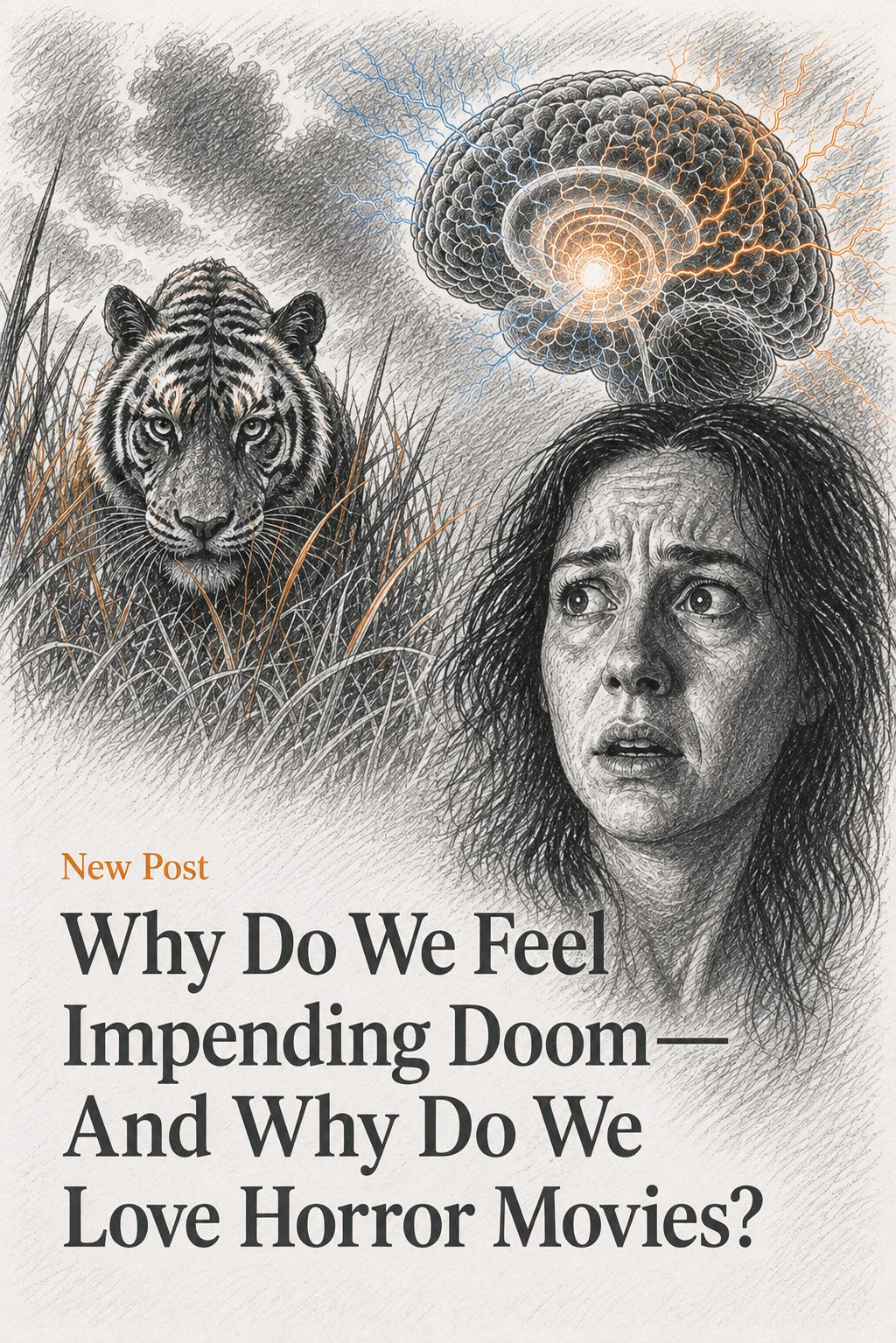
Have you ever had the unmistakable feeling that something terrible is about to happen, even when you couldn’t explain why?
Or wondered why millions of people voluntarily spend their evenings watching serial-killer documentaries, horror films, or disturbing true-crime stories?
At first glance, these seem like completely different experiences. In reality, they are connected by the same ancient survival circuitry that has protected humans for hundreds of thousands of years.
Long before modern civilization, failing to recognize danger could be fatal. Our ancestors who noticed the rustle in the grass survived more often than those who ignored it.
As a result, the human brain evolved to prioritize potential threats over almost everything else.
Several brain regions work together as an integrated threat-detection network:
The amygdala rapidly detects potential danger, often before conscious awareness.
The insular cortex monitors internal bodily sensations and generates the feeling that something is wrong.
The anterior cingulate cortex evaluates conflict, uncertainty, and possible danger.
The hypothalamus activates the sympathetic nervous system—the classic “fight-or-flight” response.
Within seconds, stress hormones are released:
Norepinephrine increases vigilance and attention.
Epinephrine (adrenaline) raises heart rate, blood pressure, and breathing.
Cortisol prepares the body for sustained stress.
The result is a familiar cluster of symptoms:
racing heart
tight chest
rapid breathing
heightened awareness
an overwhelming feeling that catastrophe is imminent
This is the biological basis of the “feeling of impending doom.”

Sometimes this warning system is appropriate.
A feeling of impending doom can accompany serious medical emergencies such as:
heart attack
pulmonary embolism
anaphylaxis
certain neurological disorders
It is also common during panic attacks, PTSD, and severe anxiety disorders.
In each case, the brain is interpreting internal or external signals as evidence that survival may be threatened. The feeling itself is real—even when the danger is psychological rather than physical.
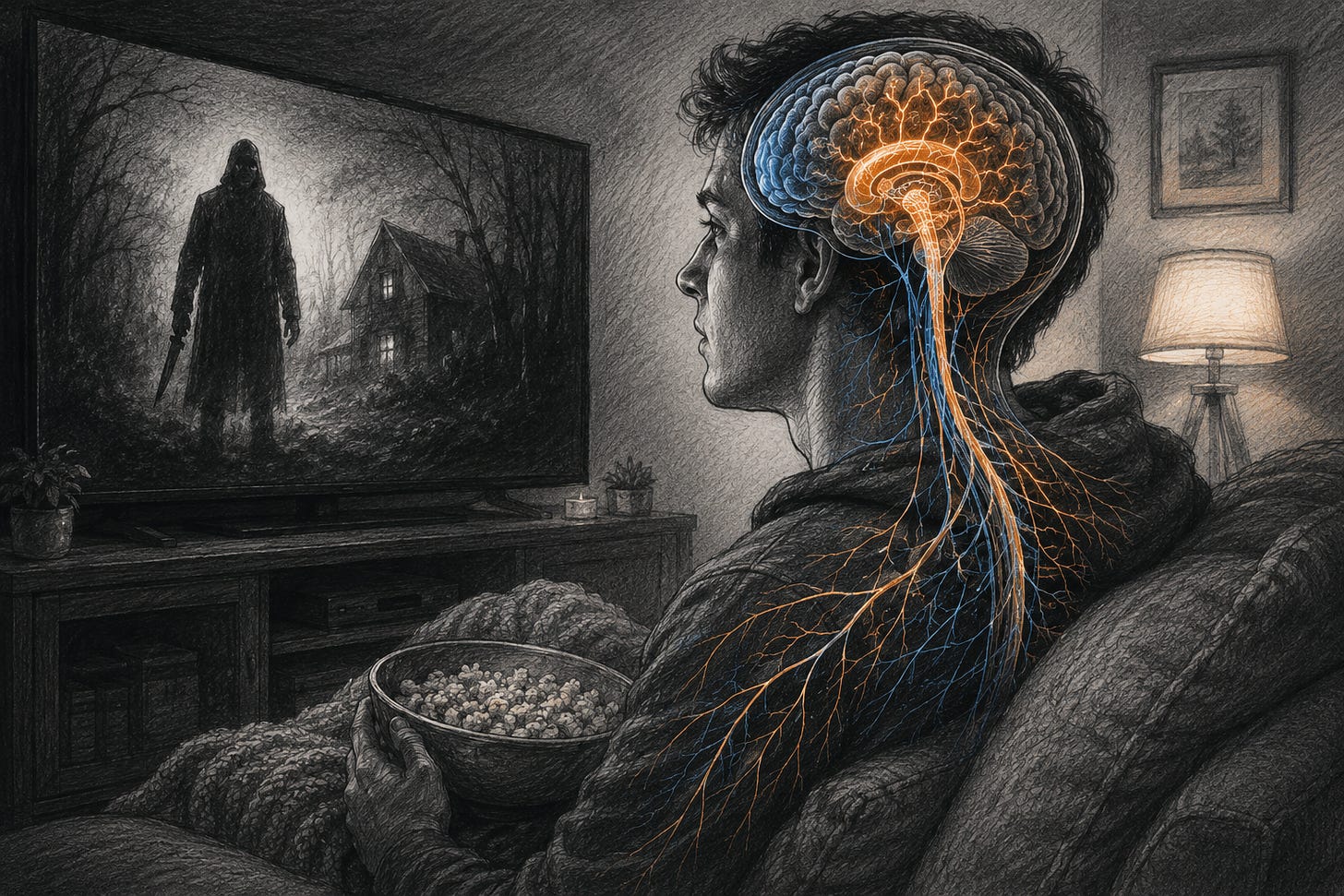
Watching a horror movie activates many of the same neural circuits.
The amygdala becomes active.
Adrenaline rises.
Attention narrows.
Muscles tense.
The difference is that another part of the brain—the prefrontal cortex—knows you are sitting safely on your couch.
Because the threat is controlled, your brain experiences the excitement without committing to full panic.
When the frightening scene ends, the chemistry shifts.
Dopamine contributes to the rewarding feeling that follows relief.
Endorphins reduce stress and produce a sense of well-being.
If you’re watching with friends or family, social bonding may also increase oxytocin release.
This combination explains why fear can become enjoyable when experienced in a safe environment.
True crime often receives criticism for being morbid, yet its popularity reflects something deeply human.
For most of human history, understanding dangerous individuals improved survival.
The brain automatically pays attention to stories involving:
violence
deception
betrayal
social manipulation
death
unusual events
These experiences strongly engage the amygdala, hippocampus, and attention networks.
Your brain treats them as valuable survival information.
In evolutionary terms, learning how dangerous people think and behave may once have increased the odds of avoiding them.
Why Some People Love Horror—and Others Hate It
Not everyone experiences fear the same way.
People who enjoy horror often have:
higher sensation-seeking tendencies
stronger reward responses after stress
greater curiosity
lower baseline anxiety
In contrast, individuals living with PTSD, panic disorder, or chronic anxiety may find horror exhausting rather than entertaining.
Their threat detection system is already highly sensitized. Additional activation may feel less like entertainment and more like reliving danger.
Our brains evolved to detect occasional threats—not to process thousands every day.
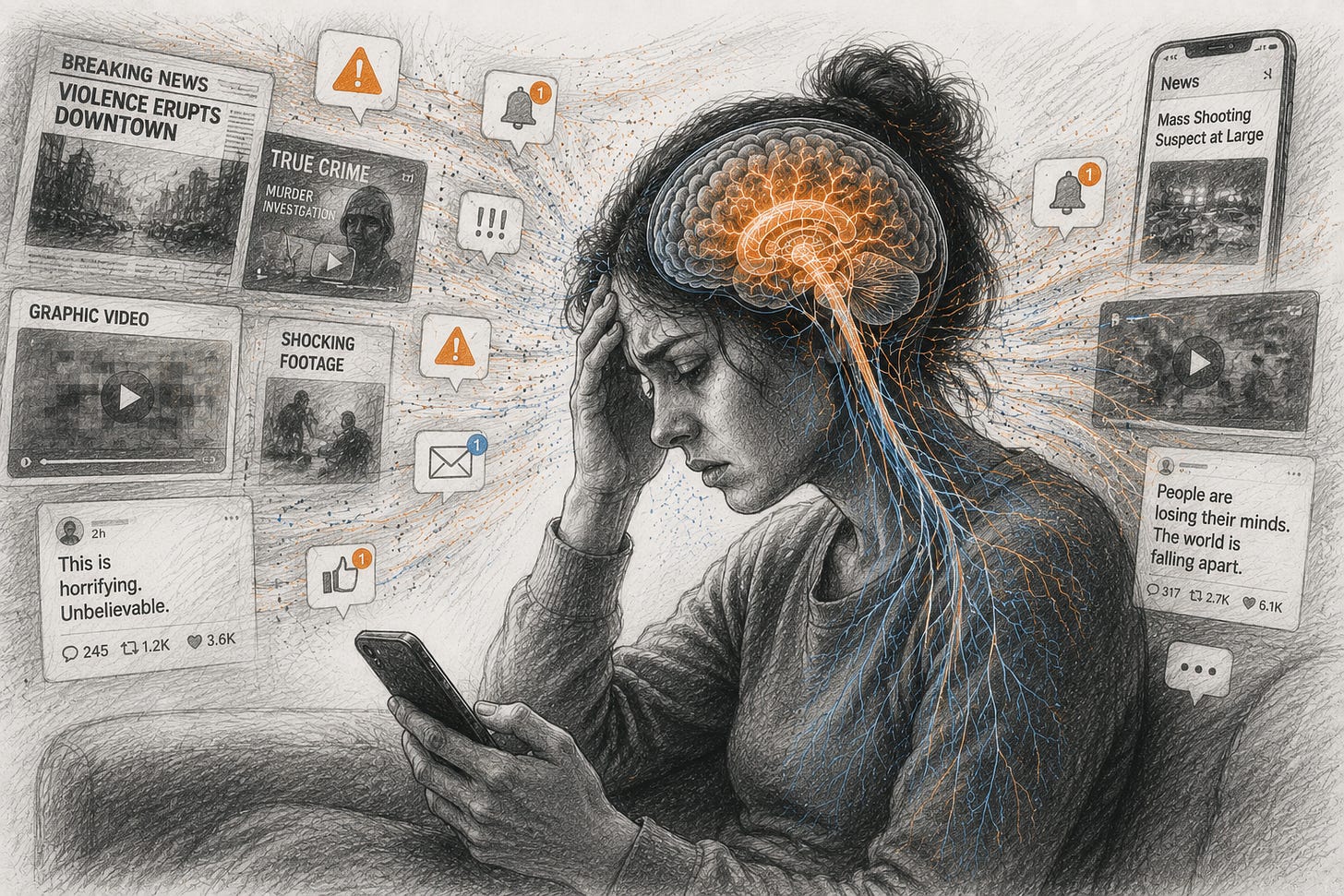
Today’s environment exposes us to:
graphic news
true-crime feeds
social media outrage
violent videos
endless notifications
Each exposure briefly activates the same biological threat circuitry.
One exposure is unlikely to matter.
Thousands of exposures over months and years may contribute to chronic hypervigilance, anxiety, poor sleep, and the persistent feeling that something is wrong—even when we are physically safe.
Your brain doesn’t always distinguish between immediate danger and repeated digital reminders of danger.
That may be one of the hidden biological costs of modern media.
Understanding this doesn’t mean we should never watch horror movies or true crime. It means recognizing that our brains evolved for a world of intermittent danger, not continuous exposure to emotionally charged content.
The same neural circuitry that once protected us from predators now reacts to headlines, notifications, and endless scrolling.
The challenge of modern life is learning when to let that alarm system rest.
LeDoux JE. Rethinking the Emotional Brain. Neuron. 2012;73(4):653-676. (Nature)
Tovote P, Fadok JP, Lüthi A. Neuronal Circuits for Fear and Anxiety. Nature Reviews Neuroscience. 2015;16:317-331. (Nature)
Gross CT, Canteras NS. The Many Paths to Fear. Nature Reviews Neuroscience. 2012;13:651-658. (Nature)
Calder AJ, Lawrence AD, Young AW. Neuropsychology of Fear and Loathing. Nature Reviews Neuroscience. 2001;2:352-363. (Nature)
Baxter MG, Murray EA. The Amygdala and Reward. Nature Reviews Neuroscience. 2002;3:563-573. (Nature)
Whether you’re a parent, teacher, healthcare professional, student, or simply someone seeking a healthier relationship with technology, your voice matters. Share the message, and help protect the human brain in the digital age.
This essay is part of a larger conversation.
Watch and subscribe one YouTube for the biology behind PTSD, digital toxicity, and the modern mind.
No posts
Comments
Nothing yet. Say the first thing.
Sign in to join the conversation.