
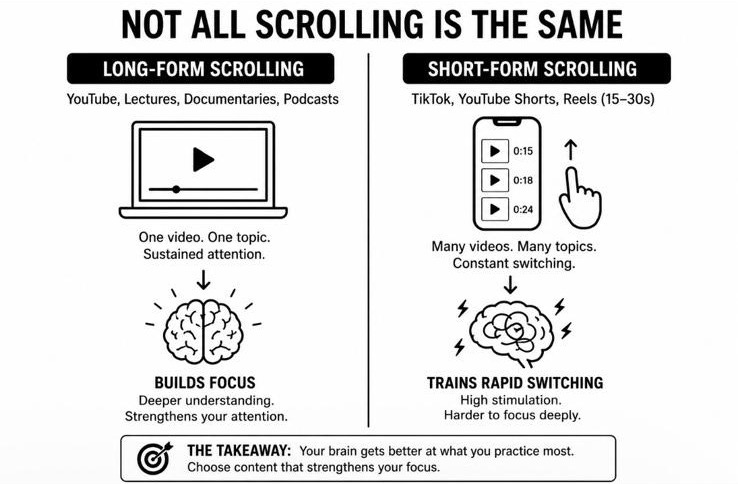
The real question isn’t whether you’re scrolling—it’s what you’re scrolling.
Watching a two-hour documentary on YouTube is not the same as spending two hours jumping through hundreds of 15- to 30-second videos on TikTok, Instagram Reels, or YouTube Shorts.
Your brain experiences these activities very differently.
Long-form content asks your brain to do something increasingly rare: sustain attention. You follow a story, build context, think critically, and remain focused on one idea for an extended period. Reading a book, listening to a long podcast, or watching a lecture exercises the same cognitive “attention muscle.”
Short-form platforms are designed around a different principle.
Every few seconds your brain is presented with a new face, a new topic, a new emotion, a new joke, a new controversy, or a new surprise. The brain never settles. Instead, it learns to expect constant novelty.
This repeated switching activates the brain’s reward system over and over again. Each swipe carries the possibility that the next video will be even more interesting than the last. That uncertainty is powerful—it keeps you scrolling.
Over time, many people notice that ordinary activities begin to feel slower. Reading becomes harder. Meetings seem longer. Conversations compete with the urge to check the phone. Homework, work projects, and even movies may feel less engaging.
The problem isn’t that your attention span suddenly disappeared.
Your brain has simply adapted to an environment where stimulation changes every 15 to 30 seconds.
This is why I am concerned about digital toxicity, not technology itself.
Technology that helps us learn, connect, or watch meaningful long-form content can be enormously beneficial. But platforms optimized for rapid-fire novelty place the brain in a constant cycle of interruption and reward.
We’re not anti-technology.
We’re pro-brain.
The goal is not to eliminate screens. The goal is to use technology in ways that strengthen attention instead of fragmenting it.
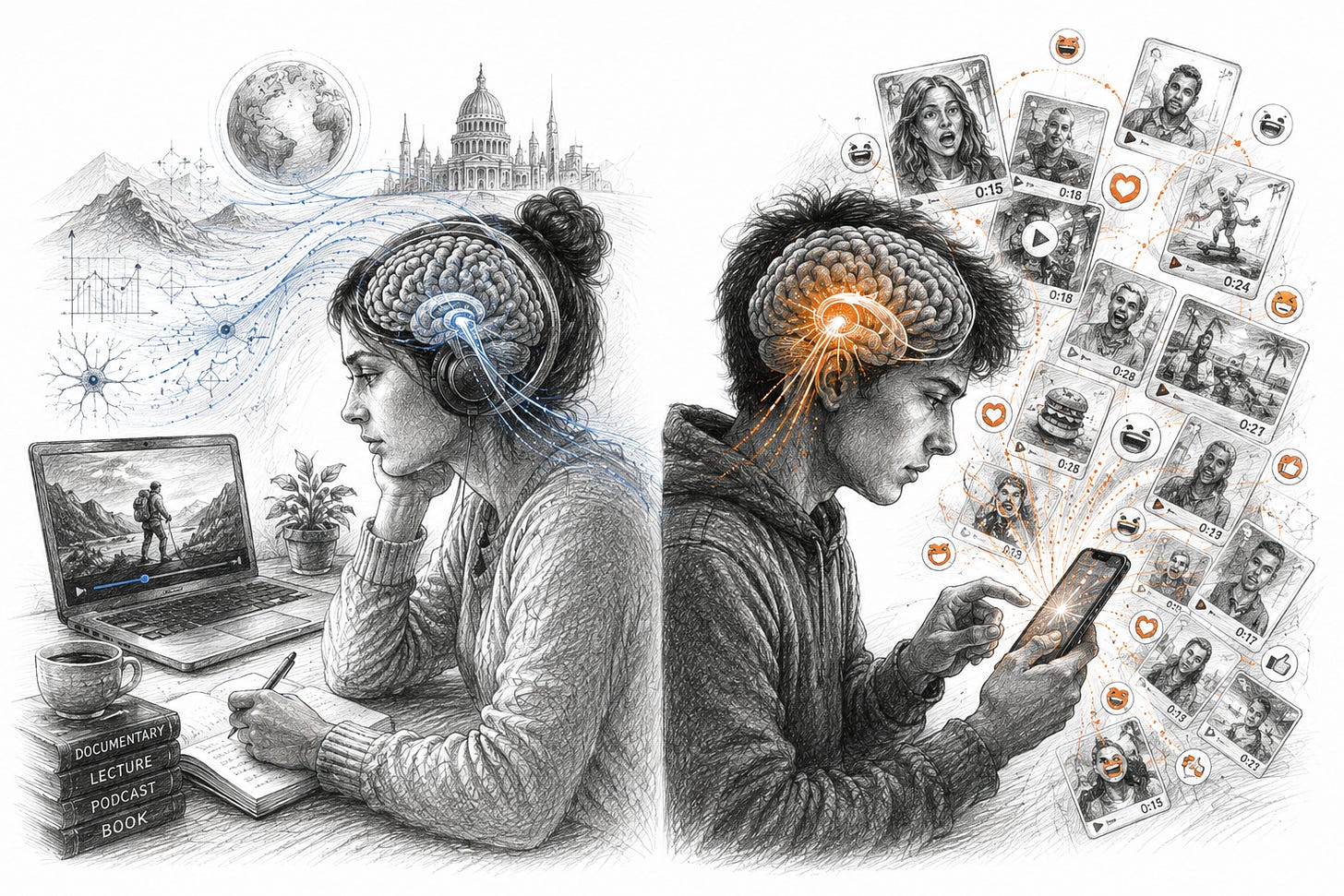
A simple rule is this:
Long-form content generally trains sustained attention.
Endless streams of short-form videos train rapid attention switching.
Your brain becomes better at whichever one you practice most.
The brain changes with experience. That is one of neuroscience’s greatest discoveries.
The question is: What are we training our brains to become?
If we want stronger focus, deeper thinking, better conversations, and healthier minds, we need to recognize that not all scrolling is created equal.
That’s why Digital Toxicity Awareness Day isn’t about rejecting technology. It’s about understanding how different digital environments shape the brain—and making intentional choices about the ones we allow to shape ours.
If you’d like, I can also make this more provocative with the title “TikTok Isn’t YouTube: Your Brain Knows the Difference.”
Whether you’re a parent, teacher, healthcare professional, student, or simply someone seeking a healthier relationship with technology, your voice matters. Share the message, and help protect the human brain in the digital age.
This essay is part of a larger conversation.
Watch and subscribe one YouTube for the biology behind PTSD, digital toxicity, and the modern mind.
No posts
Comments
Nothing yet. Say the first thing.
Sign in to join the conversation.