
How many hours did I spend scrolling?
How many times did I check my phone?
How late did I stay up?
Those questions matter. But they miss something deeper.
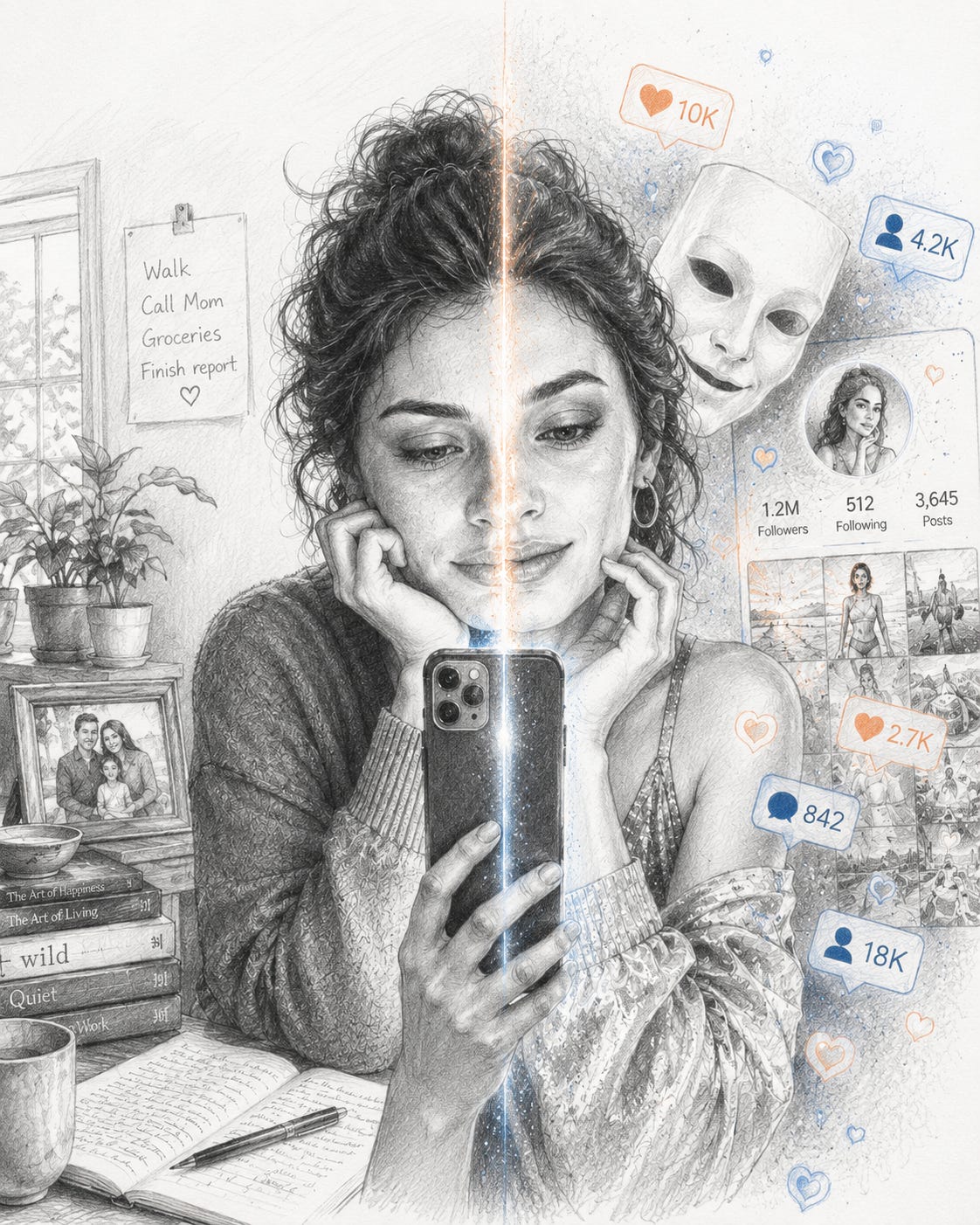
One of the hidden drivers of digital toxicity may be the split between the real-life self and the digital self.
Many people are now maintaining two versions of who they are. There is the person they are in real life — at home, at work, with family, with friends, in silence, in boredom, in discomfort. Then there is the digital version: the person who posts, edits, performs, responds, reacts, compares, and waits to be validated.
Sometimes those two selves are close together. That is healthy. The online person is simply an extension of the real person.
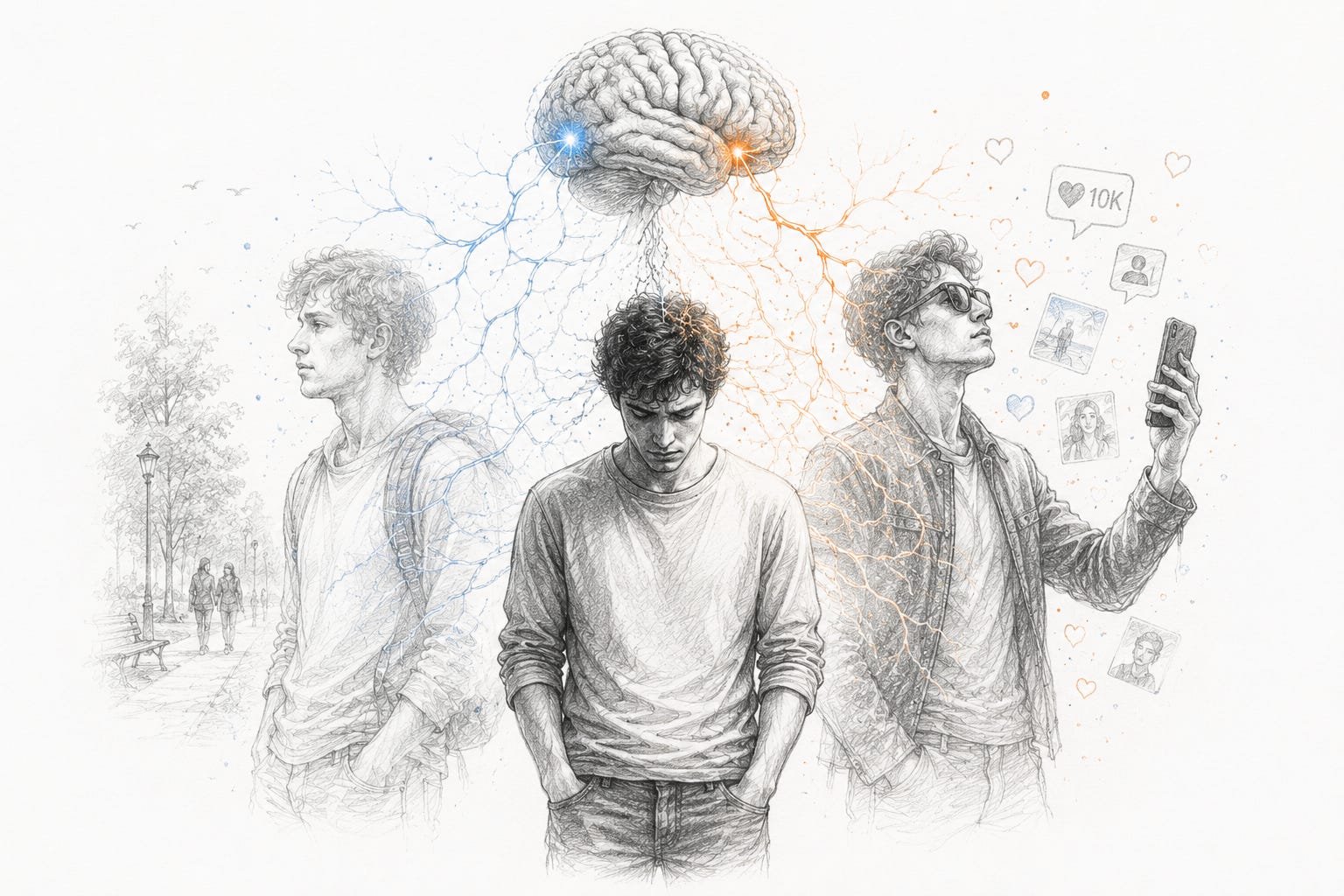
But sometimes the gap becomes large.
Online, someone may become more confident, more aggressive, more sexualized, more political, more curated, more funny, more successful, or more emotionally extreme than they are in real life. Their digital identity becomes a performance. Their real identity begins to feel inadequate by comparison.
That gap creates psychological tension.
The brain now has to manage two identities: the person I actually am, and the person I am trying to appear to be. That tension is known in psychology as self-discrepancy. Related concepts include false self-presentation, low self-concept clarity, and self-alienation.
This matters because the phone becomes the place where the digital self is maintained.
You check the phone not only because you are bored. You check because your digital self needs maintenance. Did anyone like the post? Did anyone respond? Did I say the right thing? Am I being ignored? Am I still visible? Am I still relevant?
That is not just communication. That is identity regulation.
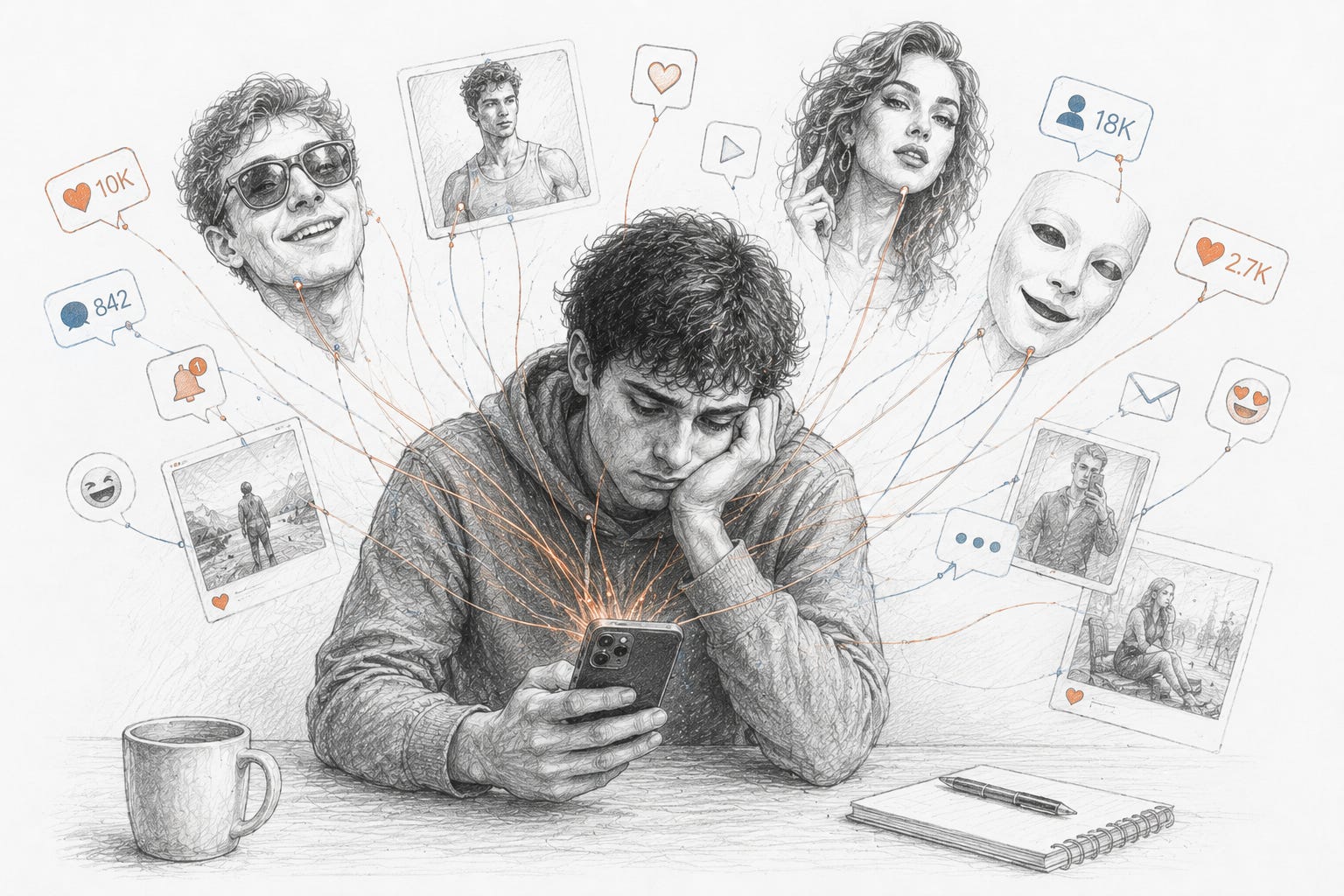
The more fragmented the self becomes, the more the phone becomes the glue holding the fragments together.
Research supports this general model. Lower self-concept clarity has been associated with greater problematic smartphone use, partly through social comparison and fear of missing out. Studies on authenticity and social media addiction suggest that self-alienation and idealized online self-presentation can increase vulnerability to addictive use. Broader reviews of self-discrepancy show that gaps between the actual self, ideal self, and online self shape online behavior.
In simple terms: when the online self becomes too different from the real-life self, the phone becomes harder to put down.
So what is the solution?
The answer is not to disappear from the internet. The answer is to consolidate the self.
The goal is to become one person again.
That means your online voice should match your real-life values. Your posts should not require you to become someone you are not. Your comments should sound like something you could say out loud. Your profile should not become a fictional character you have to keep feeding.
Would I still say this, wear this, post this, or defend this if there were no likes, no followers, no algorithm, and no audience?
If the answer is no, the behavior may be coming from the false digital self rather than the real self.
There are practical steps.
First, audit your platforms. Which apps make you feel fake, performative, angry, sexually objectified, status-driven, or dependent on reaction? Those are not neutral apps for you. They are identity-fragmenting environments.
Second, reduce alternate identities. Anonymous accounts, fake profiles, and exaggerated personas may feel freeing at first, but they can also widen the gap between who you are and who you perform.
Third, create daily “no-performance time.” This means no posting, no checking likes, no measuring yourself, no managing your image. The nervous system needs time when it is not being watched.
Fourth, move validation back into real life. Face-to-face conversation, walking, exercise, creative work, family, friendship, and nature restore the self in ways that scrolling cannot.
Finally, simplify your digital rule: one person, one nervous system, one life.

Technology becomes dangerous when it teaches us to abandon ourselves for attention.
The healthiest digital life is not one where you are perfectly branded. It is one where your online self and real-life self are close enough that you no longer need the phone to hold your identity together.
Servidio R, Sinatra M, Griffiths MD, Monacis L. Social comparison orientation and fear of missing out as mediators between self-concept clarity and problematic smartphone use. Addictive Behaviors. 2021;122:107014. doi:10.1016/j.addbeh.2021.107014.
Monacis L, Griffiths MD, Limone P, Sinatra M. The risk of social media addiction between the ideal/false and true self: testing a path model through the tripartite person-centered perspective of authenticity. Telematics and Informatics. 2021;65:101709. doi:10.1016/j.tele.2021.101709.
Hu C, Cao R, Huang J, Wei Y. The effect of self-discrepancy on online behavior: a literature review. Frontiers in Psychology. 2022;13:883736. doi:10.3389/fpsyg.2022.883736.
August 2 is Digital Toxicity ‘Brain Rot’ Awareness Day - the first effort to give this harm a name.
PTSD become real to the public when we had a word for it. Digital toxicity needs the same.
Share this essay. Subscribe. Send it to one person.
This essay is part of a larger conversation.
Watch and subscribe one YouTube for the biology behind PTSD, digital toxicity, and the modern mind.
No posts
Comments
Nothing yet. Say the first thing.
Sign in to join the conversation.