
Among the many themes up in here are:
—the current politics and the urgency of banishing (and holding accountable) Trump and his enablers;
—the affordability crunch;
—the pressures of public debt.
In this post, I tie these themes together, with emphasis on the unsustainability of the trajectory of the public debt, and how that does and doesn’t play into the first issue above—the electoral one—which is obviously the most urgent, as well as the second (affordability), which follows closely behind the first in urgency terms.
You probably have some sense of the deficit and debt numbers and how unusually inflated they are given good economic growth and a booming equity market generating high and increasingly concentrated wealth. CBO recently upgraded their ‘26 deficit expectations from $1.8 to $2 trillion, over 6% of GDP, about two percentage points higher than historical norms would suggest, given that GDP growth is at trend (~2%) and unemployment is near 4%.
As Bobby Kogan and I have explained, that’s largely a function of relentless tax cutting, such that the linkage between economic growth and revenue flows to the Treasury is, if not broken, then damaged. As I noted the other day, the expected debt path is one factor—along with war-induced and AI-investment-induced inflation—putting upward pressure on interest rates, tying the debt problem to the affordability problem.
But, for reasons that make sense to me, I don’t hear any candidates offering serious plans to do much about this imbalance between revenues and outlays. We definitely hear progressives talking about raising taxes on the wealthy, but that’s to pay for their agendas, not to improve the debt trajectory. A dollar spent on childcare is not available for paying down the debt.
So why, if I’m concerned about the impact of the public debt on our economic future, do I think that makes sense? Let me count the ways:
—I heard a snippet of an interview with Hizzoner Mamdani the other day, who, when asked about what defines a good politician, answered “delivering.” That’s not just correct, it’s profoundly correct. For years, politicians have talked about helping people and either failed to do so—Trump is exhibit A—or made their living standards worse—Trump is exhibit A here too, but I was around when Clinton promised that globalization—NAFTA, China in the WTO—was going to do wonderful things for working-class living standards. The failure of those promises is one of the reasons we’re in the mess we’re in today.
Delivering on affordability—healthcare, housing, childcare—is therefore key and from what I can see, it’s what’s winning and losing elections. If people believe that you’ll really fight for them, that you’ll go up hard against the status-quo, they’ll support you, regardless of whether you’re DSA or centrist. And to be perfectly clear, I’m talking about fighting to make their lives more affordable, not to get rid of Thanksgiving.
That’s not about deficit reduction.
—Addressing affordability is more urgent than addressing the debt. From today’s NYT:
The rise in pay-later financing comes as many households are leaning more on debt to keep up with their daily expenses. Paying interest — to afford basic needs — adds to the overall cost of living, which has already been rising amid higher medical, housing and fuel costs.
For many borrowers, the loans have become their only option: Half of those using them said they could not make ends meet otherwise…
That’s a particularly harsh problem when rates are creeping up. And yes, the fiscal outlook is probably one of the factors putting pressure on rates right now—see my “term premium” discussion here—but that’s a slow burn, not a “Liz Truss moment,” wherein creditors look at your fiscal plan and say, “I’m out!” In fact, I’ve argued that unique American advantages—dollar dominance; large, liquid markets for our debt—make such a “sudden stop” highly unlikely here. At least, I hope that’s right.
So, why worry at all about the fiscal path? For years, I inveighed against those who did so, but that was because a) the budget math was a lot more forgiving, and b) there was some evidence that Congress still maintained a “reaction function” to CBOs dire outlook predictions. But once the growth rate lags the interest rate (that’s the unforgiving math part—it’s what makes the debt path relentlessly trend up) and the political reaction function appears dead (which also pushes up the debt path), you, or at least I, can’t ignore this unsustainable reality.
Based on historical relationships, if the debt/GDP ratio climbs from around 100% today to 130% over the next decade, that’s almost an extra point on longer-term rates, including mortgages and other private debt too. That’s not nothing, to be sure, but it’s a slow burn at a time when people are having real difficulties paying rent and putting food on the table.
—Voter-preference polls typically reflect some anxiety about the public debt—people have a sense that it’s another way in which Congress drops the ball, and many know that the widely unpopular Trump tax cuts made the problem worse. But public opinion tends to be partisan on this: everyone worries about affordability, but if you’re party’s in power, you tend to worry less about the public debt.
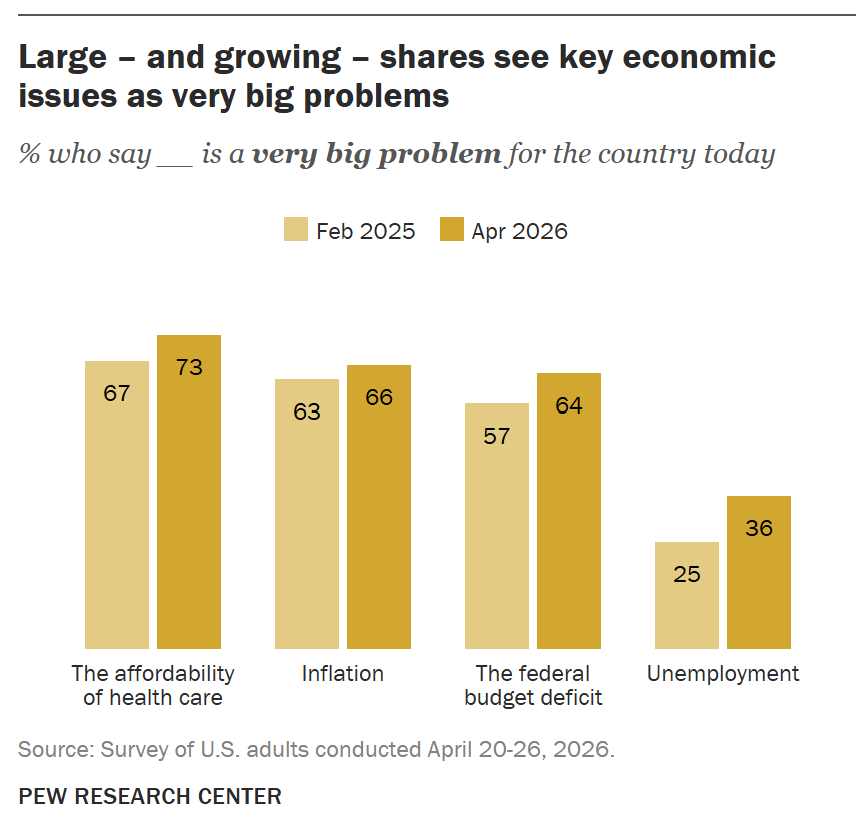
That may be changing. Two recent polls show public debt concerns are in the neighborhood of more urgent prices/affordability issues.
Here’s a time series showing the partisan element to respondents’ deficit concerns, but note how the gray total line has drifted up (red=R, blue=D).
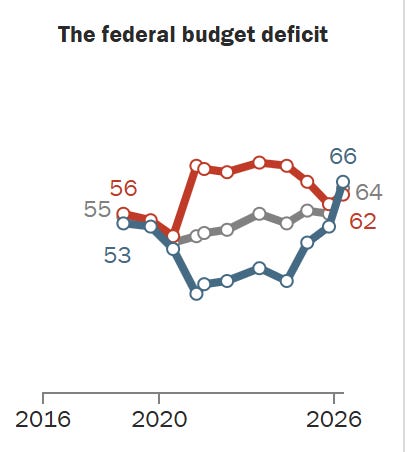
Source: Pew Research
The bigger problem with this polling question is that it’s not conditioned on anything. Sure, most people will say they’re worried about the debt when the question is framed as costless, but when you follow up with queries about cutting spending and raising taxes (at least raising their taxes), support for the issue tanks. For one, folks have heard a lot of phony nonsense about how cutting “waste, fraud, and abuse” or cutting foreign aid will solve the problem. Second, and far less phony, people are correctly aware that the wealthy pay less than their fair share, largely because wealth generally goes untaxed, and, applying JBs first rule of tax avoidance, if income type X is favorably treated by the tax code, every billionaire with a tax lawyer will discover, lo and behold, that all of their income is type X!
So, what’s a candidate to do about all this?
I’m neither a pollster nor a campaign consultant, just a bean counter increasingly concerned about this large and growing pile of beans. But as a long-time, close-up observer of such matters, I’m quite certain that the most effect progressive position on this is to forcefully acknowledge the problem, but frame it as secondary to more pressing affordability concerns.
That said, you can’t both sell yourself as a responsible steward who will banish the corrupt and hasten a return to good governance, while ignoring the debt trajectory. And in this positioning, the sharp rise in wealth inequality, emblematic in the AI buildout and the data-center controversy, and seen in the decline in the labor income share and the rise in the profit share, point the way toward a progressive answer to the question.
That is, raise high end taxes, shift the current balance of low capital and high labor tax rates, close the tax gap (make this one a big, out-of-the-gate priority, as defunding the IRS is allowing hundreds of billions of high-end revs to evade taxation) and skim some of those revenues off to make a dent in the deficit. Even a small dent will help, perhaps even disproportionately, as it will signal a slight reawakening of the reaction function.
From where I sit, those are the bones of a sound plan to meet both the electoral moment and the inexorably rising public debt.
No posts
Comments
Nothing yet. Say the first thing.
Sign in to join the conversation.