
You know the drill: a politically salient number becomes a big, round number, and everyone notices it. If only we could think in natural logs: “the gross debt hits 31.3!” isn’t a very sexy headline.
America’s gross government debt just hit $40 trillion. That’s the sum of every deficit we’ve ever run since Alexander Hamilton began his rap. That 123% of GDP, but it’s not the relevant measure because it’s “gross” vs. “net.” $8 trillion of that debt is money the gov’t has in its trust funds (Medicare, Soc Sec) which it lends to the government, meaning it’s both an asset (trust fund holdings) and a liability (deficit financing), which cancel each other out.1 The more relevant figure is “debt held by the public” which comes in at a mere $32 trillion, or 100% of GDP.
Here’s the debt/GDP history from this WSJ piece, that correctly notes, re the $40 trillion headline grabber: “Reaching that threshold carries symbolic weight, but isn’t, by itself, economically significant.” Paul Krugman adds that it is “a number that is big and round, but otherwise has no special significance.”
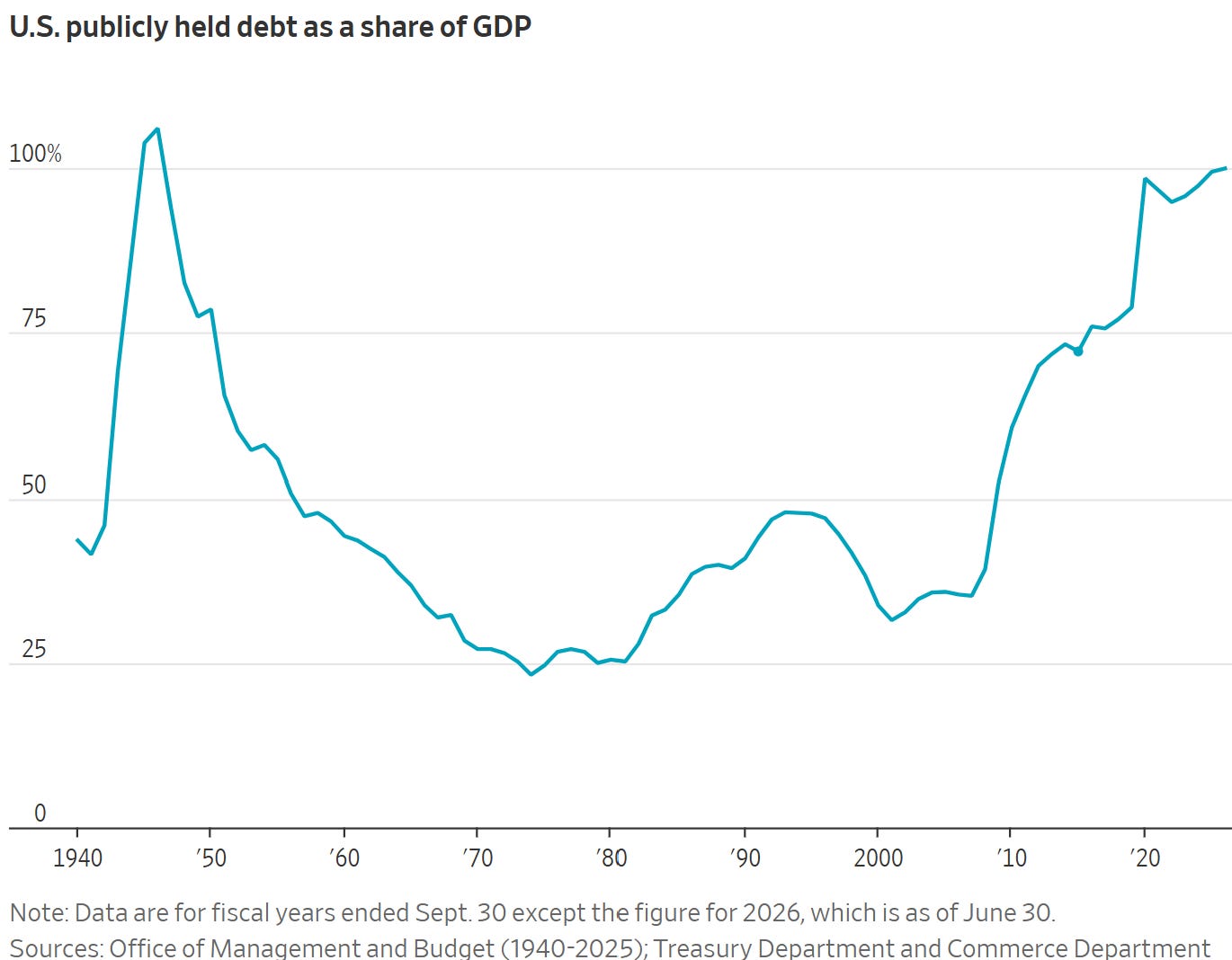
As you will see if you gaze at the above figure, we’ve had good and bad economies at low and high debt levels. But as readers know, I’ve become increasingly uncomfortable with our fiscal trajectory, not because I think it’s about to explode—I don’t—but because I think it’s starting to play a slow-burn role in pushing up interest rates and because I’ve seen close-up that neither side wants to do anything about it. No question, the Rs tax cuts are the bigger problem…read on; but this debt trajectory is a joint project wherein Ds have, in recent years, been junior partners.
The rising public debt isn’t the only force in play. In fact, the US gov’t is competing with hyperscalers for investment bucks—those firms might end up borrowing close to $1 trillion this year.
But the gov’t will borrow twice that much, a bit north of $2 trillion, or 6% of GDP, which is my second important number for today. The debt is a stock, the deficit is a flow. The debt is the water in the bathtub, the deficit is the water coming in from the faucet. The latter is therefore more relevant for forensics. And 6% deficit/GDP is recession-level; given our good macroeconomy today (which, as I’ve endlessly angst-ed over, isn’t reaching a lot of the bakers helping to bake the pie), that number should be closer to 3-4%. But all those tax cuts have broken the linkage between economic growth and revenue flows to the Treasury.
Which brings me to my third featured number: 5.2%, or the nominal yield on the 30-year gov’t bond, or I could have used the 4.7% yield on the more-commonly cited benchmark 10-year bond. Both have drifted up over the past few years, though the spread between them has opened up, meaning investors are more concerned about longer-term risks.
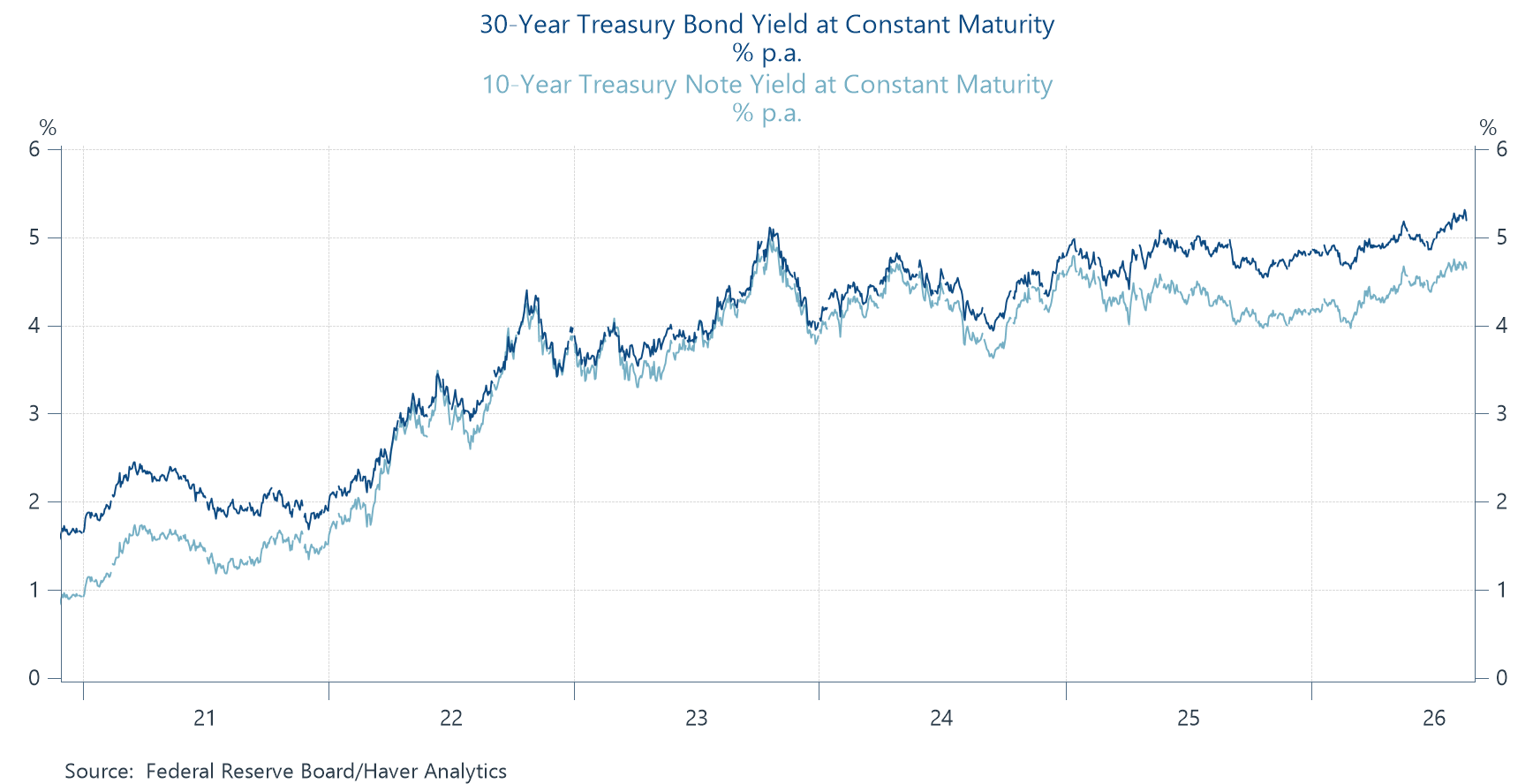
Greg Ip argues that fiscal profligacy is embedded in the rise in long-term yields:
Treasurys, long the world’s preferred “safe” asset, are looking less safe. Relative to other securities, their yields are no longer quite so low, and in moments of stress, they don’t behave like a haven.
The main reason for this is that since the pandemic, the U.S. has flooded the market with additional debt, reaching $40 trillion, including intragovernmental debt, this week. There is no sign of the flood abating.
One last number before I try to make sense out of all this numerology. This one—1.5%—admittedly isn’t in the news, but I think it’s important and relevant. I learned about it from this Nick T tweet:
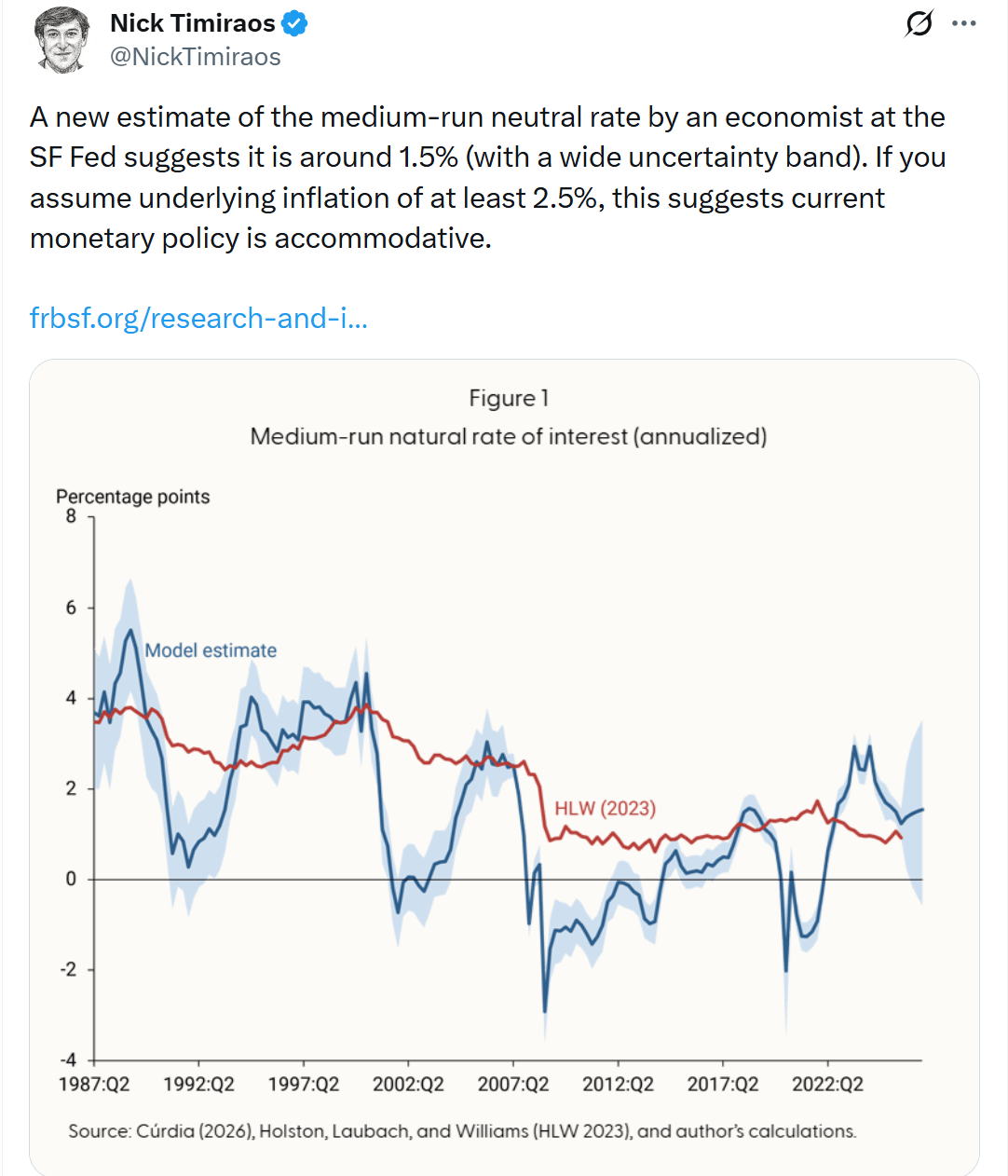
The key phrase is “this suggests current monetary policy is accommodative.” And yes, I realize this requires unpacking (here’s the underlying source). The lines in the figure show an attempt to nail down the neutral rate of interest, kind of like its resting point right in-between nudging the economy forward and holding it back. We assess this by looking at unemployment, output, and inflation and try to figure out the interest rate consistent with them being where we’d like them to be, i.e., output at potential, unemp at full emp, inflation at target, etc.
As Nick says, add this estimate of the real rate of 1.5% to where inflation roughly is—2.5%—and you get a nominal neutral rate of 4%. The current Fed funds rate is slightly below that right now (they’re targeting 3.5-3.75 percent), which is “accommodative,” as in not a headwind to growth. BTW, the red line in the figure is a less volatile, smoother version of the neutral rate, but I think the jumpier one is more informative in real time. That said, these are all rough estimates and you can see the large confidence interval at the end of the series.
But my simple point in the context of this analysis is that it’s not at all a slam-dunk that the Fed needs to lower the interest rate, regardless of how much as the Orange Menace squawks about it. So, as long as the Fed stays independent, a big if, I wouldn’t look there for rate relief. They may hold, but I don’t think they’ll cut anytime soon.
Okay, that’s a lot of numbers, both big and small, all before 9am ET. But the bottom line is that both the gov’t and the corporate sector (AI buildout) have outsized demands for credit, and that competition is one factor pushing rates up. Meanwhile, it is dawning on these investors that the fiscal path is not sustainable, which is denting the safe-haven status of Treasuries. And that, in tandem with Trump-induced inflation, is making life even more expensive to already cost-stressed households.
I’ve already written about the electoral implications of these dynamics wherein I agree with Paul re don’t panic—slow burn, yes; sudden shock, I don’t think so. No one running for office who wants to a) win, and b) meet voters where they are on affordability concerns should run on eating spinach, i.e., sharp and immediate deficit reduction.
But especially as the interest rate (and the mortgage rate, auto loans, bank loans, etc.) is also a price and thereby an affordability variable, neither should this source of financial stress be ignored. That requires a longer-term, structural plan that grapples with Bobby and my insights about how tax cuts, especially high-end tax cuts, are the primary source of this mess.
If focusing on a big, round number helps make that happen, the I’m good with that.
To go slightly deeper into this distinction, it is the case that when the Social Security system (e.g.) needs those assets to pay benefits, it will draw down from the trust fund, at which point the Treasury will borrow more to redeem these intergovernmental IOUs. In this way, money the gov’t owes to itself converts to publicly-held debt.
No posts
Comments
Nothing yet. Say the first thing.
Sign in to join the conversation.